
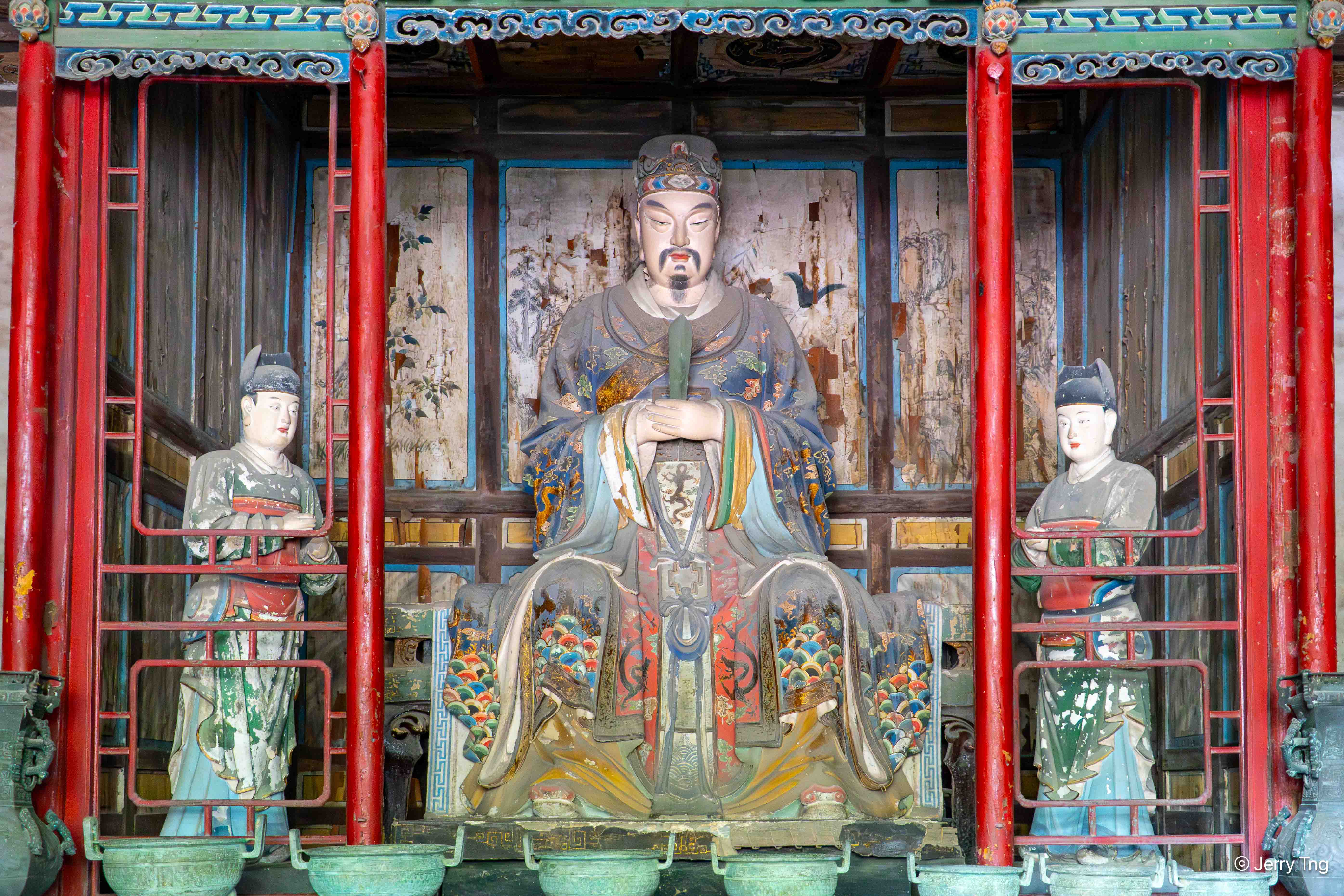
Along the main axis of Jinci are the main attractions like Hall of the Sacred Mother 圣母殿 and Flying Bridge across Fish Pond 鱼沼飞梁. While the architecture is interesting, the sculptures and art pieces are even more attractive.
Click here for the Chinese version 中文版请点击这链接

The special series about Jinci Temple comes in three parts – the first part “The Origin and Highlights” will give an overview of its origins and the main attractions; part two “Artistic and Cultural Treasures” will dwell on the details of the Song and Yuan dynasties’ sculptures; part three “Expansions” will examine some of the newer attractions built as part of the tourist attraction.
晋祠特別系列分為三部分——第一部分「起源和亮點」將概述其起源和“三绝、三宝、三匾”;第二部分「藝術文化寶藏」將重點介紹宋朝和元代彩塑的細節;第三部分「擴充」將介绍晋祠風景区的其他建筑和新景點。
Table of Contents for Part 2 第二部目录
圣母原来是邑姜,分封桐叶溯源长。隋槐周柏矜高古,宋殿唐碑竞炜煌。
悬瓮山泉流玉磬,飞梁荇沼布葱珩。倾城四十宫娥像,笑语嘤嘤立满堂。
郭沫若 《游晋祠》1
The Sacred Mother turned out to be Yi Jiang, the maple leaves cover the long lineage.
Guo Muoruo, “Tour of Jinci”
Sui oak and Zhou cypress remain tall, Song hall compete with Tang stele for glory.
The spring flows from the Hanging Urn, the bridge flies over the reed covered pond.
The forty statues of palace maids are beautiful, laughing and talking fill the hall.
Hall of the Sacred Mother 聖母殿

Jinci is gradually formed by the aggregation of many buildings. From 984 to 1964, a series of buildings was built in front of the Sacred Mother Hall, forming a central axis.2


The 43 painted maid statues, with different expressions and different costumes. It are one of the greatest sculptures in Chinese history. Among them, the most famous is the second maid from right with a red hairpiece. She is a singing Huadan 花旦. Renowned Opera Actor and Master Huadan Mei Lanfang 梅兰芳 once went to the Jinci and studied her everyday for more than three months before leaving.3


The hall enshrines statues of the Sacred Mother and more than 40 statues of maids. Except for the two small Ming dynasty statues next to the Sacred Mother, the rest are originals made in 1087 (宋元二年) of the Song Dynasty according to the inscription of Lü Ji found behind the wooden throne.4 They are one of the essences of the sculptures of the Song Dynasty in existence in China that is not in the category of religious myths and idols, but reflecting the court life and the emotional side of the courtiers in feudal society.


These maid sculptures do not use the usual artistic means of exaggeration to express the personality characteristics of each person, but through a deep understanding of the inner feelings of the characters, they use appropriate body language to shape each person’s responsibility and temperament. The former is lively and diverse, and the latter is serious and respectful, from which it can be seen that there are obvious differences in their job categories and characteristics. Maids have different occupations and personalities. Palace maids who wash clothes and sweep the floor are completely different from these two people.5


The five male attendants in the group are all eunuchs; they have different responsibilities and identities, and their clothes are also different. For example, the eunuch in charge of meals wears bow shoes, the two attendants of the Sacred Mother wear flat shoes. There are four statues of court ladies in men’s clothes, wearing black gauze, tying jade belts, and thin-soled black boots. Compared with the eunuchs, these four female officials are relatively short, but they are beautiful and affectionate.6
Temple Guardians 站殿将军


The two generals guarding the hall are about 4m tall. According to legend, they are two brothers, Fang Bi 方弼 and Fang Xiang 方相. Although the original sculpture of the Song Dynasty in the picture above has faded, it is still majestic and a rare masterpiece.7 Fang Bi and Fang Xiang were the generals of King Zhou of the Shang Dynasty. There were two people guarding the palace gate, and evil concubine Daji 妲己 and ghosts were blocked from entering the palace to make trouble. Later, King Zhou favoured Daji and believed Daji’s slander and drove away Fang Bi and Fang Xiang. Daji was able to enter the palace, which led to the destruction of the Shang Dynasty. Later, the two were honoured as the Gods of the Gates 门神 by the people.8
Iron Statues Terrace 金人台

In the centre of the Iron Statue Terrance, there is a 4-metre-high glazed roof tower. A cast iron general stands in each of the four corners. Three of them are original from the Song Dynasty, but the one in the northeast corner was replaced during the Republic of China (ROC) period. It is said that it was made by craftsmen invited to Henan, and the appearance is very different. In the Records of Jinci, it was written that “Iron is gold in the five elements, and gold can give birth to water, and if there is gold, water will be vigourous.” So the ancient people of Jinyang gathered funds to cast these statues to pray for “good weather”.9 , 10


One particularly hot summer, the iron man in the southwest corner could not bear the heat and walked to the Fen River alone. He saw a small boat coming down from upstream and asked the boatman to ferry him to the other side. The boatman pondered for a while, and then said slowly, “You are alone. There are too few people. Wait a little longer for anyone else.” The iron man was anxious and hurriedly said, “You can’t ferry me, even if you have the ability.” The boatman looked at the iron man and said, “How heavy are you? A boat can carry more than one person, unless you are cast iron.” As soon as the words fell, the iron man turned back into a stature and stood by the Fen River, motionless. The boatman hurried to find some villagers and carried the Iron Man back to the platform. The Sacred Mother ordered the generals to cut the iron man’s toes three times as a punishment. Today, the Iron Man still has the marks of three consecutive cuts on his feet.
Descendants Hall 苗裔堂

Miaoyi Hall, aka Descendants Hall, was used to pray for child birth and never-ending descendants. Date of first construction unknown; Liu Dapeng states that Descendants’ Hall was rebuilt in 1st year of the Song Zhenghe reign (1111) and repaired in the 6th year of the Ming Zhengde reign period (1511). Liu Yongde maintains that the hall was rebuilt in the 1st year of the Yuan Zhihe reign period (1328) and repaired in 1511.

Commonly known as Grandmother Temple or Offspring Hall, it was not known when it was built, but it was renovated in 1328 during the Yuan Zhihe Period and 1511 during the Ming Zhengde Period. The hall enshrines seven gods including the Goddess of Child Giving.


The hall contains images of female deities, which are thought to be Ming-dynasty works.11

The door head plates under the eave show nine vivid and interesting pictures of playing children. With balanced compositions and smooth lines, they are outstanding colored drawings in Jinci and have high artistic values. The Taoist bell before the hall was made in 1412 during the Yongle Period of the Ming Dynasty.
Tang Shu Yu Temple 唐叔虞祠

Also known as Fendong Hall, Tang Shu Yu Temple was originally located at the end of Jinci’s central axis and relocated here no later than the Jin Dynasty (1115-1234). The existing building was renovated in 1267, showing typical Shanxi features of the Yuan Dynasty. The annexed small rooms in the front were added in the Qing Dynasty (1644-1912).

Zhu Gui, “Record of Rebuilding Tang Shu Yu Shrine In Taiyuan County” (Qing)

Kublai Kahn, “Record of Rebuilding the King of Fendong Temple” (Yuan)
The front hallway has two steles on both sides. The east one shows the Record of Rebuilding the King of Fendong Temple from the Yuan Dynasty with an Imperial edict from Kublai Kahn on the back of the stele; the west one is inscribed with the Record of Rebuilding Tang Shu Yu Shrine In Taiyuan County, which is composed by Zhu Gui, mentor of Emperor Jiaqing of the Qing Dynasty.

大殿神龛内唐叔虞像及两尊侍从像为元代彩塑,另外两尊大臣像为明代彩塑。唐叔虞,姓姬,名虞,周武王之子,周成王之弟,受封为唐候。

He was granted the title “Marquis of Tang”, and his son Xie, changed Tang to Jin which becomes the short name for Shanxi. Shu Yu was imperially conferred King of Xing’an by Later Jin dynasty (936-947), King of Fendong in Northern Song dynasty (960-1127) and God Shu Yu of Tang in Ming dynasty (1368-1644).
Yuan Dynasty Statues of Music Performers 元代乐伎塑像

What is interesting are the Yuan statues of female musicians lining the hallway leading into the courtyard of Tang Shu Yu temple.

The 14 Yuan dynasty statues of music performers statues are divided into orchestra and percussion groups on the two sides. They hold different musical instruments including the bamboo flute, Sanxian (三弦, three-stringed instrument), Sheng (笙, reed pipes), drum and gong, which provide valuable physical materials for research on the development of traditional operas and musical instruments during Yuan Dynasty (1279-1368).12

If the colourful sculptures of the Sacred Mother Hall represent the beauty of the courtiers, these musicians are definitely the ordinary people of the world. They are uniformly plump, with clear eyebrows and beautiful eyes, their mouths are like cherries, and their noses are sharp, but they are not the same when observed closely. Looking at their expressions, movements and concentration, it seems that they are not static, but in the middle of a performance, and it is a gentle lyrical piece of music.


Why is such a group of statues in Tang Shu Yu temple? I guess it’s probably not because Yu, who was born in the Western Zhou Dynasty, liked opera. It is more likely to be linked to the popularity of opera in the Yuan Dynasty. Yuan opera is a peak in the development of Chinese opera, and Shanxi is one of the origin of the art of ancient opera.
Except for the servants, this group of colourful sculptures happens to be the ten musicians which reminded me of a Chinese orchestra that was popular around 2001 called “12 Girls Band” or “女子十二乐坊”. If this Jinci creates a real-life version of the Yuan ensemble, it would be really something. 13
Tang Stele Pavilion 唐碑亭


Right next to Tang Shu Yu temple is the Tang Stele Pavilion that houses the stele “Inscription of Jin with Preface” by Tang Emperor Taizong, Li Shimin. It started as a single pavilion facing west, and then in 1770 (清乾隆三十五年), it was expanded to three pavilions facing south, and the plaque of “Treasure of Zhenguan” or “貞觀寶翰” was hung. The platform was added in 1984. The stele was originally erected inside old Jinyang City, and moved to the current site in 979 (北宋太平興國四年). In 1984, the platform was added, the pavilion was rebuilt into a hall with hanging eaves measuring three room wide and two room deep.14


Qing Kangxi Stele
The north wall of the pavilion is inlaid with Li Shimin’s line-engraved portrait, and the east and west walls are engraved with Du Fu’s poetry couplet and the inscriptions of the Qing Kangxi period.
Three Steles 三碑

A stele, Chinese character “碑”, as the name implies, is a kind of stone engraved with words to commemorate the cause, merit or as a milestone. The custom of carving steles in China has a long history. Whether in triumph or praise, our forefathers wrote articles and engraved them on stones for posterity. Steles appeared as early as the Zhou Dynasty, and became popular in Han Dynasty. Steles are found almost everywhere, including steles of mountains and rivers, of cities, and of family temples, etc. As Tang Dynasty was the most prosperous era of literature and art in China, the Tang steles also entered the peak of this form of art.
Tang Stele “Inscription on Preface of Jinci” 唐碑《晉祠之銘並序》

In the winter of 645 (貞觀十九年), Tang Emperor Taizong Li Shimin 李世民 (598–649) returned from a failed conquest to Goguryeo and went to Jinyang, the place of where his father started the revolution to found the Tang Dynasty, to contemplate. At this time, he was not a triumphal prince or victorious king, but a newly defeated king in the war, nearly 50 years old. With these mixed feelings. Li Shimin wrote this famous “Inscription of Jinci with Preface” 《晉祠之銘並序》or “Preface of Jinci” on short.

唐碑《晉祠之銘並序》贞观20年

清乾隆三十五年复刻
“Preface of Jinci” stele is 195 cm high, 120 cm wide and 27 cm thick, with a total of 1203 characters. Before the Tang Dynasty, stele writing was generally written in seal 篆 (Qin dynasty), clerical 隶 (Han dynasty) or regular 楷 (Tang dynasty) script to show solemnity and dignity. However, Li Shimin broke the convention and wrote in semi-cursive script 行書, the first stele in the history of Chinese calligraphy. After that, the form of steles became more varied.

The top of the stele is semi-circular and decorated with a pair of drooping dragons. In the middle is a gui-shaped plane for the title of the stele. What is unique about this particular stele is that it is written in semi-cursive style known as Feibai script 飛白書 which was created by Cai Yong 蔡邕 of the Han Dynasty. Tang Emperor Taizhong Li Shimin was an expert of this particular script, and wrote the inscription in this style, which is very rare in stele art. Also, in place of a title, the head is inscribed with a date – “the 26th day of the first month of the 20th year of Zhenguan (646)” 貞觀廿年正月廿六日. The title of the stele is at the beginning of the inscription.16

The central theme of “Preface of Jinci” is to summarise the highlights of Zhou dynasty’s political system of aristocracy and Tang Shu Yu’s founding of Jin, and to promote and justify the military achievements of the Tang Dynasty, consolidating the regime.

Its content can be divided into four main parts17: First, it is proposed that “nation building” needs the support of the nobility and aristocracy. Li believed that without the support of those close to you, you cannot consolidate power. He then expound that you can’t get the support and love of the people without benevolent government. Zhou Dynasty was the longest kingdom in China’s history, with 37 emperors and ruled for more than 800 years. Li Shimin believed that the division and inheritance system 分封世袭禄位制 implemented in the Zhou Dynasty was the fundamental guarantee for the prosperity of the country.

Then, Li Shimin praised Tang Shu Yu’s merits of “literature, military, benevolence and righteousness”, and said that Tang Shu Yu was worthy of being the pillar of the Zhou family and the ruler of Jin. In the article, he gave importance to the ruling principles of “All Under Heaven (the world) is Home” “六合为家” and “Benevolence and Righteousness” “经仁纬义”. These two points express his political beliefs and gratitude to Shu Yu’s divine intervention. Next, he condemned the atrocities that were performed during Sui Emperor Yang, and in conclusion he praised the Tang dynasty as the divine intervention and prayed for continuity of the Tang empire to perpetuity.

The back of the stele lists the names of close compatriots and followers of Li Shimin that have died by the time of the writing of the stele. Organisations and individuals who cling rigidly to past successes or established hierarchies often falter in the face of disruption. Those who, like Li Shimin, are willing to learn from failure, listen to diverse voices, and integrate new perspectives are best positioned to survive and thrive.18

明代时碑版下部漫漶,唐碑多剥落
During the Ming Dynasty, the lower part of the stele version started to peel off. Therefore in the 35th year of Qing Qianlong reign (1770), the Jin nobilities, together with imperial scholar Yang Eryou 杨二酉 and other officials, bought the undamaged stele rubbing and asked the calligrapher Yang Yu 杨堉 to replicate the stele. The Qing replica is currently placed next to the original Tang stele in the same hall.19
Wu Zhou Stele, “The Great and Vast Buddha Avatamsaka Stone Sutra” 武周《大方廣佛花嚴石經》

In the Buddha’s Temple on the south side is the collection of stone carvings of “The Great and Vast Buddha Avatamsaka Sutra” 《大方廣佛華嚴經》. It is the earliest and most complete group of stone carvings of the Flower Garland Sutra found so far. The 80 volumes were first engraved in the late Wu Zhou Dynasty and Emperor Wu Zetian wrote the preface. It was carved in Jinyang and stored in the Fengyugou Stone Sutra Collection Courtyard 風峪溝石經藏院 in the west of the city (now Taiyuan Xishan). In 960 (北漢天會四年), some of the stone scriptures were repaired by imperial decree. In 1940, they were moved to Jinci.

The Buddha Avatamsaka Sutra 《華嚴經》, also known as the Flower Garland Sutra 《花嚴經》, is one of the most influential Mahayana sutras, forming the cornerstone of the Huayan school of Chinese Buddhism. The sutra describes a cosmos of infinite realms upon realms, mutually containing one another.

Two full Chinese translations of the Buddhāvataṃsakasūtra were made. The first complete Chinese version was translated by Buddhabhadra around 420 in 60 scrolls with 34 chapters, and the second by Śikṣānanda, assisted by Bodhiruci around 699 in 80 scrolls with 40 chapters. There is also a translation of the Gaṇḍavyūha (Flower Array sutra) section by Prajñā around 798.

石經現展示在玻璃櫥櫃內防止遊客的破壞
Of the three translations, the Wu Zetian version, aka 80 scrolls version, is the most widely spread. This version is also used in Japan and Korea, and the stone carvings are considered the first edition of the “official” translated version, much like the King James version of the bible. According to the inscriptions, Emperor Wu sent envoys to Kingdom of Khotan to bring back the Sanskrit original, and asked many scholars and famous monks to participate in the translation.

The scriptures used the Chinese character huā 花 (lit. “flower”) rather than the more familiar huá 華 (lit. “splendour”) as the name of the sutra. The Tang people must be very clear about the difference in meaning of the two characters as the appearance of the splendour character was earlier than the flower character. It shows that the translation is more in line with the meaning in Sanskrit, thus this translation is also particularly accurate.

The Northern and Southern Dynasties (420-589) had just ended, and the word “flower” was still a “new” word. According to the Buddhism scholars, the original meaning of this word in Sanskrit should refer to “flower”, so it is more appropriate to translate it as “Flower Garland sutra”. Later generations will gradually replace “flower” with the word “splendour” and become the “Huayan sutra”. Because the word huá 華 has both the original meaning of flower and the nobler meaning of splendour, it gradually replaced the word flower for this “King of Scriptures”.

Wu Zhou 武周 (690-705), aka Zhou or Southern Zhou 大周, is an interregnum dynasty founded by the only female emperor in Chinese history, Wu Zetian. Her official title was “Heavenly Mandated Holy God of Golden Wheel Emperor”, and was the sponsor for the translation and engraving of the stone sutras. According to records, Wu Zetian completed the translation in Luoyang in 699 (聖歷二年). The next year, she began the stone scripture carving project in Jinyang (now Taiyuan) next to the Jin Temple. She was 76 years old and died six years later. With the change of dynasties, this group of stone scriptures gradually came out of people’s memory.

It was not until Yuan Dynasty that it was recorded the stone sutras were still hidden in the Fengyugou Cave; Qing scholar Zhu Yizun visited the cave. In 1940, the Imperial Japanese army wanted to move them back to Japan but were stopped by the villagers. They were moved to Jinci since then.20


According to the inscription, there should be 160 stone sutra steles, two tiles for each volume. Only 135 stones remain in Jinci. Look carefully for the “flowers” among the stone tablets, just like stepping into a silent thousand-year-old flower forest. The stone tablets are silent, the flowers are silent, and the scripture is silent, but it is a boundless world of peace.21
Ming Dynasty Imperial Edict Steles 明御制敕碑


Along the corridor of the Sacred Mother Hall are 22 steles, of which ten are of the Ming Dynasty, 9 of the Qing Dynasty, two of the Republic of China period and one of contemporary age. The inscriptions mainly record the historical facts of Jinci’s repairs over the past dynasties, sacrifice rites in the hall, and regulations on governance of the Jinshui River. They are important physical materials for studying the history of Jinci as well as the whole Taiyuan area at large.

Zhu Yuanzhang’s stele

Zhu Qiyu’s stele

Zhu Jianshen’s stele
Among these steles, three Ming Emperor steles from the the founding emperor, Emperor Hongwu Zhu Yuanzhang (r. 1368-1398) 明太祖《封聖母誥》碑22; his great-grandson Emperor Jingtai Zhu Qiyu (r. 1949-1957) 明代宗《御制祭聖母祝文》碑23;and Emperor Chenghua Zhu Jianshen (r. 1464-1487) 明憲宗《御制祭聖母文》碑are the most precious steles, collectively known as the “Imperial Edict Steles” “御制敕碑”.

Stele Corridor of the Shuyu of Tang Shrine
Besides the steles along the hallways surrounding the Sacred Mother Hall, the corridors of the Tang Shu Yu shrine are also embedded of stone tablets. There are 42 stone tablets embedded in the corridor wall. The inscriptions mainly praise architecture and landscape of Jinci, including 2 from Song Dynasty, 2 Yuan Dynasty, 18 Ming Dynasty and 20 Qing Dynasty. They cover seal, regular, running and cursive scripts, having very high value in calligraphy and literature.24
It was mentioned, for a look at Chinese history, look at Shenzhen for the last decade, Shanghai for the last century, Beijing for last millennium, Shaanxi for three thousand years, and Shanxi for five thousand years. At that time, I didn’t believe it, but the trip to Jinci gave me a new understanding and perception of it!
About Jinci Temple 晋祠简介

晋祠,原名为晋王祠,初名唐叔虞祠,是为祭祀周朝晋国的开国诸侯唐叔虞及其母亲邑姜所建,是中国现存最早的皇家祭祀园林。祠内的周柏、难老泉、宋塑侍女像被誉为“晋祠三绝”,圣母殿、鱼沼飞梁、献殿则被誉为“晋祠三宝”。
晋祠最早为封地在今山西翼城的唐叔虞宗族支系所建的唐叔虞祠,最早可见的文献记载则是在北魏年间,以后数代多有增修补缮。北宋年间,宋太宗赵光义火烧晋阳城后,宋仁宗赵祯追封唐叔虞为汾东王,并为唐叔虞之母邑姜修建了规模宏大的圣母殿。之后数代,以圣母殿为主体的中轴线建筑物次第告成,逐渐形成了今日晋祠的建筑格局。
Bibliography :
- https://kknews.cc/other/4jr33xv.html ↩︎
- 郭一《权力的神圣性:晋祠圣地的中国礼制建筑》书评, 《文圖學報》第二期 The Second Issue of Journal of Text and Image Studies, 2022, Text and Image Studies Society, https://www.academia.edu/91985198/_文圖學報_第二期_The_Second_Issue_of_Journal_of_Text_and_Image_Studies, accessed 5 Dec 2025 ↩︎
- https://www.sohu.com/a/159532626_100303 ↩︎
- https://baike.baidu.com/item/晋祠圣母殿彩塑/370541 ↩︎
- http://www.silkroads.org.cn/portal.php?mod=view&aid=35992 ↩︎
- https://kknews.cc/other/4jr33xv.html ↩︎
- https://www.sohu.com/a/159532626_100303 ↩︎
- https://minyi.dodoedu.com/folkart/analysis?id=168 ↩︎
- https://www.sohu.com/a/621204450_121612295 ↩︎
- 郭一《权力的神圣性:晋祠圣地的中国礼制建筑》书评, 《文圖學報》第二期 The Second Issue of Journal of Text and Image Studies, 2022, Text and Image Studies Society, https://www.academia.edu/91985198/_文圖學報_第二期_The_Second_Issue_of_Journal_of_Text_and_Image_Studies, accessed 5 Dec 2025 ↩︎
- Miller, Tracy. The Divine Nature of Power: Chinese Ritual Architecture at the Sacred Site of Jinci. Cambridge, Mass.: Harvard University Asia Center for the Harvard-Yenching Institute : Distributed by Harvard University Press, 2007. https://books.google.com/books?id=ZN7VAAAAMAAJ. ↩︎
- Museum information card ↩︎
- https://news.qq.com/rain/a/20220808A0672J00 ↩︎
- https://baike.baidu.com/item/贞观宝翰亭/8477992 ↩︎
- https://www.shidianguji.com/zh/book/7525240710182731819/chapter/1l8tcwv3brpd4?version=1 ↩︎
- https://zhuanlan.zhihu.com/p/490760124 ↩︎
- 首先,李世民提出他的政治思想主张:“兴邦建国”必须亲信贵族,以作辅弼;“分圭锡社”也要给予采邑,来把握军政要点。“非亲无以隆基,非德无以启化”,认为不是亲属就不能巩固社稷,不施仁政就不能得到人民的拥护和爱戴。周朝是中国历史上历时年代最久的王朝,历经37位帝王,统治了800多年。李世民认为,周朝实行的分封世袭禄位制是国家长盛不衰的根本保证,极力奉行。
其次,李世民赞美了唐叔虞的功德“承文继武,经仁纬义”,称唐叔虞不愧为周室栋梁,晋国先祖。文中以“六合为家”的英雄气魄,运用“经仁纬义”的华丽文笔,对晋祠的山光水色给予“施惠、至仁、刚节、大量”的人格化的评价。
再次,揭发了隋炀帝的残暴统治,以至于神人共怒,四海腾波。他的父亲李渊顺天应民,得到拥护,从而一统中国。
最后,李世民写下“虽膺篆受图,彰于天命;而克昌洪业,实赖神功”,认为唐室政权固然是天命所归,人心所向,而兴旺发达确是神功。为此,他以“日月有穷,英声不匮。天地可极,神威靡坠”的夸张语气来报答唐叔虞的神恩。结尾并祝“万代千龄,芳猷永嗣”,以此期望唐室天下千秋永固。第二篇 第三章 晋祠公园 太原市园林局网站 [引用日期2022-07-29] ↩︎ - https://www.linkedin.com/pulse/emperor-who-bent-broke-how-li-shimin-李世民-made-adaptability-lai-kgo2c/ ↩︎
- https://www.sxwhzyw.cn/pd591397458.html ↩︎
- https://wapbaike.baidu.com/tashuo/browse/content?id=2f51528129b2a4a45e088aff ↩︎
- https://www.zaobao.com.sg/news/fukan/mini-columns/story20190128-927640 ↩︎
- https://www.shidianguji.com/zh/book/7525240710182731819/chapter/1l8tcwv3bxoa0 ↩︎
- https://www.shidianguji.com/zh/book/7525240710182731819/chapter/1l8tcwv3bzfhk?version=1 ↩︎
- Museum information card ↩︎
0 comments on “Jinci Temple 晋祠 – 2/3 Artistic and Cultural Treasures”