
228 Peace Memorial Park in Taipei City is an often overlooked park even though it is located in prime land between the Presidential Palace and Taipei Station. The park has seen the island changed hands as it moves from one regime to another.
Origin of the Park

The park is bordered by Xiangyang Road, Huaining Street, Ketagalan Boulevard and Gongyuan Road and is within walking distance from other places of interest like Ximending, Chiang Kai-shek Memorial Hall and the Presidential Office Building.

Then-president and KMT chairman Lee Teng-hui, who had participated in the incident and was arrested as an instigator and a Communist sympathiser, made a formal apology on behalf of the government in 1995 and declared February 28 a day to commemorate the victims. Among other memorials erected, Taipei New Park was renamed 228 Memorial Park.
音樂臺 Amphitheater

This would the 5th variation of the amphitheater that started as a bandstand during the Japanese colonial period.

In 1935, in preparation of the Taipei Exposition 台湾博览会, the bandstand was torn down and a modern amphitheater was built. This design has stuck over the years, although the stage was upgraded and redesigned several times over the years.
國立臺灣博物館 National Taiwan Museum

國立臺灣博物館 National Taiwan Museum is located on Xiangyang Road, near the park’s northern entrance. Established in 1908, it is the oldest museum in Taiwan and one of the first museums in East Asia. The museum’s collection includes over 800,000 artefacts, including cultural and natural specimens, as well as historical and archaeological materials. The collection is divided into several categories, including anthropology, archaeology, botany, geology, and zoology.

The site was built on an old temple built during the Qing Dynasty for the deity Ma-Tzu. It was a very popular temple, but the Japanese colonial government still took it down and built the Governor’s quarters in its place. The stone pedestal that was used to hold the columns of the temple was repurposed to stools in the park, that can still be found today.


Two bronze bulls at the gate of Xiangyang Road and Guanqian Road were gifts from Machukuo Government to the Governor’s Office of Taiwan in 1935. The Manchukuo government, though nominally in Chinese hands, was in fact rigidly controlled and supervised by the Japanese, who proceeded to transform Manchuria into an industrial and military base for Japan’s expansion into Asia.
日晷儀 Sundial


In the old days when clocks and watches were not prevalent, sundials were the only way to tell time accurately. The marble stone sundial behind the National Taiwan Museum is very intricate and precise, taking into considerations of the seasonal changes.
老火車頭 Antique Locomotives

At the entrance of the part are two antique locomotives that grew old with all the children in Taipei over the years.

Teng-Yung 「騰雲號」was the first steam locomotive of Taiwan Railway history and manufactured by Hohenzollern in 1887. Teng-Yung was purchased from Germany when the Governor General Liu Ming-Chuang was building the railway from Taipei to Keelung. Yu-Fong, the same model with Teng-Yung, were brought to Taiwan. They had been running from 1888 to 1924. Yu-Fong was dismantled and sold in parts in 1928. Teng-Yung has been preserved and displayed in the park till now.

The steam locomotive No.9 「臺灣鐵路第九號蒸汽機車」is 16 years older than the Teng-Yung locomotive, and is the oldest locomotive in Taiwan Railway. It was manufactured by Avonside of England in 1871. It is one of the earliest ten locomotives of Japan Railway, and was running between Tokyo and Yokohama from 1872 to 1895. It was once the train that served the Emperor of Japan. After nearly 30 years of service, it was transferred to Taiwan by the Department of Taiwan Railway of Governor’s Palace to join with the other eight locomotives of Qing Dynasty as the “Taiwan Railway Locomotive No.9 “. It retired from service in 1925, and has been displayed with Teng-Yung in this park as a monument of railway till today.
黃氏節孝坊 The Huang’s Arch of Filial Piety

One of the few architectural relics from the Qing Dynasty that remain in Taipei is the arch in honour of a woman from the Huang family. The arch「清旌表故儒士王家霖妻黃氏坊」in honour of the virtuous and exemplar wife and mother was erected by order of Emperor Tongzhi in 1882 (光緒8年), close to East Gate 凱達格蘭大道上的景福門. One of the instruments the Imperial government of China used to reward people was the construction of memorial arches (牌坊) to celebrate the achievements of common people who had distinguished themselves through the rigorous observance of socially sanctioned ethical norms, such as filial piety.

Born in 1820, she was a resident of Pujin, in mainland China’s Fujian province. At the age of 16 she married Wang Jialin 王家霖, a 17-year-old boy from Quanzhou, also in Fujian province. The boy’s father was a government official who later resigned his post to become a merchant. He and his family moved to Taiwan and settled in Bangka 艋舺. Wang Jialin was set to become an official like his father, but after failing the imperial examination several times, he gave up and joined his father’s business. However, in 1847 he died. His wife was only 28 years old. True to the female virtue of filial piety, the woman never remarried and died in 1893 (光緒19年) – only two years before the Japanese occupied the island – at the age of 74 years.
杏壇 Confucius Altar

Tradition says Confucius taught his students at the Ginkgo Platform “Xing Tan” 杏壇 in his home town of Qufu, Shandong province. So in every Confucius temple all around the world, there would usually be a Ginkgo Platform in remembrance of Confucius. I am not sure if there was a Confucius temple here before.
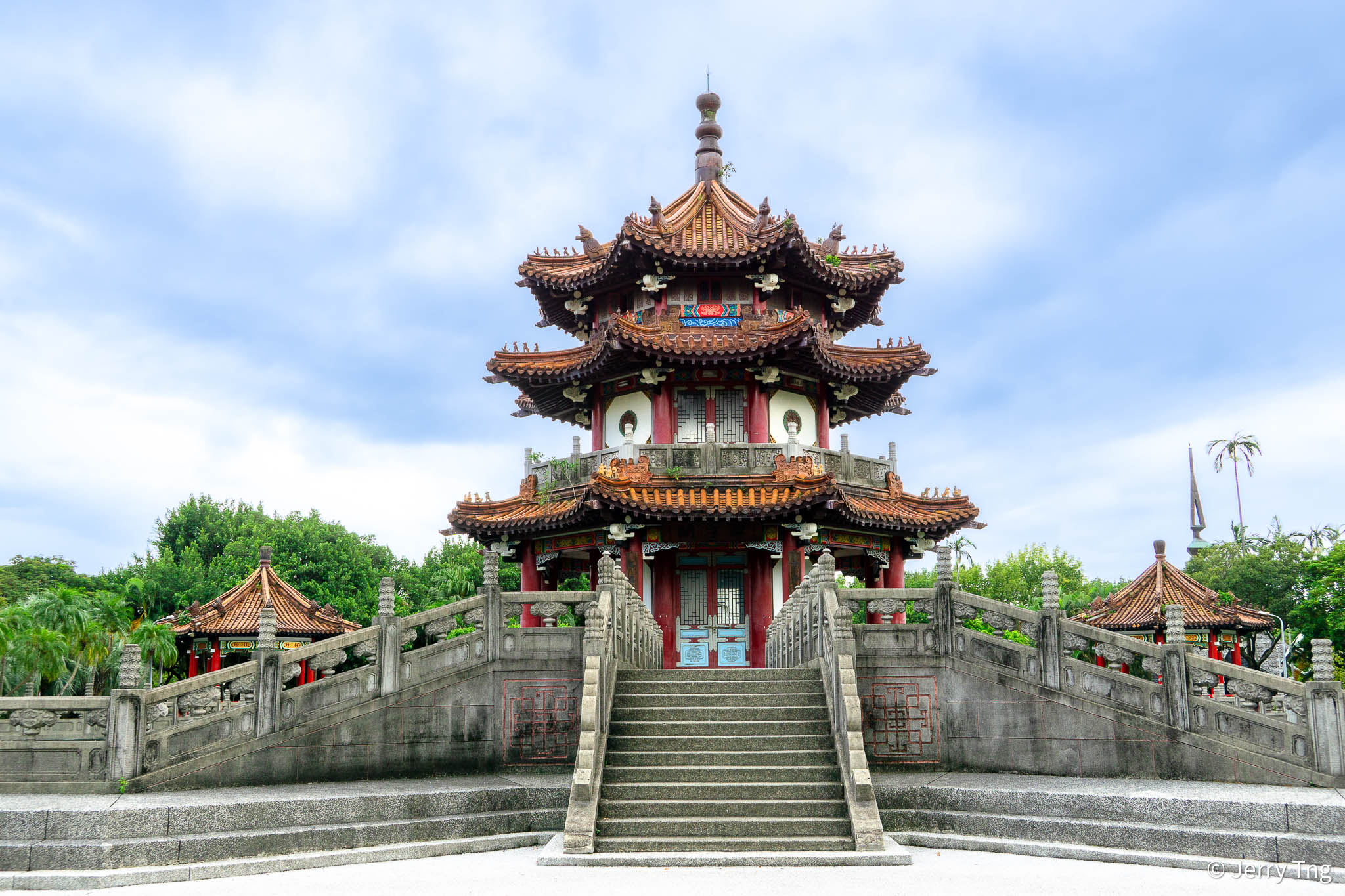
中国古典式亭陽 Cui Heng Chamber

Apart from the memorial, the most eye-catching feature of the park is the Cui Heng Chamber. The Chamber was built in commemoration of the founding father of Republic of China, Dr Sun Yat-sen. The name Cui Heng 翠亨 took after the ancestral village that Dr Sun came from in Guangdong, China. The lake around the impressive chamber includes some fountains.

The chamber and surrounding pavilions were built on what was tennis courts and basketball courts for the public when the park was repurposed to become a sport facility after the KMT takeover. And in 1965, to exude the “glory of the Chinese culture”, the facilities were torn down, and these “Imperial China” style chamber and pavilions were built.

Elements of the Forbidden Palace in China were copied in the construction of the chamber. As you gaze up to the roofs of the vast vermilion-and-gold complex, you will find the ancient palace’s original animal guardiansThese adornments, known as “ridge beasts (脊兽)” or “house-ridge beasts (屋脊兽),” were deliberately placed on the roof-ridges of the palace halls, as auspicious totems for the former imperial court to dispel evil.

Ironically, the park around the chamber used French and Western garden decorative techniques with those manicured shrubs and formations.
涼亭 Pavilion
Surrounding Cui Heng Chamber are four octagonal pavilions which house the bronze statutes of ancient sages including Zheng Cheng-Gong 鄭成功 「大木亭」, Liu Ming-Chuan 劉銘傳 「大潛亭」¸ Chiu Feng-Chia 丘逢甲 「滄海亭」, and Lien Heng 連橫 「劍花亭」were erected on each corner of the chamber.


Zheng Cheng-Gong 鄭成功 (1624-1662) was a folk hero from the Ming dynasty that fought against the Dutch East India Company that used to occupy Formosa as an outpost. He managed to chase them out of the island and ended Dutch colonisation on the island. He established a renegade government that opposed the Qing dynasty rule and was known as Koxinga 國姓爺 in the Western annals. But his achievements were patchy, and historians were divided if he was a real deal.


Liu Ming-Chuan 劉銘傳 (1836-1896) was the first Governor of Taiwan 台湾巡抚 sent by the Qing dynasty government. He led the Qing troops in the Sino-Franco war of 1884-85 and rove the French out of Taiwan. He was accredited to be the first to modernise the infrastructure of Taiwan.


Lien Heng 連橫 (1878-1936) was a historian and wrote the first Annals of Taiwan 《臺灣通史》(1920) , which is considered the first and most comprehensive scholastic work about the history of Taiwan at its publishing. His grandson Lien Zhan 連戰 became the 5th Vice President of Taiwan.


Chiu Feng-Chia 丘逢甲 (1864-1912) was a local boy from Changhua 彰化, and was a scholar of Qing dynasty. He opposed the accession of Taiwan to Japan after the Opium War, and declared the independence of Taiwan from the Qing dynasty 1885. The occupying Japanese forces defeated the defending army and the independence was short lived.
龍池 Dragon Pond

龍池 Dragon Pond was built upon the original fountain that was already present during 1935 Taiwan World Expo, which was held in this park. After the KMT government took over, the fence was built along the circumference of the pond and was never removed as if to remind one of the White Terror of that period. The railings for other parts of the park were subsequently removed.

拱橋池 Arched-bridge Pond

The area around 拱橋池 Arched-bridge Pond was the original location of the Japanese Garden that was present since the original park was established by the Japanese occupation government.


Even today, you can still see remnants of the Japanese garden lanterns, the original Japanese style radio broadcast speakers and the Japanese garden elements, with the lively squirrels, birds (these are called Black-crowned night heron) and turtles playing among the bushes.
Next week, we take a look at the 228 Incident memorials inside the park, and examine the timeline of the darkest day in Taiwan history.
Visited Sep 2023
0 comments on “228 Peace Memorial Park 二二八和平紀念公園”