
I am always fascinated by the art of giving, what to give to who. The significance of the occasion as well as the symbolism of each gift needs a lot of thinking. And these gifts are not personal but belong to the whole nation.


These are some of the highlights of the permanent collection of state gifts at Museum of the Presidency of the Republic in Lisbon, Portugal from the rest of the world (except, China and Europe).
Algeria – Samovar
England, undated. Sterling silver and ivory

Gift from Sheik Osmar Badji to President António de Spinola. Visit to Portugal, 1974
I could not find any reference to this Sheik Osmar Badji except for this state visit video from the official RTP archive in Portuguese. The video is silent and therefore I could not hear any name of the country he was from. Perhaps someone who is familiar with Africa politics would be able to point him out.
Algeria – Sword
Algeria, undated. Steel, sterling silver and semi-precious stones

Gift from President Abdelaziz Bouteflika of Algeria to President Jorge Sampaio. State visit to Portugal, 2005
The region was home to several Berber kingdoms and later became part of the Roman Empire. After the fall of the Roman Empire, various Muslim dynasties and kingdoms ruled the area before the arrival of the French in the 19th century.
Angola – Thinker (Sculpture)
Mpambukidi Nlunfidi. Angola, undated. Bronze.

Gift from President José Eduardo dos Santos of Angola to President Aníbal Cavaco Silva. State visit to Portugal, 2009
When the Portuguese began trading on the west coast of Africa in the 15th century, they concentrated their energies on Guinea and Angola. Hoping at first for gold, they soon found that slaves were the most valuable commodity available in the region for export. By the middle of the 1920s, the whole of Angola was under control. Slavery had officially ended in Portuguese Africa. By the time of the Carnation Revolution (1974) in Portugal, the colonisation of Africa was no longer in favour by the public in Portugal. In November 1975 Portugal’s last African High Commissioner Rosa Coutinho hauled down his nation’s flag and departed Angola.
Brazil – Manaus – Amazonas – Brazil
Branco Silva. Brazil, 1957. Oil on turtle shell

Gift from President Juscelino Kubitschek to President Francisco Craveiro Lopes. State visit to Brazil, 1957
In April 1500, Brazil was claimed by Portugal on the arrival of the Portuguese fleet commanded by Pedro Álvares Cabral. Until 1530 Portugal had yet to establish their first colony in Brazil. In the first century of settlement, the Portuguese realized it would be difficult to use the natives as slave labour. They were not docile, had high mortality when exposed to Western diseases and could run away and hide rather easily. So Portugal turned to imported African slaves for manual labour.
Brazil – Warrior
Bruno Giorgi. Brazil, undated. Bronze

Gift from President Ernesto Geisel to President António Ramalho Eanes. State visit to Brazil, 1978
In the 1690s, the discovery of gold, and in the 1720s diamonds further south in Minas Gerais, opened new opportunities. The gold industry was at its peak around 1750, with production around 15 tons a year. Total Brazilian gold shipments over the whole of the 18th century were between 800 and 850 tons. Prince Pedro proclaimed Brazilian independence on September 7, 1822 and subsequently became the first emperor of the country. There was some armed resistance from Portuguese garrisons in Brazil, but the struggle was brief. Portugal recognised Brazil’s independence in 1825.
In the 20th century, relations between the two countries were shaped by Brazil’s much greater size and more powerful economy. For this reason, Brazilian investment in Portugal in the 1970s and 1980s was considerably greater than Portuguese investment in Brazil.
Canada – Eskimo And Sea Lion
Quebec (Canada), undated. Stone

Gift from the Governor General Georges Vanier of Canada to President Américo Tomás. Visit to Portugal, 1960
One of the first European explorers to visit Canada was Gaspar Corte-Real who explored its Atlantic regions. Some of the earliest Portuguese migrants settled in Labrador in the 16th century.
Canada – Killer Whale Bowl
Harold Alfred. Canada, undated

Gift from the Governor General Adrienne Clarkson to President Jorge Sampaio. State visit to Canada, 2001
Canada and Portugal have friendly bilateral relations, the importance of which centre on the history of Portuguese migration to Canada. Canadians of full or partial Portuguese ancestry number approximately 482,000 people. any Portuguese settlers arrived in Canada between 1940 and 1984, with many escaping the dictatorship of António de Oliveira Salazar. Most Portuguese migrants settled in and around Toronto.
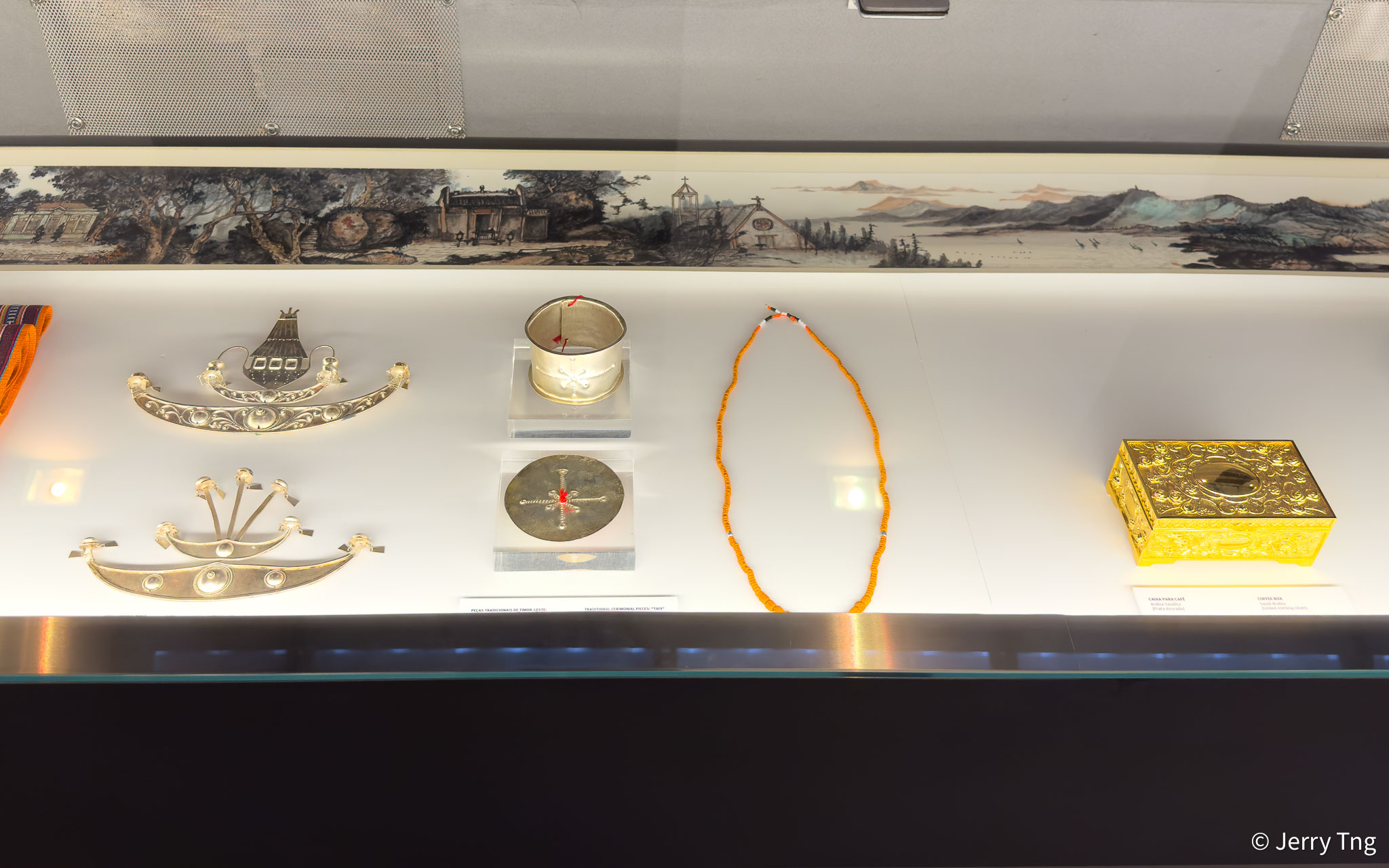
East Timor – Lulik – Traditional Timor House
East-Timor, undated. Sterling silver

Gift from the leader of the East-Timor Resistance, Xanana Gusmão, to President Jorge Sampaio. Visit to East-Timor, 2002
Portugal’s presence in East Timor dates back to the 16th century when the first merchants and missionaries disembarked on the island around 1515. East Timor was the furthest of all Portuguese colonies, which led to a rather late effective occupation. Skirmishing with the Dutch in the region eventually resulted in an 1859 treaty for which Portugal ceded the western half of the island. East Timor was occupied in 1942 by the Allies after Portugal refused to cooperate with the Allies in the defence of Southeast Asia. Following the war, the Dutch East Indies secured its independence as the Republic of Indonesia and the Portuguese, meanwhile, re-established control over East Timor. In 1975, Indonesia invaded East Timor. In 1999, East Timor gained independence through a referendum vote.
Egypt – Comemorative Coins (16)
Egypt. Sterling silver

Gift from President of Egypt, Abdel Fattah El Sisi, Eládio Loizaga to President Marcelo Rebelo de Sousa. State visit, 2018
The Ottoman-Portuguese conflicts (1538 to 1560) were a period of conflict during the Ottoman–Portuguese confrontations and series of armed military encounters between the Portuguese Empire and the Ottoman Empire along with regional allies in and along the Indian Ocean, Persian Gulf, and Red Sea. After the voyages of Vasco da Gama, a powerful Portuguese Navy took control of the Indian Ocean in the early 16th century. It threatened the coastal cities of the Arabian Peninsula and India. The headquarters of the Portuguese was Goa, a city on the west coast of India, captured in 1510. Ottoman control of the Red Sea meanwhile began in 1517 when Selim I annexed Egypt to the Ottoman Empire. The Ottomans lost control of the seas to the Portuguese at around the same time as Egypt relinquished her political independence to Constantinople. For four long centuries, Egypt would be shown on the maps of the Ottoman empire as a mere administrative division.
Indonesia – Dagger (Traditional Sword – Kris)
Indonesia, undated. Steel, copper, wood and sterling silver

Gift from President Ahmed Sukarno of Indonesia to President Américo Tomás. State visit to Portugal, 1960
Portuguese explorer and trader first reached Indonesian archipelago during the age of exploration in the 16th century in order to search for spices in the Indies. The Portuguese arrived in 1512 to dominate the sources of valuable spices. The Dutch arrived in 1602 to establish a monopoly. In 1999, Indonesia and Portugal restored diplomatic relations, which were severed following the Indonesian invasion of East Timor in 1975.
Japan – Traditional Japanese Dance
Japan, undated. Bamboo, wood and glass

Gift from Emperor Akihito to President Mário Soares. State visit to Japan, 1993
It was not until the year 1542 or 1543 that Europeans actually visited the Japanese islands proper, and the honour of being the first Westerner to enter the Land of the Rising Sun has been claimed, amongst others, by the famous Portuguese adventurer Fernão Mendes Pinto, who claims to have landed in Tanegashima Island about that time. As has been said, Pinto’s claim to be the discoverer of Japan is doubtful, to say the least of it, and the real credit probably belongs to three Portuguese adventurers who were shipwrecked there, as a consequence of a typhoon they encountered whilst on a trading voyage from Siam to China.
Japan – Vase
Japan, updated. Porcelain.

Gift from Emperor Akihito of Japan to President Jorge Sampaio. State visit to Portugal, 1998
This period of time is often entitled Nanban 南蛮 trade, where both Europeans and Asians would engage in mercantilism. The Portuguese at this time would found the port of Nagasaki, through the initiative of the Jesuit Gaspar Vilela and the Daimyo lord Ōmura Sumitada, in 1571. Because Japan was in the midst of a civil war, called the Sengoku period 三国, the Japanese bought many Portuguese guns. Oda Nobunaga, a famous daimyo who nearly unified all of Japan, made extensive use of guns (arquebus). All these trading ends with the monopoly of Western trade by the Dutch East India Company in 1637.
Morocco – Desk Clock
Chaumet (manufacturer) Paris (France), undated. Gold, diamonds, rock crystal, semi-precious stones

Gift from King Hassan II of Morocco to President Jorge Sampaio. State visit to Morocco, 1998
The Portuguese Empire was founded when Prince Henry the Navigator led the conquest of Ceuta, which began the Portuguese presence in Morocco, lasting from 1415 to 1769.
Morocco – Permanent Ink Pen
S.T. Dupont, by Tournaire (fabrication). France. Gilded Sterling Silver

Gift from His Royal Highness King Mohammed VI of Morocco to President Marcelo Rebelo de Sousa. Visit to the Kingdom of Morocco, 2016
The Portuguese who had conquered the Islamic port of Ceuta in 1415 and several other towns in current-day Morocco in a Crusade against Islamic neighbours, managed to successfully establish themselves in the area.
Mozambique – “Family”
Unknown artist. Mozambique, undated. Wood.

Gift from President Armando Guebuza of Mozambique to President Jorge Sampaio. State visit to Portugal, 2005
When Portuguese explorers reached Mozambique in 1498, Arab-trading settlements had existed along the coast and outlying islands for several centuries. Over time, Portuguese military wrestled the control of Africa from these Arabic influence. The Mueda massacre of 16 June 1960, resulted in the death of Makonde protestors, which provoked the struggle of independence from Portuguese rule of Mozambique. Mozambique continues to preserve a close relationship with Portugal with a perspective on other European markets.
Qatar – Royal Palace Of Qatar Model
Goldsmith & Silversmith Company. London (England), undated. Sterling silver, gold and malachite

Gift from Emir Hamad bin Khalifa Al Thani of Qatar to President Aníbal Cavaco Silva. State visit to Portugal, 2009
Bahrain and mainland Qatar had been seized by the Portuguese in 1521. After the Portuguese claimed control, they constructed a series of fortresses along the Arabian Coast. However, there have been no significant Portuguese ruins found in Qatar. The Portuguese focused on creating a commercial empire in Eastern Arabia, and exported gold, silver, silks, cloves, amber, horses and pearls. The population of Al-Hasa submitted voluntarily to the rule of the Ottomans in 1550, preferring them to the Portuguese. In 1602, the Portuguese were expelled from the area by the Dutch and British.
Saudi Arabia – Sword Of Honor
Saudi Arabia undated. Steel, gold and ivory

Gift from Prince Khalid Al-Faisal of Saudi Arabia to President Jorge Sampaio, Visit to Portugal, 2005
Relations between the Portuguese and Mamluks (Ottomans) were hostile in the years leading up to the Siege of Jeddah (1517) given recent Portuguese trade incursions in the Indian Ocean and Middle East. The siege ended up in defeat for the Portuguese. The Attack on Jeddah occurred in 1541 and was the last attempt by the Portuguese to capture the city. The Portuguese led by Estevao da Gama attacked Jeddah and attempted to take the city. the joint Ottoman-Meccan force led by Ali Beg (Governor of Jeddah) and Abu Nummay II (Sharif of Mecca, who called for a jihad) successfully fended off the Portuguese attack and Jeddah was successfully defended.
South Korea – Lacquerware Box
South Korea, undated. Wood, mother-of-pearl and lacquer

Gift from President Park Geun-hye of South Korea to President Aníbal Cavaco Silva. State visit to South Korea, 2014
The most recent history that the world can remember was South Korea beating Portugal 2-1 in Qatar World Cup 2022. However, the relationship was much longer. The first Portuguese people to arrive in Korea Peninsula came in the second half of the 16th century, and the earlier Portuguese maps showing Korea also date back to this time.
Zambezia – Tea And Coffee Set
(Zambezia), undated. Sterling silver

Gift from the Pakistani Community of Zambezia to President Américo Tomás. Visit to Mozambique, 1964
This was a gift from the Pakistani community of Zambezia during a state visit to Mozambique. Zambezia is an early name for Rhodesia (now Zambia and Zimbabwe). Which makes one wonder why would they made the effort to go to Mozambique to meet the Portuguese president. Another great museum mystery.

By the 20th century, many of the Portuguese colonies were lost to either rival powers or internal warfare. Of those which remained, Madeira and the Azores became autonomous regions of Portugal, and Goa became a part of India in 1962. There’s a sad past of colonisation and slavery, of a glorious monarchy that used to dominate sea trade, but in this museum we look forward.
About the Museum of the Presidency of the Republic

Meet the Presidents of the Republic and their official residence, the Palace of Belém. Museu da Presidência da República (MPR), as it is called in Portuguese, is housed in the Palácio de Belém’s old coach house.


The history of the development of the republic in Portugal is detailed in chronological order. With oil portraits, personal items and various documents illustrating the history and career of each of the presidents of the Portuguese republic, the museum presents all of the heads of state that have marked the country’s 20th century.
Permanent Exhibitions at the MPR
- Implementation of the Republic and National Symbols
- The Republic and its Presidents and Portrait Gallery
- State Visits and Gifts
- Powers of the President of the Republic
- Honorary Orders
- Belém Palace
Operating Hours
- Tuesday to Friday, from 10:00 a.m. to 6:00 p.m.; Saturday and Sunday, from 10:00 a.m. to 1:00 p.m. and from 2:00 p.m. to 6:00 p.m.
- Access is only allowed up to 30 minutes before closing.
- Closed every Monday, New Year’s Day, Easter Sunday, May 1st and Christmas
Museu da Presidencia da Republica
Palacio Nacional de Belem 1349-022, Lisbon, Portugal
Tel : +351 21 361 4660
Visited Aug 2023
@museupr
0 comments on “Museum of the Presidency of the Republic – Gifts from the Nations (Rest of World)”