
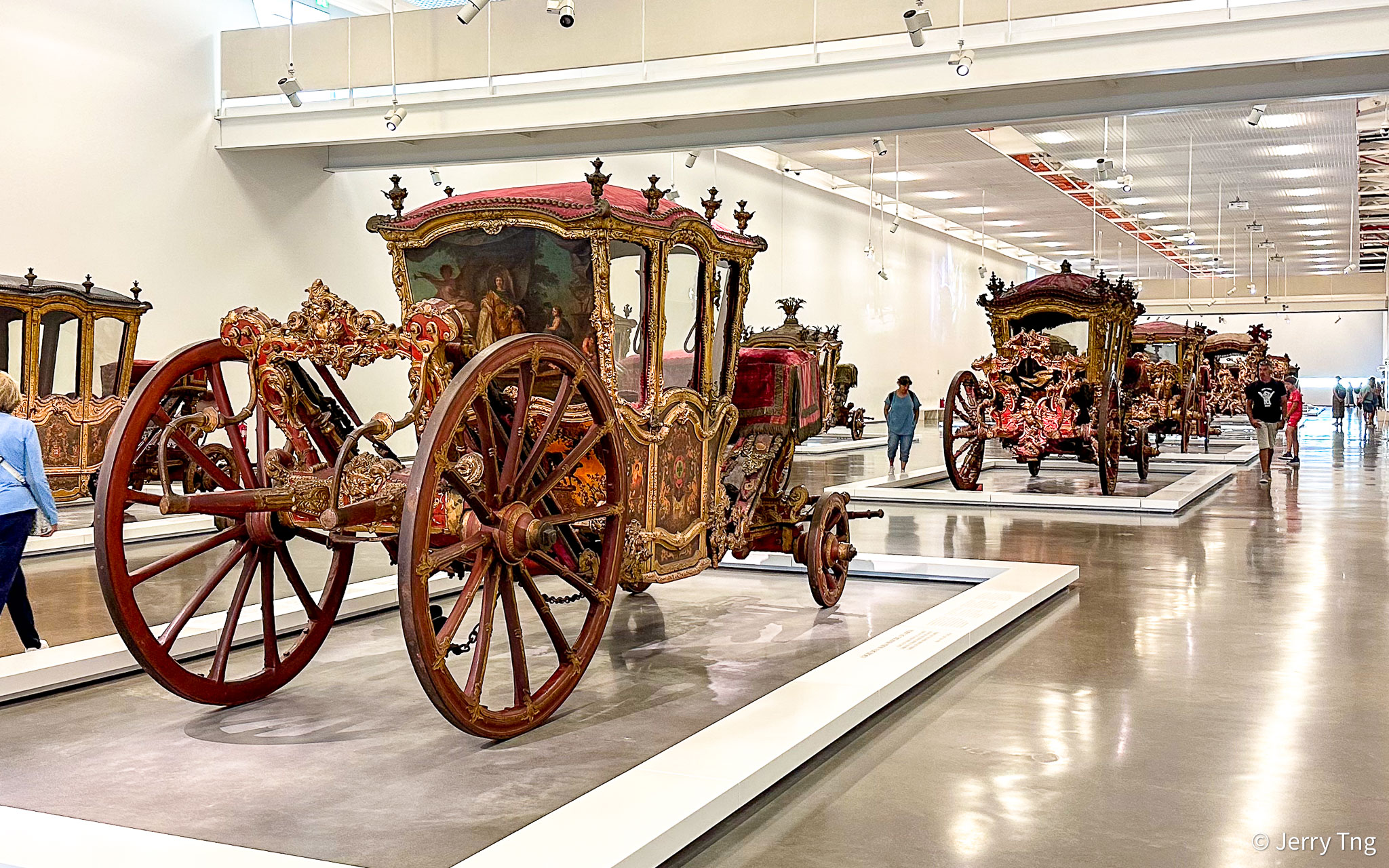
Before the invention of automobiles, the aristocrats and upper classes travel around in coaches and carriages drawn by horse. The Royal houses of Europe used them as status symbols as much as modes of transportation.

The main exhibition floor of the new National Coach Museum offers a majestic look at the royal carriages and more modern iterations of the same. The ones that you first see when you enter museum from the gigantic lifts that were purpose built for moving the carriages to their positions are a procession eight royal carriages led by the oldest one in the collection, Coach of Filipe II.
Table of Contents
Coach of Filipe II
Unknown author | 16th – 17th century, Spain | Physical Dimensions: 241 cm x 185 cm x 572 cm Wheels: 145/113 cm (diameter); 5 cm (thickness) | Oak wood, leather, iron, glass, velvet brocade, silk

It is an extremely rare coach, the oldest in the museum’s collection. It was used on the journey of Filipe II of Portugal, III of Spain, from Madrid to Lisbon in 1619.


It was driven by two postilions on horseback. In the front there is a chest to store travel utensils. Spanish work. 16th-17th Centuries.
Queen Maria Francisca of Savoy Coach
Unknown author | 17th century, France | Physical Dimension : 5,93 x 1,87 x 2,65 m

This coach was given by Louis XIV, King of France to his cousin Maria Francisca of Savoy, on her marriage to Afonso VI, in 1666.


The body, with four seats and seven windows, features the Royal Arms on the door panels. On the rear panel is represented the “Royalty” – crowned female figure sat on a throne, holding a sceptre and with on her lap, several fruits symbolising the Prosperity of the Kingdom. French work. 17th Century.
Queen Maria Francisca of Savoy Coach
Unknown author | 17th century, France | Physical Dimension : 6,10 x 2 x 2,40 m

This coach is a rare example of the “Carrosse Moderne” – closed body with eight windows – that appeared for the first time in Paris. It belonged to Queen Maria Francisca of Savoy-Nemours, cousin of Louis XIV, King of France. It was brought to Portugal as part of the wedding dowry when she married Afonso VI in 1666. On the doors, two female figures flank a medallion with the queen’s monogram. It was driven by a coachman. French work. 17th Century.
Coach of King Pedro II
Unknown author | 17th century, Portugal | Physical Dimension : 5,95 x 1,90 x 2,63 m

The body of this coach is decorated in the French style of Louis XIV, carved wood coated with a fine gold leaf.

The door panels feature the Portuguese Royal Coat of Arms and the side panels display a female figure with a branch of laurel and a shield with the monogram of King Pedro II. On the rear panel is represented the figure of Abundance. Portuguese work. 17th Century.
Coach of King João V
José de Almeida, Félix Vicente de Almeida (manuf.), José da Costa Negreiros or Pierre Antoine Quillard (painting) | 1723, 18th century, Portugal | 633cm x 215cm x 335cm | Wood (oak, hollow), bronze, glass, silk, taffeta, velvet

This coach was commissioned by King João V. The wooden body has flowing, undulating lines, in a shape known as bombé or bowed, which announces the rocaille style.


The decoration features busts, in wood or carved bronze, of young women known as “espagnolettes”. The rear wheels display the twelve signs of the Zodiac. Portuguese work. 18th Century.
Coach of Maria Ana of Austria
Unknown author | 18th century, 1st quarter, Austria or Netherlands | Physical Dimensions: 290 cm x 210 cm x 675 cm Wheels: front and rear: 87/172 cm (diameter); 6.5 cm (thickness) | Wood (holm oak, hollow), crystal, bronze, iron, velvet, silk taffeta

This coach was commissioned in 1708 by Emperor Joseph I of Austria for the marriage of his sister Maria Ana with the King of Portugal D. João V. The body is covered with fine gold leafs and decorated with crowned lions, the monograms of the Queen and the Portuguese Coat of Arms in an oval shield.

On the rear panel is represented a painting allusive to the virtues of the Queen: Truth, Firmness and Fidelity. The twelve spokes of the wheels have the shape of sceptres, Symbols of the Royal Power. Dutch work. 18th Century.
Coach of Pope Clemente XI
Unknown author | 18th century, 1st half, Rome, Italy | Physical Dimensions: 285 cm x 225 cm x 665 cm Wheels: 84/170 cm (diameter); 5.2 cm (thickness) | Wood, bronze, iron, silk velvet, silk taffeta, crystal / glass, linen

This coach was offered by the Pope to João V of Portugal, in 1715. It carried the “Blessed Ribbons” for the baptism of the king’s firstborn son, Prince D. José. The open «Roman-style» body features feminine figures, at each corner, representing the four continents. On the rear a boy holds a flaming heart, symbol of the Affection.


The shell, alluding to the baptismal font, is flanked by two seahorses and supports the coachman’s feet. Italian work. 18th Century.
Coach of the Crown
Unknown author | 18th century, 1st quarter, France, Paris | Physical Dimensions: 365 cm x 220 cm x 715 cm Wheels: 88/178 cm (diameter); 6.5 cm (thickness) | Wood, leather, bronze, copper, iron, glass, turtle, silks, silk velvet

This coach was part of the Embassy procession of Count of Ribeira Grande sent by King João V to the court of Louis XIV, King of France, in 1715, in order to re-establish diplomatic relations with several European courts after the signing of Utrecht Peace Treaty.

In the centre of the hood there is a crown, representing the Royal Power, flanked by small crowns supported by winged dragons, symbol of the Bragança Dynasty. French work. 18th Century.
Coaches of the Embassy

The three main coaches of the Embassy of the Marquis of Fontes, sent by King João V to Pope Clement XI, in Rome in 1716, are unique examples of Italian baroque. As a result of this grand Embassy, Portugal obtained the Patriarchal status for the Royal Chapel.

Coach of the Coronation of Lisbon
Unknown author | End of 18th century, Rome | Physical Dimensions : 6,60 x 2,60 x 3,55 m

The theme of this coach is the Coronation of Lisbon, capital of the Portuguese Empire. The sculptural composition of the rear presents, above, two winged genies holding garlands. At the center, the female figure of Lisbon, sat with a scepter in her hand, is crowned by the Goddess of Fame holding a trumpet, and by the Goddess of Abundance with a cornucopia of flowers and fruits.


At her feet, the winged dragon symbolizes the House of Braganza. On a lower plane, two male figures represent Asia and Africa. Italian work. 18th Century.
Coach of the Oceans
Unknown author | End of 18th century, Rome | Physical Dimensions : 7,26 x 2,60 x 3,20 m

The theme of this coach is the connection of the Oceans and represents an important maritime episode of the history of Portugal.


On the rear (L), in the centre, Apollo sings the feats of the Portuguese and is flanked by two female figures, Spring with flowers (to the right of Apollo). and Summer with ears of wheat. In front of the globe, two old men, the Atlantic Ocean and the Indian Ocean, shake hands symbolising the passage of the Cape of Good Hope. Italian work. 18th Century.
In the front of the carriage, on either side of the driver’s seat, are Autumn, depicted with seasonal fruits and Winter. Seasons were also widely depicted throughout the Baroque period, proving almost a perfect fit as part of the carriage’s decorative narrative.
Coach of the Ambassador
Unknown author | End of 18th century, Rome | Physical Dimensions : 7,23 x 2,45 x 3,40 m

The theme of this coach is the Conquests and the Navigation.


On the left rear (L), a Zephyr offers to Tethys, Goddess of Navigation, a compass, a square, and the globe. The goddess is on the shoulders of a Triton. The ship’s compass symbolizes Palémon, God of the Ports. On the right, Belona, Goddess of War, holds a shield and commands a lion, symbol of royal power. At the base, the giant Adamastor represents the dangers endured by the Portuguese in the passage of the Cape of Good Hope. Italian work. 18th Century.
Coach of Prince António
Unknown author | 18th century, 1st half, Portugal | Physical Dimensions: 630cm x 200cm x 270cm | Wood, leather, moroccan, glass, bronze, silk velvet, silk taffeta, golden brass


This ceremonial coach belonged to Prince António, son of King Pedro II and Maria Sofia of Neubourg. Its body is closed with glass windows.

In the center of the doors are painted shields with the Portuguese Royal Arms, supported by cherubs. In the bottom are represented the figures of Providence, with a basket of flowers and fruits, and Prosperity with ears of wheat. On the rear panel a female figure, that symbolises the Portuguese Monarchy, seated on a throne, holds a shield with the royal coat of arms. Portuguese work. 18th Century.
Coach of King José I
Cyrilo Volkmar Machado (paintings), José and Felix Vicente de Almeida (carvings) | 18th century, 3rd quarter, Portugal | Physical Dimensions: 298 cm x 225 cm x 642 cm Wheels: 83/189 cm (diameter); 5/5.7 cm (thickness) | Wood (oak and / or hollow), bronze, leather, glass, silk velvet, silk taffeta

This coach belonged to King José I and is considered one of the best examples of Portuguese Baroque – an artistic style characterised by decoration with excessive detail. The interior is lined in red velvet and the Portuguese Royal Coat of Arms appears on the hood.


The carving is attributed to the sculptors José de Almeida and Felix Vicente de Almeida and presents fruit and flower garlands and Indian’s heads, symbolising the first contacts with Brazil. Displayed on the front panels, are human heads with distinct features of South American Indians clearly evoking the connection of the Portuguese with the new world.


Its body is closed with glass windows. The red and gilt woodwork is a very lavish decorative work of art. On the upper rear panel is a painting by Cirilo Volkmar Machado. The decoration is inspired by Louis XIV and Louis XV styles in an interpretation of Portuguese characteristics. In the rear panel stands out an imperial eagle, representing the Absolute Power of the King. Portuguese work. 18th century.
Coach of the Children of Palhavá
Silvestre de Faria, José da Costa Negreiros & others | 18th century, 3rd quarter, Portugal | Physical Dimensions: 265 cm x 189 cm x 560 cm Wheels: 84.5/179 cm (diameter); 7/6.5 cm (thickness) | Wood, leather, glass, bronze, silk velvet, damask, silk taffeta, blade and gold fringe

This coach belonged to the illegitimate sons of King João V – the princes António, Gaspar and José, known as “the Children of Palhava” because they lived in the palace with the same name, in Lisbon. It is called coupé because its body, compared to the coach, is cut off at the front to make it lighter and faster. Inside there is only one seat for two passengers. The decoration is attributed to the woodworker Silvestre de Faria and the painter José da Costa Negreiros. Portuguese work. 18th century.
Coach of Princess Marianan Vitória
Unknown author | 18th century, Spain | Physical Dimensions : 6,15 x 2,14 x 2,61 m

This coach was used on the journey of the Spanish Royal Family from Madrid to Badajoz where a ceremony, known as the “Princesses Exchange” was held at the border of the Caia River, in 1729. On this occasion the Spanish princess Mariana Vitoria de Borbón marries Prince D. José of Portugal and on the wedding dowry brings this coach. In the panels are painted the Portuguese Royal Arms. Spanish work. 18h century.
Coach of the Princesses
Unknown author | 18th century, Portugal | Physical Dimensions : 6,05 x 2,05 x 2,79 m

This coach belonged to the princesses Maria Francisca, Maria Ana, Maria Francisca Doroteia and Maria Francisca Benedita, daughters of King José I. The body is decorated with mythological scenes. On the right, Venus swims in the company of happy cherubs and on the left the god Baco is carried in a Roman car pulled by lions. The rear panel features the coat of arms of Portugal and Neptune releasing the trapped Tritons. Portuguese work. 18th Century.
Table Coach
Unknown author | 18th century, Portugal | Physical Dimensions : 6,40 x 2,10 x 2,80 m

This coach joined the procession of the Portuguese Royal Family from Lisbon to Elvas, where the ceremony, known as the “Princesses Exchange” was held at the border of the Caia River, in 1729.


The Portuguese princess Maria Bárbara marries the Spanish prince D. Fernando and the Spanish princess Mariana Vitória marries the Portuguese prince D. José. The table inside could be used for meals. Portuguese work. 18th Century.
About National Coach Museum
The National Coach Museum houses one of the most important collections of horse drawn carriages in the world, making this a highly recommended place to visit.

On May 23, 1905, by the initiative of Queen Amelia of Orleães and Bragança, wife of King Carlos I, the Royal Coach Museum was inaugurated in the Old Riding Arena.
When the Republic was established in 1910, the Museum was renamed National Coach Museum (Museu Nacional dos Coches).
This museum houses an important horse-drawn carriage collection of vehicles are from the seventeenth, eighteenth and nineteenth century.
The museum was formerly housed in the Royal Riding Hall of Belém, the former home of the Portuguese School of Equestrian Art, known as the Picadeiro Real. The Picadeiro Real is part of the larger Belém Palace complex, formerly a Royal Palace, which is now the official residence of the President of Portugal.

In the Royal Riding Arena it is still possible to see some vehicles, oil paintings of the monarchs of the Bragança dynasty and a set of saddles and harnesses related to the Equestrian Art.

The new museum building was inaugurated on May 23, 2015. The horse-drawn vehicles belonging to royal palaces of the Crown, the Church and various noble houses are exhibited in chronological order revealing the different models used, their characteristics and evolution from the 16th century until the end of the 19th century.
Opening Hours:
Tuesday through Sunday: 10am to 6pm. Mondays: closed.
Closed: January 1st, May 1st, Easter Sunday, June 13th, 24th and 25th December.
Visited Aug 2023
0 comments on “National Coach Museum – The Royal Coaches”