
For me, Bak Kut Teh is Bak Kut Teh and not Rou Gu Cha. What’s the difference? BKT is associated to the old Chinese diaspora story of the 19th century which my dad was part of. And the other is just some BKT store owners trying to cater to the new Chinese diaspora.

Food blogging was not a thing in the 19th century when BKT became a staple of the local Chinese for breakfast and lunch, so the history and origin were not documented. And then there’s the Klang’s claim to be the original. But one thing for sure, BKT in Singapore generally refers to the Teochew version made popular by folks like Ng Ah Sio (1955), Ya Hua (1973) and Song Fa (1969).


Since the moment Song Fa Bak Kut Teh got a Bib Gourmand mention in the Michelin Singapore guide for their BKT served at their North Bridge Road outlet, they have expanded around the island with outlets in every corner. Right down the street from their 11 North Bridge Road is 17 North Bridge Road branch. These days, everything comes from the centralised kitchen, so everything should be the same.

Much has changed since Mr Yeo started selling bak kut teh from his pushcart in Johor Road back in the late ’60s – nowadays it’s the second generation of the family who are running the show. They are still selling their celebrated pork ribs and peppery broth but are now doing so from 10+ shops – and this one, the simplest, seems to be the best. Queue, order, pay, and then tuck into your soup – when you’ve finished they’ll top it up for you.

Chinese tea is the preferred beverage when having bak kut teh, as it is believed to help wash down the oil and fat from the dish. It used to be just a Hokkien Oolong tea mix called “Unknown Fragrance” 不知香 by Pek Sin Choon 白新春茶庄. Now you can choose from a variety of difference famous Chinese teas. Today we had the Tie Guan Yin 铁观音 also hand packed by Pek Sin Choon.

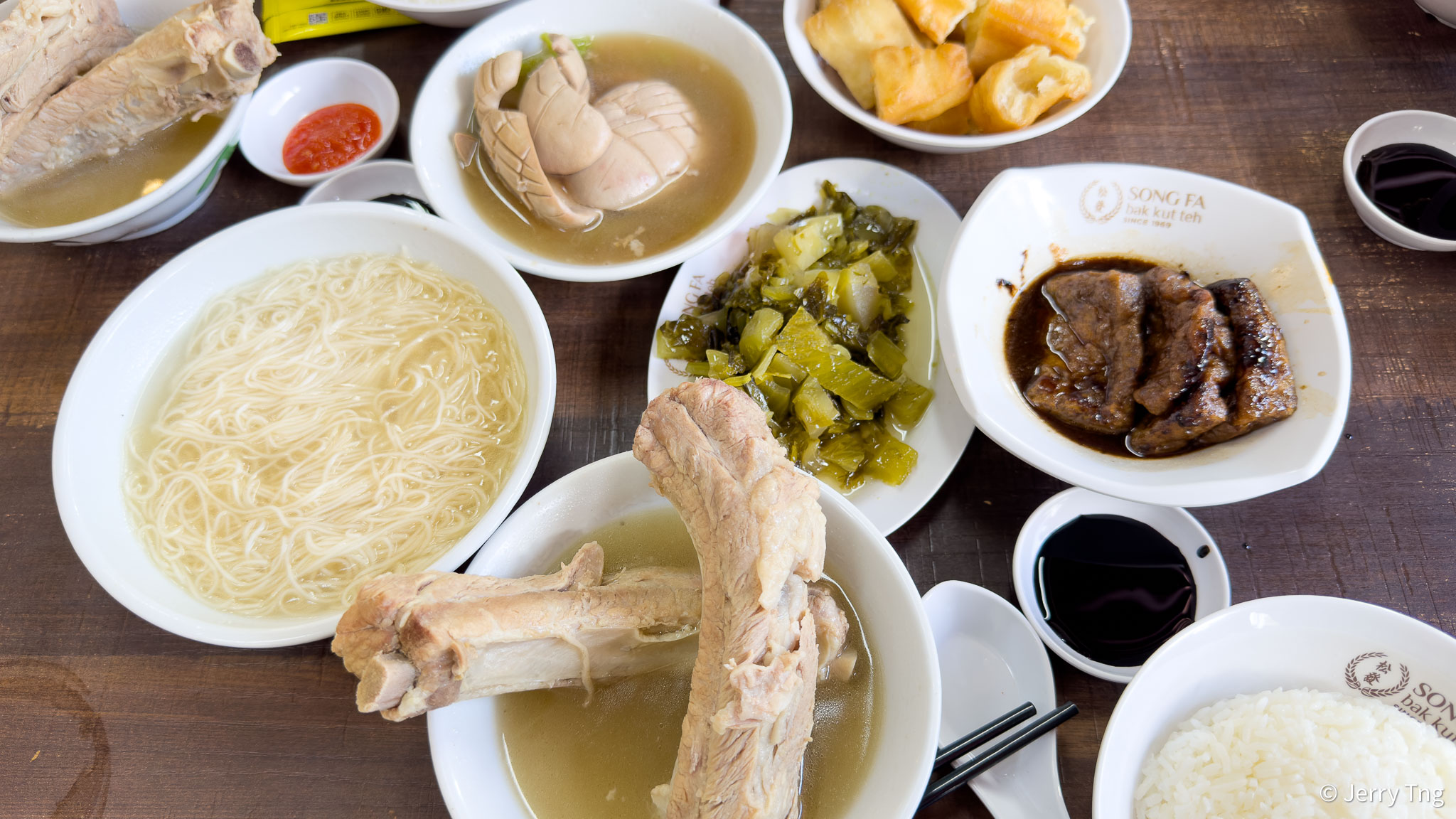
Bak kut teh is typically eaten with steamed white rice, you tiao (dough fritters), offal, salted vegetables and braised beancurd skin. Light or dark soy sauce is used as a dip. Sliced chilli, minced garlic or chopped chilli padi are often added to the dipping sauce.

This side dish of preserved Chinese mustard green

Braised taupok 卤豆卜, or braised beancurd skin, is a classic side dish with BKT. This version was a bit too salty for my taste, but it was definitely well braised as compared to many other BKT stores.

Teochew bak kut teh soups are typically clear in appearance and light in taste. As such, the Teochew variant of bak kut teh is seasoned only with garlic, soy sauce and pepper, with the soup simmered and skimmed. The result is a fine, light brown consommé that is garlicky and peppery. These days it is not just bones with specks of meat. You get to choose the normal pork ribs 排骨, prime ribs 肋骨 and the ultimate whole ribs that they named 特级龙骨汤. I always order prime ribs because normal ribs are too small and whole ribs are too big.

The introduction of the dish to Singapore and Malaysia is attributed to Hokkien immigrants who moved to this region in the 19th century. The dish is said to have been popular with the Chinese coolies as a hearty breakfast before embarking on their backbreaking tasks of the day. And very often, they could only get bones and offals because the pork meat was sold in the market. These days, pig kidney is a lot more expensive because of the labour needed to rid off the urine smell from the organ. And intestines are very rare because we do not have abattoir in Singapore anymore.

The braising liquid was the same as the one used for the taupok, and the seasoning packets can be bought home for your own home stew. I couldn’t say I really enjoy their braised items, but it is like a routine. I always order this item to share with my guests.

Song Fa has one item that differentiate them from the rest and it’s this mee sua in their famous soup. As mee sua is made from rice flour, it tends to stick together when cooked. But somehow their version is not soggy and maintains the form throughout the meal. Especially when paired with their BKT soup, it is absolutely delicious.

The drought fritter is used to dip into the soup, but you need stale fritter to do it properly. These were too fresh and oily and covered the taste of the soup.
The BKT soup is the gauge of a good BKT or not. The soup needs to be garlicky and peppery, and yet clear and not oily. This requires the right blend of spices (which only consists of cinnamon, star anise, white pepper and garlic) and cooking time. There are subtle variations between the brands, and Song Fa, while good, lacks character and perhaps that’s why they are the yardstick to measure against.

Franky a Michelin nod doesn’t mean it’s the best BKT in town – it’s more like a consistency and quality mark that one can trust. There are not many that are consistently better IMHO, the soup in many other places can vary from outstanding on a good day, and horrible on a chef’s day off. But when you are a tourist and most like the only time you get to taste BKT, you want to make sure you get the real deal. Song Fa definitely falls into that category.
Song Fa Bak Kut Teh (New Bridge Road)
#01-01, 11 New Bridge Road, Singapore 059386
Tel : +65 6533 6128
Visited Feb 2024
Michelin Singapore Guide Bib Gourmand 2016-2023 (2020 was skipped because of Covid-19)
0 comments on “Song Fa 松發 @ North Bridge”