
This is a strange Japanese restaurant combining fine dining yakitori with sushiya, a very daring challenge given that there are many excellent examples of each genre.

Opened around March 2024 by a group veteran of Japanese cuisine chefs (there were many who lost their jobs as the Japanese restaurants closed after the ban in Japanese seafood into China), Torisanmai combines the popular yakitori with a high-end sushiya; casual vs uptight, approachable vs expensive, a crash of two different food culture in Japan.


I wouldn’t call this an izakaya as it caters to the high-end crowd with an omakase menu starting at RMB 1,200 (~USD 170) per person before all the necessary service and tax. And they also offer an extensive imported wine list and sake that are priced above average.
Omakase Menu
蘆薈海帶山藥泥蝦蛄 Mantis Prawn (Shako) with Aloe Vera, Mozuku and Mashed Yamaimo

The first course, a rather complicated looking appetiser making up of a lightly poached shako (mantis prawn) on pieces of aloe vera, mozuku and mashed yamaimo. Everything worked nicely together, bonded by the refreshing yuzu vinegar. Mozuku (もずく) is an edible seaweed grown 99% in Okinawa with a slimy texture as opposed to more commonly used wakami that has a silky texture.
生海苔蛤蜊清湯 Hamaguri Nama Nori Clear Soup

When eaten fresh from collection, fresh nori (nama nori) has a lovely salty taste, subtle and not at all overpowering. Combined with the giant clam (hamaguri), the clear soup had great umami and savouriness from the sea.
太巻 Futomaki

This is a futomaki without any shari. Futomaki is a traditional thick sushi roll with colourful ingredients that’s perfect for potlucks, picnics, and celebrations. It remained very colourful with different types of fish and scallions wrapped around a nori sheet. Departure from the Japanese tradition but incredibly delicious.
帶魚 | 金槍魚 | 鱸魚 Tachiuo | Chutoro | Suzuki

These fish are sourced for alternative places instead of Japan after the national ban of import of seafood. Tachiuo (タチウオ) or beltfish was sourced from Korea, suzuki (鱸) or seabass from local source, and the chutoro from Taiwan. They were tasty and fresh, but do not have the same prestige as the Tsukiji (or Toyosu) market-sourced produce. And this fact has resulted in many high-end sushiya to close down since. In fact, the chef was rather reluctant to share the origins.

And the condiment used was also different from the usual, to supplement the subtle difference of the fish.
碳烤鴿腿 Grilled Pigeon Leg

Grilled pigeon leg is an addition specifically in China’s yakitoriya. Not self-respecting yakitoriya in Japan would serve this because technically it is not chicken. The taste is highly dependent on the quality of bird. This was quite good, plump and delicious.
Hiramasa 平政 Yellowtail Amberjack

Hiramasa (yellowtail amberjack) is also known as kingfish and is currently farmed in New Zealand. When I travel to NZ, the kingfish is featured very often as a ceviche. The chef added a yuzu dressing before serving the raw kingfish sprinkled with a colourful array of sesame called 京ら一油ふりかけ, a special condiment usually used in ramen.
雞皮包蝦 Shrimp Wrapped with Chicken Skin

If the yakitori are all like these three, then it would be a disappointing night. The traditional yakitori are served as a la carte orders. These three were innovative takes of the traditional. First up, a shrimp wrapped with chicken skin. The shrimp stuck to the skewer as the skin was grilled to a delicious crisp, which also got stuck onto the skewer.
西班牙火腿烤帶子 Spanish Iberico Jamon with Scallop

No chicken in the next skewer. A piece of Iberico ham placed on top of grilled scallops wasn’t my idea of yakitori.
魚子醬海膽碳烤鱈魚 Caviar and Sea Urchin with Grilled Silver Cod

And the next item total was a page out of the izakaya playbook -grilled silver cod fish.
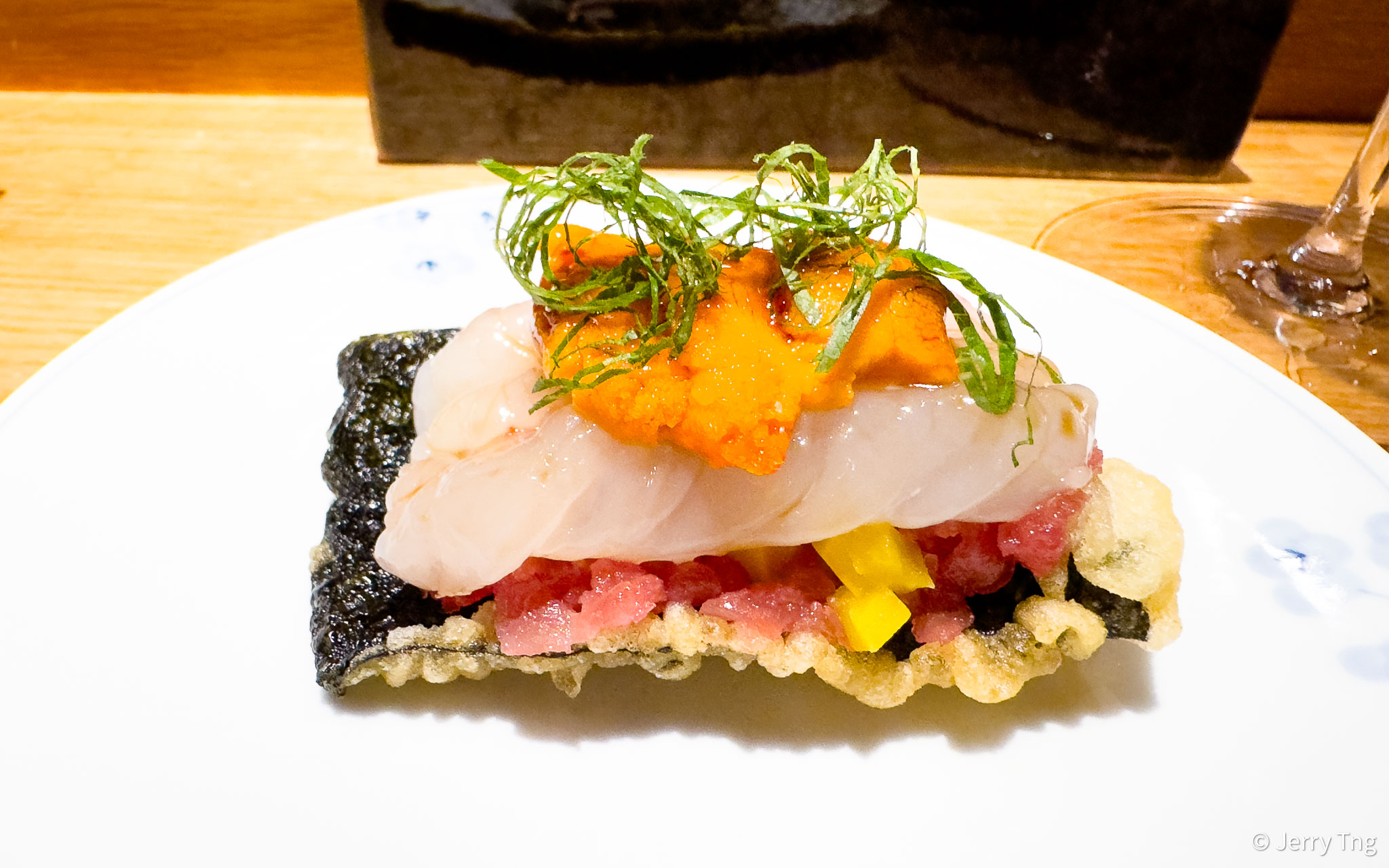
金槍魚泥甜蝦海膽塔塔 Chopped Tuna Belly Botan Shrimp Sea Urchin on Nori Cracker

The sequence of the presentation of the courses was quite mind boggling. After three grilled items, a seafood tartare was served. This tartare was put together like a pile of random expensive seafood.
明太子雞翅 Chicken Wing Stuffed with Mentaiko

And right after the tartare, the grilled portion of the omakase continued with a stuffed chicken wing which left us wondering what that (tartare) was all about. This item was really out of place in the omakase and should have come together with the first three yakitori and the tartare after all the grilled items.
白蘆筍 White Asparagus

Right after the chicken wing, the first (and only) vegetable for the evening – grilled white asparagus.
碳烤雪場蟹腳 Grilled Snow Crab Leg

Next, a grilled snow crab leg with a sauce that’s between a remoulade and a Japanese mayo. They should have place the sauce on the side, as the crab was already sweet and delicious on its own.
碳烤馬友魚 Grilled Threadfin

And the final grilled item was a piece of threadfin. This fish is used in Hong Kong (and Macau) as the base for salted fish. Not the best fish for grilling as it was quite dry.
海膽山藥司醋凍生蠔 Raw Oyster with Sea Urchin, Julienned Yamaimo and Vinegar Jelly

We returned to the regular programming with a raw oyster topped with raw sea urchin dressed with vinegar jelly. Delicious.
握壽司5貫 Nigiri Sushi 5 Pieces


握壽司5貫 Nigiri Sushi 5 Pieces – not quite the high-end stuff as these days one cannot get the seafood from Japan. The technique of processing the fish has not been passed on to the rest of the producers.

Served with an assortment of pickles.
雞湯拉麵 Chicken Consomme Ramen

I always look forward to the main course of a yakitori meal, which either usually is a soboro donburi (minced chicken rice bowl) or chicken consommé ramen. Either makes good use of the chicken and provides a good summary of the yakitori omakase. But it really seemed a bit too much after all those nigiri sushi.
A la Carte Items
For a yakitori restaurant, the omakase had very few, if any, yakitori. You have to order these separately as a la carte items.
雞心 | 雞胗 Hatsu | Sunagimo

雞腿 Momo

雞肝 Reba

雞頸肉 Seseri

鳳尾 Bonjiri

提燈 Cochin

Cochin or chicken ovaries is one of my favourite yakitori. Unfortunately it was not grilled to perfection, the yolk was still quite cold. And the rest of the yakitori were not so greet either.
鐵火巻 Tekkamaki

I also finish my sushi meal with tekkamaki. And tonight was no different. It seemed to be more of a sushi meal than yakitori.
デザート Dessert

Finally, dessert – some gigantic blueberries, local sourced melons, matcha ice cream with mint jelly. I am amazed how fruit agriculture in China has progressed in leaps and bound with produce that can almost equal the Japanese.

IMHO, they should stick to do what they were good at, which is sushiya. They have one in the same compound, and this seems to be just an extension of that with some yakitori thrown in. Some innovative eats, but not something I would frequent.
Torisanmai 鳥三昧碳燒壽司
常德路800号800秀A3幢1楼
Tel : +86 18521736707
Visited Jun 2024
0 comments on “Torisanmai 鳥三昧 @ Shanghai”