
In antiquity Yunnan was the Dian Kingdom 滇國 (277-115BC) that was inhabited by indigenous groups that were beyond the reach of Han Chinese civilisation, though they acknowledged Chinese suzerainty under the Qin (221–207 BC) and Han (202 BC-8 AD, 25-220 AD) dynasties.
Table of Contents
The Dian Civilisation – How It Began
Neolithic communities settled in the river valleys of Yunnan evolved into politically stratified societies known as the Dian during the second half of the first millennium BC. Dian 滇 was an ancient kingdom established by the Dian people 滇族 (4th century BC-1st century AD), a non-Han metalworking civilisation that inhabited around the Dian Lake plateau of central northern Yunnan, China from the late Spring and Autumn period until the Eastern Han dynasty.
Bronze Cowrie Container with Paying Tributes Diorama 贡纳场面青铜贮贝器
Bronze Cowrie Container with Sacrificial Ceremony Diorama 诅盟场面青铜贮贝器


The bronze lids of the bronze cowrie containers were covered with miniature figurines and structures, depicting various scenes from the life of the Dian people. The bronze lids depicted the Dian people engaged in everyday activities such as hunting, farming and weaving. Other scenes depicted the leisurely pursuits of the Dian people, such as bullfighting, dancing and music-making. The bronze lids also depicted the Dian decapitating their enemies (who wore their hair in long plaits).

The Dian people dressed in tunics over short pants and wore their hair in topknots. The bronze lids corroborated Sima Qian’s description1 of the Dian hairstyle.
Gilded Bronze Buckle Ornament 鎏金四人舞俑青铜扣饰

The Dian people are religious. This ornamental buckle2 shows four Dian men in full ceremonial garbs, holding a bronze bell of sorts on their right hands, and pounding their chest with their left hands in a religious trance.
Gold Seal of King of Dian Kingdom “滇王之印”金印

The Dian buried their kings at Shizhaishan 石寨山, which was discovered in 1954 near Shizhai Village in Jinning County 晋宁, Yunnan. The burial grounds were identified by the gold seal with inscription “King of Dian’s Seal“. The inscription was written in seal script on a gold imperial seal of investiture given by the Han Emperor3.

Governmental power rested with tribal chiefs, and Chinese settlers penetrated only the eastern parts of the province. Yizhou prefecture 益州 was set up in the area by the Han in 109 BC.
Bronze Culture of Dian
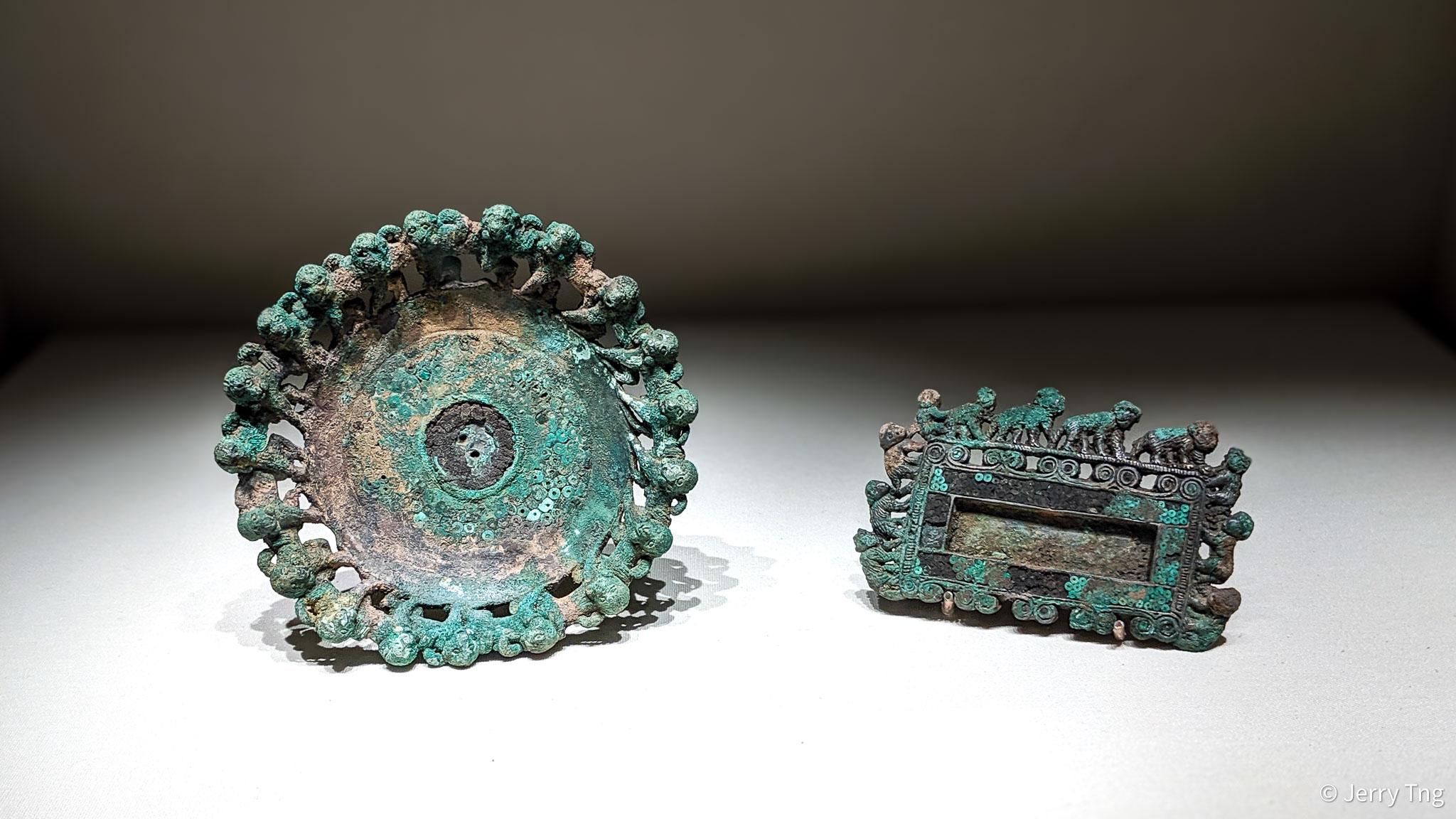
The Dian had a developed bronze culture of its own. Among its wide-ranging bronze products, the cowrie shell containers, ornaments with animal designs, tools, farming implements and weapons are the most famous for their sculptural decorations of figures and animals. The techniques of its gilding, inlaying and linear carving has reached a very high level.
Bronze Buckle Ornament with Monkey Procession 群猴环边青铜扣饰

Many of the artefacts depict the daily lives of the Dian people. The thousands of bronze artefacts and their distinctive figural decoration give important information about social hierarchy and gender relations, as well as about interaction between animals and human.
Bronze Pillow 青铜枕

The Dian cast bronze objects using both the piece mould method and the lost wax method. Dian elite burials contained an impressive array of bronze objects that included bronze pillows like this one excavated in Lijiashan, Yunnan Province in 1972, and well as many bronze cowrie containers, etc.

Animal husbandry in Dian Kingdom is relatively developed. At that time, livestock and poultry mainly included cattle, horses, sheep, pigs, dogs and chickens, ducks and other breeds, among which cattle was the largest number. This is evident in the large amount of bronze images of the local bull.
Bronze Cowrie Container with Seven Oxen and Tiger Handles 七牛虎耳青铜贮贝器

Excavated at Jinning, Yunnan Province in 1956, this container, found in a tomb, features two tigers and seven oxen; cattle and buffalo are symbols of wealth and influence in an agricultural society. The container was made by the Dian people of Yunnan, and suggests that exchange between bronze cultures of the Central Plain and Southwest China were occurring at this time.4
End of the Dian Kingdom

In 109 BC, armies dispatched by the Han Wudi 汉武帝(r. 141-87 BC) reached present-day eastern Yunnan, annexed the kingdom of Dian and established Yizhou Prefecture 益州郡. Historical sources and archaeological data –mainly objects recovered from Dian burials– highlight China’s impact on the region both before and after the conquest. However, divergent interpretations emerge in light of additional information, which includes textual evidence for continuing local uprisings against the Han presence, as well as evidence from later historical periods of China’s uneven and incomplete control of eastern Yunnan. 5
Bronze Spearhead with Hanging Figures 吊人青铜矛

The tip of this spear6 is round, the blade is in the shape of a willow leaf, the front end is closed into a sharp edge, and the middle is ridged. A pair of naked men hung near the handle of the blade, with hair combed back and hands tied behind back, like a crucified person. This hangman bronze spear has a unique shape and a strong Dian cultural style.
Forever Dian
Although tiny nation of Dian is no more, and much of its existence are recorded in formal history books, the discovery of these artefacts strengthen the richness of this culture. To this present day, the Yunnan Province is also known as Dian.
Aretfacts shown in this post are from the National Museum of China in Beijing, photos taken during visits in Sep 2023 and May 2022.
Footnote
- 据《史记》《汉书》记载,滇 (diān) 是“椎结、耕田、有邑聚”的部落,滇池周围土地肥美,“有盐池田渔之饶,金银畜产之富”,“人俗豪忲,居官者富及累世”,反映在葬俗上便是统治阶级的厚葬风气。“元封二年(公元前109年)天子发巴蜀兵,击灭劳浸、靡莫,以兵临滇,滇王始首善,以故弗诛……于是以为益州郡,赐滇王王印,复长其民。” ↩︎
- 此扣饰作4人并排站立舞蹈状。4人均头戴尖顶高筒帽,身着长衣,肩部披帔,腰束带,带上佩圆形扣饰;右手执铃,左手挥舞于胸前;口微张,似乎在说教。
为取悦、祈求大自然的一切事物和逝去的祖先给人间带来恩赐和保护,滇国居民常举行繁杂的祭祀仪式。在这些仪式中,巫师承担着沟通人与神之间信息的职能。他们一般有两种形象,一种服饰虽与众不同,但形象平和、稳重,以说唱表演为其作法方式;另一种不仅服饰奇特,而且装神弄鬼,狂奔乱跳。此扣饰表现的是滇国巫师起舞作法的场面,巫师的形象和风格属于前者。 ↩︎ - 1956年,这枚形如盤蛇印紐的金印「滇王之印」於中國雲南石寨山西漢古墓群的6號墓滇王墓出土,經考證是漢武帝劉徹于元封二年(前109年)滇王嘗羌臣服漢室后賜予的印綬。并且印证了,东汉光武帝赠与日本的汉倭奴国王印,尺寸及印紐均符合漢制。 ↩︎
- 器盖上铸七牛,其中六牛环绕于器盖边缘,一牛仁立于青铜鼓上,耸然独出于众牛之上。这些牛全部为黄牛,主要包括两种类型。一种体型较大,前额宽广,大耳,角长且上翘,頭项上有突起的肉峰,四肢粗大,颈下垂肌发达,长尾。另一种体型较小,前额突起,两角弯曲下垂,颈项上有突起的高肉峰,闷尾。此类黄牛数量较少。此贮贝器器盖上的黄牛当属前者,其造型健壮威武,闪烁着夺目的艺术光辉。 ↩︎
- Allard, Francis. “China’s Early Impact On Eastern Yunnan: Incorporation, Acculturation, And The Convergence Of Evidence.” (2015). ↩︎
- 此矛为圆銎,刃部呈柳叶形,前端收束成尖锋,中间起脊。刃部近柄处各吊一裸体男子,头梳棰酱,双手背剪,似为受刑之人。滇人青铜矛可以分为阔叶形和柳叶形两种基本样式,其中柳叶形的数量最多。此吊人青鋼矛器形奇特,具有浓郁的滇民族风格,是滇人仪仗用青铜兵器中的珍品。 ↩︎
Pingback: National Treasure – Seal of Dian King (Western Han) – live2makan