
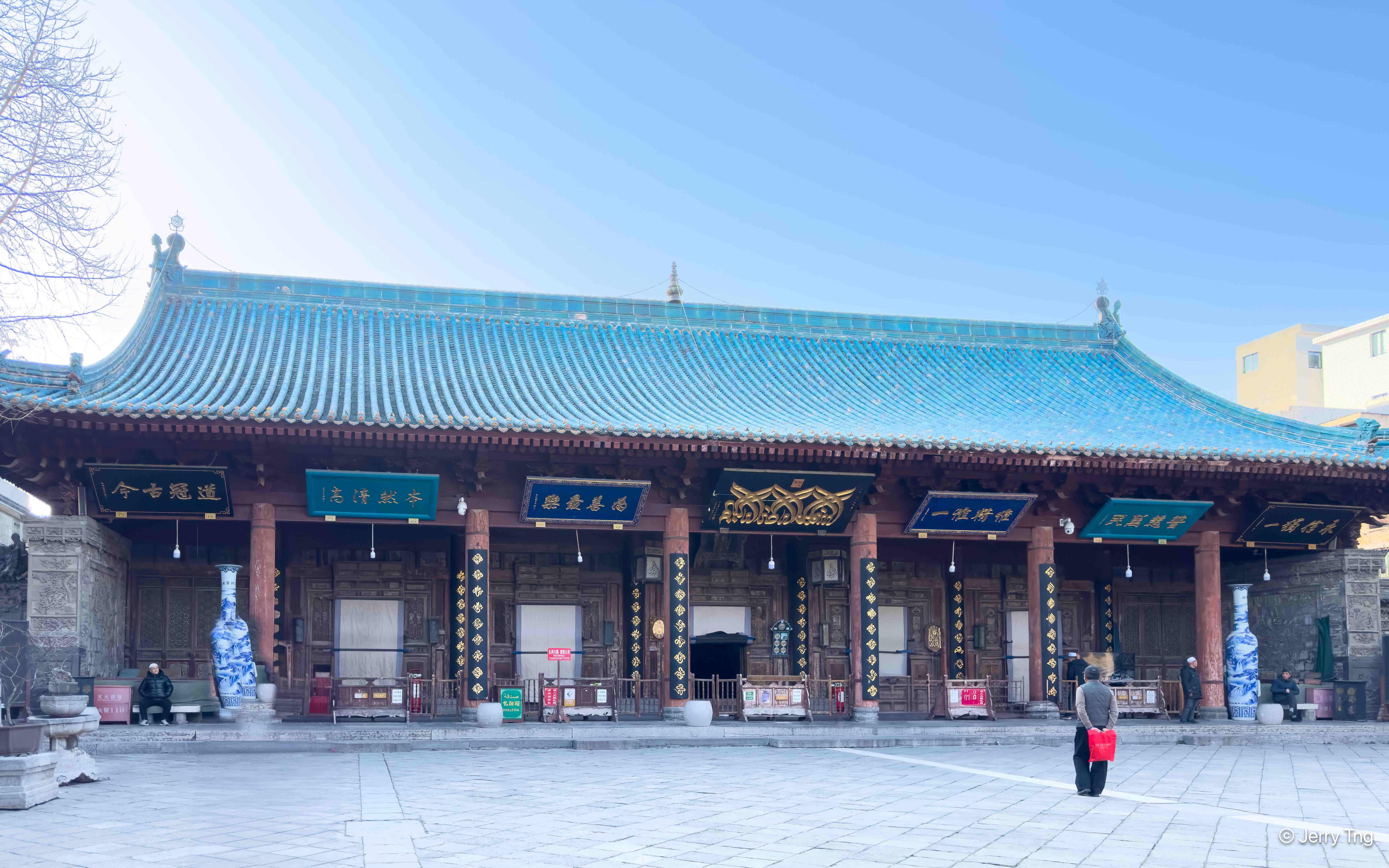
After passing the Bell Tower 钟楼 and Drum Tower 鼓楼 in the ancient capital Xi’an, you will be in the Muslim residential area – Bei Yuan Men 北院门 aka Muslim Street 回民街. Here, you will find a historic and magnificent ancient architectural complex – Great Mosque of Xi’an.

Table of Contents
The Great Mosque of Xi’an 西安大清真寺1 aka 化觉巷清真大寺 is one of the largest premodern mosques in China. The mosque was allegedly first built in the year 742 天宝元年, or the first year of the reign of Tang Xuanzong (r. 742-762), according to a stele in the mosque. Its current form was largely constructed in 1384 during Emperor Hongwu’s reign of the Ming dynasty, as recorded by the Records of Xi’an Municipality 西安府志.

It is located in Huajue Lane 化觉巷 in northwest corner of the Drum Tower area. Most of the renovations were done during Ming Hongwu period 明洪武年间 (1368~1398), with a major renovation in 2nd year of Chenghua 成化二年 (1466). In 1482 or 18th year of Chenghua, the name was changed to “敕赐清修寺”, which gave it royal status and thus the azure glazed roof on the Main Prayer Hall. Subsequently the complex was expanded in 1522 (1st year of Jiajing 经嘉靖元年), 1606 (34th year of Wanli 万历三十四年) and 1765 (30th year of Qing Qianlong 清乾隆三十年) to what you see today.2

The mosque consists of five courtyards along an extremely long axial line, oriented to the east so that the mihrab is in the westernmost building’s westernmost wall.3 More than twenty buildings occupy the enormous enclosed space.
First Courtyard 第一进

After entering from the side gate of the mosque you will come to the Screen Wall 照壁 (most part of the screen was under renovation when I was there). Here’s the first courtyard that was constructed during Qing dynasty.
Wooden Decorated Archway 木牌楼

The wooden decorated archway 木牌楼 was built at the turn of the 17th century. On both side of the archway, there are several houses in which there are some old Ming and Qing furniture on display.


This Paifang 牌坊 is built during the Qing dynasty during one of the many renovations ordered by the emperors. A paifang, also known as a pailou, is a traditional style of Chinese architecture, often used in arch or gateway structures.


Besides the calligraphy works of famous calligraphers on the plaques hanging on the lintels on both sides of the paifang, the other significant piece of artefact is the stone altar with carved four-clawed dragons under the arch.
South Exhibition Hall 南展厅

Once you enter the courtyard, a main axis splits the entire complex into north and south, with symmetrically buildings on both sides serving different purposes. The South Exhibition Hall 南展厅 currently showcases some of the Ming and Qing furnitures that were acquired in the 80s to main the visit to the mosque more interesting.


The layout of the building is one hall with two chambers. The main hall showcases a Qing period dragon motifs daybed that was allegedly used in the Forbidden City by three generations of emperors. One of the more interesting pieces is the set of Western style sofas that are placed on the left chamber that was supposed to be gifts from foreign diplomats to Empress Dowager Cixi. These could not have been in the mosque as Islam forbids images of living beings.
North Exhibition Hall 北展厅

Right next to the current entrance of the mosque is the North Exhibition Hall 北展厅. This building, just like the one in the opposite side, was added during the expansions in the Qing dynasty.

The ridge of the roof is the familiar Chinese-style ornamental stone carved ridge, but as this is a mosque, there’s no creatures or beings represented, only floral motifs.

The exhibits feature rubbings of plaques and steles of prominent calligraphers, including the back plaque 《道法参天地》4 (left) on the Paifang by Song dynasty calligrapher Mi Fu 米芾 (1051-1107) , stele rubbings with poem《前赤壁赋》(middle) by Song dynasty poet and calligrapher Su Shi 苏轼 (1037-1101), and entrance plaque 《勒赐礼拜寺》(right) by Ming dynasty politician and scholar Dong Qichang 董其昌 (1555-1636).
Second Courtyard 第二进

The Five-bay Gate 五间楼 is the entrance to the second courtyard, which houses the stone arch and two towering tablets. This courtyard is where the worshippers socialise and prepare themselves for prayers.
Five-bay Gate 五间楼


Architecturally, the Five-bay Gate 五间楼5 was the main entrance of the mosque during the Ming dynasty. It has three pairs of stone drums and at its main lintel hangs the plaque “The Mosque”《清真寺》that declares the purpose of this religious complex.
Stone Arch in Ming Dynasty 明石牌坊

In the middle of the second courtyard stands a stone arch that was built in Ming dynasty. Carved into the lintel in the middle, the Chinese calligraphy says, “The Court of Heaven”《天监在兹》. Two more stone-laid passageways on either side of the arch lead the worshipers to the inner courtyards.
The Library 图书馆


The library is out of bounds and serves as the meeting room for the Chinese Communist Party Committee for the mosque. Yes, religious matters need the CCP’s approval too.
Towering Tablets Carved with Dragons 冲天雕龙碑


Two stone steles are erected here with the decorations of carved dragons. Both of them are carved with the inscriptions about the repairs of the mosque at the imperial orders of Ming Emperor Wanli 明万历 (1572-1620) (left) and Qing Emperor Qianlong 清乾隆 (r.1735-1796).

At the backs of these steles 碑阴 are inscribed with calligraphy of two great calligraphers, Mi Fu 米芾 and Dong Qichang 董其昌. These writings are regarded today as some of the best works of arts in China.
Bath Room 沐浴室


On the south side of the courtyard are the bathrooms for male and female worshippers. One of the pillars of Islam is that Muslims pray five times a day. Before those prayers, they are expected to perform a purification ritual called wudu, during which they wash their face, hands, arms and feet. These bathrooms are specially reserved for the ablution practice before an “appointment” before God.

The well of the lobby pavilion is decorated with intricate carvings that is similar those in the Forbidden City, except that it’s all patterns and floral motifs. Islamic art is all about repeating patterns, like Fibonacci patterns and fractals which mimics the nature.


Time for a bio break – and one cannot use the special bathrooms as the water in the room has to be pure. Located behind the halls are the public toilets. And as you walk in, do stop and admire the beautiful stone carvings on the wall and the air well.
Third Courtyard 第三进


Three avenues lead to the third courtyard whose focus is an octagonal building named Introspection Tower 省心楼 whose height and shape have led many to assume it is a minaret. Today the Third Courtyard 第三进 is where many of the mosque community’s daily activities take place. For instance, the mosque’s central kitchen, the residential Imam’s office, and other governmental administrative departments are located here.
Chixiu Hall (“The Imperial Hall”) 敕修殿

The Imperial Hall 敕修殿, aka Chici Hall 敕赐殿, is the oldest building in the mosque dating back to Song dynasty, however the actual date of its construction was not recorded. It used to be the main prayer hall6, and now acts as the gateway to the third courtyard.

As you step into the hall you will find a stele from 1455, 明景泰六年刻“长安礼拜寺无相碑”, which described the renovation of the mosque. Emperors loved to leave evidence of their “faithfulness” or “approval” of the Islamic faith. Interestingly, some of the inscriptions on these steles are in Arabic.

There is a piece of stone called the Moon Tablet 月碑 with an inscription in Arabic; it is written by the famous imam Xiaoxining 小西宁7 in the mosque about the way of determining the moon phases, which is important in determining the month of Ramadan. On the right edge was carved “雍正十年三月十三日勒石” (10th year 3rd month 3rd day of Qing Emperor Yongzheng) which dated the tablet to 1732, but the text was written way earlier.

The main lintel in the main gate hangs a plaque “Royal Mosque”《敕赐礼拜寺》written in the 2nd year of Ming Emperor Tianqi 天启二年 (1622) by Dong Qichang 董其昌 who was then the Minister of Home Affairs 礼部侍郎. Hence the hall is called Chici Hall, shortened from this original name.

On the western lintel in the hall hangs a plaque 《派衍天方》written by Empress Dowager Cixi 慈禧太后 (1835-1908). This plaque was given when Cixi and Emperor Guangxu escaped to Xi’an during the Boxer Rebellion
Minaret aka Introspection Tower 宣礼楼 (省心楼)


Introspection Tower 省心楼, also known as Minaret 宣礼楼, is the highest position from which a muezzin summons the muslim to pray. It is said that the words “省心楼” on the plaque was written by Ming politician and accomplished calligrapher Yan Song 严嵩.
Officials Reception Hall (South) 南官殿

Located on the southern side of the Minaret, the Official Reception Hall 南官殿 (as the name suggest) was built specially for receiving officials and generals who came to announce the edicts from the emperors in the successive dynasties.

The rosewood furnitures in the hall are from the Ming and Qing style recreate8 the atmosphere of the time when these officials were here to deliver the imperial edicts. Singapore’s founding father Lee Kuan Yew once set in these chairs during an official visit in Sep 19859 and met with the Imam of that time, Ma Liangji 马良骥. Most of the information in this article was from a book by Imam Ma.

In the middle of the hall is a bamboo screen decorated with carvings of calligraphy works by four famous persons from the Song dynasty (960-1279), (from right to left) Su Shi 苏轼 (1037-1101, aka Su Dongpo of the Dongpo pork belly fame), Huang Tingjian 黄庭坚 (1045-1105), Mi Fu 米芾 (1051-1107) and General Yue Fei 岳飞 (1103-1142).
Preaching Hall (North) 讲经堂

On the north side is the Preaching Hall 讲经堂. Before Covid it was where the souvenir store was. But now due to extensive renovations going on, the hall is used to showcase some of the old furnitures.

It was famous for keeping the handwritten copy of the Quran《古兰经》from Ming dynasty as well as the Mecca map 《麦加图》from Qing dynasty.

The map was drawn by a muezzin of the mosque who had never been to Mecca (i.e. performed the Haj). From the description of those who had performed the hat, he drew the map in the 2D layout of a typical Chinese painting. Many modern scholars were amazed how accurate the layout was.


The 12 panel boxwood screen with “Longevity” script 黄杨木寿屏 is the main feature in this hall. The screen was gift from Emperor Qianlong and was inlaid with precious stones and mother-of-pearl. There was a jade carved bee on one of the panel that often tricked the onlooker as a real bee. Unfortunately, I could not look at it closeup as it was not opened for viewing.
Fourth Courtyard 第四进
An imposing stone gate wall with three doors separate the third and fourth courtyards.
The Three Connected Gates 连三门

Proceeding from east to west deeper into the complex, this gateway separates the third and fourth courtyards. An Arabic inscription10 is carved directly above the lintel. The surrounding carvings are vegetal motifs.
Yizhen “The One God” Pavilion 一真亭

The One God Pavillion 一真亭 is a very special building with a combination of Chinese traditional archway and pavilion. The main body in the middle is hexagonal with its eaves upturned and top protruded. Both sides are triangular and upturned like archways.

The whole architecture seems to a beautiful phoenix which is opening its wings and is about to fly away; that is why it is also known as The Phoenix Pavilion 凤凰亭.


Looking up into the open roof of the pavilion, one can appreciate the complex system of interlocking brackets (斗拱) that support the roof. The main lintel of the east side of the pavilion hangs a plaque “一真” with dragons engraved written by Ming Jianwen era Minster of Defence Tie Xuan 铁铉 (1366-1402), who was a muslim.
South Hall 南厅

The purpose of these halls were lodgings for the officials and generals that came to deliver the imperial edicts. Today in these halls are used to exhibit the many historical and cultural relics from the Ming and Qing dynasties.


The South Hall 南厅 now houses an exhibition of Ming and Qing furnitures. Many were just lying around, and you can wipe the dust off these ancient pieces. I guessed these were not the rare pieces as those would have been placed in the Official Reception Hall and the Lecture Hall.
North Hall 北厅

North Hall 北厅 was living quarters and classrooms for the clerics and students of the burgeoning faith.

Today in the North Hall is an exhibition of sorts (it felt more like a storeroom) of stone statues and steles. The inscriptions on the steles are important information about the mosque from Tang and other dynasties.


Among those steles are two of significance. Tang dynasty stele 唐天宝元年《创建清真寺碑记》that described the founding of the mosque and Ming dynasty stele 明嘉靖年《重修清真寺》that described the rebuilding of the mosque.11

Sundial 日晷 was used to measure time in the olden days, and a timer for the muezzin to call the faithful for prayers. It was said (according to the museum label) there were only four stone sundials in China, and one of them is in the mosque. This is hard to believe.
Prayer Hall 礼拜大殿

The main prayer hall is “凸” shaped, eight pillars wide and six pillars deep, or 38.53m by 32.95m. The roof is laid with azure glazed roof tiles, second only in prestige after the yellow roof tiles of Forbidden City in Beijing.

All muslims have to face towards the qibla during prayers, and is the only mandatory feature of a mosque design. This is also why the whole complex is east-west facing, instead of the normal north-south facing of most buildings in China.


Stipulations in treatises issued by Imperial bureaucrats specify how many columns could be constructed, their heights, distances from one another, the kinds of bracketing to be used, and roof style. The details of each feature indicated the status of a building.


The main plaque (middle) at the Prayer Hall is an Islamic prayer opening called Tasmiyyah 泰斯米12 (in full: Bi-smi llāhi r-raḥmāni r-raḥīm بسم الله الرحمن الرحيم, “In the name of God, the Most Merciful, the Ever Merciful”) written in modern Islamic calligraphy. Behind the main lintel is a Ming dynasty plaque 《临下有赫》(left) is the old plaque that took a phrase from Chinese classic “Classic of Poetry”《诗经·大雅·文王之什·皇矣》, a perfect example of Chinese influence. Hidden from view on the eastern lintel is the plaque by Ming Emperor Yongle giving the mosque royal status.
The main prayer hall can only be entered by muslims, and tourists are asked to refrain from entering unless invited. Also I was there at evening prayer time, so I walked away to let the devotees performed their rituals.

Around the hall, the Quran is carved on pieces of wooden boards, 30 each in Chinese and Arabic. On the western wall called the qibla is the mihrab. The qibla indicates the direction of Mecca. A minbar stands on the north side from which the sermon is delivered.
About the Xi’an Great Mosque


The city of Xi’an, after being destroyed during the collapse of the Tang dynasty, was reconstructed during the Ming dynasty by 1378 AD. The reconstruction of the original Xi’an Great Mosque into its contemporary form was patronised by the imperial government during Emperor Hongwu’s reign. The mosque witnessed further additions during the Qing dynasty, which included the mosque’s front gate, Paifang, and Sebil.


Xi’an Great Mosque was designated as a provincial key cultural relic protection unit in 1956 and was included in the third batch of the national key cultural units in 1988. Since its re-opening in 1978, the Mosque has attracted a large number of tourists and world leaders from more than 100 countries and regions around the world, including Lee Kuan Yew in Sep 1985.


An active place of worship within Xi’an Muslim Quarter, this courtyard complex now houses more than twenty buildings in its five courtyards, and covers 1.23 hectares.
Visited Mar 2024
Footnote
- 据《西安府志》载:“清真寺洪武二十五年(1392)建”。原称“礼拜寺”;明成化时称“敕赐清真寺”;明天启时又改称“敕赐礼拜寺”。现建筑占地面称为500多平方米,为国内占地规模最大的清真寺。 ↩︎
- According to all the different steles that are left behind in the mosque, recording each one of these renovations and expansions. ↩︎
- Architecture blueprint of the layout of the mosque drawn to scale.

↩︎ - “道法参天地”是宋代著名书法家米芾的手迹。米芾(1051—1107),字元章,世居太原,后定居江苏镇江,人称“米颠”。米芾为清真寺留下墨宝时,官任礼部员外郎,墨宝所落年款为宋神宗元丰年间。据穆斯林口碑相传,米芾为穆斯林。“参天地”一语引自《中庸》,其文曰:“唯天下至诚,为能尽其性;能尽其性,则能尽人之性;能尽人之性,则能尽物之性;能尽物之性,则可以赞天地之化育;可以赞天地之化育,则可以与天地参矣。” ↩︎
- 穿过木牌楼,沿中轴线的第二座建筑物因其开间为五间、进深两间,属硬山建筑形制,故命名为“五间楼”。从功能上来讲,它是清真寺真正的大门,进入大门就是清真寺的第一进院落。从古典建筑形制上来讲,“五间楼”的建筑规格很高,有石鼓三对,穿过时需拾级而上。覆盖着琉璃瓦的屋檐下悬挂着清真寺的匾额。“五间楼”的两侧是连接清真寺东西的铺砖甬道。 ↩︎
- The source of this assumption needs to be reviewed, as there was no documented evidence. ↩︎
- 有关“小西宁”其人其事知之者甚少,甚至连姓名、生卒情况未留下。只知道他是青海西宁人。传闻小西宁年轻时来到这座寺院,因为人忠厚老实,被一些人视为笨,不太瞧得起。但他尊敬师长,刻苦学习,品德修养高,终于学成,受到人们的敬重。 ↩︎
- When I was researching abou the mosque, I found this passage from Shaanxi Social History Database 陕西省文史资料数据库. “在彻底修复寺院建筑的同时,我们也花费了大量精力和时间,对寺院的环境绿化和家俱陈设进行彻底改造和添增。过去荒草丛生的庭院,现在百花吐艳;昔日满目凄凉的寺院,现在一片葱绿。原来寺院基本上没有什么家俱陈设,近几年我们从北京或从当地民间陆续挖掘到一些古式家俱和宫内陈设,如:清式楠木桌椅、清制黄杨木12扇屏风、红木8扇屏风等等,现寺院所有建筑物都程度不同的相应配备,古老建筑配古式家俱陈设,格调和谐一致。” ↩︎
- https://interactive.zaobao.com/2020/singapore-china-30-years-diplomatic-relations/1980-en.html#&gid=1&pid=5 ↩︎
- 第四进院落的大门俗称“连三门”,门额上有阿拉伯语文字,其义中间为太斯米 (Basmala) “奉至仁至慈的真主之名” (Bi-smi llāhi r-raḥmāni r-raḥīm بسم الله الرحمن الرحيم),南向为清真言 (Shahada) “万物非主,唯有真主,穆罕默德,主之使者” (La illaha ill Allah, Muhammadur Rasul Allah لَا إِلٰهَ إِلَّا الله مُحَمَّدٌ رَسُولُ الله),北向为“清真寺是敬畏者的家” ( الْمَسْجِدُ بَيْتُ كُلِّ تَقِيٍّ وَقَدْ)。 ↩︎
- 据寺存的一通石碑“重修清真寺碑记”记载,化觉巷清真大寺始建于唐天宝元年(742),其文记述“遂命工部督工官罗天爵董理匠役,创建其寺,以处其众”。当时寺坊的阿訇“主其教者,摆都而的也”(今译“摆德尔丁)。撰写碑文的是唐玄宗朝户部员外郎兼侍御史王鉷。寺存的另一通“敕赐清修寺重修碑记”记载,“但考其寺之颠末,其初创立于唐之天宝元年三月,…宋靖康二年,差指挥佥事阿讨拉督工重修……”,依次叙述了元至正二年、元延佑二年以及明成化二年和十八年几次重修的事由、经过及主持重修人的姓名。该碑立于明嘉靖五年,由时任国子监太学生的李时荣撰写。 ↩︎
- 一般太斯米/泰斯米的中文译为“奉至仁至慈的真主之名”,而英文译为“In the name of God, the Most Gracious/Compassionate, the Most Merciful”(定冠词有时省略)。但根据词根 R-Ḥ-M 派生出来的 ar-raḥīm除了有“怜悯”之意,同时也指出了时间上的永恒。因此中文最好的翻译是 “奉至仁永仁的真主之名”或更传统的译法“奉特慈普慈的真主之名”,而英文最好的译法是“In the name of God, the Most Merciful, the Ever Merciful”。 ↩︎
Bibliography
- 《西北回族与伊斯兰教》 (第七章 教派门宦与清真寺) 马良骥著 (马健君整理)
0 comments on “Great Mosque of Xi’an 化觉巷清真大寺”