
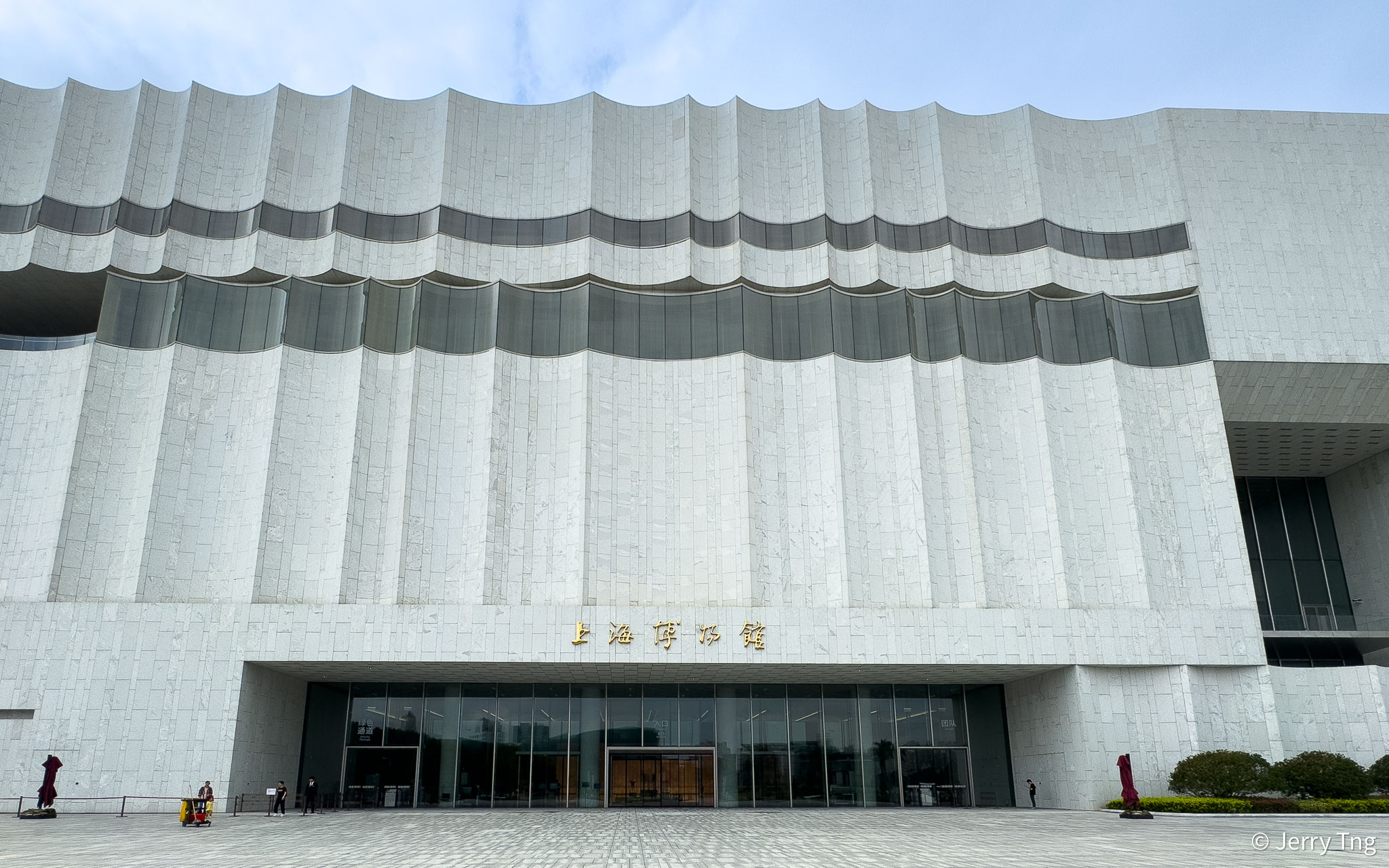
Shanghai Museum has one of the best collection of ancient bronzes from the Xia, Shang and Zhou dynasties. It used to be housed in the People’s Square location. They are now moved the brand new museum in Pudong.
Shanghai Museum East (SHMEast)


Shanghai Museum East (SHMEast), which opened in Feb 2024 is adjacent to the Shanghai Science & Technology Museum (still under renovation), the Shanghai Library East Branch, and the Shanghai Oriental Art Centre, turning this once deserted part of Pudong into a new cultural wonderland.

The massive grey building houses artefacts spanning over 33 categories, with a total collection exceeding 1.02 million pieces or sets, including nearly 145,000 precious artefacts. Covering an area of approximately 46,000 square meters, the building comprises six above-ground floors and two underground levels.

At the main foyer, there are three modern artwork sculpture that mimics the Chinese bronzes. Right behind the sculptures is the Chinese Bronze Galley 青銅館. Shanghai Museum has one of the best and most complete collections of Chinese bronzes in the world given its prominent (and notorious) position at the earlier part of 20th century as one of the most prolific trading centres of Chinese relics.
The Bronze Galley 青銅館

The Chinese Bronze Galley 青銅館 is the first gallery to open in the new museum and remains the highlight and most important gallery of the museum. During the construction period, some of the bronzes travelled to Shenzhen Museum for a short exhibition (which I promised to do a special blog about it but I procrastinated). But since its relocation here, the entire collection is back together again.
Plaque with Animal-mask Pattern Inlaid with Turquoise 镶嵌绿松石兽面纹牌饰

青铜器|夏代晚期(公元前18 世纪一前16世纪)|(左)长14.6厘米,重104克|上海博物馆藏
Bronzes mark the beginning of civilisation in ancient China. They epitomize the nobles’ reverence for rites. Bronzes are called “ritual vessels”, as they served as ceremonial offerings for gods or ancestors, official gifts for a mutual exchange, or utensils at banquets. Nobilities, according to their ranks, were entitled to possess bronzes of various types and sizes. Bronzes were an indispensable tool to consolidate the reign. They were a symbol of power.

Majority of the Shang Dynasty collection was from excavations that were carried out in Yinxu 殷墟 in Henan province in the 1970s which uncovered a lot of Shang bronzes from the royal tombs surrounding the once capital of Shang Dynasty. OF course the most famous tomb of them all is the tomb of the warrior queen Fu Hao 婦好, who was the wife of King Wu Ding 武丁 (r. c.1250 BC – c.1200 BC).

Another prominent Chinese bronze period is Zhou Dynasty. These were sought after by collectors all around the world, in particular museums and private collectors in Japan, US and Europe. Many of these Zhou Dynasty relics were recovered from overseas, primarily from generous donors from Hong Kong.
Zhong (percussion instrument) of Su, Marquis of Jin 晋侯苏钟

The gallery is still as comprehensive as before, but the user experience is much better as the space is expanded and the exhibitions are better grouped together based on their period and functions. The glass enclosure has been upgraded to a less reflective glass, and this is really evident in the photos taken here vs the old photos taken in the 2018 visit to the old museum.
The Seal Gallery 璽印篆刻館

This entire collection of Chinese seals 璽印 from different dynasties comes of a generous donation from Mr Li Yinxuan and Mdm Qiu Hui. Previously, it was just a small gallery in the old museum, which did not do justice to the collection’s depth and variety in representing all the different official seals that had been the testimony of history.
Seal with swirl pattern 涡纹玺1


Chinese seals 璽印 refer to those private and official ones that were primarily used for verification from the Spring and Autumn and Warring States periods (770-221 BCE) to the Republic of China (1912-1949). Bronze seals in the late Shang dynasty (ca. 1200-1046 BCE) had already taken on the mature form that we are familiar with today. From the Warring States period (476-221 BCE), seals extensively served as an instrument for verification in social life. The issuance of official seals gradually became associated with the centralized national administrative system. Official seals were seen as an embodiment of hierarchical status.
Jade Seal with Button Engraved with Double Chi (Dragon) 双螭钮玉押


Jade | Southern Song (1127-1279) | Shanghai Museum Collection.
玉器|南宋 (公元1127—1279年)|(印)上海博物馆藏
During the Qin, Han, Wei, and Jin dynasties (221 BCE-420 CE), seals had profound historical and artistic connotations. They laid the foundation for the aesthetic norms for seal engraving that later generations conformed to. In the Sui and Tang dynasties (581-907), the reform of the official seal system brought about new designs which were later imitated by other East Asian countries. Seals of the northern ethnic minority regimes were crafted with the scripts of Khitan, Xixia, Nüzhen Jurchen), Phags-pa and Manchu. They are an integral part of the Chinese seal culture.
Security seal of the eunuch on the emperor’s mandate to inspect the textile production of three provinces 钦差督理三省织务内官关防 万历三十二年(1604)

象牙|明(公元 1368 – 1644年)|上海博物馆藏
Contrary to popular belief that the Communist Party forced these rich people to give up their heirlooms to the state, many actually volunteered as they were entrusted and burdened by the forefathers, and believed that the State was in a better position to take care of these relics. There were many stories of these relic heroes protecting the collection from ending up in Japanese invaders’ hands, and when the war ended, they felt relieved and donated the collection to the new formed nation.
The Jiangnan Gallery 江南造物館

Jiangnan Weaving Bureau 江南織造2 is an official position during the Ming and Qing dynasties that were in-charged with all weaving and embroidery of silk products for the Imperial families as well as for exports. This is a new permanent exhibition that showcases the handicrafts and exquisite royal items from this bureau that used to run a huge number of silk mills in Jiangning (modern day Nanjing), Suzhou and Hangzhou.

Due to the rapid development of the three weaving bureaus in Jiangnan3, during the Ming and Qing dynasties, the court set up offices in Jiangning (now Nanjing), Suzhou and Hangzhou, which were mainly responsible for managing local textile affairs and supplying textiles and embroidery products to the court. They managed the work and production of employees at all levels, social order, tax collection, etc., and were equivalent to the modern-day state-owned factories, including management personnel, various expenses, profits and losses, all of which were borne by the state.

Jiangnan 江南, not to be confused with Gangnam in Seoul also the Hangul is the same, is a basic description for the area south of the Yangtze where the Jiangnan architectural style originated. It includes Shanghai and the southern parts of Anhui and Jiangsu provinces, along with northern Jiangxi and Zhejiang. I was surprised that they actually recreate an entire Jiangnan-style courtyard on the roof of the museum, from all the rooms to the gardens and galleries. Open when the weather permits.
Brocade robe with plum blossom patterns 满地黄梅朵花纹丝布夹袍
Mesh bun cover and related ornaments 银丝发罩及穿戴

As early as the Eastern Han dynasty (c. 2nd century AD), Jiangnan areas became one of the more economically prominent areas of China. Other than rice, Jiangnan produced highly profitable trade products such as tea, silk, and celadon porcelain. The wealth also brought upon higher expectations in fashion, food and living.

When it came to taste, Jiangnan had the final word. This was even truer in the sphere of high culture. Landscape painting, the tradition of which started in China in around the 7th century, found its ultimate expression in the vistas of Jiangnan’s water-rich scenery, which it in turn helped to eternalise.
Set of Wucai Plates With Flowers and Butterflies 景德镇窑五彩描金花蝶纹攒盘连盒

From a place of exile to a cultural and economic powerhouse, the influence of Jiangnan still echoes in China today.
Shanghai Archaeological Gallery 上海考古館

Another new permanent exhibition features the archaeological findings around Shanghai. Shanghai as a Chinese city is not really old, although there are more evidence that human habitation was way earlier. Archaeologists in Shanghai have recovered and reconstructed the 6,000-year-old history of Shanghai that spans from the Neolithic Age to the present day.
Scepter 象牙权杖


Ivory | Liangzhu Culture (c. 3400 – c. 2300 BC) | Shanghai Museum Collection, Unearthed in Fuquanshan site, Qingpu district in 2010. 象牙|良渚文化(公元前3400一前2300年)|上海博物馆藏,2010年青浦区福泉山遗址出图
Important discoveries in urban archaeology, including ancient tombs and architecture, have revealed the growth of urban areas in Shanghai since the Zhou dynasty. The urbanisation of Shanghai reached its peak during the Ming and Qing dynasties, forming the prototype for its later development into a modern metropolis.
Longping Temple Pagoda Plinth with Lotus Design 隆平寺塔基莲花石柱础

The modern city of Shanghai has its origin in Qinglongzhen 青龙镇 (today’s Baihezhen, Qingpu district). It is believed to be established during the Tang dynasty during the reign of Tianbao 唐天宝年间 (742-756 AD). According to written accounts, Qinglongzhen prospered from the beginning of the Northern Song dynasty and reached a peak during the Southern Song dynasty. In 1131 (绍兴元年), the imperial court set up a specialised institution 市舶务 to manage overseas maritime trade. Extensive amount of artifacts of the Tang and Song dynasties have been unearthed, including the plinth of the Longping Temple Pagoda, which was then a navigational mark.

As Jiangnan region prospered and Wusong River could not sustain the ever-growing trade that was happening between the region and overseas, an alternative route was required to support the trade. Huangpu River became the main waterway and has been that position since. Sedimentation at the Pearl Delta expanded the landmass outwards and formed what became the modern day Shanghai.
Zun (wine vessel) with thorn 青铜楸刺纹尊

Archaeology pieces together the shards of Shanghai’s urban scenery, interpreting the convergence and fusion of cultures across time and space. Whether it is to “prove” or “supplement” historical accounts, the fundamental purpose of archaeology is to perceive the essence of humanity within artefacts – that is to understand the past, enlighten the present, and inspire the future.
Architectural Marvel

Young designer and professor Li Li from Tongji University created an open design and the Tongji Architectural Design Co Ltd balanced the design with other cultural buildings in the neighbourhood. The new building features a simple and elegant rectangular form. Its marble surface symbolises the waves in the ocean, as Shanghai is a meeting point of land and sea and seen as a pioneer moving forward into the future. It has open balconies, terraces and gardens and streamline appearance.

The permanent museums also include
- Ancient Chinese Ceramic Gallery
- Ancient Chinese Jade Gallery
- Ancient Chinese Sculpture Gallery
- Chinese Calligraphy Gallery
- Chinese Numismatic Gallery
- Chinese Painting Gallery
About Shanghai Museum East

Individual visitors can enter the Museum with a valid ID (foreigners need passport) through the B1 East Gate (near Dingxiang Road) after security check; while groups reserved can enter through the North Gate (1F, near Century Avenue) after security check.
Opening Hours:
- Wednesday to Monday, 10:00-18:00 (last entry at 17:00)
Closed on Tuesdays (except national holidays)
Reservation for individual visitors is not required since 15 Sep 2024, but do check with the website as restrictions may be implemented any time.
Shanghai Museum East Gallery 上海博物館東館
1952 Century Avenue, Pudong New Area, Shanghai
上海市浦东新区世纪大道1952号
(Reservations)
Visited Oct 2024
Footnotes
- Chinese seals originated in the Shang dynasty. The prototype and production of seals were related to the patterns and inscriptions of bronze impression tools. This work shares the same pattern with the bronzes of the Shang and early Zhou periods and has important historical value. ↩︎
- 即江南三织造,是清代宫廷设在江宁(今南京)、苏州、杭州三处专为“上用”、“官用”制作绫罗绸缎的织造机构,直属清宫总管内务府管辖。我国自周代始历代都有专为皇宫营造服饰用品的机构。在江宁营建皇家织造始于元代,明、清两代沿袭。江宁织造是清顺治二年(1646年)清军占领江南后在明朝织造旧有的基础上建立起来的,后又陆续营建苏州织造和杭州织造。其官员全由皇帝亲自委派,多为亲信要员。开始为一年一更换,至顺治十五年(1658年)改为三年一轮换。https://www.dpm.org.cn/lemmas/243105 ↩︎
- http://www.360doc.com/content/19/0228/22/30696644_818235280.shtml ↩︎
Pingback: Treasures – Gilt Zhongs with Dragon Pattern (Qing Dynasty) – live2makan