
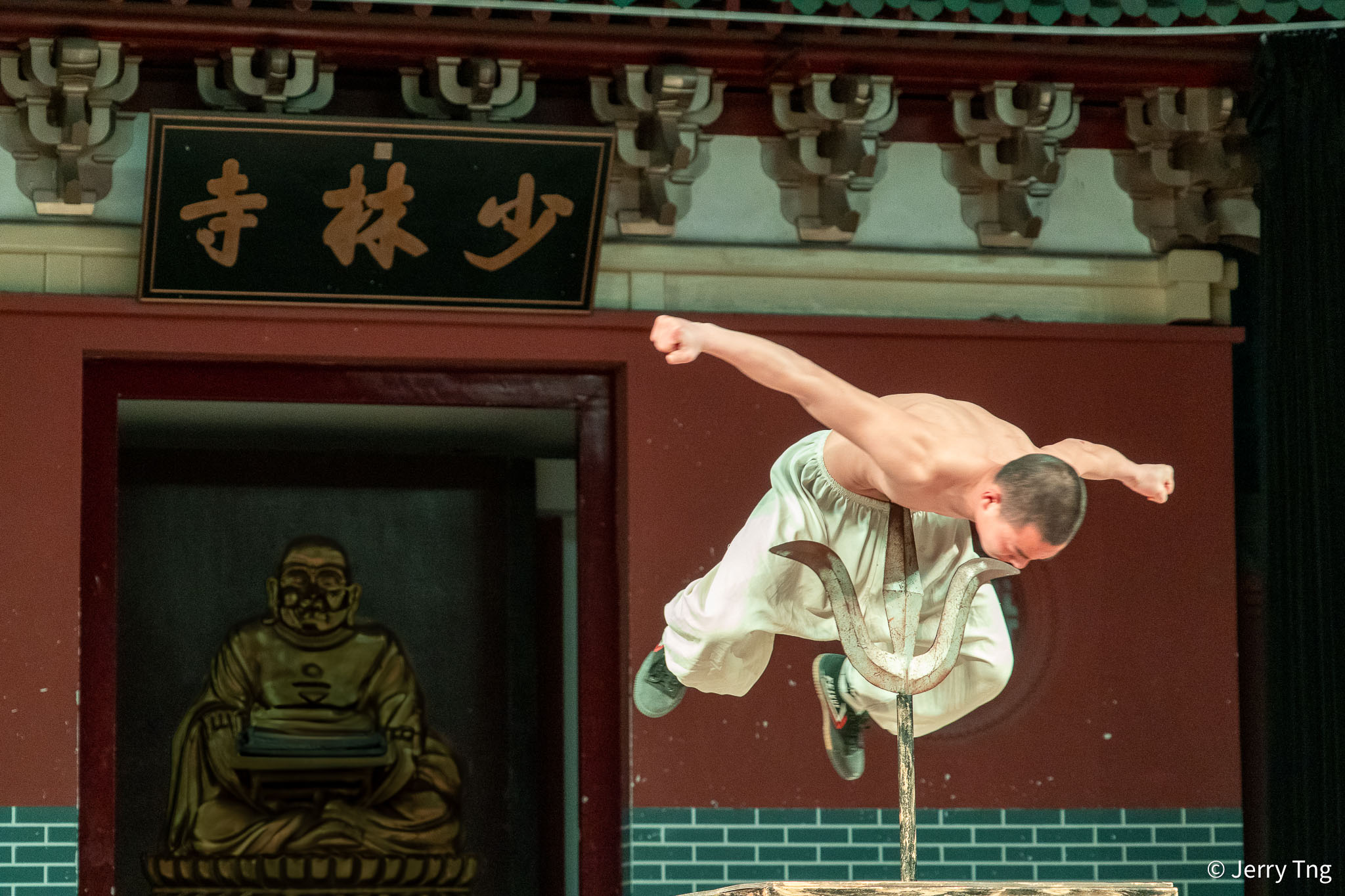
For most Westerners, Shaolin is synonymous with Kungfu. Rightfully so as Shaolin is considered the origin of many kungfu styles that followed.


When you enter Shaolin Temple (the monastery, not the kungfu school), you will come across two steles, one from the Taekwondo Association of Korea, and another written by publisher/novelist Louis Cha, aka Jin Yong 金庸. Many martial arts can trace their roots to the fists and breathing techniques developed by Damo, the founder of Shaolin Temple. And Mr Cha has written many stories surrounding Shaolin that we grew up and became familiar with Shaolin with.

Chinese martial arts, aka kungfu, have a long, colourful history that is almost as fascinating to learn about as performing the arts themselves but the history/legend of the origins of the martial arts in China all lead back to one common source, the Indian monk Damo.
Legend has it that Bodhidharma, aka Damo 达摩, appalled by the physiques of the monks in the monastery after he took over from , spent nine years meditating facing a wall in the cave. Returning to the Shaolin Temple, he taught the monks internal meditations as well as the Eighteen Arhat Hands 十八罗汉手, a series of eighteen external exercises.
This developed into Luohan Fists 罗汉拳, the more commonly known martial arts style still practised today. Damo also left two famous texts, the Yijin Jing 易筋经 (Muscle/Tendon Change Classic), which still survives today and the Xi Sui Jing 洗髓经, which has since been lost.1

Batuo 跋陀, the founder of Shaolin Monastery, had few disciples. However, two former generals, Huiguang 慧光 and Sengchou 僧稠, became his students and were the first to bring martial arts to the temple despite many who claim it was Damo who first introduced martial arts practice to unhealthy monks. In fact martial arts practice has been a part of Shaolin Temple from almost its beginning, so Damo is just a romanticised urban legend.2


The 21st century has come to the famed temple at the heart of Chinese kung fu, bringing with it a new wave of foreign interest from an unlikely quarter, and a growing debate domestically about what this means for the culturally iconic Chan Buddhist institution.

Today, Shaolin Kungfu is a multi-million business. Foreign businesspeople from many fields, and motivated professionals willing to fork out about $800 a month to learn and live at Shaolin.

Located next door to Shaolin, the Tagou Educational Group campus could be mistaken for part of the temple complex. Founded in 1978, Tagou’s schools now boast 32,000 students at several locations in China, providing “Shaolin style” wushu as a core syllabus subject for Chinese youths. Since 2007 it has also provided lodging and lessons for about 200 foreign students annually, at a rate of about $10,000 a year.
Every day, thousands of tourists throng the temple grounds, once a quiet retreat for 13 famous warrior monks who, legend has it, took down a despotic warlord and his army during the Tang Dynasty (AD 618-907). And one of the activities that these tourists will attend is the kung fu show that runs 5 times a day at the theatre next to the school.

One cannot but wonder if these young students are exploited to perform for us for a fee while they get nothing out of it. In the small city of Dengfeng at the base of Songshan mountain near Shaolin, more than 50,000 people train at 52 kung fu schools annually.

The current abbot Shi Yongxin says the temple’s growing connectivity with the modern world is about survival, and about spreading the benefits of Shaolin wushu to those who are seeking it, globally. On the ancient battleground, or in the modern boardroom, Shi says wushu is about more than physical prowess. It is about mental discipline and the Buddhist drive for constant self-improvement, personal and professional.3


Besides kung fu, you can also buy Shaolin medicines and sign up for meditation classes. I personally filled up with their cough drops (which became really popular during Covid) and their pain relief patches for sprains and muscle pains. Given the amount of injuries incurred from practicing wushu, these patches must be really effective.
Follow this link for an official video of Shaolin Temple and its martial arts.
Visited Mar 2024
Footnotes:
- https://whitecraneacademy.com/2013/04/02/a-brief-history-of-damo-and-the-origins-of-the-chinese-martial-arts/ ↩︎
- http://shaolinchancity.blogspot.com/2008/12/three-lineages-of-shaolin_11.html ↩︎
- https://www.chinadaily.com.cn/kindle/2014-08/25/content_18481558.htm ↩︎
0 comments on “Shaolin Martial Arts 少林功夫甲天下”