
Shenzhen is an amazing city in Guangdong Province in China. Bordering Hong Kong on the Western side, it is a long stretch of land that extends all the way the land border of Macau in the Eastern end.

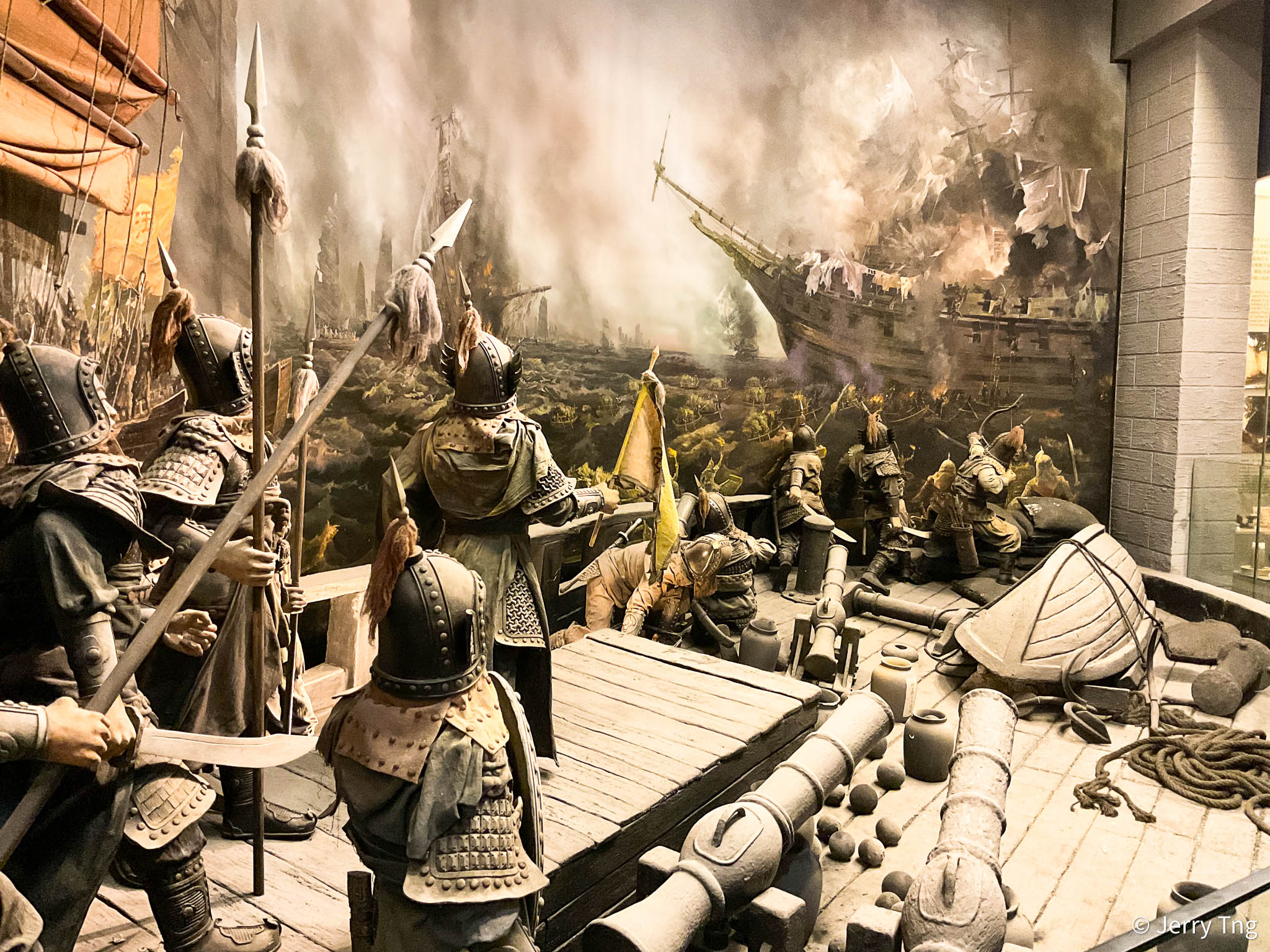
Shenzhen Museum of History And Folk Culture is one of the four museums under the Shenzhen Museum umbrella focusing on the sociology and history of the stellar development in this cosmopolitan city.
The Permanent Exhibitions
Ancient Shenzhen 古代深圳


Shenzhen sprung up like mushrooms after the summer rain, because of liberal economic policies which resulted in the Shenzhen Miracle. Shenzhen is not an ancient city like Nanjing or Beijing or Xian, where they have been past capitals of China. However many graves were turned inside out because of the development and many of these relics are now housed in Shenzhen Museum of History and Folk Culture.

Most of these Neolithic relics are fragments of pottery pots and utensils that have been reconstructed to represent their original functions. I would not been able to identify any of them even if I dig some out of the grave.

During the late Tang and early Song Dynasties, the Silk Road on land from Central Plains to the West were blockaded by the Tibetan Empire 吐蕃 (618-842 AD). Hence, an alternative route by sea was needed and with the advancement of navigation technologies, the coastal ports along Guangzhou were used for the “Porcelain Road” 陶瓷之路.

Porcelain was another major export to the outside world from Medieval China, besides silk and tea. The porcelain trade was increasing during the Song Dynasty, but they didn’t transport well on the land route of the Silk Road due to warring factions and the rather tough journey. The sea route was much more desired.
Folk Culture 深圳民俗文化

Every place has its own folk culture and customs, and Shenzhen is no different. Over the course of history when different people migrated to Shenzhen, the cultures crashed and merged, and a uniquely Shenzhen culture starts to emerge. The permanent exhibition seeks to present the different cultural influences to this melting pot.

The Shenzhen Folk Culture Exhibition 深圳民俗文化 is divided into four main sections, namely, Regional 区域, Cantonese 广府, Hakka 客家 and Maritime Folk Culture 海洋文化.


Full scale models depicting the different trades that flourished in Shenzhen in the different markets.

Since the 1990s, Shenzhen Museum has been spending efforts in researching the dominant folk cultures of Shenzhen and neighbouring regions, and accumulating folk cultural relics. Among those collected was an exemplary collection of golden varnished woodcarvings 金漆木雕 from Qing Dynasty 清朝 (1636-1912) and Nationalist 民国 (1912-1949) periods.

Culture and customs are something that you can never replace or forget no matter where you are. Even though the Chinese in Singapore have left the motherland for over two centuries, many customs were brought over and become rooted in the adopted lands.
Modern Shenzhen 现代深圳

Another permanent exhibition looks at the darkest history in the 19th and early 20th century of China and how it affected this “young” metropolis, an economic miracle that made Shenzhen one of the most successful cities in the world in terms of urban development.

On 15 Oct 1949, the People’s Liberation Army (PLA) conquered Huizhou. On 16 Oct 1949, when the Guangdong-Guangxi Column 两广纵队 took over Nantou. Considering that Shenzhen is an important border town to Hong Kong and abroad, in order to avoid conflicts with the Hong Kong and British authorities, the leaders of CPC ordered the troops to only go as far as Bao’an Buji 布吉. On 19 Oct 1949, the PLA changed their badges to People’s Police and took a freight train from Buji to Shenzhen and took over Shenzhen Market (Luohu) and Kowloon Customs.

Shenzhen’s Reform and Opening Up 深圳改革开放史

This exhibition takes the new period of China’s reform and opening up as the background. According to the economic and social development status of Shenzhen in the past 30 years

Shenzhen, one of the earliest Special Economic Zones (abbreviated to “SEZ”) in China, is like a magnificent pearl in the south. She was born in the expectation of reform and opening up, and grew up in the sunshine and rain of the China’s Miracle. She is used as the “experimental field” and “window” of reform and opening up, and spread her wings and soared by the east wind of reform and opening up.

Shenzhen’s development and achievements are a wonderful microcosm and vivid reflection of China’s historic changes and great achievements since the reform and opening up. With her continued economic and social success, Shenzhen has shown the world the vigour and bright future of socialism with Chinese characteristics.
Taxidermy Exhibits


Situated right at the main lobby of the Shenzhen Museum are two huge specimens of an African elephant and giraffe. They are not made from fibreglass and are real stuffed animals donated by Kenneth E. Behring.

He was also famous for his collection of taxidermy animals which he generously donated to museums around the world, including the Smithsonian. This collection was mainly from his donation.
Shenzhen Museum of History and Folk Culture
Shenzhen Museum 深圳博物馆 was founded in 1981. It consists of 4 museum sites including Shenzhen Museum of History and Folk Culture 历史文化馆, Shenzhen Museum of Ancient Art 古代艺术馆, Dongjiang River Guerrilla Command Headquarters Memorial Museum 东江游击队指挥部旧址 and Shenzhen Reform and Opening-up Exhibition Hall 深圳改革开放展览馆.

Located in Shenzhen Civic Center, the Shenzhen Museum of History and Folk Culture, opened in December 2008, takes up 12,500 square meters of land, and covers a construction area of 33,600 square meters.


The exhibition building has a total of 3 floors, including 5 basic exhibition halls and 2 special exhibition halls, with an exhibition area of more than 10,000 square meters. The ground floor is a storehouse of cultural relics. In addition, the exhibition building also has multi-functional report Hall, VIP Hall, teahouse, souvenir shops and other ancillary service facilities.
Shenzhen Museum of History and Folk Culture 深圳博物馆历史文化馆
广东省深圳市福田区福中路市民中心A区
Tel: +86 (0755) 8812 5550
Opening hours : 10:00~18:00
Visitors are not allowed to enter the museum after 17:30. Closed on Mondays. Open during major festivals and closed the first day after major festivals. Foreigners must bring the passport to gain entry.
Visited in Jan 2022
0 comments on “Shenzhen Museum of History And Folk Culture”