
Thanks to its talented culinary director, Richard Ekkebus, two-Michelin-starred Amber offers one of the best dining experiences in Hong Kong. His contemporary French cuisine (with Asian notes), exquisitely plated, is a favourite of numerous legendary chefs when visiting Hong Kong.

Since its launch, Amber has challenged the status quo of fine dining in Hong Kong and beyond, attracting a global audience of discerning gourmands for its innovative approach to French cuisine. Culinary Director Richard Ekkebus and his team continue to redefine cuisine for a modern audience, with consciously sourced ingredients whose innate flavours and nourishment are celebrated through a foundation of French technique.

In the elegantly composed dining room created by renowned New York firm Tihany Design, Dutch-born chef Richard Ekkebus’s restaurant has undergone a radical revamp. The bright space is characterised by organic curves, luxury materials and a gold and beige colour palette.

Its most recent evolution has ushered in a new era of responsible contemporary dining, with a thoroughly reimagined dining experience, recognised for 16 consecutive years two Michelin-stars and The Michelin Green Star since 2022.


The menu is dairy-free and less meat-centric, uses local organic produce, as well as sustainably harvested seafood, and Fair Trade agricultural commodities. Amber works with manufacturers to develop plant-based alternatives for plastic products. An anaerobic digester system has been introduced to process food waste, while other materials are recycled.

I asked if Chef Richard is lactose intolerant, which the waiter explained that he purposely chose to leave out diary in his cooking as most Asians are more susceptible to lactose intolerance so as to provide a more soothing dining experience. I didn’t think of that angle.
Winter 2024 Full Amber Experience (Lunch)
Amuse Bouche

The first amuse bouche looked like Peranakan kueh pie tee. An excellent one bite (or two) that consists of ocean trout is cubed and mixed with salmon roe (Ikura) and flavoured with fresh horseradish and sprigs of lemony dill, housed in a ship-shaped seaweed cracker. Ocean trouts are similar in taste to Atlantic salmon but it has a more subtle flavour and less salty. They are an oily fish with a firm rosy pink/orange flesh and make excellent tartare.

The next amuse bouche I truly enjoyed, the “panna cotta” that was made with macadamia nut oil instead of cream, and topped with herring roe with lemongrass jelly on the bottom.

You don’t need the expensive sturgeon caviar to make such a delicious appetiser. The herring roe and lemongrass combination was perfect. Although the panna cotta was more tauhua (beancurd pudding) like, it was really tasty. Not sure why it was not on the main menu.
Alaskan King Crab ˚ Salt Tomato ˚ Espelette Chili ˚ Extra Virgin Olive Oil ˚ Uchibori Vinegar ˚ Ginger ˚

The first course of the degustation menu featured the Alaskan king crab, hiding under a salted tomato crust. To get to the crab, you need to crack the crust like a creme brûlée. Besides the risk of getting cut by the sharp crust, there’s some tiny bits of crab shell that may be left from the shelling process, so we were warned.

Other than these inconveniences, this appetiser hit all the spots with the mix of sweet, sweet crab meat with a little spice from the Espelette pepper, the balance of the seafood with ginger and rice vinegar from Uchibori in an espuma held together by olive oil.
Aka Uni ˚ Cauliflower ˚ Lobster ˚ Royal Cristal Caviar ˚ Acipenser Schrenckii X Huso Dauricus ˚

Amber came to fame over a decade ago with this sea urchin dish, which features the underwater delicacy from Hokkaido coddled in a jacket of lobster jello, atop a bed of cauliflower cream and accompanied on the side by a paper-thin seaweed chip. The chip tasted like one of those Japanese rice crackers.

As if it was not complex enough, a generous half sphere of Royal Cristal caviar from Zhejiang, China was topped onto the sea urchin and then decorated with gold foil. It was temporarily discontinued in 2016 until it was brought back in the degustation menu by popular demand.

The caviar had a strong creamy nutty flavour with long after taste. The final result was nothing short of phenomenal, somehow managing to perfectly encapsulate the taste of the sea without feeling like we were swilling our mouths with saltwater.

After the stunning sea urchin course, we were invited into the kitchen for the next course. Called the kitchen experience, you eat the next course served directly by the chef while looking at the rest of the action in the busy kitchen.

As we settled down at our place at the table, we were poured a special non-alcoholic cocktail made from carbonated pu-er tea and apple juice.
Normandy Scallop ˚ Salt-Roasted Celeriac ˚ Scallop Garum ˚ Périgord Black Winter Truffle ˚ Toasted Hazelnut Butter ˚

This course is hand-dived Normandy scallops, cooked inside its shell. Hand diving for scallops is a sustainable method of fishing; the diver hand picks the scallops from the seabed leaving the smaller undersized scallops to grow and spawn. There is no waste or bycatch from trolling.

Despite the theatricals and rare experience of watching the kitchen in action, I felt that the course would be better served at the table. The distractions of the kitchen activities were unfair to the beautifully executed scallops steamed in its own juice and served on a bed of mashed smokey celeriac. How the two were sealed together was a mystery. The dish was properly complete with the black winter truffles.

After we finished the kitchen experience, we were escorted back to our table. Overall it was simply theatrics and the course would still taste the same at the table. At this point, the server brought some gluten-free bread made from quinoa flour. It tasted like a Sara Lee pound cake without the sugary taste.
Chicken ‘Sot-l’y-laisse’ ˚ Red Abalone ˚ Sugar Pea ˚ Seaweed ˚ Plankton ˚ Oyster Leaf ˚

This course is a very busy plate of many rare and delicious ingredients, like spirulina, umi-budō (meaning “sea grapes”, type of seaweed), red abalone, and a mushroom/oyster tasting leaf that is simply called oyster leaf. The only cheap ingredients were the chicken and sweet peas. Sot-l’y-laisse is a cut of meat from a bird, usually a chicken, that’s located on either side of the backbone more commonly known as the chicken oysters. It is simply a juicier and more flavourful piece of dark meat.

On hindsight, this was my favourite because of the sweetness of the peas, as well as the juiciness of the grilled chicken oysters that went so well with those umami laden flavours from the seaweed and algae. The abalone was tender but I wished for chicken.
Roe Deer Loin ˚ Neck & Foie Gras a la Royal ˚ Beetroot ˚ Mas A Miel ˚ Plum ˚

Game season is the most exciting part of winter as it means that I would be able to get these wild games for meat. Game cooking takes skill that is unfortunately vanishing, as well as disappearing from the menu as the younger and so-called WOKE generations find hunting inhumane.

Roe deer is one of the two native species of deer in UK, and most areas of Europe. The buck meat is usually available in winter. One of the gamiest deer, this wild venison is sweet but has a wild flavour. The Roe deer is a browser, living off a huge variety of plants and flora, which affects the flavour depending on region.

Nothing is wasted, the neck meat is used to make into a medallion and the liver was properly pan fried and both were liberally drizzled with a au jus reduction spiked with cognac from Mas Amiel and plum juice. Served with a beautiful rose of boiled beetroot and poached plums in cognac.

Chef Richard is a keen advocate of game cooking, which he learnt from the absolute maestro Robert Kranenborg. Good game meat is often hard to source in Asia, and difficult to manage for its strong taste and really lean meat. And the younger set is not accustomed to the traditional game food. He is working hard on an education project where the “craft” of serving game meat will be continued.
Wagyu ˚ Braised Rib Cap & Oxtail ˚ Swiss Chard ˚ Button Mushroom ˚ Crosne ˚ Home-made Beer Vinegar

Darling picked the supplement of wagyu beef that came with two perfectly cooked medium-rare Kagoshima A5 ribeye. The trimmings were combined with oxtail and braised in red wine and then wrapped in softened Swiss chard. Served with boiled button mushrooms that tasted like the Meilin canned version and pickled crosne (Chinese artichokes) and parsnip mash, and topped with beer vinegar sauce.

No longer satisfied with classic butter-laden European-style tasting menus, the new Amber remains an Asian-inspired contemporary French restaurant but now serves dishes that are both dairy free and gluten free. Nut milks and plant-based oils are used and there’s also more of a focus on vegetables.

We ordered our double espressos and looked forward to the dessert, and wondered how they would achieve that without cream or butter.
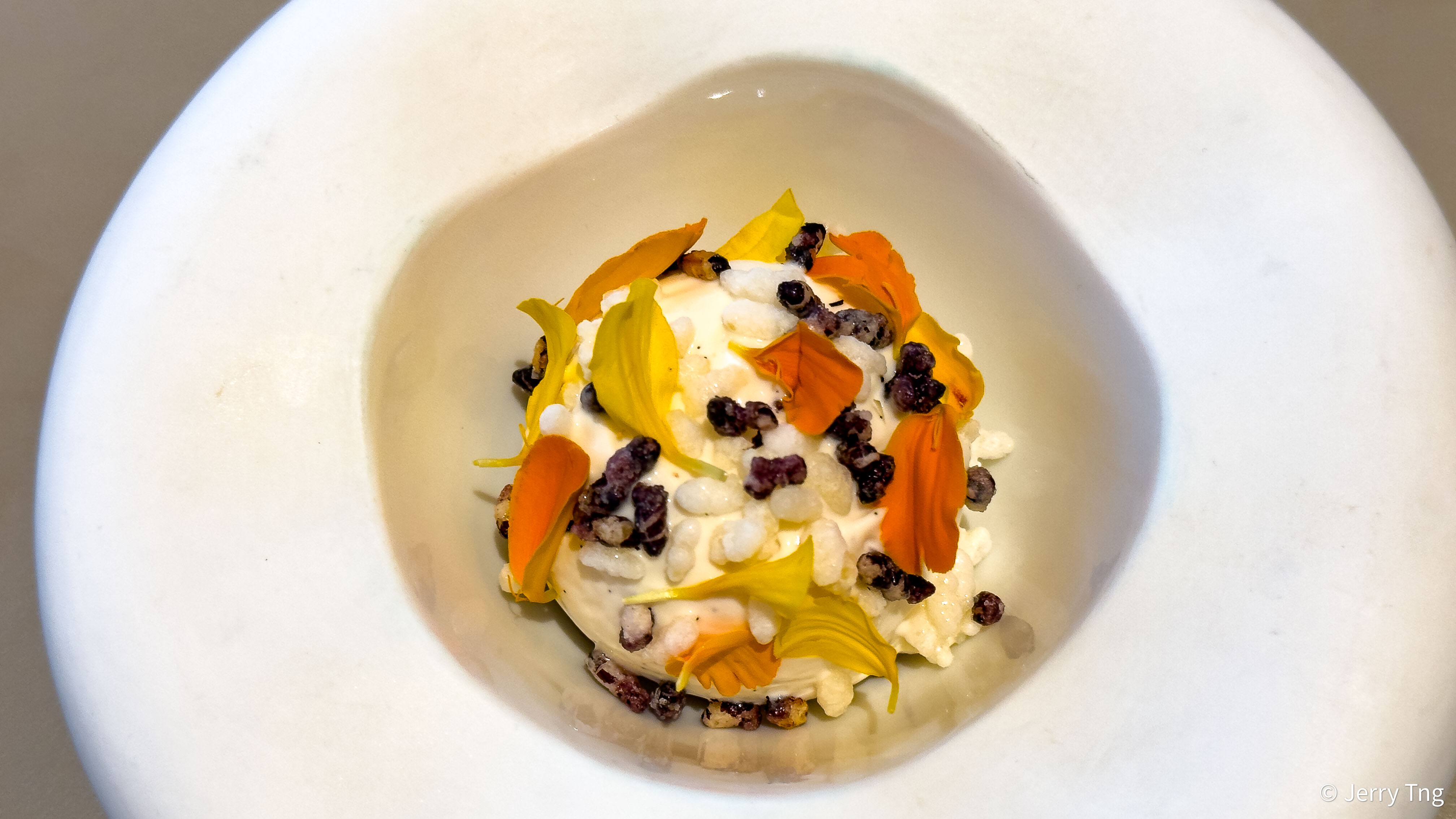
Persimmon ˚ Isesou Miyako Malted Koji Rice ˚ Sake Leese ˚ Kuromai Black Rice ˚

I ordered the seasonal persimmon dessert which did not look anything like a persimmon until you dig deeper into it. The white stuff looked suspiciously like cream, topped with popped Koji rice and black rice.

I was expected dried persimmon as they are easier to manage in a Western dessert. Au contraire! The delicate fresh fruit is enchased in a mousse made from sake leese, a white gooey by-product of sake making, and still packed with lots of the sake flavours and a little bit of the the alcohol. Absolutely innovative and delicious.
AN Soy ˚ Tofu Skin ˚ Sugar Cane ˚ Bourbon Vanilla ˚ Pitaya ˚ Macadamia Nut ˚ Sea Salt ˚ Extra Virgin Macadamia Oil ˚

Darling picked the soy bean pudding with a quenelle of natural bourbon vanilla ice cream made with macadamia nut oil instead of heavy cream. Served with balls of pitaya a.k.a. dragonfruit on a bed of sweetened beancurd skin. Very light and delightful dessert, no burden on the body at all.
Petit Fours

And just when we thought we couldn’t possibly take on more food, here comes the petit fours.

The first mini bake was the chocolate tartlet made with the same chocolates as their dessert. Instead of a butter cream, coconut cream was used. The base tasted like Orio, but nothing else did.

These delicious, scallop-shaped delights were buttery and light as air, except that these Madeleines were made with quinoa flour and without butter; olive oil was used as substitution. The use of Okinawa brown sugar gave it a smokey taste with a natural sweetness that can only be from that particular sugar.

And then something healthy, a trio of luxurious fruits from all around the world – Reunion Island pineapple, Australian cherry, Japanese strawberry – all of them in season. So the Green star only takes into consideration the full use of the ingredients, but not the carbon footprint.

Finally, a fruit cocktail made with green apple and Peckham pear infused with “monkey picked tea”. Years before tea became a go-to beverage in Europe and North America, Chinese tea merchants created the myth of “Monkey Picked Tea.” Chinese tea merchants dealing in Wuyi Mountain oolong tea 武夷烏龍茶 often label their teas “monkey picked” to signify the high altitudes it grows on and its rarity. Refreshing end to the meal as we foot the bill.

The ambience is luxurious, the service faultless, and the wine list impressive although I skipped wine for the lunch. Not heavily promoted, but a favourite of Hong Kong gourmands and regulars, it is only a matter of time before the restaurant is awarded a much-deserved third Michelin star.
Amber
7F The Mandarin Oriental, 15 Queen’s Road Central, Hong Kong
Tel : +852 2132 0066 (Reservations)
Visited Dec 2024
Michelin Hong Kong Guide 2 Stars 2008-24, Green Star 2022-24
#amberhk @mo_landmarkhk @landmarkhk #LandmarkMandarinOriental #LMOinCentral @michelinguide @lesgrandestablesdumonde #amberlicious #cleanamberflavours #essentialcooking #michelingreenstar #michelingreenstarhk#michelinrestaurant #foodgasm #chef #foodstagram #food #michelinstar #chefsroll #foodporn #foodie #gastronomy #foodlover #hongkongfoodie #chefslife #theartofplating #finedining #cheflife #foodart #michelin #chefstagram #restaurant #michelinguide #foodphotography
0 comments on “Amber @ Hong Kong”