
In our last instalment of the Beihai Park series, we take a look at the remaining scenic spots in Beihai Park focusing mainly on the Western Foothills.
Landscape of the Western Foothills 西麓景观
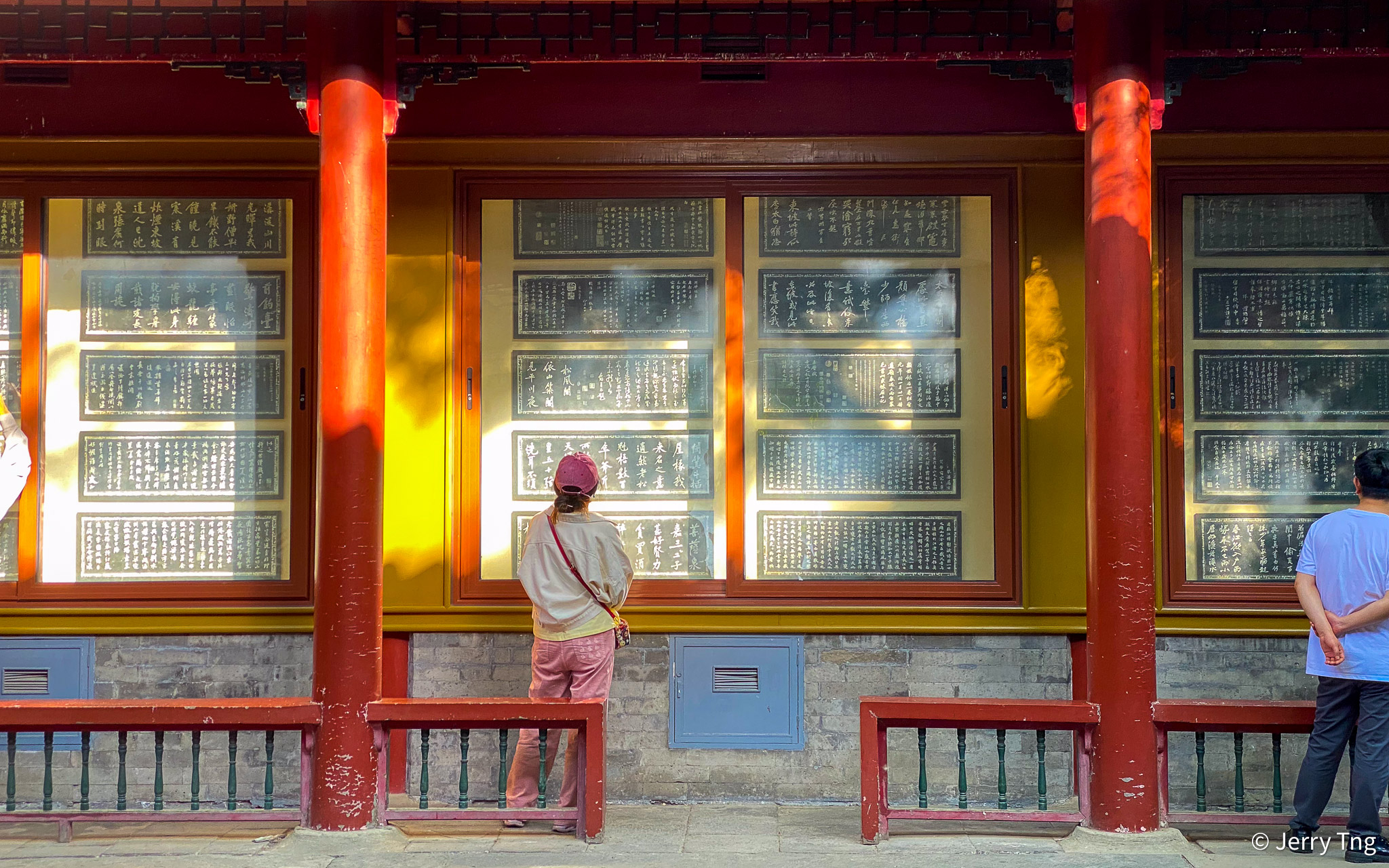
Classics Reading Cloister 阅古楼


The cloister is a two-story structure, with 25 columns on each floor. and was completed in 1747 on the order of Emperor Qianlong. These engraved stone tablets are valuable as they represent the crème de la crème of Chinese calligraphic art.


Built in 1753, it houses a total of 495 stone tablets bearing the inscriptions taken from the Model Books of Calligraphy from the Hall of Three Rarities 《三希堂法帖》, which is an imperial collection of famous calligraphic pieces from the Three Kingdoms Period to the Ming Dynasty (220-1644).


The building is constructed as a semicircular, two-storey structure and consists of 25 columns (Jian 間) on each floor.1


But what you see today on the first floor are replicas of the original as the originals are moved to the second floor for better preservations. Many of these carved stones are one of a kind as the original calligraphy has been lost in the annals of history.


The full name of the Model Books of Calligraphy from the Hall of Three Rarities 《三希堂法帖》is 《三希堂石渠宝笈法帖》, named after the Forbidden City index of precious oddities and treasures called Index of the Stone Moat《石渠宝笈》. The stone moat refers to Western Han dynasty imperial library that was protected by the stone moat against fire. The ruins of this imperial library is found in modern day Xian. 2


Linguang Hall 琳光殿


This is one of the Buddhist temple hall mentioned in inscriptions of the White Dagoba stele 《白塔山记》 by Emperor Qianlong, ” Walking downhill from Shuijing Wall 水精域 (Wall of the Old Wall) is Ganlu Hall 甘露殿 (Hall of Sweet Morning Dew), and downhill from Ganlu Hall is Linguang Hall 琳光殿 (Hall of Light of Buddha); beyond that it is a flat walkway.”3 These three buildings form a straight line from the western elevation of White Dagoba hill.
Room of Scaling Sky and One Room Hill 蟠青室、一房山

South of Linguang Hall is Room of Scaling Sky (Panqing Room) 蟠青室 and One Room Hill 一房山. Originally built in 1752, the two buildings are built on an elevated platform and surrounded by a hallway that’s 36 columns long. 4
Three-fold Jade Belt Bridge 三折玉带桥

On the west side of the Room of Scaling Sky is the Three-fold Jade Belt Bridge 三折玉带桥 that was built in 1752 too. The unique thing about this bridge is that it is not straight but zig-zag with an arch in the middle. Because of the arch, it was nicknamed Luoguo Bridge 罗锅桥, after the famed official Liu Luoguo 劉羅鍋 during Qianlong reign who has pronounced hunchback.
Inland Pond 内湖

The bridge arches over an Inland Pond 内湖 that is connected to the main Beihai Lake through the small inlet under the bridges. It was a cesspool according to old photos, but it has been refurbished into a koi pond.
View of Penghu Pavilion 蓬壶挹胜亭


The original pavilion5 was built in 1773, but was destroyed don’t know when. This exact replica was built on the original foundation based on drawings left behind. The pavilion is hexagon shaped with protruding eaves. The east side features an artificial mountain stacked using Taihu stones. And at the top of the hill is Cloud Embracing Pavilion 意远亭. 6
Stele of Jade Islet in Spring Shade 琼岛春阴碑


The Northeast hillside of the island is one of the eight scenic spots of ancient Beijing “燕京八景”. And to commemorate this view, Emperor Qianlong had this stele placed here in 1751. He renamed the view from “Spring Clouds” to “Spring Shades” and had the pedestal of the stele carved with Rain Seeking Gods, making this east facing stele a prayer to the gods for rain.7


At the foot of hill which the stele stood that was stacked using Taihu stones are two coiled dragons in lotus basins that were badly damaged by the elements and had to be protected using a glass hood. Although the period of these carvings were unknown, but it was moved here from other places.
Temple of the Goddess of Silk 先蠶殿

This is not along the slops of the Western Foothills but located near the North Gate of the Park. This place is now a functioning kindergarten for the toddlers of the cadres of the Communist Party. Closed to visitors, and highly secured as the family members of the officials are also protected by the State. Love this shot as the child on the outside is from an ordinary family enjoying a sunny afternoon in the park, and behind the big red gates are her peers that would one day rule over her.


Along these pathways, the ordinary Beijingers and other tourists enjoy a leisurely weekend afternoon, taking in the sights that once was the privilege of the ruling class. Since the founding of the Republic of China, and then People’s Republic of China, these once forbidden grounds remain open for everyone to enjoy. And with the current administration, the park was thoroughly refurbished to its former splendour.

China has come a long way and it is silly for us as bystanders to comment if they should be democratic or otherwise. Every nation on this planet has a right to its path of nationhood and who are we to judge if they are the best for them.
(This post was completed on the eve of Singapore’s parliamentary elections)
About Beihai Park 北海公园

Beihai Park 北海公園 was originally Beihai 北海, or North Sea, of the “Three Seas of the Imperial Western Gardens” 西苑三海 of the Ming and Qing Dynasties. It is located within the Imperial City, northwest of the Forbidden City, and was the royal garden only for enjoyment by the royal family of the Liao, Jin, Yuan, Ming and Qing Dynasties, spanning across a period of almost a thousand year. In 1925, it was opened to the public as a park.


First built in the 12th century, Beihai is among the largest of all surviving Chinese gardens and contains numerous historically important structures, palaces, and temples. The present park has an area of around 71 hectares (180 acres) with a lake that covers more than half of its area.
At its centre is Jade Flower Island 瓊華島/琼华岛, whose highest point is 32m. The park’s lake is connected at its northern end to the Shichahai 什刹海 (a nightlife area of pubs and restaurants around the lake) and to Zhonghai 中海 (where the central government of China operates and closed to public) to the southern end.
As with many of Chinese imperial gardens, Beihai was designed to imitate renowned scenic spots and architecture from various regions of China, particularly Jiangnan around the Yangtze Delta. Various aspects of the park evoke the elaborate pavilions and canals of Hangzhou and Yangzhou, the delicate gardens of Suzhou, and the natural scenery around Lake Tai with its famously porous stones. Beihai Park itself is now reckoned one of the masterpieces of Chinese gardening and landscaping.

The park is opened all year round, and can be accessed from four gates, two on the southern end (West and South gates), one in the north (North gate) and one on the east side (East gate). The park would need at least 4 hours to see everything.
Opening hours for the park are 6am – 9pm (peak season, Apr-Oct), 6.30am – 8pm (off peak, Nov-Mar); Opening hours for the attractions are 8am – 6pm (peak season), 8.30am – 5.30pm (off peak)


Visited May 2023
Footnotes:
- 走进阅古楼,从院内看两层的阅古楼均有内围廊,共25间,左右围抱相合。https://zhuanlan.zhihu.com/p/548783008 ↩︎
- 那么为何取名《三希堂石渠宝笈法帖》呢。乾隆时期编纂了一本记录朝廷收藏的精品书法绘画资料目录——《石渠宝笈》,其内记载了一万多件珍贵作品的资料。“宝笈”意指珍贵的书籍或者记录宝物的大账本。而“石渠”出自西汉时专门供皇家藏书的“石渠阁”,其周围环绕着一条用石头垒起来的水渠,由此得名“石渠阁”。建这条水渠,就是为了在藏书之地遭遇火灾时,以水灭火,能及时保护和拯救珍贵的藏书。石渠阁遗址,在西安市未央区未央宫遗址北边。https://zhuanlan.zhihu.com/p/54878300 ↩︎
- 在乾隆帝御笔的《白塔山记》里(这部白塔山记可拍下了1个亿,创了书画作品拍卖
的记录)这样写道:“水精域之下为甘露殿,又下为琳光殿,则就平路,为山西之路。” https://wenku.baidu.com/view/84145332497302768e9951e79b89680202d86b72.html?_wkts_=1740989169996&needWelcomeRecommand=1&unResetStore=1&ILK=17409891-0591-0684-0626-756130765384 ↩︎ - 琳光三殿以南,庆霄楼以西的就是蟠青室、一房山,原建于清乾隆十七年(1752年)。两建筑位于高台之上,由三十六间游廊环绕,自成一体。1901年摄,蟠青室、一房山已经破败不堪,环抱的游廊都已无存,从而可以清楚的看到蟠青室屋顶特色:西面歇山顶,东面硬山顶。https://zhuanlan.zhihu.com/p/548783008 ↩︎
- 字詞:蓬壺,注音:ㄆㄥˊ ㄏㄨˊ,釋義:傳說海中仙山蓬萊,形如壺器,故稱為「蓬壺」。元.湯式〈天香引.望三山〉曲:「望三山遠似蓬壺,捱到如今,提起當初,檳榔蜜涎吐胭脂。」https://dict.revised.moe.edu.tw/dictView.jsp?ID=24263&la=0&powerMode=0 ↩︎
- 蓬壶挹胜亭原建于乾隆三十八年(1773年),早已毁,只存基座。后1993年在基座上,依原式复建。亭子为灰筒瓦六角攒尖顶,砖雕宝顶,背倚虎皮石墙。亭东有大量太湖石堆叠成山,山上就是永安寺部分的意远亭。https://zhuanlan.zhihu.com/p/548783008 ↩︎
- 后乾隆帝重新更定了“燕京八景”,改“琼岛春云”为“琼岛春阴”,并立琼岛春阴碑于琼岛东部,三首御制诗所共同表达的,除了对眼前景色的欣赏,心之所系均为农桑稼穑之事,春阴祈雨重农耕,此乾隆御碑之意。加之御碑浮雕押鱼和须弥座束腰部分的主尊雨神计蒙的充分展现,那么“琼岛春阴”碑除了用以形容琼岛之景色,也是一尊面东而立的祈雨碑。https://zhuanlan.zhihu.com/p/383396624 ↩︎
0 comments on “Beihai Park – Landscape of the Western Foothills 西麓景观”