
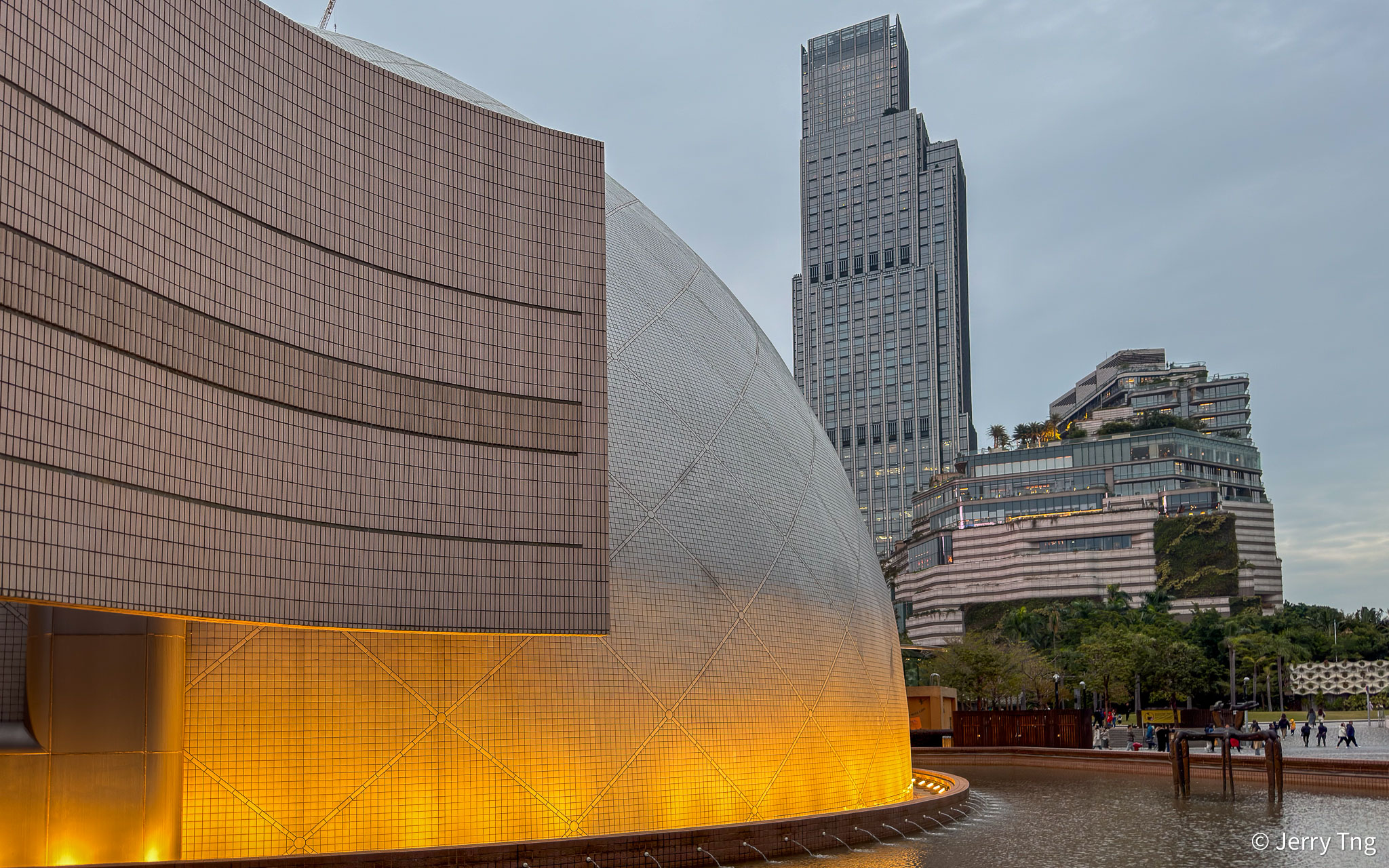
This was my favourite museum when I was little as I had aspiration to be an astronomer.

The Hong Kong Space Museum is a public astronomy and space science museum located in Tsim Sha Tsui, Hong Kong. Opened on 8 October 1980, it is notable for its hemispherical shape, which contains a planetarium. I visited the museum when I was 10 years old, and at that time it was the most advance planetarium in the eastern world.

The Hong Kong Space Museum aims to popularise astronomy and space science through various exhibits and facilities, including the Space Theatre and different halls showcasing space exploration and technology.

The Museum comprises two wings – east and west. The former, the planetarium’s nucleus, has an egg-shaped dome structure. Beneath it are the Space Theatre, the Hall of the Cosmos, OMNIMAX projector room, workshops and offices.

The west wing houses the Hall of Space Exploration, the Lecture Hall, the Gift Shop and offices. The Museum has two thematic exhibition halls: the Hall of the Cosmos and the Hall of Space Exploration on the ground and first floors respectively. The exhibits, predominately interactive, enable visitors to learn through a series of entertaining and educational experiences.


The exhibits had been updated to focus more on the Chinese space program instead of NASA. The original moon rock that was collected from one of the Apollo mission is the only display from that era.
Hall of the Cosmos

This is not the same permanent exhibition that I saw many years ago, although a lot of the content is similar. The hall was refurbished and updated in 20182, and reopened as the Hall of the Cosmos.

I read a lot of books about astronomy and understood at a young age that the moon is a satellite of the earth, and that Jupiter had 13 moons. Today, many of these “facts” have been debunked – to date, Jupiter has 95 moons3, and Pluto is no longer a planet.

The James Webb Space Telescope (JWST), is NASA’s flagship infrared space observatory, and a joint international project with the European and Canadian space agencies.It’s designed to study every phase of cosmic history, from the first luminous glows after the Big Bang to the formation of galaxies, stars, and planets. Webb’s infrared capabilities allow it to see farther and deeper into space than previous telescopes, including the ability to observe the earliest galaxies and stars, and to study the atmospheres of exoplanets.

Unlike visible light telescopes, Webb primarily observes in infrared wavelengths, allowing it to see through dust clouds and detect the redshifted light from distant objects. Webb’s primary mirror, which is over two stories high and was folded origami-style for launch, is the largest ever sent into space.

Black holes are regions in space where gravity is incredibly strong, so much so that nothing, not even light, can escape. They are formed when massive stars die and collapse, or possibly through other mechanisms not yet fully understood. The boundary around a black hole where this escape is no longer possible is called the event horizon.

The Doppler effect is the change in frequency or wavelength of a wave for an observer who is moving relative to the wave source. When a light source is moving towards an observer, the light waves are compressed, resulting in a higher frequency and a shift towards the blue end of the spectrum (blueshift). Conversely, when a light source moves away, the light waves are stretched, resulting in a lower frequency and a shift towards the red end of the spectrum (redshift).

Sagittarius A*, abbreviated as Sgr A*, s the supermassive black hole at the Galactic Center of the Milky Way. On May 12, 2022, the first image of Sagittarius A* was released by the Event Horizon Telescope Collaboration. The image, which is based on radio interferometer data taken in 2017, confirms that the object contains a black hole. This is the second image of a black hole, and took five years of calculations to process.

When I was staying in Hong Kong, I had the joy of observing a meteor shower despite all the light pollution of the City of Lights. Hong Kong residents can observe several meteor showers in the coming months in 20254. Key showers include the Perseids (July 17 – August 24, peaking around August 12), Geminids (December 4-20, peaking around December 14), and Leonids (November 6-30, peaking around November 17-18). The best viewing times for these showers are generally during the late evening and early morning hours of their peak dates, away from city lights.
Hall of Space Exploration

I have dreamt to be an astronomer, learning about the stars and planetary phenomena in the cosmo. But my generation grew up with the lofty aspirations of the Cold War, with the US and USSR rushing to get the first of everything. First man-made satellite Sputnik, USSR-US 1-0, first dog in orbit Laika, USSR-US 2-0, first man on the moon Neil Armstrong, USSR-US 2-infinity and beyond. And after that the sky is dominated by US and NASA.

The first crewed lunar landing occurred on July 20, 1969, in the Apollo 11 LM-5 Eagle. Four days later, the Apollo 11 crew in the command module Columbia splashed down in the Pacific Ocean, completing President John F. Kennedy’s goal: “…before this decade is out, of landing a man on the Moon and returning him safely to the Earth”.

occupied for about 24 weeks between May 1973 and February 1974.
Then came a decade of space explorations fuelled by sci-fi movies intergalactic themes like Star Wars and Star Trek. The rest to put man in other planets and to “to go where no one has gone before” became mankind’s common mission. US put the first space station in orbit, making long missions in space a reality.

In the weightless environment of space, astronauts lose muscle and bone since it is not required to support their weight. Astronauts spend about an hour a day doing cardiovascular exercise and an hour doing exercises for strength training. They use a cycle machine, a treadmill and a resistive exercise device which mimics weightlifting on Earth. Their blood would carry less oxygen, thus reducing their capacity to work.

In the space race, it has become a practice to name their spaceman and woman according to their language. US has her astronauts, USSR (Russia) has her cosmonauts, and China has her taikonauts. Yes, China joined the exclusive club of nations that have sent people in their own spacecraft on 29 November 2022, with the launch and docking of Shenzhou 15 (second rocket from right) with the Tiangong space station5.

It’s cramped inside a launch capsule. They must be as small as possible to save weight. Most capsules are bell-shaped with the bottom covered with an ablative heat shield. After a flight, the capsules return to Earth bottom first. Friction with the atmosphere heats up the heat shield and the material gradually burns away. The change of phase from solid to liquid and then to gas absorbs heat and the gas taking heat away from the capsule helps to protect the astronauts from the heat of re-entry.

The seats which are fitted with form-fitting liners and shock-absorbing systems are set in a recumbent position so that the body can tolerate the maximum acceleration force during launch and landing.

What caught my eyes was the space food that the taikonauts brought to their mission. They actually had abalone in red sauce as a meal option.

Do not miss one more attraction when you are there. Go to the promenade behind the museum, and you will be rewarded with one of the most recognisable skyline in the world. Come in the evening for the lights on the buildings.
About Hong Kong Space Museum
Accessible from Salisbury Road, Hong Kong Space Museum is adjacent to the Hong Kong Cultural Centre, the Hong Kong Museum of Art, and the Tsim Sha Tsui Clock Tower.


Opening Hours:
- Monday, Wednesday to Friday: 1pm – 9pm
- Saturday, Sunday and public holiday: 10am – 9pm
- Christmas Eve and Chinese New Year’s Eve: closed at 5pm
- Closed on Tuesdays (except public holiday), and the first two days of the Chinese New Year
Hong Kong Space Museum 香港太空館
10 Salisbury Road, Tsim Sha Tsui, Kowloon, Hong Kong
General Enquiries: (852) 2721 0226
Visited Dec 2023
Footnotes
- Pluto was initially discovered in 1930 and was long considered the ninth planet in our solar system.As technology advanced and more objects were discovered in the outer solar system, particularly in the Kuiper Belt, it became clear that Pluto shared characteristics with these other objects.
In 2006, the IAU defined a planet as an object that: 1/ Orbits the Sun; 2/ Is massive enough to be rounded by its own gravity (hydrostatic equilibrium); 3/ Has cleared the neighborhood around its orbit.
While Pluto meets the first two criteria, it has not cleared its orbital path of other objects in the Kuiper Belt. It shares its orbital space with numerous other icy bodies. Because Pluto does not meet the third criteria, it was reclassified as a dwarf planet, a category that includes other celestial bodies with similar characteristics. ↩︎ - https://www.info.gov.hk/gia/general/201804/24/P2018042400291.htm ↩︎
- https://science.nasa.gov/jupiter/jupiter-moons/ ↩︎
- https://hk.space.museum/en/web/spm/resources/special-astronomical-events/meteor-shower.html ↩︎
- https://en.wikipedia.org/wiki/China_Manned_Space_Program ↩︎
0 comments on “Hong Kong Space Museum 香港太空館”