
This sushi-ya serves fish that are not fresh, but it is not always good to serve fresh fish for sushi.

For 10 years, Sushi Ashino has been honoured to share the art of Jukusei Sushi — a tradition of time, technique, and deep respect for ingredients. This year, they moved from their original location at Chijmes to begin a new chapter in their story at Mercure ICON Hotel at Club Street.

Perching on one of eight seats to watch Owner and Chef Taku Ashino at work is an utterly absorbing experience. Each piece of sushi placed on the Hinoki wood counter is a testament to Master Taku Ashino’s lifetime pursuit of perfection and his profound understanding of ingredients.

This year, Chef Ashino marks 10 years of bringing Jukusei sushi mastery to Singapore. A decade spent in Tokyo has resulted in a very Japanese obsession with detail. His aged sushi contains two types of rice, cooked in water flown especially from Mount Fuji and topped with the most unusual fish (parrot fish, surf clam) that Toyosu Market can provide.

In the initial stage of jukusei 熟成 (maturing), the increase in inosinic acid (the umami component) improves the taste. After that, the inosinic acid starts to decrease, and once the long-term maturing stage (two weeks or more) starts, free amino acids such as glutamic acid and aspartic acid really start to affect the flavour. It takes a lot of experimentation and experience to get it righter else what you ended up having is rotten fish.

Every perfectly crafted piece tells a unique story. In collaboration with like-minded artisans in Japan — including renowned fish supplier Hiroki Hasegawa and fisherman Junichi Fujimoto. Ashino-San’s expertise allows him to assess the fat distribution and water content of each catch, determining the precise ageing process that unlocks its fullest flavour. It’s painstaking, time-consuming work.

At Ashino, the shari (sushi rice) is crafted with a blend of Koshihikari 越光 and Nahatsuboshi ななつぼし rice from Hokkaido, chosen for their structure, gentle sweetness and firmness. The rice is washed in pure Mount Fuji water, celebrated for its mineral content, and cooked in a Nambu Tetsubin iron kettle for even heating and optimal moisture retention. It is then seasoned with a blend of Shiragiku (白菊) and Aka-su (赤酢) vinegars—both integral to Edomae-style sushi for generations.

The meal started with Chef Ashino laying down cucumbers, in-house-aged baby ginger and salt made by his friend Sakamoto-san, who produces small batch salt from 2,000-year-old deep seawater in Izu Oshima island. Interestingly, when Sakamoto-san started making salt years ago, it was considered illegal but he had done so as he disapproved of the salt being sold everywhere.
Springtime 2025

“Kuchisabishii” 口寂しい is a uniquely Japanese word that literally means “lonely mouth” or “longing to have or put something in one’s mouth.” As I was waiting for my guests, Chef Ashino gave me something for my “lonely mouth” to munch with my cold beer. These were bones of the conger eel (which we would be having later) that had been dried and roasted over charcoal fire to a crisp and coated with teriyaki. Tasted like a savoury-sweet cracker but with strong smell of the ocean.
Honmaguro 本マグロ (Bluefin Tuna)

Honmaguro 本マグロ refers to bluefin tuna, and while not specifically mentioned as a local specialty of Akita Prefecture 秋田県, Akita is known for its seafood. The tuna we were having tonight weighs 141.6 kg and is caught using the longline method.

Akami zuke 本鮪の漬 is a traditional Japanese dish of lean tuna (akami) that is marinated in a soy sauce-based mixture, often with mirin, to preserve its freshness and flavour. The tuna had been aged for 8 days before marinating it just before dinner service. Texturally it was incredibly smooth thanks to the marinade and aging. The resulting bite was simply fantastic, especially when paired with good shari.
Shiroebi 白海老 (Baby White Shrimp)

Shiroebi 白海老 (baby white shrimp) from Toyama Bay 富山湾 had been aged in their special refrigerator for 3 days before serving it as a neta (sushi topping). Shiroebi, or broad velvet shrimps, are in season beginning in the springtime and I look forward to them every year as much as I anticipate the hotaru-ika (firefly squid) from the same place.
Tachiuo タチウオ (Beltfish)

This was the first time I had beltfish, aka tachiuo タチウオ or largehead hairtail, served in a soup that also include some ジュン菜 (water shields) for texture and an aoba (perilla leaf) to give it some minuteness.

The boney fish had been skilfully deboned and served with a stick made from its bones. A delightful soup after just two pieces of sushi.
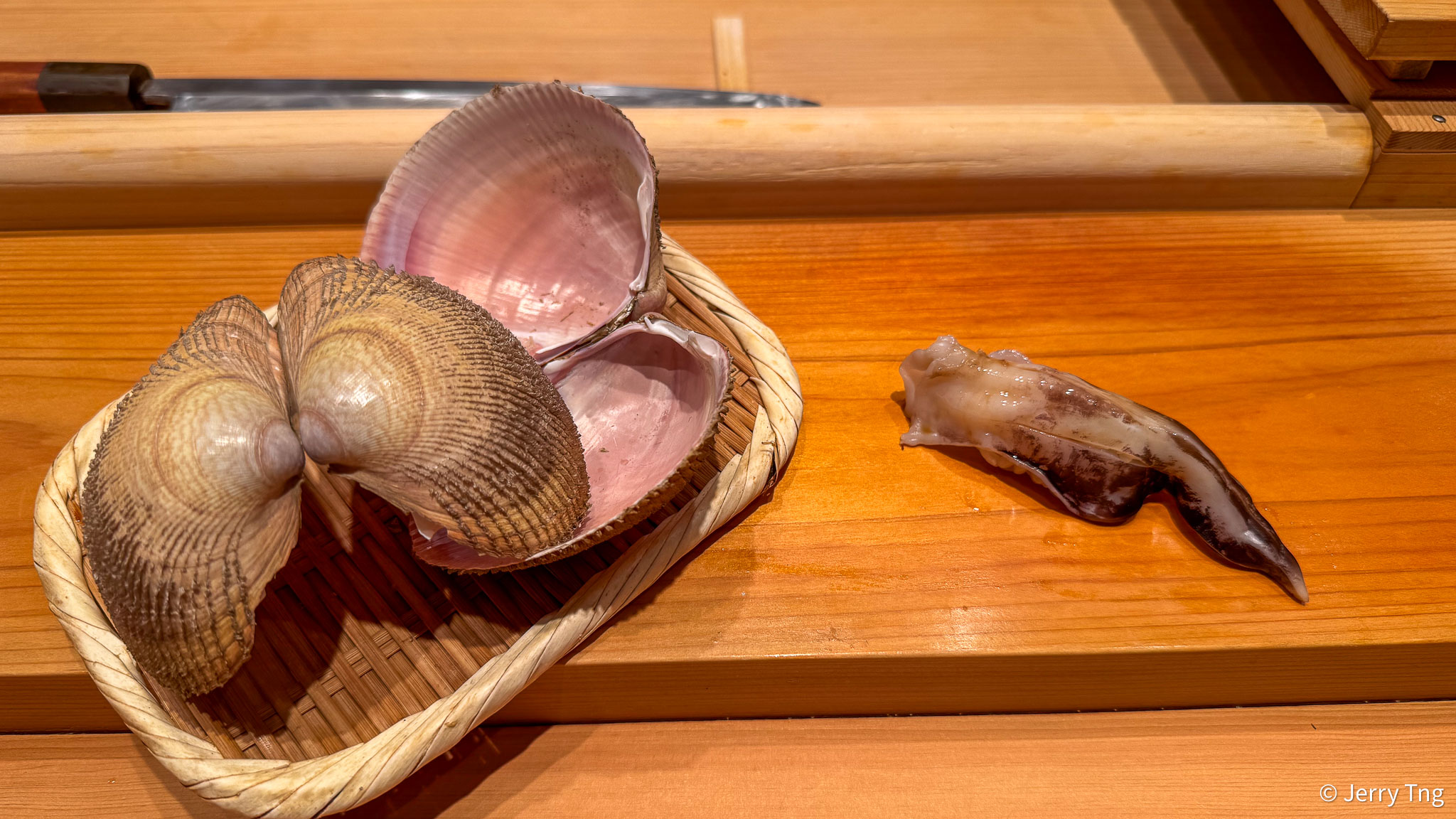
Torigai 鳥貝 (Heart Clam)

I ignorantly asked Chef if this clam was also aged, to which he answered, sounding surprised, “Clams have to be served fresh!” This was a fresh heart clam, aka torigai 鳥貝 from Maizuru Bay 舞鶴湾. Very crunchy and full of sweetness that come only from the freshest clams.
Itoyoridai イトヨリダイ (Golden Threadfin Bream)

The itoyoridai イトヨリダイ had been aged for 8 days, firming up the texture of the flesh and concentrating the flavour of the fish. To elevate each piece, the shari is served at varying temperatures, perfectly matched to the fish it accompanies.
Shinke-Jime Shima Aji 神経締めシマアジ (Horse Mackerel)

Shima aji シマアジ (horse mackerel), wild-caught and treated with a special method called Shinkai-jime 神経締め, had been aged for 9 days.
What is Shinkai-jime 神経締め?
Blue-backed fish like mackerel lose their freshness quickly and judging the maturity is extremely difficult. Furthermore, if the fish is matured without sufficient advance preparations, bacteria breed in the remaining blood and organs. This may cause food poisoning.

These types of fish can then be matured using the following method. Shinkai-jime 神経締め is the traditional fish killing technique used in Japan to kill and paralyse the live fish without much stress in order to preserve the umami flavour while draining as much of the blood as possible. The fish is then put in salt-ice (water-cooled with ice and salt) and is sent to the sushi restaurant in this state. Unfortunately, what happens after this is apparently a trade secret.
Smoked Shima Aji シマアジ (Smoked Horse Mackerel)

The same shinke-jime shima aji, but aged for 9 days and then smoked. Chef played with smoke using the same fish. First you taste the intensity of the fish itself. It is really difficult to age a blue-back fish and maintain the integrity of of the fish. Then you get a totally different taste sensation with the smoked version. Both were equally good.

OK, too much science for a delicious piece of stale fish. We needed some edamame (soy bean) for a break from all those details. Actually, every time you order a drink, they would provide a small snack to go with your drinks. Back to regular programming.
Tokiko 時子 (Young Salmon Roe)

Toki-shirazu 時しらず, translates to a salmon that ‘does not know time’, is the term for the specific type of chum salmon caught outside of its typical spawning season. A rare salmon from Hokkaido that does not sexually mature and instead lingers in the oceans getting fatty rather than going up rivers to spawn. Fresh sujiko 筋子 from the chum salmon is cured in-house and served on delicious and fragrant shari. Unlike ikura, which is the processed and separated salmon roe, sujiko is the whole skein of eggs.
Chutoro 中卜口 (Medium Fatty Tuna Belly)

This was one of the few pieces of sushi that evening that had not been aged. Nobody would say no to toro (fatty tuna belly), and chutoro 中卜口, the medium fatty belly, had gone through the baptism of fire (aburi 炙) to release even more of those delicious grease and smokiness, make this a favourite among the sushi lovers.
Shinkei-ajime Aji 神経締め鯵 (Horse Mackerel)

Aji 鯵 that had been aged 9 days had turned a few shades darker and looked like it had been dried. Instead it had its flavours intensified and the texture turned more waxy. The fishiness of aji that is not fresh is non-existent. Again, blue-backed fish is difficult to age, so this is an excellent piece of sushi.
Abalone with Bamboo Shoot & Seaweed 真竹と飽とワカメの煮付け

And then an interlude from the sushi with a simmered dish of abalone with bamboo shoot and wakame 真竹と飽とワカメの煮付け. I love bamboo shoot simmered in the dashi. The crunchiness presented a nice contrast in texture with the soft braised abalone.
Kuromutsu 黑鯥 (Blue Fish)

Shinkei-jime kuromutsu 黑鯥 from Nagai, Kanagawa Prefecture. It is a deep-sea species from depths of up to 600m, hence it is incredibly rare for kuromutsu to be prepared using the delicate shinkei-jime method. Served as a nigiri with salt and lime.
Aoriika アオリイカ (Bigfin Reef Squid)

4.5 kg Aoriika アオリイカ from Nagai, Kanagawa Prefecture and shinkei-jime by 長谷川さん Hasegawa-san. Amazing quality from Hasegawa-san, as always.

Try leaving your squid in the refrigerator yourself, after a couple of days the squid will turn slimy. But over here, even after 12 days of aging, this squid still felt crunchy with incredible freshness. Served simply with a dusting of salt and nothing else.
Kuruma Ebi 車海老 (Japanese Tiger Prawn)

Kuruma Ebi 車海老 (Japanese Tiger Prawn) is almost always served boiled, in this case a la minute. The sweetness of the prawn was retained perfectly with the crunchiness of not overcooking it, as well as the doneness that presented the prawn in its most beautiful colours.
Murasaki Uni i ムラサキ雲丹 (Purple Sea Urchin)

Purple sea urchin, aka Murasaki uni i ムラサキ雲丹, is classified as white uni (shiro uni), as opposed to the more common Bafun uni that is red uni (aka uni). Shiro uni is typically a seasonal delicacy, with its peak season often occurring in the summer months.
Bafun Uni バフン雲丹 (Horse Dung Sea Urchin)

So as a comparison, I ordered a portion of Bafun uni. And here’s the difference. Bafun uni tastes rich, briny and has a more intense, bold flavour with a custard-like texture, perfect for those who love deep umami and a creamier bite. Murasaki uni on the other hand, has a lighter, clean and slightly sweet taste, with a bit firmer mouthfeel with a delicate finish.

The ‘Narabi’ arrangement of uni refers to consistent sizes and perfectly shaped portions of uni being hand-picked rather than the random and odd pieces you will see for ‘bara’ uni; hence narabi uni commands a premium.
Hoshiekimo ホシエイ肝 (Stingray Liver)

This next neta is not something that you get everywhere, often as a special or omakase item. Hoshiekimo ホシエイ肝 (Stingray Liver) is really creamy and succulent in terms of mouthfeel and a rich, iron-like flavour, like foie gras except it is raw. Nothing funky in terms of taste, the experience is all about the texture.
Kohada 小肌 (Gizzard Shad)

This silver-skinned fish, called shinko when young and kohada as it matures, is a true test of a chef’s skill. Its preparation is delicate and deeply methodical. Each step, from filleting and salting to marinating in vinegar, demands care, patience, and intuition.
Tekka-temaki 鉄火手巻 (Tuna Hand Roll)

Tekka temaki 鉄火手巻 is a simple and popular dish, often enjoyed as a quick and satisfying meal.

Chawanmushi Junsai (Water Shield) ジュン菜の茶碗蒸し

Another interlude of steamed custard with water shield, or Chawanmushi Junsai ジュン菜の茶碗蒸し. I didn’t know the Japanese eat water shields too, and I only had it before in Hangzhou along the restaurants in West Lake. My guest loves the texture of the floating plant, which formed a slimy layer gelatine when cooked.
Anago 穴子 (Conger Eel)

I saw the next group had this as part of their omakase and couldn’t help added one a la carte order. The boiled anago 煮穴子 (conger eel) has a delicately sweet taste with a soft, melt-in-your-mouth texture.
Tekkamaki 鉄火巻 (Tuna Roll)

My traditional end to an omakase meal, an item that will signalled that I am full. Tekkamaki 鉄火巻 (tuna roll) is not exactly what one would considered a last order, but it has a lot of significance for me over the many sushi omakase I have been to.

I casually mentioned to Chef Ashino that I love my bluefin tuna in the akamai zuke 本鮪の漬 (marinated tuna) style. He made my tekkamaki in that exact style, and showed me the soy sauce that he has been using since he opened the shop 10 years ago. Delicious, and I shall not ask him how he kept the sauce.
Tamagoyaki 玉子焼

One final miso soup with a razor clam and final piece of “sushi”, the tamagoyaki, the subtly sweet, savoury rolled egg you usually encounter at the end of the sushi omakse. But this castella-style tamagoyaki a la “Jiro Dreams of Sushi” is similar to a Japanese dessert with a spongecake-like texture with darkly browned top and bottom.

I skipped the black sesame ice cream (also available in matcha flavour), and went with only the fruits. Dessert is always the Achilles’ heel of these sushi-ya.

While they do not have the recognition of the tyre company, I would say Sushi Ashino is one of the best sushi restaurants in Singapore, beating most of those mentioned in that food guide. I am no exaggerating, one meal here would turn your view of sushi completely upside down, recognising that freshness is not the only thing with sushi. I will come again very soon, I have been converted.
Sushi Ashino あし乃
8 Club St, #01-12/13 ICON Hotel, Singapore 069472
Tel : +65 6684 4567
Visited Jun 2025
#sushiashino #熟成 #江戸前 #鮨 #edomae #sushi #agedsushi #神経〆 #マダイ #ehime #愛媛 #愛媛の漁師 #藤本純一
0 comments on “Ashino あし乃 @ Telok Ayer”