
Although the location is the same, this Yuanxing Restaurant is not the same as Guan Hin Restaurant that used to be here, even though the Chinese characters are the same.

The reverent Guan Hin Restaurant 源興菜館 used to be a “gold-sign” namesake 金字招牌 that represented the epitome of Teochew tzechar in Singapore. But I believed the owners sold the place, and the new owners kept the Chinese name and used the Hanyu Pinyin (Mandarin romanisation), Yuanxing, for its English name.

Several items are no longer in the menu, like their fermented crab 醃螃蟹 that featured raw mud crabs marinated in garlic, chilli and soy sauce, but most of the Teochew classics are still there.
Our Lunch Order from the A La Carte Menu
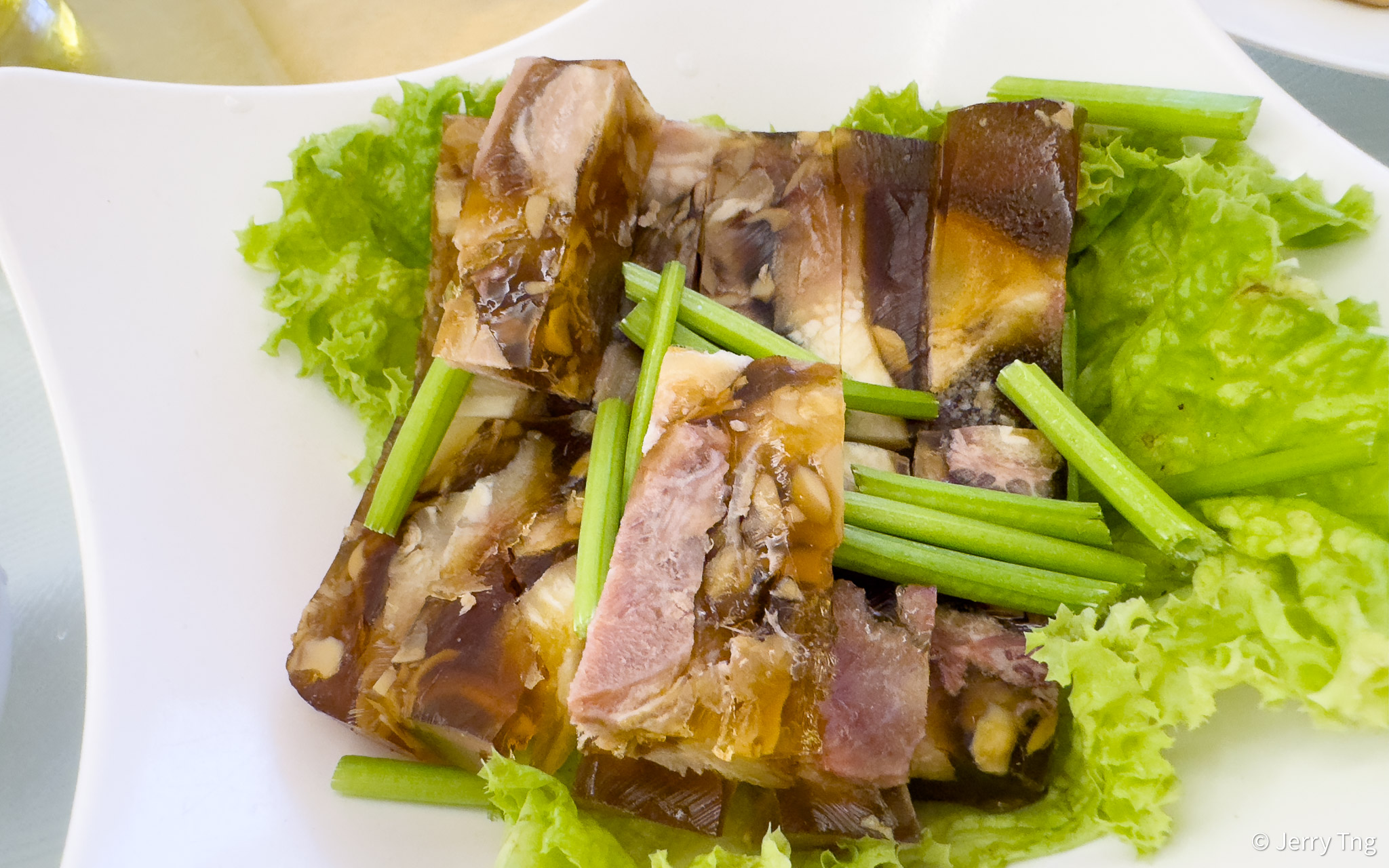
Pig Skin Jelly 猪皮冻

Called “Nek Puay Dang” in Teochew, Pig Skin Jelly 猪皮冻 is made by boiling pig trotters and skins with braise spices to a gelatinous reduction that is placed in the fridge to cool and solidify into aspic. One of the better ones I have tasted recently.
Pork Liver Roll 猪肝花

Pork Liver Roll 猪肝花 is a classic Teochew appetiser that is almost lost. In addition to the crispy taste of fried ngoh hiang (five-spice meat rolls), it was characterised by the addition of pork liver and refreshing jicama. As with many Teochew dishes the addition of water chestnuts adds crunchiness and sweetness to the savoury paste, but the liver was frozen did not escape us.
Teochew Stewed Vegetable 潮州素菜

My sister has this infatuation with Teochew stewed vegetable 潮州素菜, which she tried so many times and still hasn’t found what she’s looking for. Layers of vegetables (Chinese cabbage, abalone mushrooms, gingko nuts, etc, usually eight items) are layered and steamed, finally smothered with a thicken sauce made from chicken stock. That’s right, it is the Teochew method of 素菜荤做 (vegetarian made with non vegetarian stock).
Pig Stomach and Salted Mustard Soup 鹹菜豬肚湯

After weeks in the US, I was craving for some hot soup. So I ordered the pig stomach soup that came in single portions.

It wasn’t the peppery type that I came to be familiar with, but still a good soup as it reminded of how my mom would do it. The stomach was properly prepped, which is a good thing, and it wasn’t chewy (that’s even better).
Braised Goose And Foie Gras 鹵水鹅片、鹵鵝肝

If you are looking for braised goose 卤水鹅片, this is the place to get it. Whenever I see this dish on the menu, I make sure we order it. Goose meat is a little coarser than duck but the flavour is more robust as it requires more time to braise. I have no idea why Chinese goose was not allowed to be imported, so as Teochews we were so deprived of our favourite dish. They used Irish goose.

I was quite disappointed as the goose was dry and overcooked. Just like the one I had at Chui Huay Lim, the best part of the dish was the braised bean curd 卤水豆腐 below the goose. I added braised foie gras 鹵鵝肝, which used French foie gras instead of lion head goose 獅頭鵝肝 – it is not bad substitution. If only their braising liquid was better and more delicious.
Olive Fried Rice 橄欖炒飯

When I ordered the olive fried rice 橄欖炒飯, I thought it was Teochew olive and leaves 潮州橄欖菜. Instead they used Spanish black olives which turned out to be quite good as well.
Candied Taro 反沙芋頭

If there’s one dessert that all Teochew chefs hated to make, it would be this candied taro 反沙芋, which is yam stick encrusted with sugar. Firstly, you cooked the best yam you can find by deep frying them. Then, you have to toss the hot yam sticks in custard sugar to coat and form a candy crust on the yam surface. It cannot be too hot or else the sugar becomes caramel; it cannot be too slow or else the sugar becomes crusty; too wet and the sugar becomes a coating. And when done perfectly, it was not exactly the best dessert – like a sugar coated French fries. But it was a demonstration of the chef’s skills, and this one wasn’t good. What’s that chives doing in the sugar?
Orh Nee with Ginkgo Nuts 白果芋泥

What’s a Teochew meal without Orh Nee (Yam Paste). Most Orh Nee is Singapore feature a watered down yam paste with lots of coconut milk. This one, the yam is slowly cooked in a big wok until it caramelises and becomes a paste. However it was not the smoothest one I had, and there’s no lard in it.

Overall, the meal was like its Orh Nee – looks Teochew, tastes Teochew, yet something is missing. They managed to replicate the Teochew classics that everyone reckons with. But the old Teochew taste that defines Singapore’s Teochew cuisine is gone forever. Modern day Teochew restaurants use chefs from China, which in turn are trained in a standard culinary school in Guandong, resulting in more Cantonese than Teochew. A lot of the old techniques are lost as these techniques are not recorded and passed down.
Yuanxing Teochew Restaurant 源興潮州菜館
34 Whampoa West #01-01, Singapore 330034
Tel : +65 6298 3179
Visited May 2025
0 comments on “Yuanxing 源興 @ Boon Keng”