
The name “Ayu-mu” (あゆ夢) means walking towards a new beginning. Founded in 2018, they walked straight into a nightmare a couple of years later. Thankfully, they came out unharmed.

The name was the inspiration of Chef Masakazu Ishibashi 石橋正和, affectionately known as “Chef Masa” by his followers in Japan and Asia. Born and raised in Japan, the Hokkaido native made his first sushi when he was 10 years old. In 2016, Ishibashi came to Singapore to head Shoukouwa sushi restaurant, leading it to two Michelin stars in a mere four months after opening. This is Chef Masa’s second outpost outside of Tokyo, following his highly successful “Sushi Nanami by Masa Ishibashi” in Taipei.

Head Chef Odashima Shougo ran the itamae like clockwork, making sure all 20 of us get what we ordered correctly. I observed that there was 6 groups, and all three options of omakase for lunch had been ordered. And at same time, he had to entertain my constant questions on origins of the neta and such.
水無月 Omakase Minazuki
with Seasonal, Premium and Chef’s Signature Items
The shari is a blend of Nanatsuboshi and Akitakomachi with the former being more flavourful while the latter adds more texture. He also pays careful attention to the temperature of the rice as he believes that warmer rice is more tasty, again a move away from the traditional rules of edomae sushi.
Ankimo あん肝 (Monkfish Liver)

The extra large portion of minced monkfish liver, aka ankimo あん肝, gave a creamy and crunchy texture which matched the crisp wafers called monaka 最中very well.
Kegani 毛ガニ (Japanese Hairy Crab)

The Japanese hairy crab, aka kegani 毛ガニ or horsehair crab from Hokkaido, is a popular delicacy in Japan. Despite being smaller than other popular crab varieties, it’s highly prized for its taste and texture.

The crab meat and legs had been shelled and the flavoured with wasabi. It had sweet, firm meat and rich, flavourful kani miso (crab innards).
Katsuo 鰹 (Bonito)

Ubiquitous in Japanese flavours, bonito is a fish related to tuna and mackerel. Sometimes the term “bonito” is used interchangeably to mean both the bonito itself and the technically different skipjack tuna due to their extreme similarity and the fact that they’re both culinarily used the same way. Today, we had it served as katsuo no tataki, or seared bonito fillet cut into thick slices and smoked with hay. Topped with shredded myoga ginger and dressed lightly with dashi stock, it was quite a good eat.
Awabi 鮑 (Abalone)

This exquisite dish combines the delicate sweetness of fresh abalone, gently poached in dashi and sake to preserve its tender texture, with a rich and umami-packed liver sauce. Perfectly balancing the briny essence of the sea with the smooth richness of sake, this small bite served on shari was a refined culinary experience that showcased the abalone’s natural flavours.
Shima-Aji 縞鯵 (Striped Jack)

Shima-aji 縞鯵, or Japanese striped jack, is a common point of confusion for many sushi eaters. The shima means “striped” and aji is Japanese “horse mackerel.” But shima-aji and aji make two very different types of sushi. Shima-aji tastes like a cross between saba (mackerel) and kanpachi (greater amberjack, like leaner yellowtail). It’s light and buttery with very tender flesh and just a bit of fat. When very fresh, it has a firm texture and finishes with sweet notes.
Chutoro 中トロ (Medium Fatty Tuna Belly)

Chutoro 中トロ is a medium-fatty cut of tuna, specifically from the bluefin tuna belly, offering a balance between the lean akami and the fatty otoro. Over time, I have had many chutoro and otoro. It had rich, buttery flavour and smooth, velvety texture which was really gratifying for its melt-in-mouth feeling. But as age catches up, I prefer the lighter, less fattier fish.
Nodoguro 喉黒 (Blackthroat Seaperch)

The term mutsu (むつ) comes from the meaning of mutsukkoi (むつっこい, Tukushima dialect) and means in other words “greasy” or “strong in taste”. Nodoguro 喉黒, aka blackthroat seaperch and more commonly in Japan as akamutsu, has this taste profile which is best grilled to bring out the fattiness and sleek texture. The meat is soft and has a wonderfully full-bodied umami taste. Served here as a temaki, this is my favourite fish grilled whole in a robatayaki.
Tachiuo タチウオ (Beltfish)

Tachiuo タチウオ (beltfish) is a saltwater fish of the cutlassfish family and its total length exceeds 2m in the largest fish. It is a tasty fish with little fishiness and fat, so even children who do not like fish can enjoy eating it. However it is really boney. I once watched a documentary in NHK that showed how kindergarten children were served beltfish, and they handled the fish like a pro.

I love beltfish, this is something my mom would cook at home – pan fried belt fish. Here, they took the deboned fish, lightly coated it with flour, fried it and then finished it by simmering in dashi. Served with a dollop of radish mash to balance the greasiness and a scoop of dashi for flavour, it was a very good dish.
Wakamomo 若桃 (Baby Peach)

Unusual candied green peaches from Kyoto, wakamomo 若桃 are unripe, young Japanese peaches, typically preserved in syrup or pickled. They are known for their small size, jade green colour, and delicate, slightly tart flavour. They kept their greenness from the time of harvest and are brined/pickled to become a perfect palate cleanser.
Akami Zuke 本鮪の漬 (Marinated Bluefin Tuna)

To “zuke” is to marinate something, and in this instance, soy sauce with mirin and sometime sake, to produce a lean tuna, or akami, that tastes better than fresh. Zuké nigiri had a bold, bright red appearance, and texturally it was incredibly smooth thanks to the marinade. The resulting bite was simply fantastic.
Toro Sukiyaki トロ すき焼き (Fatty Tuna Sukiyaki)

Toro sukiyaki トロ すき焼き is a fantastic way to enjoy the fatty tuna belly. The piece of tuna belly was lightly poached and served in sukiyaki sauce with a drizzling of onsen egg yolk. Wouldn’t say I enjoyed it, but it was an innovative way to sample the really fatty fish.
Aji 鯵 (Horse Mackerel)

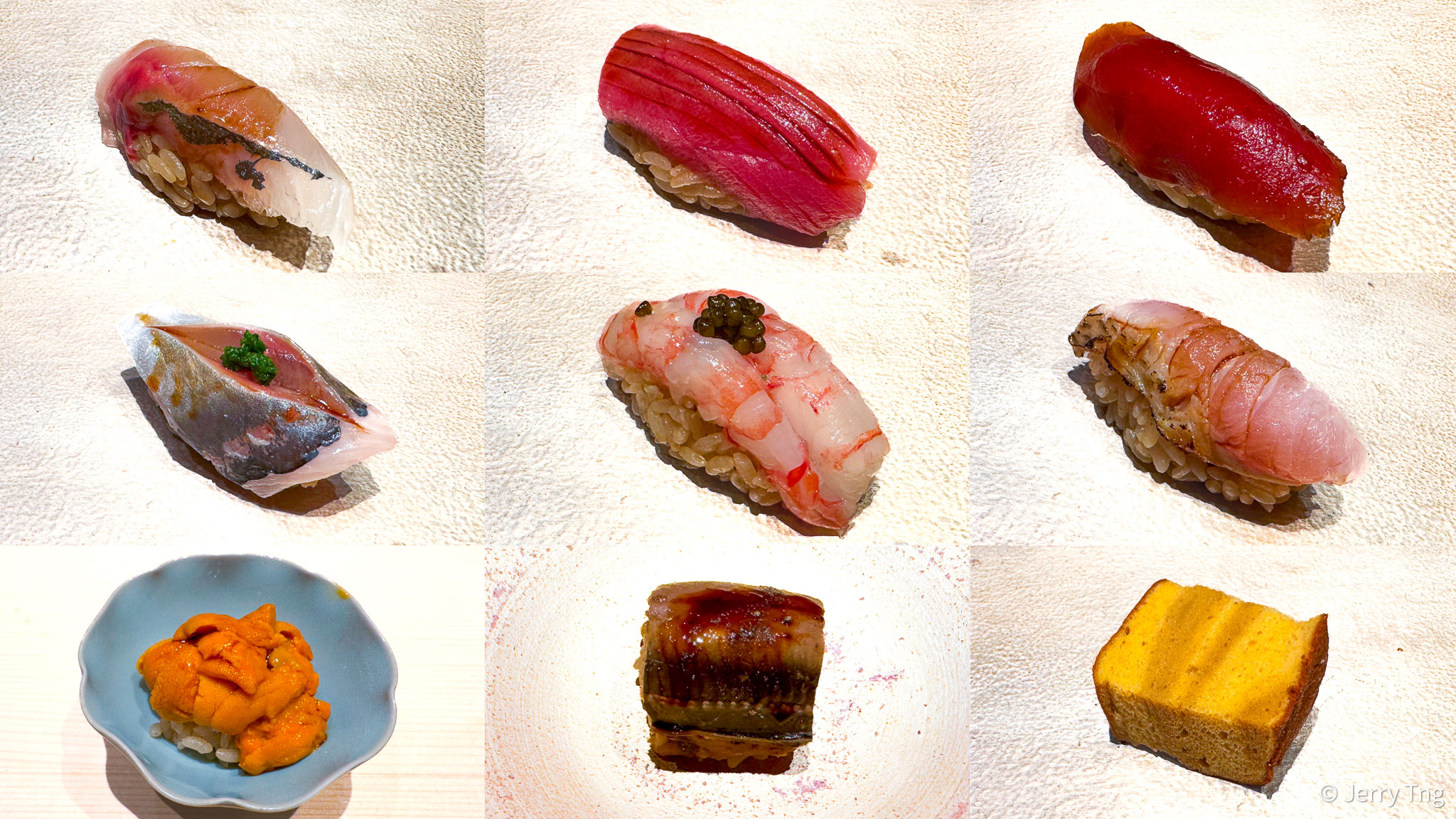
Aji 鯵, aka horse mackerel, would be more familiar to those who have eaten the more common saba (mackerel), which is a bit more fatty and oily with a “fishier” finish. Aji is a small fish, slimmer than a mackerel. It has a firm, yet delicate texture with light and mildly sweet flavour. This was a really good piece of aji nigiri, the neta was slightly marinated vinegar which intensified the flavours of the fish and made the fish softer.
Amaebi 甘海老 (Deep Water Shrimp)

Amaebi live in 500 to nearly 2000 feet of water. They taste best when sourced from the cold waters of Hokkaido, and have a soft texture and sweet, lingering flavor. They are sometimes called akaebi due to the reddish taint of their flesh.
Kuromutsu 黒むつ (Japanese Bluefish)

Kuromutsu 黒むつ (Japanese bluefish) is often mistaken for its close cousin, the nodoguro (blackthroat seaperch). Kuromutsu is a deep-sea fish and is a high-end fish that is traded at a high prices in the market because the number of catches is small and is prized for its rich, fatty flavour, clean texture, and sweetness (umami).
Bafun Uni 馬糞海胆 (Bafun Sea Urchin)

Bafun uni 馬糞海胆 from Hokkaido, aka short-spined sea urchin or yellow sea urchin, is prized for its vibrant yellow-orange colour (and hence classified as aka uni or red sea urchin) and rich, sweet, and creamy flavour.
Anago 穴子 (Conger Eel)

Unlike unagi (freshwater eel), anago (conger eel) is a purely saltwater-dwelling fish and sought after for its delicate, mild flavour and is prepared in various ways, including simmering, grilling (kabayaki), and tempura. This version was simmered in a combination of mirin, sake and soy sauce, and served as a neta on a nigiri, topped with shiso pepper.
Kanimisoshiru かに味噌汁 (Crab Miso Soup)

Kani miso shiru かに味噌汁 is a Japanese soup made with miso paste and crab internal organs, often referred to as crab “brains” or “paste”. It’s a savoury and rich soup with a distinct umami flavour, a wonderful end to the omakase.
Torotaku Temaki トロタク手巻 (Chopped Tuna and Pickled Daikon Radish Hand Roll)

Torotaku maki トロタク巻 is a popular Japanese sushi roll (makizushi) featuring a combination of fatty tuna (toro) and pickled daikon radish (takuan). Chopped pickled radish is combined with sukimi to form the centre of this hand roll (temaki). Sukimi refers to a thin slice of the fish from which the meat between the muscle and the fat remaining on the back of the skin is cut away. The pickled radish has a refreshing flavour and matches perfectly with the thick fat of the tuna.
Suzhihiro-style Tamagoyaki 玉子焼き (Cooked Fluffy Eggs)

“This Tamagoyaki is the final dish.” Tamagoyaki 玉子焼き, literally “grilled egg”, is a type of Japanese omelette made by rolling together several layers of fried egg. It tastes a little bit sweet with soy sauce and mirin (sweet rice wine). The Suzuhiro-style tamagoyaki uses wild fish surimi as a base giving it a smooth texture and a richness of umami. It almost looked like a dessert, and tasted like one too.
Japanese Musk Melon and Kyoto Grape

I am seeing a trend of all the top-end sushi-ya move from a la carte to omakase. Two main reasons IMHO: a less clued up clientele and a cleverer restaurant. Feeding the same stuff to 20 diners cuts ordering problems, cooking problems and waste and also increases margins because you can feed nonsense and call it part of the omakase.

From the booking to the welcome to the sit down and start enjoying the food, everything was done to perfection. Compliments to the chef (Mr Shintaro), his assistant and to the wait staff for giving us an omakase to remember. Good for business dinners and clueless patrons who cannot be bothered to learn what to order.
Sushi Ayumu by Masa Ishibashi あゆ夢
333A Orchard Road, #04-16 Mandarin Gallery, Orchard, Singapore 238897
Tel : +65 6733 2114 / 9159 0102 (Reservations)
Visited Jun 2025
0 comments on “Sushi Ayumu by Masa Ishibashi @ Orchard”