
I do not go to an Italian restaurant when I am in China for obvious reasons, but this being 8½ Otto e Mezzo BOMBANA, I gave it a try before they are all gone.

8½ Otto e Mezzo BOMBANA is a fine dining Italian restaurant by Chef Umberto Bombana based in Hong Kong (which boasts to be the one and only three Michelin star Italian restaurant outside Italy) with branches in Shanghai, Beijing (since closed) and Macau. The restaurant is named after the classic movie by Federico Fellini and reflects Chef Bombana’s passion for Italian culture and art.

Located on the top floor of the Associate Mission Building 协进大楼 along a stretch of the Bund named Rockbund 洛克·外滩源, this Italian fine dining restaurant was among the first tenants of this batch of refurbished early 20th century buildings that were part of the Bund.


The Shanghai branch was opened by Lombardy-born Executive Chef Gabriele Delgrossi. His unrivalled talent and passion for Italian cuisine, coupled with 3 years of living in China, gives him an enriched insight to interpret local ingredients with a unique Italian flair. The restaurant has been awarded two Michelin stars since 2017 in the Michelin Guide Shanghai. Last year, his Chef de Cuisine was promoted to Executive Chef. Chef Nicoló Rotella joined in 2023 and was promoted to Executive Chef in 2024, continuing to bring fresh ideas and inspiration to diners with his vibrant creativity and the delicacy and romance of Italian cuisine.

I did not pick the full degustation menu, but instead picked the a la carte options as the degustation menu did not offer two of my favourite ingredients – pigeon and sea urchin. And promptly the amuse bouche came with my Negroni.
A la carte dinner
Amuse bouche
mushroom consommé, maitake mushroom powder, almond and camomile foam

The amuse bouche was a mushroom consommé that tasted like Brand’s essence of chicken, covered with a foam made from camomile and almond (a combination that I have not tried before) and topped with a powder made from dried maitake mushroom. Delicious. Tonight’s gonna be a good night.

Promptly after the amuse bouche, they brought out the bread service. And this is reminiscent of the one I had with Joël Robochon many years ago.

And you do not need to choose anything, every option was given to you. But the highlight was not the bread, but the selection of olive oils.

I was presented with three types of extra virgin olive oil, (from L-R, lightest to heaviest) Guglielmi Dal 1954 Fior D’o Olio Extra Vergine Di Oliva, Jara Estratto A Freddo Noi olio extravergine di oliva and Frantoi Cutrera Olio Extra Vergine Di Oliva specially bottle for Bombana and Chef Nicoló Rotella.


fior d’o from Puglia is pressed from the first olives of the last oil campaign. This oil with an authentic character releases an intense aroma of fresh olives and boasts a creamy consistency that makes it ideal for those seeking a rustic and genuine flavour. It is heaviest of the three and perfect for enriching simple and traditional dishes.
This single-varietal olive oil from Sardinia is crafted through the cold pressing of Tonda di Cagliari, a unique variety native to the Giara di Gesturi. With its natural, authentic profile and bold yet refined character, it’s the perfect complement to any dish, enhancing its flavours and elevating the culinary experience.
Frantoi Cutrera has been growers of olive trees and producers of extra virgin olive oil in Sicily for over a century. Its aroma is fresh and intensely fruity with the marked characteristic notes of the freshly produced oil, freshly cut grass, aromatic fresh herbs, and green almond. It is the lightest of the three with slight bitterness


The most substantial bread was the low temperature fermented sourdough. They served you the whole loaf. Grissinis originated in the Italian city of Turin, Piedmont. These were made in house in three different flavours. But my favourite was the sun-dried cherry tomato panini. The bread was really fluffy and the tomato was spot on.


And throughout dinner, Head Sommelier and Malaysian Ervin Leong gave some very good recommendation from their extensive wine list of our a la carte choices. Ervin joined in June 2021 as the sommelier, and was promoted to the Restaurant Manager & Head Sommelier position last December.
His first recommendation to pair with the first course was the deliciously refreshing and crisp Chateau Musar 2010 Gaston Hochar from Bekaa Valley, Lebanon. It is deep, rich garnet in colour with aromas of raisins, cedar, prunes and cinnamon. The 2010 is a savoury, herby wine with delicate spices and the raisiny, figgy aromas follow through to the palate. This is an elegant vintage with fresh acidity and a long, dry finish.
Scampo
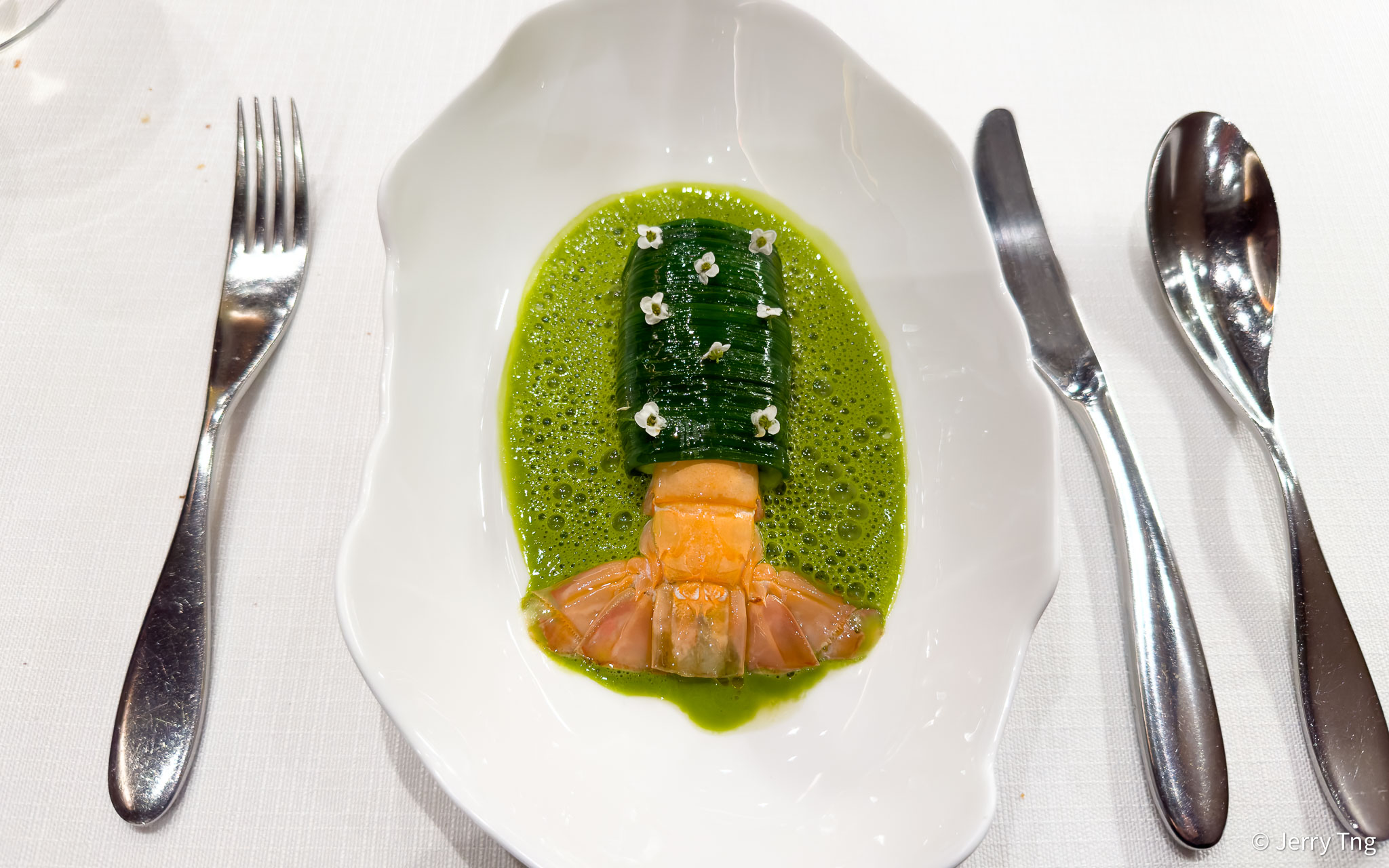
gently steamed new zealand scampi, sand chives, thai basil and scampi bisque 清蒸新西兰鳌虾配沙葱,九层塔鳌虾浓汁

清蒸新西兰鳌虾配沙葱,九层塔鳌虾浓汁
The first starter features New Zealand langoustines, wrapped with Mongolian chives (allium mongolicum), and served on a bed of Thai basil and langoustine bisque. Chef Nicoló came personally to explain his inspiration for this beautifully plated dish.

Mongolian chives is an Asian species of wild onion native to Mongolia, Inner Mongolia, Tuva, Kazakhstan, and parts of China. This is the first time I see it in Western cuisine, having tasted it in Mongolian and Xinjiang cuisines. It is not as pungent as Chinese chives, often compared with scallions but sweeter.
Linguine
artisanal linguine pasta and fresh sea urchins 意式肩面配新鲜海胆

Next course featured my favourite ingredient, sea urchin. Sea urchin is known for its rich, briny umami flavour. This taste is a result of the presence of amino acids and nucleic acids, particularly glutamic acid, which gives it an umami-salty sweetness.

Anything with sea urchin is always good tasting and easy on the body. A serving of fresh sea urchin provides fewer calories than many other types of seafood while offering an abundance of nutritional benefits.


This makes uni a fantastic option for those looking to maintain a balanced, nutrient-dense diet without consuming excess calories. But with the meagre amount of pasta that accompanied the sea urchin, this main course does not make it on the calories count.


Thank goodness there’s a second bread service, a very dense full grain bread served with my choice of olive oil (Frantoi Cutrera) and Gran Deposito Aceto Balsamic by Giuseppe Giusti Modena. Named the “3 gold medals” because of three awards that this esteemed vinegar got, it is now sought after by many because of the low production and high demand. This is the best tasting balsamic vinegar that I have tasted and grow to trust in my own cooking.


And the next pairing with the next main course of pigeon was 2015 Inama ‘Oratorio di San Lorenzo’ Colli Berici Carmenere Riserva. Very attractive medium b body red from Carménère grape from the Médoc region of Bordeaux, with crushed-berry and orange-peel aromas and hints of wood. It has a crisp finish and perfect for drinking now.

And for the next course of pigeon, I had to pick the colour of the Laguiole steak knife that I fancied. For 4 generations since 1920, the family owned company Jean Dubost manufactures the famous Laguiole knife. The Laguiole Jean Dubost collection is a middle range knifes set.
Piccone
smoked pigeon, Jerusalem artichoke and pickled mushrooms 煙燻鴿子配洋姜及調味蘑菇

The main course was another of my favourite ingredients. I always order pigeon whenever it appears on the menu. The pigeon was sealed with honeycomb wax and aged for four to five days. The whole pigeon was then grilled and smoked with cherrywood chips and served in three ways.

The first part was two slithers of the pigeon tenderloin, the best cut of the small bird. It looked slightly raw, but that’s just an illusion as the pigeon went through two rounds of smoking, first with the cherrywood during the prep, and than with the rosemary. It was topped raw mustard grains, a wonderful addition to a most tender piece of meat that was cooked perfectly.

The next part of the course was the smoked pigeon breast with Jerusalem artichoke mash and chips, bunapi-shimeiji mushroom from Yunnan 云南白玉菇 and parsley sponge cake. The pigeon breast was paired with a black truffle based au jus sauce.

The skin of the pigeon was as crispy as Yuen Long roast pigeon 元朗乳鸽, but the breast meat was much more tender and juicy. Pigeon used tonight was quite big and I forgot to ask when it came from. Considering how delicious pigeon can be, it’s a shame it isn’t more mainstream.

The final part of the pigeon course was a refreshing pastry tart base filled with a mousse made from the pigeon legs covered with pickled bunapi-shimeiji from Yunnan and topped with parsley powder. Not quite a bite, I really enjoyed the dark meat filling that was chopped up coarsely into a confit mousse. The pickled mushroom took the edge off the gaminess of the bird, but that was what I liked about pigeon. Overall, all three parts were enjoyable and felt like three small courses even though it came from the same grilled bird.
Palate Cleanser

The palate cleanser before we proceeded to dessert was a spherification of ginger honey lime. Popularised by Ferran Adrià of El Bulli, spherification is a culinary technique where a liquid is encapsulated within a thin, gel-like membrane, forming spheres that burst in the mouth, releasing a burst of flavour.
Chicco
traditional venetian dessert 威尼斯传统甜品

I couldn’t find any reference on how traditional is this dessert in Venice, and the closest I can relate this chocolate dessert is the Italian word “ciccolato.” But I did find another dessert of the same name by a bistro Romania that claimed the same inspiration. Can someone leave a message where “Chicco” originates?


I would assume that this would be a modern take of the Venetian classic tiramisu. Spongy cake filled with espresso chocolate mousse, served with 75% dark chocolate discs, espresso milk chocolate crumble, and a quenelle of honeycomb ice cream. This dessert is a refined treat, combining delicate textures with intense flavours of coffee and chocolate. A modern twist on a classic, it’s the perfect way to end a memorable meal.
Sgroppino


The classic Sgroppino – arguably the most refreshing dessert there ever was – involves a tableside display of mashing lemon sorbet and vanilla ice cream together with grappa, homemade limoncello and Champagne.
The result is a fluffy custard that is concurrently bright and lusciously whipped, speckled with shaved lemon rind.
Petit Fours

And finally the traditional “small oven” artfully presented in bone-white custom-made serving dishes as the waiter fetched the bill. The stunning set of Petit Fours featured five little bites ranging from tart to sweets in flavours, from crunchy to molten in textures, a wonderful variety of after-dinner treats.


I particularly loved the celery tart and the passionfruit sphere on a liquor soaked sponge cake. The celery tart was refreshing if you like the herby taste of celery, and spherification of passionfruit mousse was a good palate cleanser at the end of the meal.

8½ Otto e Mezzo BOMBANA Shanghai is the only Italian restaurant in mainland China to have two Michelin stars. From service by the entire staff to GM/Sommelier Ervin Ong’s elegant pairings, every detail is masterful. This was an evening of good food, elegant dining and wonderful small talks for everyone. Hope to return soon for more Italian fine dining in this magical city.
Afterthoughts


The Shanghai branch of 8½ Otto e Mezzo BOMBANA has a stunning view of Financial District in Pudong and the Suzhou River from its balcony, with the lights of the city creating a dazzling contrast with the dark water. This view is the postcard of a city that has embraced foreigners as part of its own for more than two centuries, whether was it voluntarily or by force.


The Bund means ‘wharf along the muddy shore’. This name was given by Westerners – the Chinese still refer to the river bank as Waitan 外滩. The first European-style building along the Bund was constructed in 1843. Since then, many more consulates, banks and hotels have been built, particularly in an East-Indian, i.e. Western design. At the beginning of the 20th century, Art Deco made its entrance and the China Baptist Building 真光大楼 (1931) was one of the earliest commissioned.

Remember the comment I made at the beginning that I was afraid that they will all be gone? I was referring to the series of closures of Western restaurants in China, that became prominent with the closing of Ultraviolet by Paul Pairet in Nov 24, followed by the Camel Group of restaurants in Dec 24.

According to data from canyin88.com, a respected food industry data provider, Shanghai has witnessed a dramatic contraction in its high-end dining sector. In just over a year, the number of restaurants with an average per-person cost exceeding 500 yuan has plummeted from 2,700 to a mere 1,300. This represents a staggering decline of over 50% in the city’s premium dining establishments, a trend that has sent shockwaves through the industry and beyond. After “Liberation Day”, this had worsen with more foreign companies closing their China operations.

As I looked towards Pudong after dinner, I looked back at the 35 years I have spent in this city. When I first arrived, Pudong had just completed the Pearl of Orient TV Tower, the construction of the Pudong Financial District had only just begun. And then decades of progress made the world blinded by the dazzling speed this city transformed itself and caught up in lost time.

As the world grappled with a new world order, one of which China has a voice on the table, many were afraid and I was asked to take side for my ethnic heritage. This is kind of saddening progression of a more inclusive world.

I grew up exposed to all cultures because of the multi-ethnicity of Singapore, and I love every one of them, culinary and otherwise. So I really do not want to take any sides. Every type of cuisine is a good eat.
8 1/2 Otto e Mezzo Bombana Shanghai
Associate Mission Building, 169 Yuanmingyuan Road, Huangpu District, Shanghai, 200002, China 上海市黄浦区圆明园路169号协进大楼6楼至7楼
Visited Apr 2025
Michelin Shanghai Guide 2 Stars 2017-25
0 comments on “8 1/2 Otto e Mezzo Bombana @ Shanghai”