
A regional specialty restaurant for Akkeshi has opened in Nihonbashi, allowing you to fully enjoy Akkeshi’s nationally famous Kakiemon and Maruemon oysters, as well as extremely fresh fish and seafood sent directly from the Fisheries Cooperative Association of Akkeshi.

Nowadays, Tokyo has lively areas like Shinjuku, Shibuya, Akasaka, and Roppongi, but the heart of old Edo is undoubtedly Nihonbashi, which back then felt almost like a rural area. Near Sendagaya Gate, there’s the former residence of Arai Hakuseki, who was demoted and moved there—the countryside feeling was palpable, and it’s mentioned in Shuhei Fujisawa’s works as well. Despite its changes, Nihonbashi still retains its old charm.
Dinner Menu (Summer 2025)


The main attraction of Oysterbar Hokkaido inside COREDO Muromachi is Hokkaido oysters, and they are delicious. The town of Akkeshi in Hokkaido is famous for its exquisite oysters, with their large size and firm texture. And they specialise in bringing these oysters to Tokyo.

Akkeshi is known as a famous oyster producing area in Hokkaido. It is a rare region in Japan where oysters are available throughout the year because the maturation of oysters is controlled by the cold currents flowing around the area. Oysters grown slowly in the cold water are characterised by their concentrated flavour.
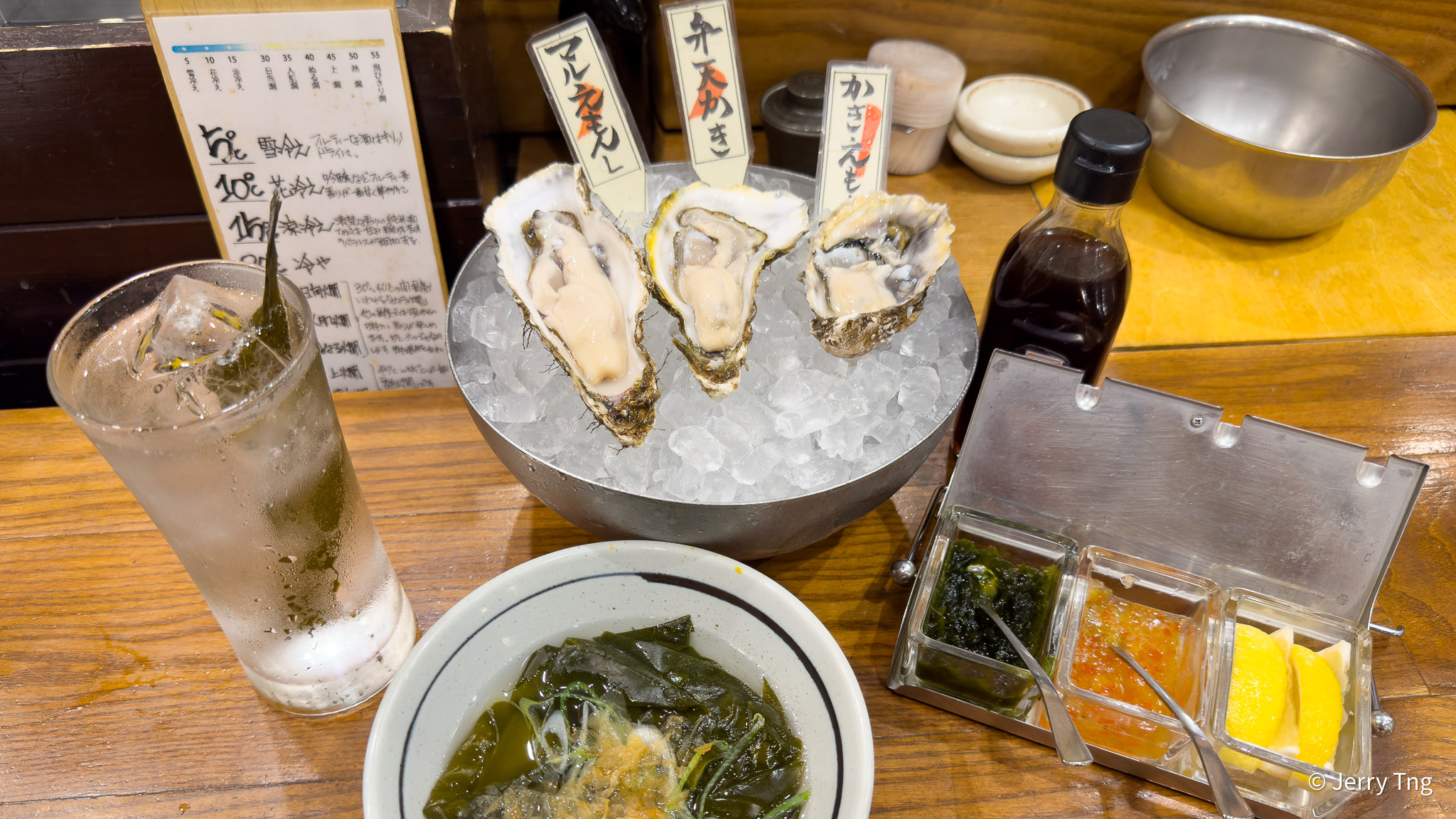
マルえもん食べ比べセット Maruemon Oyster Tasting Set

There are two types of oysters in Akkeshi. “Kakiemon” is made from oyster larvae attached to oyster shells and cultivated in Akkeshi. “Maruemon” is made from oyster larvae attached to scallops imported from Sanriku and cultivated in Akkeshi. This set allows you to compare three sizes of fresh oysters: M, L, and LL! We love fresh oysters.


- マルえもん Maruemon – Maruemon is a type of oyster produced in Akkeshi, Hokkaido. It is a “Born in Sanriku, Raised in Akkeshi” oyster, which is made by cultivating young oysters from Sanriku in the waters off Akkeshi. Characterised by their round, plump shape, they have little of a fishy smell and are full of meat, and can be enjoyed in a variety of ways, such as eaten raw, grilled, or fried.
- 弁天かき Bentenkaki – Benten oysters are cultivated using the scallop disc method, in which oyster larvae born at the oyster seedling centre are attached to scallop discs by the dozens. After cultivating for about a year, the oysters are removed from the discs and cultivated in cages.
- カキえもん Kakiemon – Kakiemon is a brand of oysters from Akkeshi Town, Hokkaido, and is a pure Akkeshi oyster grown in Akkeshi using the Akkeshi variety. Grown using the single-seed method, the oysters are exposed to low-salinity seawater and the air caused by the ebb and flow of the tides, resulting in small, but rich, sweet oysters with a rich, mellow flavor and the aroma of the sea breeze.

The oysters came with a bowl of wakame (kelp) soup which was quite simple and clear.
本物のシシャモ Shishamo

The shishamo, or smelt, is native to Hokkaido and is known for its rich, buttery flavour and often eaten whole from head to tail when grilled or deep fried. Shishamo is especially prized in the fall when it’s full of roe (eggs), providing a burst of flavour.
時不知刺し Tokishirazu Sashimi

Tokishirazu 時不知 is a young white salmon that migrates through the coast of Hokkaido in early summer. The name Tokishirazu (lit. “wrong timing”) comes from the fact that it’s not caught in Hokkaido during the autumn, the main salmon season, but rather from May through July. Tokishirazu has a buttery, tender, and supple texture with a sweet, clean, and deeply umami flavour
蝦夷鹿肉の炙り焼き Grilled Ezo Deer

Ezo deers are native of Hokkaido and can grow to 190 cm in length and 150kg in weight, are about twice as large as their Honshu (main island) counterparts. Due to overpopulation that caused a sharp rise in car accidents involving deers, Hokkaido government has been culling them and promoting the venison for consumption. It is a very dry piece of meat and they did not do justice with the cooking method.
炙りイカ塩辛 Salted Squid Guts

Ika Shiokara イカ塩辛, or salted squid guts, is a great side dish to go with drinks. I always order this when I see it in the menu. I liked their version as it was not too salty and the squid used was quite fleshy.
カンカイ炙り焼き Grilled Saffron Cod

Kankai カンカイ(寒海), or the saffron cod, has been cut off its head and internal organs, then put in salt and dried. As its kanji characters suggest, it is so cold-hardy that it can swim under the ice, and is caught from autumn to winter. Dried versions are also sometimes called “kankai,” and they are eaten with hot mayonnaise made by adding soy sauce and shichimi pepper, or by deep-frying the skin and bones.
カキ蒸しわっぱ飯 Oyster steamed rice

And to round up the evening with a more substantial course, I ordered the oyster steamed rice. It is a savoury rice with dried oysters which was really delicious and full of umami flavours.

Great oysters and even if you don’t like oysters, there are many choices of other wonderful ingredients from Hokkaido. This was the first time I tried venison form Hokkaido, but it needed better cooking method. Other than that one miss, the rest of the food was quite delicious. I was sitting at the bar counter and enjoyed my interactions with the itamae even though our language skills were quite limited. Recommended for a good evening of shucking oysters and a casual drink.
Oysterbar Hokkaido Akkeshi 蠣場 北海道 厚岸
東京都中央区日本橋室町2-3-1 コレド室町21F
〒103-0022 COREDO Muromachi 21F, 2-3-1 Nihombashimuro-machi, Chuo-ku, Tokyo
Tel : +81-3-6262-3144
Visited May 2025
0 comments on “Oysterbar Hokkaido Akkeshi 蠣場 北海道 厚岸 @ Nihonbashi”