
When you mention Quanjude, two things would definitely come to mind – Peking roast duck and it’s overrated.

Over the years, I have been to many Quanjude 全聚德 over the years living and working in China. This is the honten that I went to for the first time after almost twenty years. Quanjude is synonymous with a Beijing favourite – Peking roast duck. But over the years, other better examples have emerged and overtook them in terms of flavours and presentation. Since my first visit to this store in 2002, I have not been to a Quanjude since 2005.

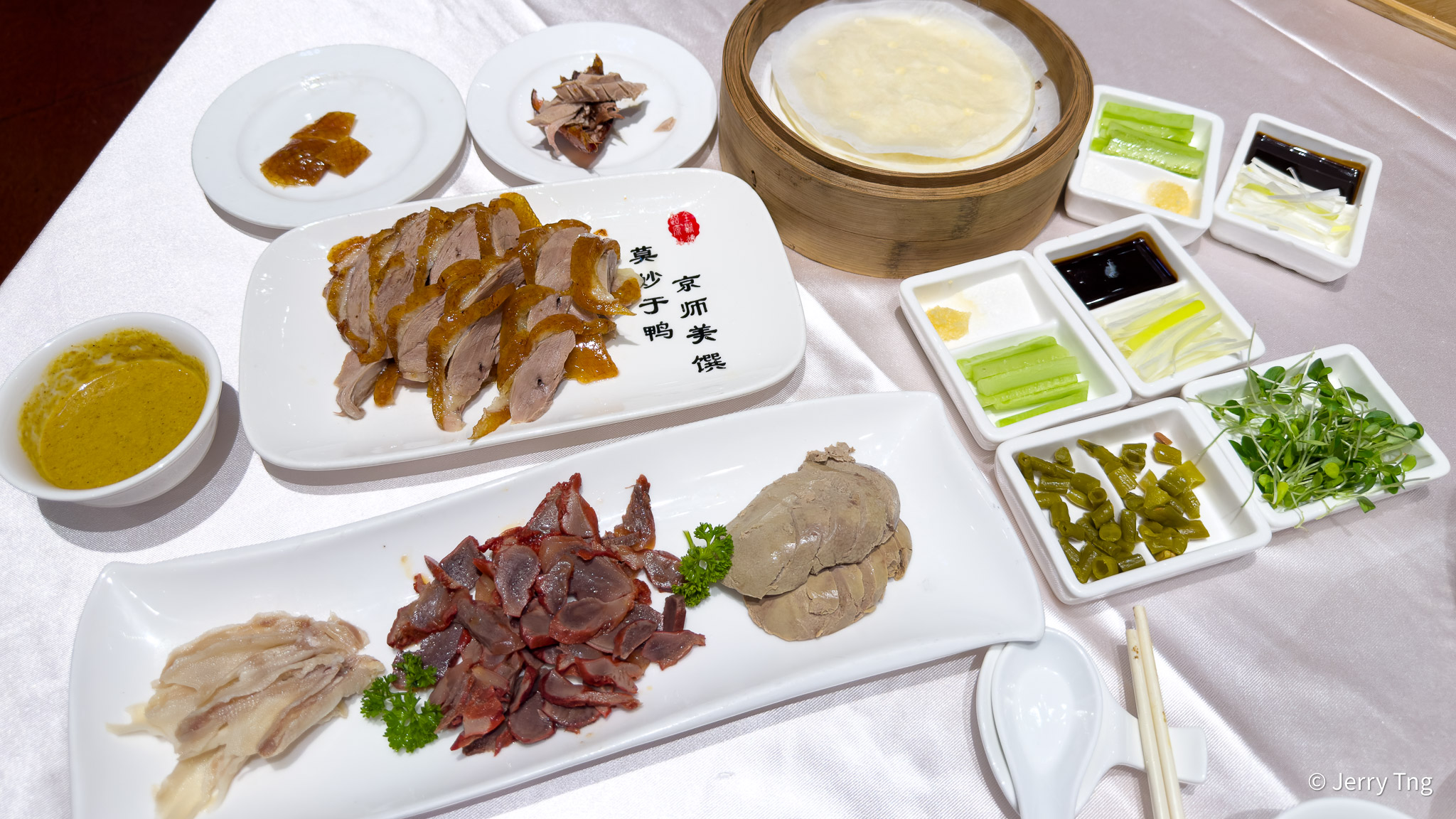
I was pleasantly surprised that they have a set for one (or two) person to enjoy the famous Peking duck, which included one set of crepes, a portion of roast duck and their duck soup.

I ordered a trio of duck appetisers, consisting of some of my favourites. First, the duck feet, deboned and ready to eat with a wonderful yellow mustard dip. Then there’s the duck gizzard roasted with a charsiu like sauce. Finally, the foie gras Chinese-style – duck liver that has been brined and cooked to perfection. Just the right amount with the roast duck set.
As I didn’t order a whole duck, I couldn’t enjoy the carving process. Here’s a video of how it’s done properly.

Peking duck, a representative cuisine of Beijing, has won popularity across the world for its golden, crispy skin and juicy, flavourful meat. The cooking craft of Peking duck, which has been passed down for seven generations in Quanjude, is mainly used in two steps, preparation and roasting. To ensure the quality of its duck, Quanjude only chooses a type of local ducks which are fed and raised in a special way so that the proportion of the fat in the duck meat is strictly under control.

During the roasting procedure, Quanjude uses wood from hard fruit trees and open fire to get a better taste. Meanwhile, the chef will also use a long stick to turn and move the duck from time to time according to his experience, making sure the duck is heated evenly.

The special part is the skin just between the neck and the breast, very crispy, very greasy. The best way to enjoy it is to dip it in sugar and eat it as is.

I have to say I was quite disappointed how the duck was presented. They were quite thick and carved quite haphazardly. Perhaps it’s a small order and they just do it any how. But that’s the same reason why I have not been back for so many years. I cannot be sure if the quality is maintained between visits.

When the founder Yang Shoushan 杨寿山 was the manager, he saw that after the princes and noblemen finished the banquet, they would use the thicker pita-like pancake to wipe their greasy mouth and threw the pancake away and wasted it. Therefore, he was indignant and set the rules of Quanjude. He would provide crepe-like pancakes to roll the duck meat. Diners, regardless their social status started to roll their own roast duck pancakes.

Eating Peking duck is a very hands-on affair like rolling a burrito. The method of eating roast duck by rolling roast duck with shredded cucumber and sugar is said to have been invented by Beijing opera artist Mei Lanfang. Besides that, you must have the special sweet and savoury sauce that has come to be associated with Peking duck.

Many other Peking duck places have moved to egg crepes or other forms of wrapping the duck. But I still prefer this traditional “lotus leaf” crepe. It is the best carrier for the greasy duck skin and the sauces without breaking and making a mess.

The duck soup was really horrible even after all these years. It tasted exactly like what it was, water and duck bones boiled with salt and pepper. I rather be ordering other soup.
History of Quanjude

Quanjude was established in 1864 during the Qing dynasty under the reign of the Tongzhi Emperor (r. 1856-1875). Although Peking duck can trace its history many centuries back, Quanjude’s heritage of roast duck preparation – using open ovens and non-smoky hardwood fuel such as Chinese date, peach, or pear to add a subtle fruity flavour with a golden crisp to the skin – was originally reserved for the imperial families.

The founder of Quanjude, Yang Quanren 杨全仁 (courtesy name Shoushan 字寿山), who started out selling chicken and ducks, paid a retired chef from the palace for the imperial recipe. Soon after, Quanjude began to serve roast duck from the imperial kitchen to the common masses. Yang Quanren opened his first, small store inside Yangrou Hutong in Qianmen (前門), which at the time was one of the busiest areas in Beijing. His restaurant became an instant success and has since grown into the current branch in Qianmen that employs over 400 staff members and can occupy 900 guests at one time.

磚刻老匾,由秀才钱子龙书写(1864年)
This was the original signboard in the old shop dated back to 1864. The one on the wall outside the shop is a brand new one placed during the renovation.


Towards the end of Qing dynasty, eating roast duck was a popular thing to do, and people will gift roast ducks during celebrations. But carrying a roast duck to the function was quite unsightly, so the ingenious folks at Quanjude came up with the duck coupons. Wrapped in a bright red packet, the holder of the coupon can go to Quanjude to exchange for a freshly roasted duck. The 1935 menu showed the courses in a banquet that would set you back 20 Yuan (around 2 months salary), a princely sum of month back then.

In 1950s China, coal purchase was a state-controlled system under central planning, especially post-1949 nationalisation and during the First Five-Year Plan (1953-57) and the chaotic Great Leap Forward (late 1950s). Coal flowed from state/communal mines to state industries, transportation, and local needs, managed via plans. Coal purchase book 购煤本 issued by the state-owned coal industry company records the amount of coal allocated and “purchased”.

It was said that the old shopkeeper often carried it in his pocket. Judging from the coal purchase book, Quanjude bought 3-4 tons of coal on average per month, and they were all high-quality coal. It seems that the business of the old store was still very prosperous at that time.

At the mini-museum in the restaurant, you can see the old oven as well. The old ovens were removed at one point and replaced with electric ones. But thankfully the coal ovens are back.

On June 1, 1952, the Beijing Municipal People’s Government officially announced the public-private joint venture of Quanjude, becoming one of the first three to be granted the status. (The other two were Fengzeyuan 丰泽园饭庄 – now part of the same group as Quanjude – and Tongheju 同和居).

After a merger in 2004 with Beijing New Yansha Group, Quanjude is now a part of the Beijing Tourism Group, a state-owned enterprise. The company’s stock is listed on the Shanghai stock exchange. The group also owns the Imperial cuisine restaurant in Beihai, directly supervised by Quanjude. I wasn’t so sure about dining here, but as a solo diner I couldn’t find a place to satisfy my Peking duck cravings.

Quanjude Vancouver has been award Michelin 1 Star 2022-2025, and the Beijing Qianmen store has been on the Recommend list since 2020. Seriously? The quality of this store is questionable. They are now part of the history of the city, and depending on tourists for the bulk of their business. The locals have totally abandoned them.

While I appreciate the history behind the place, the Peking duck is not exactly the best. I won’t be coming back, not for another 20 years.
Quan Ju De 全聚德 (前门店)
30 Qianmen St, Dongcheng, Beijing, China, 100051
Tel : +86 10 6511 2418
Visited Nov 2025
0 comments on “Quan Ju De 全聚德 @ Beijing”