
This store is very nondescript, but the old Taiyuan people recognise it as value for money. They can have a filling meal for less than 10 RMB, and everything has the same familiar taste of home.

Jia Ji 贾记灌肠 is a chain restaurant with many stores all around the city. The food is quite simple, just local specialties and variations surrounding noodles, wantuo and zhanpianzi. This one is just behind my hotel in downtown Taiyuan.

Over generations—especially in places like Taiyuan and Jinzhong— everyday comfort food like these became a regional emblem. Zhanpianzi reflects Shanxi people’s practical “one-dish” approach: combining staple (batter) and side (vegetables) in one easy process.

太鋼汽水 Taigang soft drink is the original “happy juice” of Taiyuan people. Formed in 1952, Taigang was originally the soft drink manufacturing arm of Taiyuan Steel Mill. Soft drinks were given to steel workers to cool down in the high temperature environment. The classic was the orange flavour, but I really like the lemonade that tasted like Sprite but fizzier.

Zhanpianzi 沾片子, or Dipping Noodles, is a noodle cuisine of Qingxu County. Zhanpianzi’s exact beginnings are hard to pin down, but it clearly grew from thrift and ingenuity. In eras when resources were limited, families stretched vegetables and flour into satisfying meals by coating leaves or strips of produce with batter and boiling them. The result was an economical, filling dish that doubled as both vegetable and staple.

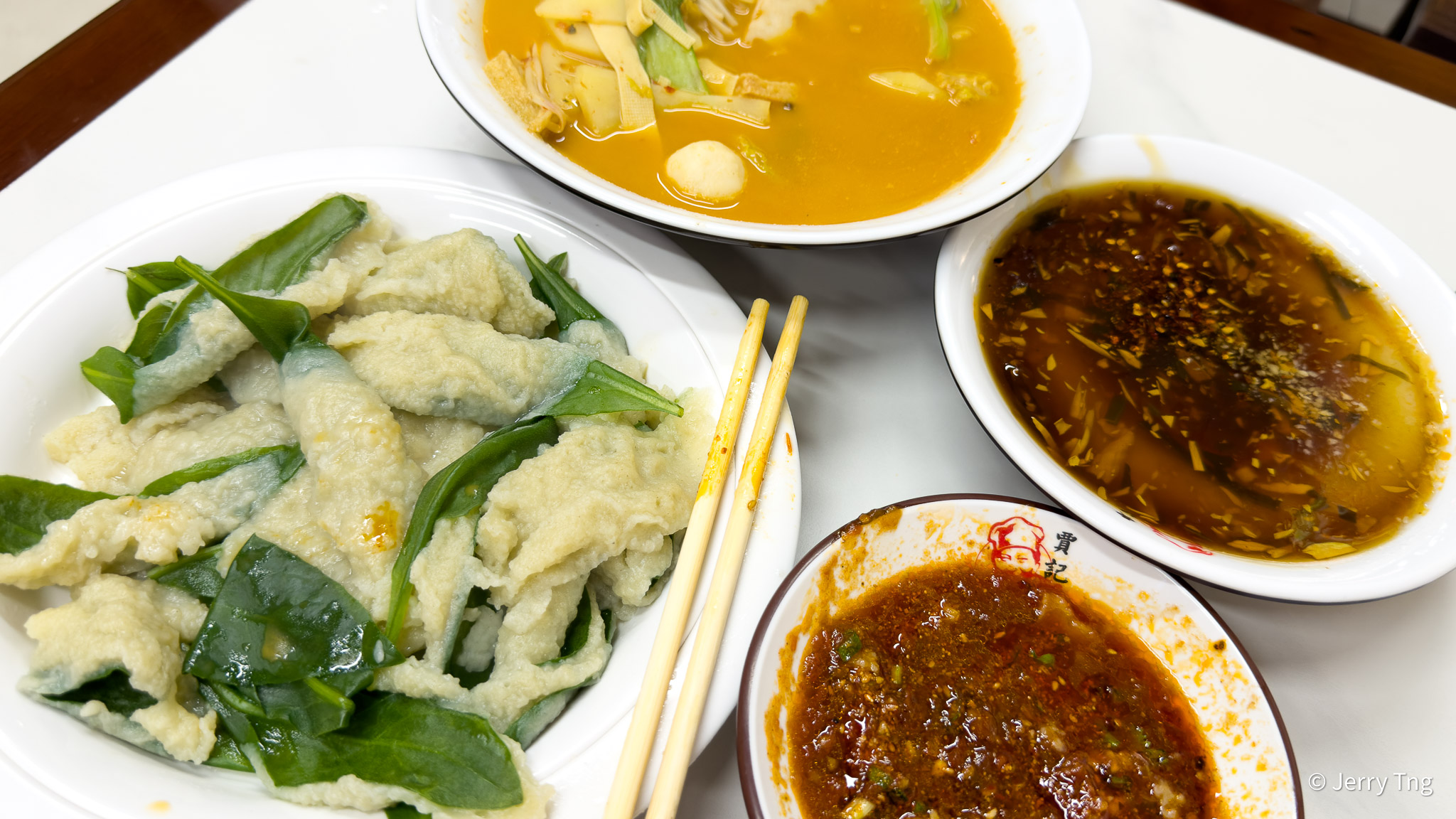
I ordered a portion of Sanqi leaf noodles 三七叶沾片子. Sanqi leaf 三七叶 is the leaf of the Notoginseng Root, more commonly known as Tianqi 田七. The slippery, slightly chewy batter, the vegetable’s fresh sweetness and the bold dipping sauce unfold together on your palate.


If you do not know what to do with the condiment, they have provided a formula to follow. The owner of shop was so nice, knowing that I was having zhanpianzi for the first time, helped me to concoct the final dipping sauce. Then you just take a piece of zhanpianzi and dip it into the sauce and enjoy. The tomato-based sauce made this experience like eating pasta.

Guanchang 灌肠, aka wantuo 碗托, is made from mung bean starch instead of oatmeal. It is served with a soy sauce and vinegar-based sauce. After the buckwheat batter is cooked, it is cooled and solidified in the bowl. The guanchang is then scrapped off the bowl and then cut into pieces. Then the savoury sauce is poured liberally over the wantuo.

You got to mix it up before eating so that every piece of guanchang was coated with the sauce. And if the savoury sauce is not enough, feel free to add another spoonful of chilli oil at the table. If not, it tasted just like a bland piece of steamed flour. Not used to it, even though this was the second time I had it in Taiyuan.

I thought the vegetable stew 冒菜 would be similar to the Szechuan version. It is like a bowl of boiled vegetables in a watered down soup. Can’t complain, only 11 RMB for a huge bowl.

The whole meal was less than $10 in total and there’s enough food for two persons – it’s always difficult to order for one person for me given that my eyes are bigger than my stomach. I was obviously the only non-local in the restaurant, the owner of the shop was curious if I was used to the flavours.
Jia Ji 贾记灌肠
Multiple locations in Taiyuan
Visited Oct 2025
0 comments on “Jia Ji 贾记灌肠 @ Taiyuan”