
Eurasian cuisine is often mistaken with Peranakan. So what is Eurasian cuisine?

To understand Eurasian cuisine, you have to understand a bit of the Eurasian lineage in Singapore. Many would think that it is a simple marriage of European and Asian people, but it is more than that. Before the British East India Company made Singapore an outpost, the Portuguese and Dutch were already active in these waters along the Straits of Malacca and in the Indonesian archipelago.

And with that rich heritage comes a cuisine that is a potpourri of flavours and techniques. The Eurasians grew up from its own cuisine from a wide expanse of cultural influences, the rich history which has transpired throughout Asia. However these days, you can many find the roots among the Portuguese, Indian, Kristang, Macanese (Cantonese-Portugese) and Peranakan to boot.

Eurasian cuisine is an important part of Singapore’s multicultural food heritage. It showcases the blending of East and West through recipes that have been preserved for centuries.
Pastéis De Bacalhau

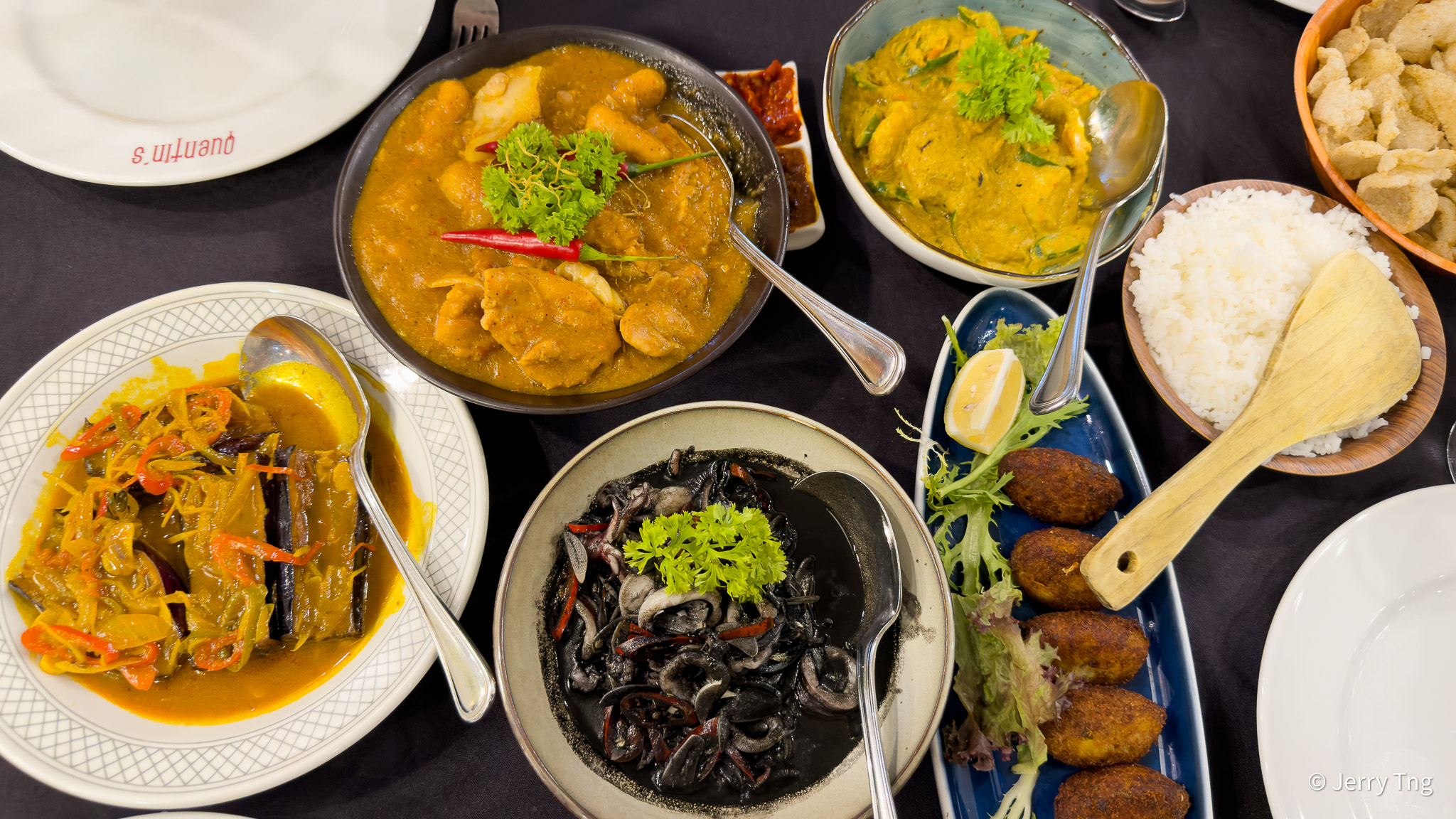
Eurasian cuisine was born from centuries of cultural blending. When the Portuguese and other Europeans settled in Southeast Asia, their culinary traditions merged with local spices and cooking techniques. But tradition dishes like this well-loved Portuguese salted cod fish cakes, aka Pastéis De Bacalhau served with dried codfish pickle sauce, stay true to its roots. A very delicious appetiser.
Chuan-Chuan

Pan-fried codfish fillet in a special blend of sweet, sour and mildly spicy ginger sauce is a classic example of culinary adaptation, combining Chinese, Malay, and European influences.
Prawn Bostador

This Eurasian dish has its roots in Portuguese Malacca and is very much Malay influenced in the spices used. Bostador is actually Creole Portuguese for ‘slap’, Quentin’s Prawn Bostador is a thick coconut based-dish of large tiger prawns cooked in a luscious union of sliced green chillies and a blend of fresh local herbs. While it did not give you the tight ‘slap’, it was complex with many flavours. The key characteristic is the used of green chillies instead of the reds which resulted in a sharper curry.
Black Ink Calamari

This is the Eurasian take on squid stir-fried in onions, garlic, dark soy sauce and squid ink. This is adapted from the a similar dish in Portugal. And the ink was pure black – a natural dye that can’t be replaced by any artificial colouring. Love it.
Patchri

Patchri are eggplants are halved, scored, marinated with pepper and salt, and then fried to perfection. The soul of the dish was Quentin’s special tamarind, sugar, onions and ginger sauce that was smoother on the eggplant in abundance with aromatics.

The saucy dishes were quickly devoured with lots of steamed rice. The sauces were varied, from the spicy chuan-chuan, to the sharp bostador to the tangy patchri. We had to order a second helping of rice to go with these dishes.
Dessert Platter

An assorted mix of Sugee cake, Putugal and Breudher Cake in a platter. Breudher cake is a traditional, buttery cake with Dutch origins, popular among the Eurasian communities in Sri Lanka, Malaysia, Singapore, and Kochi, India. It is a unique cross between a bread and a cake, typically baked in a fluted bundt-style tin. Here, it was made with toddy (fermented sap from a coconut tree flower) as a substitute for yeast, giving it a unique flavour.
Sugee Cake

This is a cake that you will find in every Eurasian wedding. Sugee cake is simply a moist and comforting homemade cake using butter, almonds and semolina flour, topped with marzipan and laced with icing sugar and sprinkled with roasted almonds. Crumply like a muffin but sweet like a Viennese almond cake, the sugee cake is definitely local with the nutty flavour.
Putugal

Putugals are Eurasian steamed rice cakes made with tapioca, shredded coconut, pisang Rajah, butterfly pea flower and pandan extract. At first glance you would have mistaken it with the Malay kueh ubi kayu, but as you bite into one, the caramelised banana in the rice cake made the differentiation.

“Skinny Chef” Quentin learned the art of Eurasian Cooking from his Grandparents. He has taken the bold step of setting up a Eurasian Restaurant knowing full that Eurasian Family cooks will be his harshest critics. Quentin’s Eurasian Restaurant is the leader in continuing to offer these now rare Eurasian dishes to a hungry Singapore and is universally acclaimed as offering some of the most delicious food in the City, Eurasian or otherwise.

Whether or not you have tried Eurasian cuisine, I would recommend for you to come for the homely feeling and an excellent meal.
Quentin’s Eurasian Restaurant
139 Ceylon Rd, Level 1 Eurasian Community House, Singapore 429744
Tel : 6348 0327 (Reservations)
Visited Nov 2025
0 comments on “Quentin’s @ Joo Chiat (2025)”