
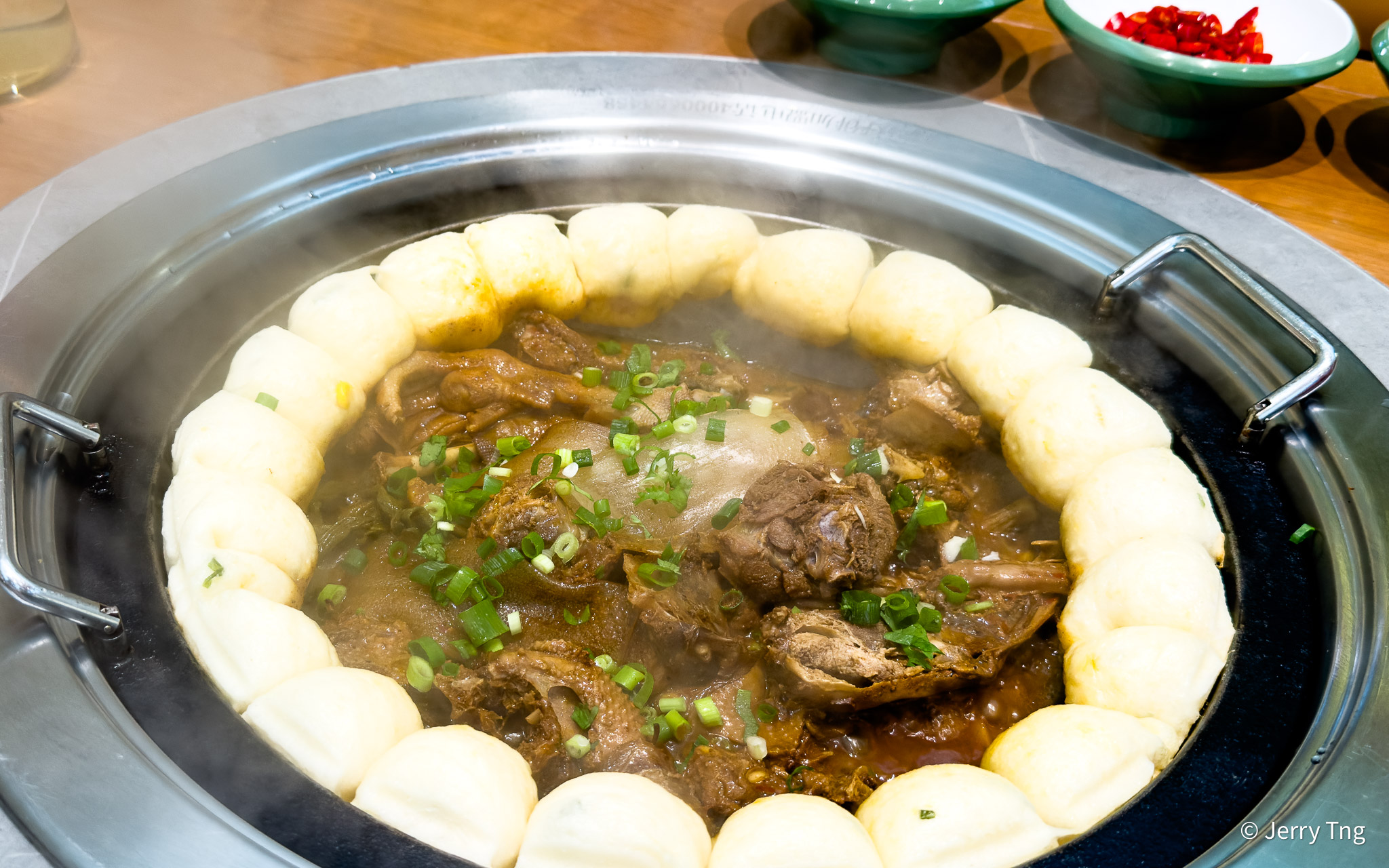
If there’s one thing to define Dongbei cuisine, it has to be the Dongbei Cast Iron Pot Stewed Goose 东北铁锅炖大鹅.

Mama’s Buns is a chain restaurant specialising in Dongbei-style cast iron pot stew. You can choose from pork ribs, chicken, freshwater fish, besides the goose. And on top of each stew, there’s the Dongbei-style Hubing (cornbread).

If there’s a cultural pattern for Dongbei, it would have to be their floral pattern. 东北大花 Dongbei Dahua, aka Dongbei Big Floral Print, is a type of clothing fabric with distinct folk characteristics, unique because of its red and green colour blocking, phoenix and peony patterns, etc. Its origin can be traced back to the Soviet printed fabric in the 1950s, which was imported in bulk to China through trade due to surplus, but it was not used for clothing because the patterns were too bright. It was mostly used as home textiles such as bed sheets and quilt covers.

The bright colours of the Dongbei Dahua pattern also align with the “dopamine dressing” trend, where people choose colourful clothing to lift their mood. And you can see these colour combinations in the restaurant, like the cups, lights, and others.


The restaurant also offers side dishes like Korean kimchi, Dongbei pickles as well as unlimited servings of grit porridge 大渣粥.

Dongbei Cast Iron Pot Stewed Goose 东北铁锅炖大鹅 is a classic stew dish in Northeast China and belongs to the Dongbei (Northeastern) cuisine. It uses local geese that have been free-range for more than a year as the main ingredient, along with side dishes such as cabbage and vermicelli. Goose is one of my favourite food, and wherever and whenever I get a chance, I would order it. But a whole goose is big enough to feed four. So imagine our shock when the food was served.
After special marinating, stir-frying in a cast iron pot over firewood with a secret sauce that is different with each family, it needs to be stewed for about 1 hour until the meat is tender.

Traditional cooking requires a cast iron pot, along with more than a dozen spices such as dried chili peppers, Sichuan peppercorns, and cinnamon. The finished product has a golden skin and the soup is infused with the fresh flavour of goose meat.

This dish carries the folk culture of Northeast China and has been included in the list of intangible cultural heritage, becoming a symbol of regional food culture. It uses plump farm geese, along with special side dishes such as pickled cabbage and dried potatoes. It is often eaten with corn cakes. The steaming hot iron pot stewed goose is a warm memory of the year-end reunion of Northeast families.

Hubing 烀饼 is a traditional specialty cornbread especially from Liaoning, which is stuck to the rim of the pot and steamed until cooked, combining the aroma of the stew with a chewy texture and ability to absorb the broth from the stew.

These days, the gas stove replaced the firewood stove, lacking that smokiness. Thankfully the cast iron pot is still used, retaining a bit of the wokhei. Besides the goose, the pot was full of other ingredients like corn, potatoes, string beans and vermicelli.

The moment the lid was lifted, the aroma filled my nostrils. The goose meat was firm yet tender, falling off the bone with a gentle tear, making it incredibly satisfying to gnaw on. The cornbread was crispy on one side and soaked in the meat broth on the other, bursting with flavour with every bite.


My favourite part was the goose head. It may looked yucky at first glance but once you get over the fear factor, the flavour and texture will grow onto you.

Dongbei frozen pears 东北冻梨 are a specialty fruit of Northeast China during winter. Pears are repeatedly frozen outdoors and then naturally thawed. The skin turns black, and the flesh is dense, juicy, and sweet. The proper way to eat them is to thaw them in cold water and then suck out the juice. It’s a unique winter delicacy for Northeasterners and also a cultural symbol. The low temperature causes the pear cells to rupture, concentrating the sugar, resulting in a taste and flavour completely different from fresh pears.

The portion was huge, just like everywhere else in Shenyang. Service was below par compared with other Chinese cities like Shanghai, but better than others like Beijing, if you know what I mean. But the food was genuine and hearty. And definitely worth a visit if you are in town.
Mama’s Buns Restaurant 满兴咱妈烀饼铁锅炖(太原街万达店)
沈阳和平区太原街万达广场4楼
Visited Sep 2025
0 comments on “Mama’s Buns 咱妈烀饼 @ Shenyang”