
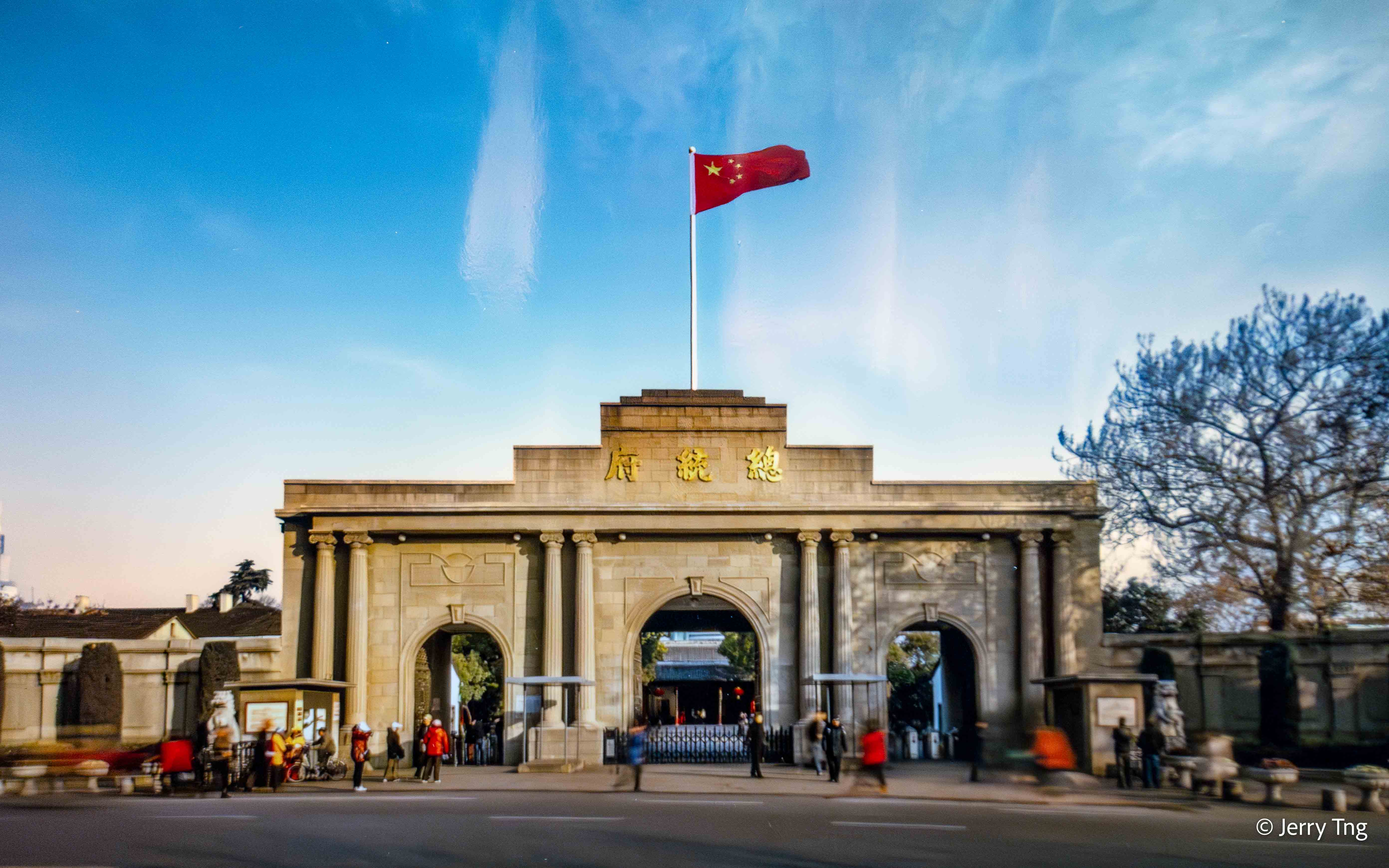
The Presidential Palace in Nanjing housed the Office of the President of the Republic of China from 1927 until the capital was relocated to Taipei in 1949. It is now a museum called the China Modern History Museum.
Table of Contents
History of the Presidential Palace

The Presidential Palace has a history of over 600 years. In the early Ming Dynasty, it served as the residence of the Marquis of Guide 归德侯 and the Prince of Han 汉王. During the Qing Dynasty, it was the Jiangning Textile Bureau, the Governor-General’s Office of Jiangnan, and the Governor-General’s Office of Liangjiang. Both the Kangxi and Qianlong Emperors of the Qing Dynasty used it as their temporary palace when they traveled to the south of the Yangtze River.1
Taiping Heavenly Kingdom 太平天国 (1851—1864)

In March 1853, the Taiping Army captured and established its capital in Nanjing. Hong Xiuquan 洪秀全 (1814-1864) built the grand Taiping Heavenly Kingdom Palace (Heavenly King’s Palace) there. After the Qing army captured Nanjing, they burned down the palace buildings and rebuilt the Viceroy’s Office of Jiangsu and Zhejiang (aka Liangjiang 两江) in 1870. Lin Zexu, Zeng Guofan, Li Hongzhang, Liu Kunyi, Shen Baozhen, Zuo Zongtang, Zhang Zhidong, and Duanfang all served as Viceroys of Liangjiang 两江总督.2

In 1851, Hong Xiuquan led over 20,000 members of the God Worshipping Society in an uprising in Jintian Village, Guangxi, establishing the Taiping Heavenly Kingdom. In 1853, the Taiping army established the Taiping Heavenly Kingdom regime in Nanjing, which confronted the Qing Dynasty. In July 1864, the Taiping peasant uprising failed under the combined suppression of domestic and foreign reactionary forces.3
Republic of China 中华民国 (1912-1949)

Following the outbreak of the Xinhai Revolution in October 1911, Sun Yat-sen was sworn in as the Provisional President of the Republic of China here on January 1, 1912, and established the first republican government in Chinese history—the Provisional Government of the Republic of China.

On 29 December 1911, delegates from the 17 independent provinces held the Provisional Presidential Election of the Republic of China in Nanjing and elected Sun Yat-sen as the provisional president. In the evening of 1 January 1912, the inauguration ceremony of the Provisional President of the Republic of China was held at the Presidential Palace in Nanjing. The founding of the Republic of China was officially proclaimed.4

On 31 December 1911, the day before Sun Yat-sen’s inauguration as provisional president, Nanjing military police began to cut off the queues of passers-by on the streets. Besides the political transition from a monarchy to a republic, initiatives including the adoption of the Gregorian calendar and the removal of queues showed the Republic’s resolve to innovate social customs and culture.


After taking his oath of office, Sun released the Declaration of Provisional President Sun Wen《中華民國大總統孫文宣言書》(Sun Wen being Sun Yat-sen’s other name), proposing the country’s approach to ethnicity, territory, military administration, internal governance, finance and so forth.


to announce the return of “Han” rule in China
In April 1912, the Provisional Government dissolved, and the Nanjing Garrison Headquarters was established here, with Huang Xing as its garrison commander. During the Second Revolution in 1913, it became the headquarters of the anti-Yuan Shikai army, with Huang Xing and He Haiming serving as commanders successively.

From 1913 to 1927, this location successively served as the Jiangsu Governor’s Office, the Jiangsu Military Governor’s Office, the Jiangsu General’s Office, the Jiangsu Governor’s Office, the Vice Presidential Office, the Pacification Commissioner’s Office, the Headquarters of the Five-Province Allied Army, and the Joint Office of the Zhili-Shandong Allied Army, among other institutions.5

Shortly after the establishment of the Nanjing National Government in April 1927, it moved its offices here in September. In October 1928, the National Government implemented a “five-branch system,” designating the East Wing (East Garden) as the Executive Yuan’s office and the West Wing (West Garden) as the General Staff Headquarters and the Accounting and Budgetary Affairs Office. By November 1937, Tan Yankai, Chiang Kai-shek, and Lin Sen had successively served as Chairman of the National Government; Tan Yankai, Song Ziwen, Chiang Kai-shek, Chen Mingshu (acting), Sun Ke, and Wang Jingwei had successively served as Premier; Li Jishen, He Yingqin, Zhu Peide, Chiang Kai-shek, and Cheng Qian had successively served as Chief of the General Staff; and Chen Qicai had served as Chief Accountant.

On 20 May 1948, after Chiang Kai-shek and Li Zongren were elected President and Vice President respectively at the “Constitutional National Assembly,” the National Government was renamed the Presidential Office.6
Post Liberation (1949 onwards)

Nanjing was liberated on April 23, 1949, and the People’s Liberation Army occupied the Presidential Palace on April 24.

For nearly 50 years after the liberation of Nanjing, the Presidential Palace served as the office space for government agencies. Since the 1980s, these agencies gradually relocated, and in 1998, construction began on the site of the former Presidential Palace to build the Nanjing Museum of Modern Chinese History. After careful planning and five years of construction, it was largely completed by 2003.7
Central Axis 中轴线
The main axis of the Presidential Palace complex consists of the gate tower, main hall, second hall, eight-character hall, reception hall, Qilin Gate, government affairs bureau building, and Zichao Building. The architectural style is predominantly Chinese in the front half and predominantly Western in the rear half.8
Gate Tower (Main Gate) 总統府门楼

Built in 1929 and designed by Yao Bin, this gatehouse is also the former site of the Zhenshen Rongguang Gate of the Taiping Heavenly Kingdom’s Heavenly Palace, the former site of the Qing Dynasty’s Liangjiang Governor-General’s Office, and the former Governor-General’s Office. In front of this gatehouse, which is in the typical ancient Roman architectural style, the stone lions in front of the Governor-General’s Office were preserved, and a screen wall was added (which was later demolished in 2003 due to the widening of Changjiang Road).9

The plaza between the gatehouse and the main hall is paved with cement flagstones, with some column bases regularly hidden beneath them. The east and west wing rooms still retain their Qing Dynasty architectural style. The east wing room once housed the three departments of Personnel, Revenue, and Rites of the Governor’s Office, while the west wing room housed the three departments of Military Affairs, Justice, and Public Works. During the Republic of China period, they served as guard rooms.10
Main Hall 大堂

The main hall, with its red pillars, grey tiles, and square brick flooring, was built on the original site of the Glory Hall 荣光大殿 of the Taiping Heavenly Kingdom. A horizontal plaque bearing the inscription “The World Belongs to All” in Sun Yat-sen’s handwriting hangs in the center of the hall.


Behind the main hall are east and west wing rooms, connected to the second hall by a closed, Western-style, square-pane frosted glass passageway. To the east of the passageway is a Qing Dynasty courtyard house, and to the west is the main auditorium.11
Second Hall 二堂(中堂)

The second hall is the True God Heavenly Father Hall 真神天父殿, where Hong Xiuquan handled important military and national affairs. Inside, there are four thick red pillars, and the upper part of the arched north door has a lattice window. The ceiling, walls, roof, doors and windows are all made of wood, and with the double eaves and blue tiles, it looks like a standard Chinese building at first glance. However, its north exterior is a typical Western style, with a keystone embedded in the huge arched door and decorated with Western patterns.12
The President’s Reception Room 总统会客室

The arched outer corridor on the north side of the second hall connects to the east and west buildings. The open passageway to the north connects to a Western-style bungalow. The bungalow’s design is similar to that of the West Flower Hall.

The colourful stone steps in front of the door unfold in the shape of the character “八” (eight), hence the name “Eight-Character Hall.” It was a place where guests often took photos when bidding farewell to each other.13

It was built in 1917 by the Vice President of the Northern Warlords Government Feng Guozhang 冯国璋.14 During the periods of the Nationalist Government and the Presidential Government, this room successively used to be the reception room of the Chairman of the Nationalist Government and the President. The whole reception room was divided into two parts by the centre aisle. The room on the east side was the office of the Chairman and the President.

The room on the west side was a place to meet foreign guests. Chiang Kaishak used to receive the envoys of various countries and foreign visitors. They often took photos on the steps. Marshall, Leighton Stuart and Wedemeyer had all been here at that time. 15

Both the east and west bungalows have arched doorways and outer corridors. In the corridors is a traditional Chinese red double-door wooden door, which is still opened with a door jamb and is called the “Qilin Gate”. The Kirin Gate is a red gate situated on the north of the reception hall. This gate would open only if the president went through this place. The gate leads to the House of the Government Affairs, the original office building of the Chairman of the Nationalist Government. However, the real Qilin Gate was demolished in the early 1950s. It was located two or three meters north of the Red Gate, where the words “Made by Jiankang Construction Factory” and “24th year of the Republic of China” are still left on the ground.16
Bureau of Administration Building 政务局办公楼

The two-story Western-style building behind the corridor was built in 1925. It was the best office building in the Presidential Palace before the Zichao Building was built. It served as the office building for the Civil Service Office and later as the office building for the Political Affairs Bureau.17
Office Building of the Presidential Palace 总统府办公楼(子超楼)

At the northernmost end of the central axis stands the Office Building of the Presidential Palace 总统府办公楼, aka Zichao Building 子超楼, the most important building within the Presidential Palace. Designed by Yu Binglie, it was completed by Lu Chuang Construction Company in December 1935.

This was a rare high-rise building at the time, with the middle section being taller at six stories and the two sides slightly lower at five stories, symmetrically arranged, and constructed of reinforced concrete.18
West Axis 西轴线

The western axis consists of the Provisional Presidential Secretariat, Zhongshan Square, the Provisional Presidential Office of Sun Yat-sen, and the General Staff Headquarters of the National Government. The buildings along this axis primarily showcase Sun Yat-sen’s achievements, with the Provisional Presidential Office of Sun Yat-sen being the core.19
The Secretariat of the Provisional President 总统府秘书处

The Secretariat of the Provisional President was rebuilt in 2003 based on historical records. The courtyard between it and the Provisional President’s Office was expanded into Zhongshan Square in 2011 to commemorate the centenary of the Xinhai Revolution, and a seated statue of Sun Yat-sen stands there. This single-story building, modeled after the French Renaissance style, was built by Duanfang, the Viceroy of Liangjiang during the late Qing Dynasty, after his return from a trip to Europe and America. Originally named “Baohua’an,” it served as a guesthouse for important guests. Because it was located in the western part of the Viceroy’s residence, it was also known as “Xihua Hall.”20
The Office of the Provisional President Sun Yat-sen 孙中山临时大总统府办公室

The Commission House, variously called the West Garden Hall and the Office of the Provisional President, was built in 1909 by Duanfang, the 80th Viceroy of Liangjiang, who visited Europe just before the construction started. The construction finished in 1910, during the period of Zhang Renjun, the last Viceroy of Liangjiang. From 1 January 1912, the house was used as the office of the provisional president by Sun Yat-sen, thus becoming one of the birthplace of the Republic of China.

The first cabinet council of the provisional government was held in the house as well. Since 1927, the house was served as the seat of the Military Affairs Commission, which grasped the real power of the Nationalist Government. Today this yellow house is also a popular tourist attraction in the Presidential Palace.
The General Staff House 参谋本部办公楼

Built in 1935, the General Staff Headquarters building now serves as an exhibition hall for historical materials related to Sun Yat-sen and the Nanjing Provisional Government.

Bo’ai Lake, located to the north of the building, was created in 2003 after the demolition of surrounding scattered houses and is now planted with greenery, providing a place for people to relax.21
Assembly Hall 总统府礼堂

Originally part of the west wing of the main hall of the Qing Dynasty’s Viceroy of Liangjiang, it underwent several renovations during the Republican era. Many important meetings, formalities, and diplomatic activities of the Nationalist government were held here, such as the “National Army Reorganisation Conference” held in 1929 and the “Commemoration of President Sun Yat-sen” “总理纪念周”22 held every Monday.23
Accounting Department Building 主计处办公楼


The Accounting Department Building was built in 1935 and is shaped like the Chinese character “回” (hui). It was later used as office space for the Military Command, the General Staff Headquarters, and the Capital Garrison Command.24
The Library of the Presidential Palace 总统府图书馆

The three-story building on the north side of the lake was built in 1929. It was initially the office building of the General Staff Headquarters, and later the library of the Civil Service Office of the Nationalist Government. The bungalow was originally an archive room, and has now been converted into a tourist restaurant.25
Xu Garden 煦园
Xu Garden 煦园 was named after Prince of Han, Zhu Gaoxu 朱高煦. It consists of the Office Building of the Directorate-General of Budget, Accounting and Statistics, Tongyin Hall, Flower Hall, Theater Stage, and Sun Yat-sen’s Former Residence. It was completed in 1870, during the period when Zeng Guofan renovated the Viceroy’s Office.26

Taiping Lake, the heart of the West Garden, was originally a pond and stream leading to the moat of Yangwu City. After several dredgings, it took on a bottle-shaped form, symmetrical from east to west and narrower in the north and wider in the south, with a circumference of over 500 meters. East pavilions and west towers, north pavilions and south boats, are asymmetrically built around the lake.
Wangfei (Forget to Fly) Pavilion 忘飞阁水榭

The Wangfei Pavilion 忘飞阁 , situated on the eastern bank of Taiping Lake, faces the Xijia Tower 夕佳楼, which is also surrounded by water on three sides, across the lake, offering an excellent vantage point for viewing the garden’s beauty.27 This pavilion was built in the reign of the Qing Emperor Kangxi and rebuilt in the ninth year of the reign of the Qing Emperor Tongzhi (1870). The scenery around it is so beautiful that birds forget to fly away. Hence the name.28
Xijia (Dusk Beauty) Tower 夕佳楼

The tower was built in the ninth year of the reign of the Qing Emperor Tongzhi (1870). It is called the Xijia Tower because the setting sun casts a golden glow over the tower. 29
The Stone Boat 石舫(不系舟)

The Stone Boat 不系舟 is the oldest remaining structure in the compound, built by Yin Jishan, the Viceroy of Liangjiang during the Qing Dynasty, and named by Emperor Qianlong himself.

Today, apart from the stone materials, the wooden structure has been replaced several times, and the Taiping Heavenly Kingdom-style cabins were added after the founding of the People’s Republic of China.30
Yilan (Ripples) Pavilion 漪澜阁

Yilan Pavilion stands in the water, connected to the shore only by stone bridges on either side, which is why the Taiping Heavenly Kingdom chose this location for its secret service. In the early 1930s, it served as a senior staff office. This pavilion was rebuilt in the ninth year of the reign of the Qing Emperor Tongzhi (1870) . After the Provisional Government of the Republic was established in 1912 , Sun Yat-sen sometimes worked and received guests here. 31
The Tongyin (Sound of Rain) Hall 桐音馆

The hall built in the ninth year of the reign of the Qing Emperon Tongzhi (1870) was called “Tongyin Hall” because of the sound of rain falling on the leaves of the trees. Tongyin Hall is nestled among several paulownia trees and served as the office of the Director of the Military Affairs Bureau during the Republic of China period.

The artificial hill between this hall and the Flower Hall was built over several phases. The Flower Hall, the stage, and the rectangular corridor to its east are all late Qing Dynasty buildings. Sun Yat-sen once held meetings and received guests here, and it was later used for poetry gatherings and private parties, before becoming the office of the Military Affairs Bureau.32

Wax Figures of Zeng Guofan Played Go
In his later years, Zeng Guofan played two games of chess almost daily without interruption. His residence, including the Tongyin Hall, was where he played against others. Due to excessive chess playing, his mental and visual abilities were depleted. On the tenth day of the fourth month of the tenth year of the Tongzhi reign (1871), he felt unusually tired and listless, and for the next three days he was too weak to play chess. During these three days, Zeng Guofan struggled to write, read intermittently, and frequently rose and sat. Finally, after lunch on the thirteenth day, he managed to play two more games of chess, immediately feeling refreshed and invigorated. From then until the day before his death, he played two games of chess every day.33
Sun Yat-sen’s Former Residence 孙中山起居室

The two-story building that served as Sun Yat-sen’s living quarters was used as a residence for the wives and children of governors-general during the late Qing Dynasty.34
East Axis 东轴线

The East Garden, also known as the Restored Garden, was the additional garden of the viceroy’s office. During the period of Taiping Rebellion, it became the east garden of the Celestial Palace. After the troops of Qing dynasty captured the palace, the east garden was totally destroyed. When the Nationalist Government came to Nanjing, some minor office buildings attached to the Executive Yuan were built on the site, which were all demolished in the 2000s. In 2003, the garden was partly rebuilt according to the historical information. Some other buildings, like the warehouse, were rebuilt at the same time.
Golden Dragon Hall 金龙殿

The Qing Dynasty courtyard to the east of the main hall now houses the Taiping Heavenly Kingdom and Heavenly Dynasty Palace Relics and Historical Materials Exhibition Hall, which recreates scenes such as the Heavenly King’s throne, study, privy council chamber, and empress’s palace.

The Golden Dragon Hall was located at the centre of the Heavenly Dynasty Palace of the Taiping Heavenly Kingdom. The hall with a dome and double eave roof looks tall and imposing. The walls of the hall painted with dragons, tigers, lions and elephants. The horizontal board on the front wall is inscribed with four golden characters, Taiping, yitong.

The hall was designed by the Heavenly King Hong Xiuquan and its construction was also overseen by Hong Xiuquan. After the completion of the hall, Hong Xiuquan and the officials discussed the state affairs here.35

The two exhibition rooms were built in the late Qing Dynasty and served as offices for the General Affairs Bureau during the Republic of China period. East Lake was created in 2003 by demolishing the original buildings on the site. In the early 1930s, an auditorium, dining hall, and staff dormitories were built here.36
Secret Room of the Heavenly King 天王机密室

It is the place where Hong Xiuquan perused the official documents and discussed state affairs with important officials of the Taiping Heavenly Kingdom.
Study of the Heavenly King 天王书房

According to recordings of historical documents. the Heavenly King secluded himself in the palace seldom went out and spent a lot of time in writing painting and calligraphy.
Executive Yuan 行政院

The Executive Yuan North Building, completed in 1928, is a two-story concrete building extending southwards in a concave shape. The central roof is pointed, with platforms on either side. The South Building, designed by Zhao Shen, was completed in June 1934.37

Both buildings have air-raid shelters on the ground floor, which is a characteristic of wartime Republican-era architecture.38 Japanese planes often made attacks on Nanjing after the outbreak of the Shanghai conflict on 28 January 1932. This air-raid shelter was built along with the construction of the Nationalist Government office building. The main structure of the shelter which was made entirely of steel cement was two stories The shelter was only a dozen meters away from the chairman’s office. When the Japanese troops occupied Nanjing, the Nationalist Government had already headed west. As a result, this shelter didn’t put into service. On the eve of the liberation in 1949, Presidential Government officials burnt a lot of documents in the shelter.39

Originally, there were 10 rows of single-story buildings here. During the Taiping Rebellion and the Governor’s Office period, they served as stables. During the Republic of China period, they successively housed a printing and minting bureau factory, a military band, a guard unit, a traffic corps, a sanitation team, and dormitories for the military staff and the accounting department. In 2003, four rows of single-story buildings were demolished as part of the overall plan. The remaining four rows are used for exhibitions on the late Qing and Republican periods, and two rows are used to recreate the scenes of the stables and the military band.40


The Executive Yuan’s north gate doesn’t actually face due north, but rather slightly east. Because the main gates of the Nationalist Government and the General Staff Headquarters faced south, occupying the entire area north of Guofu Road (now Changjiang Road), and the railway line running through the city on the East Arrow Road restricted the eastward and northward expansion of the office area, the Executive Yuan was relegated to the northeast corner. Since the East Arrow Road wasn’t wide enough for convenient vehicular traffic, an east gate was soon opened not far to the east. Both gates are quite distinctive and are well-preserved.41
China Modern History Museum 南京中国近代史遗址博物馆


The Presidential Palace in Nanjing has a history of over 160 years, it has now become China’s largest museum of modern history. For more than 100 years, from the Opium War of 1840 to the liberation of Nanjing in 1949, Nanjing, as the political center of modern China, repeatedly served as the political and military hub and the birthplace of major events.

This huge compound is rich in history; it was the residences of Qing governor, capital of the Taiping Kingdom and later the government headquarter of the Chinese republic. The vast site includes buildings of different times and backgrounds.


A series of significant events in Chinese history either occurred here or were closely related to this location, and many important figures were active here. This architectural complex has become an important site in modern Chinese history.45

In addition to the central axis, the Presidential Palace in Nanjing also has three or four smaller axes on each of its east and west sides. The Presidential Palace complex has gone through the historical periods of the Six Dynasties, Ming and Qing Dynasties, Taiping Heavenly Kingdom and the Republic of China, and finally established the basic layout of the complex as it is today.
In the process of expansion, renovation and reconstruction, a total of eight axes of various sizes have been created.46
China Modern History Museum 南京中国近代史遗址博物馆
No. 292 Changjiang Road, Xuanwu District, Nanjing, China
江苏省南京市玄武区梅园新村街道长江路292号
Footnotes :
- 总统府,迄今已有600多年的历史。明朝初年曾是归德侯府和汉王府。清朝为江宁织造署、江南总督署、两江总督署。清朝康熙、乾隆皇帝下江南时均以此为“行宫”。 ↩︎
- 1853年3月太平军占领南京,定都天京,洪秀全在此兴建了规模宏大的太平天国天朝宫殿(天王府)。清军攻破南京后,焚毁宫殿建筑,于同治九年(1870)重建了两江总督署。林则徐、曾国藩、李鸿章、刘坤一、沈葆桢、左宗棠、张之洞、端方等均任过两江总督。http://总统府景点介绍.网址, accessed 28 Jan 2026 ↩︎
- 1851年,洪秀全率拜上帝会会众2万余人在广西金田村宣布起义,建号太平天国。1853年太平军在南京建立与清王朝对峙的太平天国政权。1864年7月,在中外反动势力联合镇压下,太平天国农民起义失败。 ↩︎
- https://chiculture.org.hk/en/photo-story/2158 ↩︎
- 1911年10月辛亥革命爆发后,1912年1月1日,孙中山在此处宣誓就任中华民国临时大总统,并组建了中国历史上第一个共和制的国家政权──中华民国临时政府。1912年4月,临时政府结束,在这里成立了以黄兴为留守的南京留守府 ;1913年“二次革命”中 ,又成为讨袁军总司令部,黄兴、何海鸣先后任司令。1913年至1927年,这里先后成为江苏都督府、江苏督军署、江苏将军府、江苏督办公署、副总统府、宣抚使署、五省联军总司令部、直鲁联军联合办事处等机构。 ↩︎
- 1927年4月南京国民政府成立后不久,即于9月移驻这里办公。1928年10月,国民政府实行”五院制”,辟国民政府东院(东花园)为行政院办公处 ,国府西院(西花园)为国民政府参谋本部和主计处。 至1937年11月,谭延闿、蒋介石、林森先后任国民政府主席;谭延闿、宋子文、蒋介石、陈铭枢(代理)、孙科、汪精卫先后任行政院长 ;李济深、何应钦、朱培德、蒋介石、程潜先后任总参谋长;陈其采为主计长。1948年5月20日,蒋介石、李宗仁在”行宪国大”分别当选总统和副总统后,国民政府改称总统府。 ↩︎
- 1949年4月23日南京解放,24日,中国人民解放军占领总统府。从此,揭开了中国历史新的一页。南京解放后的近50年中,总统府一直作为机关的办公场所。 自20世纪80年代以来,机关单位陆续搬迁,并于1998年在总统府旧址之上,开始筹建南京中国近代史遗址博物馆。经过精心的规划和五年的建设,至2003年已初具规模。 ↩︎
- 总统府建筑群的主轴线,由门楼、大堂、二堂、八字厅、会客厅、麒麟门、政务局楼、子超楼组成。建筑风格前半部分以中式为主,后半部分则以西式居多。 ↩︎
- 门楼建于1929年,姚彬设计。这里也是太平天国天朝宫殿的真神荣光门、清两江总督署以及旧督军署大门旧址。在这典型的古罗马建筑风格门楼前,保留了督署前石狮,并加建了照壁(后于2003年因长江路拓宽被拆除)。 ↩︎
- 门楼与大堂间的广场由水泥条石铺成,有些柱础规律地掩于条石下。东、西朝房依旧保持清代建筑风格,东朝房曾为督署的吏户礼三科,西朝房曾为兵刑工三科。民国时期是卫士室。 ↩︎
- 红柱灰瓦、方砖铺地的大堂建于太平天国荣光大殿原址,大堂正中悬挂孙中山手书“天下为公”横匾。大堂后有东、西厢房各一,其后由封闭的西式通体方格毛玻璃封闭穿堂与二堂相连。穿堂东面是一清代四合院,西面是大礼堂。 ↩︎
- 二堂位置是洪秀全处理军国大事的真神天父殿,内有4根粗壮红柱,拱形的北门上部是空格窗,天棚、四壁、屋顶、门窗皆为木结构,加上重檐青瓦,粗看是标准中式建筑,其北面外部却又是典型的西式风格,硕大的拱形门上嵌有拱心石,并饰以西式花纹。 ↩︎
- 二堂北面的拱门外廊与东、西建筑相连,正北的敞开式穿堂与一座西式平房相连,平房造型与西花厅相似,门前的彩色石子台阶呈“八”字状展开,故称“八字厅”,是当年送别宾客时经常合影留念的地方。 ↩︎
- 八字厅通入的平房建于1917年,是冯国璋任副总统时期在一次大火后的废墟上所建,后来作为内、外宾会客室。后面又是一条中西合璧的开放式长廊,地面上的彩色磨石至今花纹鲜亮如新。 ↩︎
- 1917年5月北洋政府副总统冯国璋所建。国民政府、总统府时期先后为国府主席、总统会客室。中间穿道将会客室分为东、西两个部分,东边是主席、总统办公之处,内里有隔间;西边一大间,为会客之处。蒋介石曾在此会见各国使节和外宾、并在正中穿道台级上合影,马歇尔、司徒雷登、魏德迈等都曾在此驻足。 ↩︎
- 东、西所通平房都有拱门外廊,走廊中却是一樘极具中国传统的红色双扉木门,至今仍用门臼开启,名曰“麒麟门”。不过,真正的麒麟门已在上世纪50年代初被拆除,地址位于红门以北两三米处,那里地上还留有“建康营造厂制”、“民国二十四年”的字迹。 ↩︎
- 长廊后的两层西式楼房建于1925年,是子超楼建成前总统府内最好的办公楼,曾作为文官处办公楼,后来是政务局办公楼。 ↩︎
- 中轴线的最北端,就是大名鼎鼎的子超楼,也是总统府内最重要的建筑。虞炳烈设计,1935年12月由鲁创营造厂建成。这是当时少见的高楼,中间高些,有六层;两边稍低,为五层,左右对称,钢筋混凝土结构。 ↩︎
- 西轴线由临时大总统秘书处、中山广场、孙中山临时大总统办公室、国民政府参谋本部楼组成。这条线的建筑以展现孙中山业绩为主,孙中山临时大总统办公室是核心。 ↩︎
- 临时大总统秘书处系2003年根据史料复建。它与临时大总统办公室之间的庭院,于2011年纪念辛亥革命百年之际扩建为中山广场,并立有孙中山先生坐像。这幢仿法国文艺复兴风格平房,是清末两江总督端方赴欧美考察回国后所建,初名“宝华盫”,作为接待重要宾客的馆驿。因位于督署西部,又名“西花厅”。 ↩︎
- 建于1935年的参谋本部办公楼,现为孙中山与南京临时政府史料展厅。楼北面的博爱湖,是2003年将周边零散房屋拆除后挖掘而成,种有绿化植被,供人们小憩。 ↩︎
- 国民党“总理纪念周”的由来
辛亥革命网 2016-11-17 09:21 来源:人民政协报 作者:贾晓明 查看:20652 http://www.xhgmw.com/html/xiezhen/jishi/2016/1117/22796.html, accessed 29 January 2026 ↩︎ - 原为清两江总督署大堂西暖阁部分,民国时期多次改建。国民政府许多重要会议、仅式和外交事务活动都在此举行。如1929年召开的“国军编遣会议”,每周一举行的“总理纪念周”等。 ↩︎
- 主计处办公楼建于1935年,呈回字形,后作为军令部、参谋本部、首都卫戍司令部办公用房。 ↩︎
- 湖北的三层小楼建于1929年,初为参谋本部办公楼,后为国民政府文官处图书馆。其后平房原为档案室,现改建为游客餐厅。 ↩︎
- 由主计处办公楼、桐音馆、花厅、观戏台及孙中山起居室组成。成形于1870年,曾国藩重修督署时期。 ↩︎
- 太平湖是西花园的中心,原是通向杨吴城壕的池塘小溪,后经多次开凿,呈东西对称、北窄南阔的瓶形,周长500余米。东榭西楼,北阁南舫,不对称地围湖而建。
建在太平湖东岸的忘飞阁水榭,与同样三面临水的夕佳楼隔湖而望,是观赏园中美景的绝佳之处。 ↩︎ - 始建于清康熙年间,同治九年(1870年)重建。因构筑精巧,周围景致优美,飞禽水鸟至此乐而忘飞,故名。 ↩︎
- 建于清同治九年(1870年)。因落日时余晖映照,景致绝佳,故名。 ↩︎
- 不系舟石舫是大院最古老的遗留建筑,为清两江总督尹继善所建,名字是乾隆亲赐。如今除石质材料外,木质结构已更换多次,太平天国风格的船舱则是新中国成立后修建的装饰。 ↩︎
- 漪澜阁立于水中,左右只有石桥与岸相连,所以太平天国机密房选址于此。上世纪30年代初为高级参谋室。清同治九年(1870年)重建。1912年中华民国临时政府成立后,孙中山曾在此办公会客。 ↩︎
- 桐音馆掩于数棵青桐之中,民国时期为军务局局长室。此馆与花厅间的假山系多次垒建而成。花厅、观戏台及其东部长方廊均为晚清建筑,孙中山曾在此议事会客,后用于诗会、堂会,后为军务局办公处。
↩︎ - 曾国藩晚年每日弈棋两局,几无间断。署内桐音馆等处,是他与人对弈的场所。由于下棋过度,耗损心神和眼力,同治十年(1871年)四月初十日,他感觉昏倦异常,此后一连三日竟无力执弈。此三日内,曾国藩写字吃力,看书或断或续,时起时坐,至十三日午饭后,终于又弈棋两局,顿觉精神抖擞,神清气爽。此后直至临终前一天,每日必与人手谈两局。 ↩︎
- 孙中山起居室的二层小楼,晚清时供总督内眷居住。 ↩︎
- 金龙殿位于天王府中心,重檐圆顶,栋梁涂金,龙飞风舞,高大气派。
殿内四壁绘龙虎狮象,威猛庄严。正中匾额为“太平一统“四个金字。
此殿由天王洪秀全亲自设计督造,建成后为洪与群臣议政之处。众臣朝见时,洪坐金龙宝座,引赞官呼跪,则皆跪。天王有旨则依次而入,趋跄起跪,山呼万岁,听旨传宣。朝觐既毕,皆站立两边,尔后掩门而散。 ↩︎ - 大堂后东面的清代小院现为太平天国与天朝宫殿文物史料陈列厅,复原了天王宝座、天王书房、枢密室、娘娘宫等场景。两展用房系清末建成,民国时期为总务局办公用房。东湖系2003年拆除原址建筑挖掘而成。上世纪30年代初这里建有礼堂、餐厅及职员宿舍。 ↩︎
- 行政院北楼1928年建成,为二层混凝土建筑,两边向南伸展,呈“凹”形。中间屋顶为尖形,两边为平台。南楼由赵深设计,1934年6月建成。 ↩︎
- 两楼底层地下均有防空洞,这也是战时民国建筑的一个特色。 ↩︎
- 1932年“一二八”淞泸战争爆发后,日军飞机经常袭扰南京。当时国民政府缺乏防空力量,所以在建造国民政府办公楼时,建造了这座地下室。该建筑主体结构为两层,全部由钢骨水泥浇制,水、电、通风设施一应俱全。顶层厚数米,可抗击重磅炸弹轰炸。地下室且距主席办公室仅十几米,疏散极为方便。1937年12月日军占领南京时,国民政府早已西迁,地下室并没有启用。1949年解放前夕,总统府官员曾在防空洞焚烧了大量来不及运走的文件材料。 ↩︎
- 这里原有10排平房,在太平天国及督署时期为马厩,民国时期先后为印铸局工厂、军乐队、警卫队、交通队、清洁队及参军处、主计处宿舍。2003年,整体规划拆除了4排平房。余下的,4排作为晚清与民国展览用房,2排用于复原马厩和军乐队的场景。 ↩︎
- 行政院北门其实并不是面朝正北,而是略微偏东。由于国民政府、参谋本部正门向南,占据了国府路(今长江路)以北的全部区域,而东面东箭道上的那条贯穿市内的铁路,限制了办公区域向东和向北扩展,行政院只好屈于东北一隅。东箭道的路面毕竟不够宽畅,车辆往来有所不便,不久就在东面不远处又开了东门。这两门均颇具特色,现保存完好。 ↩︎
- 国府西迁
The Westward Move of the Nationalist Government
1937年11月,日军兵临南京城下。林森率国民政府仓促西迁重庆(左起:立法院长孙科、国府主席林森、监察院长于右任、行政院长蒋介石、司法院长居正、考试院长戴季陶)。作者:时卫平。
In November 1937 the Nanjing city was besieged by Japanese troops. The Chairman Lin Sen led the members of the Nationalist Government to Chongqing hastily. (from the left of the painting, the President of the Legislative Yuan Sun Ke, the Chairman of the Nationalist Government Lin Sen, the President of the Control Yuan Yu Youren, the President of the Executive Yuan Chiang Kai-shek, the President of the Judicial Yuan Ju Zheng, the President of the Examination Yuan Dai Jitao)
The author of the oil painting: Shi Weiping ↩︎ - 国共和谈
The Peace Negotiation between the Chinese Kuomintang and the Communist Party of China
1946年5月,国民政府“还都”南京后,周恩来率中共代表团继续与蒋介石和国民党进行和平谈判(左起:董必武、周恩来、陈诚、蒋介石、张群、邵力子)。
作者:陈世和。
In May 1946, the Nationalist Government returned to Nanjing. Zhou Enlai led the Communist Party of China’s delegation to hold peace negotiation with Chiang Kai-shek and the Chinese Kuomintang (from the left of the painting, Dong Biwu. Zhou Enlai, Chen Cheng, Chiang Kai-shek. Zhang Qun. Shao Lizi)
The author: Chen Shihe ↩︎ - 煦园曙光
The Dawn in the Xu Garden
1949年4月23日南京解放。渡江战役总前委领导先后进入总统府(左起:三野副司令员粟裕、二野司令员刘伯承、二野政委邓小平、三野司令员陈毅)。
作者:陈坚。
Nanjing was liberated on April 23,1949 The leaders of the Former General Front Committee for the Chinese PLA’s Crossing Yangtse River Campaign entered the Presidential Palace successively. (from the left of the painting, the vice commander of the third field army of the Chinese PLA Su Yu, the commander of the second field army of the Chinese PLA Liu Bocheng, the political commissar of the second field army of the Chinese PLA Deng Xiaoping, the commander of the third field army of the Chinese PLA Chen Y1)
The author of the oil painting: Chen Jian ↩︎ - 南京总统府已有160多年的历史,1840年鸦片战争至1949年南京解放的100多年里,作为中国近现代政治中心的南京,这里多次成为中国政治军事的中枢、重大事件的策源地,中国一系列重大事件或在这里发生,或与这里密切相关,一些重要人物都在此活动过。这一建筑群,成为近代中国历史的重要遗址。 ↩︎
- 南京总统府除中轴线外,东西两侧还各有三四条自成一体的小轴线。总统府建筑群经历六朝、明、清、太平天国和民国等历史时期,最终奠定建筑群现今的基本格局,在一次又一次扩建、改建、重建过程中,先后产生了大小共八条轴线。 ↩︎
Pingback: Jinling Feast 金陵宴 @ Nanjing – live2makan