
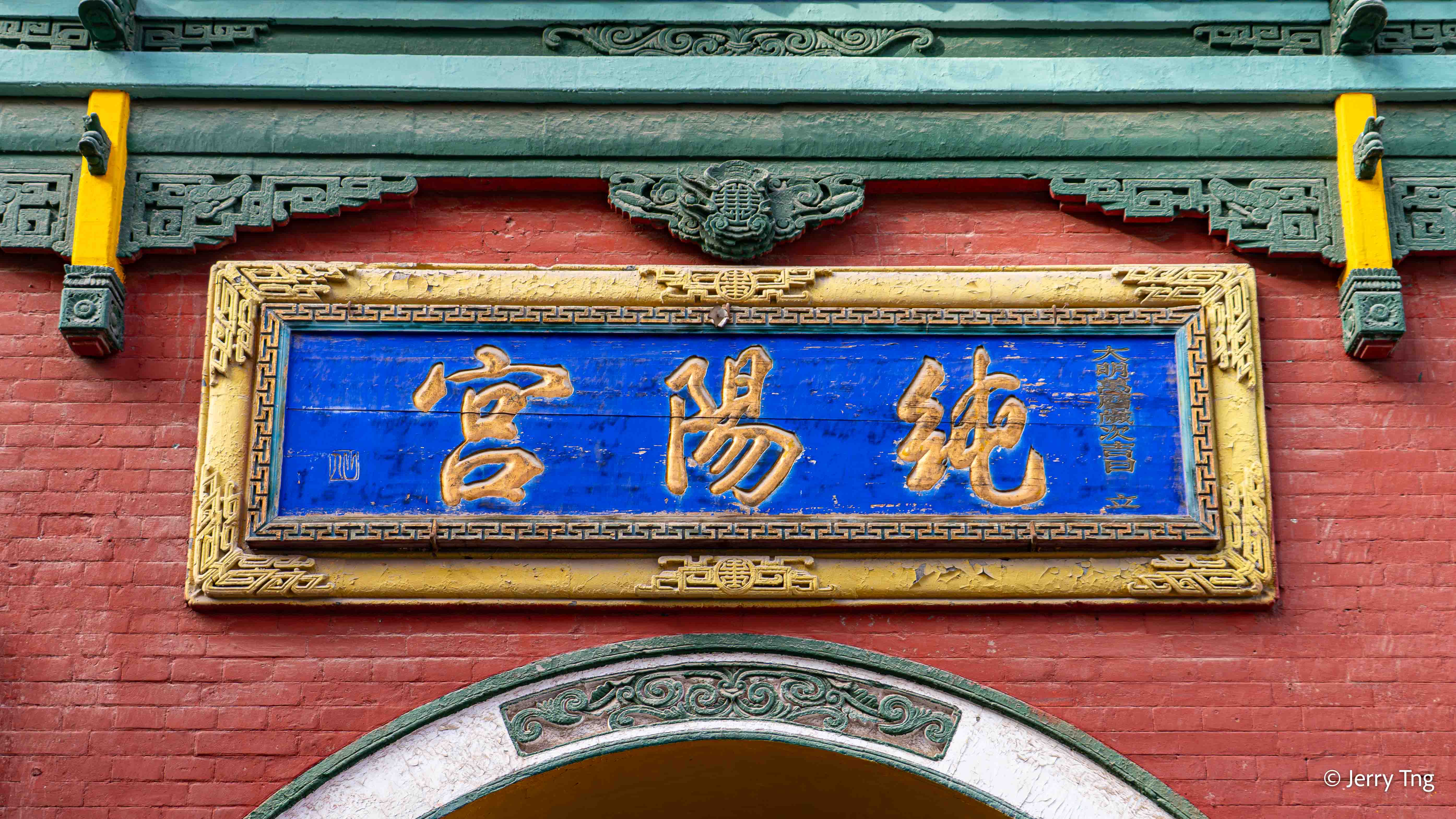
It is known by multiple names – Shanxi Art Museum, Shanxi Ancient Architecture Museum, Chunyang Palace, Lüzu Temple – but it was first setup as the Shanxi Provincial Museum in 1953.

Chunyang Palace 纯阳宫 is located in the northwest corner of May Day Square 五一广场 in Taiyuan City. It is located in a Taoist temple named dedicated to Lü Dongbin 吕洞宾, a prominent Taoist priest from Tang Dynasty. Chunyang Palace was built in the late Song Dynasty and early Yuan Dynasty, but the original temple was lost to fire. It is the “Central Palace” of the three major Taoist temples in the south, middle and north of Shanxi.1, 2 This current temple was rebuilt on the original site built in the Ming Dynasty (1368-1644).3 It is a national key cultural relic protection unit and a national second-level museum.


Shanxi Art Museum 山西省艺术博物馆 was established in the premise of Chunyang Palace in 2003, and renovation was done to the structure and buildings for exhibitions. Shanxi Ancient Architecture Museum 山西古建筑博物馆 was registered in the same address in 2020.
First Courtyard – Stele Corridor and Taihu Stone Rockery 碑廊石山


The first courtyard was created after the founding of the People’s Republic of China by enclosing the open space outside the original temple gate. In the centre of the courtyard stands an elegantly designed, ingeniously structured four-pillar, three-story wooden archway. The two plaques on the front and back of the archway, “Temple of Lü Tianxian” and “Penglai Wonderland,” reveal the essence and scenery of the place. Lü Tianxian refers to Lü Dongbin, the deity worshipped in this temple. Penglai is the mythical island off the east coast of China that is the home of the eight immortals whom Lü is their leader.


To the east of the first courtyard is a rockery made of Taihu stones. Climbing the steps along the path, one can see the stone coffin of Song Defang (a Taoist master) and a bronze statue of Guan Yu from the Ming Dynasty at the top.


Song Defang 宋德方 (1183—1247), courtesy name Guangdao, Taoist name Piyun, one of the four great masters of the Quanzhen School in the early Yuan Dynasty.4 He studied under Liu Chuxuan and Qiu Chuji and was an important successor of the Longmen School of Quanzhen Taoism. He also led the upgrading of Chunyang Temple in Ruicheng, the former residence of Lü Dongbin, into Yongle Palace, making it one of the three major ancestral temples of Quanzhen Taoism. In 1244 he was granted the title of “玄都至道真人” “Xuandu Zhidao Zhenren” and posthumously honoured as “玄通弘教披云真人” “Xuandong Hongjiao Piyun Zhenren”.5


Guan Yu 关公 (160-220), courtesy name Yunchang 云长, was a famous general from the late Han dynasty. He is a native of Yuncheng in Shanxi Province, and hence Guan Yu worship is very active and popular in Shanxi. Many temples still exist that placed him as the main deity. This rare monument is unique because it depicts Guan Yu as a young and dashing warrior on horseback with his weapon but without his signature beard.

Along the west wall is a gallery of steles containing more than twenty ancient steles, including stone Buddhas, stone beasts, and stone scriptures from the Han and Tang dynasties. Among them, the Nirvana Transformation Stele is a relic of the Dayun Temple in Linyi County, Shanxi Province, carved in the second year of the Tian Shou era of the Wu Zhou Dynasty (691 AD).6


Some of the prominent steles and statues not to be missed (from left) :
- Inscription on the Stone Tablet Inscribed with Talismans 书符缘启石碑7
- Stone | Qing Dynasty, Guangxu Year 1886 (Year Bingcheng) | Height 126.5 cm, Width 101.5 cm, Thickness 11 cm. 石|清•光绪丙成年(公元1886年)|高126.5厘米 宽101.5厘米 厚11厘米。
- The inscription records that this tablet was kept beneath the Chunyang Palace and used to ward off evil spirits, subdue demons and monsters, repel malevolent ghosts and plague gods, and protect the family.8 It was really awesome when I saw this stele as stele of this theme (Taoist talisman) is not common – this is the only one so far I have seen. Also it was purportedly based on the talisman by Lü Dongbin, to prevent evil spirits from invading the mind. When the mind is upright, it is upright; when one is free from desires and pure, the spirit and the Tao are in harmony.
- Thousand Buddha Pagoda 千佛幢
- Stone | Northern Dynasties | Height 189 cm, Width 79 cm, Thickness 25 cm | Collected from Taibei Village, Licheng County, Shanxi Province. 石雕|北朝|高189厘米,宽79厘米、厚25厘米|山西省黎城县台北村征集
- All four sides are fully carved with niches containing a thousand Buddha images. The lower centre of the front features a pointed arched Buddha statue containing one Buddha and two Bodhisattvas. The Buddha sits in the lotus position, wearing a robe covering both shoulders, with the robe draped over the seat. The two Bodhisattvas stand on lotus pedestals. At the very bottom center is a strongman. Niches are carved on either side, each containing a seated Buddha with robes draped over the seat. There is another niche in the centre of the back, but the Buddha image is damaged.9 According to the guide, the buddhas were defaced during the Huichang Destruction of the Buddha.
- Standing Statue Commissioned by Tanling et al 昙灵等造释迦立像
- Stone | Western Wei • The 14th year of Datong (548) | 330 cm high | Collected from Sunli Village, Yishi County, Shanxi Province (1957). 石雕|西魏•大统十四年(公元548年)|高330厘米|1957年山西省猗氏县孙里村征集
- The standing Shakyamuni statue, commissioned by Tanling and others, is a stone statue dating back to the 14th year of the Datong era of the Western Wei Dynasty (548 AD). Commissioned by Tanling and others, the statue belongs to the late Northern Dynasties Buddhist art style and depicts the standing image of Shakyamuni Buddha. Shakyamuni has a high nose, large ears, and a small mouth. His eyes are slightly closed, and he looks down. He has a thick neck, broad but not sloping shoulders, a plump figure, and a slightly short stature. He wears a square-necked robe. He is bare-chested and barefoot, with a slightly protruding lower abdomen. He stands barefoot on an inverted lotus throne.10 It is an important material resource for the study of Western Wei period Buddhist art and history.11
Second Courtyard – Hall of Sacrifice 献殿

The Gate of Morality “道德之门” was the original front gate of the temple. The words were purportedly inscribed by Master Zhengyang, Han Zhongli, which sounded to me like a myth than fact.


Passing through the “Gate of Morality” into the second courtyard, one finds stone couplets written by Sun Yiyuan, a famous Taoist priest of the Ming Dynasty, on either side of the gate.


Above the back wall of the second courtyard gate is engraved the nine-fold seal script “蓬壶佳瑞” “Auspicious Omens of Penglai.” Inside the second courtyard, ancient trees reach for the sky, their branches and leaves flourishing.12 The courtyard is filled with ancient trees and gnarled vines, creating a charming atmosphere. It is said that the wisteria is even more stunning when it blooms.


Currently the Worship Hall 献殿 housed a Maitreya statue. Maitreya, aka 彌勒菩薩 or 彌勒佛, is depicted in the incarnation that is most familiar to Chinese believers, in the rotund and cheerful image.
Third Courtyard – Main Hall of Lüzu 吕祖殿

Passing the Maitreya statue in the second courtyard, you arrive at the third courtyard. The Chunyang Palace Lüzu Hall in the centre of the courtyard, built in the Ming Dynasty, is the main hall of worship of the temple. This building, with its simple yet robust design that exudes exquisite beauty, is of extremely high standard and is a rare gem among existing Ming Dynasty architecture.13

Chunyang Palace is the temple of worship for Lü Dongbin 吕洞宾, the leader of the Eight Immortals. He is enshrined in the main worship hall. Lü Yán 吕巖 (also written as 岩 or 喦), courtesy name Dòngbīn, is called “Master Pure-Yang” 純陽子 (Chunyang Zi), and is also called “Lü the Progenitor” 呂祖 (Lü Zŭ) by some Taoists, especially those of the Quanzhen School. He was born in Jingzhao Prefecture (京兆府) around 796 during the Tang dynasty. His birthday is said to be the 14th day of the fourth month of the Chinese calendar and supposedly lived for 220 years. Lü is also a historical figure and mentioned in the official history book History of Song. He is widely considered to be one of the earliest masters of neidan 内丹, or internal alchemy.

On the back of the statues is an exact replica of the mural of Lu Dongbin receiving instructions from Zhongli Quan that was originally in Yongle Palace. Zhongli Quan 钟离权, aka Han Zhongli 汉钟离, is an enlightened Taoist deity who was a native of Xianyang during Eastern Han Dynasty. According to legend, he met the Priest Wang Xuanfu of Shaoyang and was taught the Way of the Golden Pill 金丹大道. After enlightenment, he traveled around the world, met Lü Dongbin, and taught him the Way. After that, they co-founded the Zhonglu Golden Pill Sect 鍾呂金丹派, and was referred to as the leaders of the southern and northern sects of Taoism.14


On the wall are the murals of the Eight Immortals Crossing the Sea 八仙过海. While cults dedicated to various Taoist immortals date back to the Han dynasty, the popular and well-known Eight Immortals first appeared in the Jin dynasty. The term “Eight Immortals” became commonplace after the popularisation of the Taoist group of writers and artists known as the Complete Realization (Quanzhen 全真). The most famous art depiction of the Eight Immortals from this period is a mural of them in the Eternal Joy Temple (Yongle Palace 永乐宫) at Ruicheng.

The hall was built in a square shape, with square corridors extending from all four sides, forming the Chinese character “回”, which looks like two mouths. Lü Zu’s surname 吕 has “two mouths”, and Lü Zu often referred to himself as “回道人” “Priest Hui“.
Fourth Courtyard – the Nine Palaces and Eight Trigrams Courtyard 九宫八卦院


The Chunyang Palace contains over seventy halls in total, but the most exquisite part of the architecture is undoubtedly the Nine Palaces and Eight Trigrams Courtyard in the fourth courtyard. The courtyard was built according to the eight trigrams, with buildings on the four sides of the cave roof, and the pavilions are connected by corridors, which has distinct Taoist architectural features.

The gate to the fourth courtyard is called the “Nothingness Cave.” Above the brick archway is inscribed the words “Nothingness Cave,” and above that are the four characters “别有洞天” or “A Different World Within a Cave.” “Nothingness” 虚无 is a multi-dimensional concept in Taoism15, with its core meaning referring to a state of emptiness, vagueness, non-existence, or meaninglessness, similar to the Western concept of Nihilism.

A plaque reading “Wonderful Realm of Yingzhou” 瀛洲妙境 hangs under the eaves of the upper floor of the cave. Although faded over time, the old name of the courtyard, Shanxi Guiyi Temple 山西皈一道院, can still be seen on the outside wall. “Guiyi” 皈一 refers to the belief in the unity of Confucianism, Buddhism, and Taoism that arose in the mid-Qing Dynasty. This sect once occupied and renovated Chunyang Palace, and developed its doctrines there. That explains why there are both Taoist and Buddhist statues in the temple.
The Nine Palaces system is a unique creation of ancient Chinese astronomers. They divided the celestial sphere into nine equal parts using a grid pattern: Qian (乾), Kan (坎), Gen (艮), Zhen (震), Zhong (中), Xun (巽), Li (离), Kun (坤), and Dui (兑). By observing the movement of the seven luminaries and constellations in the night sky from the ground, they could determine directions and seasons.


Because “immortals prefer to live in pavilions,” Taoist architecture often features multi-story buildings. These typically consist of buildings on the four sides of a cave roof, with nine-cornered pavilions at each corner. The pavilions and buildings are connected by surrounding corridors. The four buildings and four pavilions, along with the three-room, two-story square pavilion in the center of the courtyard, form the Nine Stars, corresponding to the Nine Palaces underground.16
Fifth Courtyard – Weige Pavilion 巍阁

Passing through the “Lingbao Cave,” you enter the fifth courtyard. All the buildings in the courtyard are two stories high, with the three-storey Weige Pavilion 巍阁 being the tallest building in the Chunyang Palace. According to the Annals of Taiyuan 《山西通志》, you can see the whole city from its terrace, hence the name “小天台” “Small Terrace”. 17
The fifth courtyard, Weige Pavilion 巍阁, was built during the Jiaqing period of the Qing Dynasty under the supervision of the Taoist priest Gao Lianchang. Weige Pavilion is a single-eaved hip-roofed building, one bay deep, symmetrically arranged on the east and west sides. It is the tallest building in Chunyang Palace, offering panoramic views of the city center from its summit.18

When I visited the place, most of the prominent relics and artefacts are already moved to the new Shanxi Provincial Museum 陕西省博物馆. Only limited artefacts remained in this museum, but it includes two National Treasures. The buildings themselves are included in the seventh batch of national key cultural relic protection unit 第七批全国重点文物保护单位.
Three Wonders of Chunyang Palace – One Statue, One Courtyard, One Stele 纯阳宫三绝 :一像、一院、一碑
The most eye-catching things in the museum are the “Three Wonders of Chunyang” – the Nine Palaces and Eight Trigrams Courtyard 九宫八卦院 (see section above about the fourth courtyard) and the Statue of Changyang Tianzun 常阳天尊像, the Nirvana Monument 涅槃变相碑.19
Statue of Changyang Tianzun 常阳天尊像

Stone | The Seventh Year of Kaiyuan in Tang Dynasty (719) | Collection of Shanxi Provincial Art Museum (Chunyang Palace). 石雕|唐开元七年 (公元719年)|山西省艺术博物馆(纯阳宫)藏
According to legend, “Changyang Tianzun” 常阳天尊 refers to Laozi 老子, a thinker from the late Spring and Autumn Period and the founder of the Taoist school, also known as “Taishang Laojun” 太上老君. Because the Tang Dynasty imperial family’s surname was Li, they posthumously recognised Laozi, aka Li Er 李耳, as their ancestor and honoured him as the Xuanyuan Emperor. Taoism flourished during the Tang Dynasty, and the construction of Taoist temples and the creation of Taoist statues became a fashionable trend.20 This is one of the few Taoist National Treasure.
Nirvana Monument 涅槃变相碑

Stone | The second year of Tang Wuzhou Tianshou (691 A.D.) | 302 cm high, 87 cm wide, 25 cm thick | Retrieved from Dayun Temple, Linyi County, Shanxi Province | Collection of Shanxi Art Museum. 石碑|唐武周天授二年(公元691年)|高302厘米,宽87厘米,厚25厘米|山西省临猗县大云寺征集|山西艺术博物馆藏
The Nirvana Monument vividly shows the scene of Sakyamuni Buddha’s Nirvana, and every carving contains a profound history and faith. It was one of few steles and monuments from Wu Zhou interregnum period (690-705) that survived to modern day. Although it was not originally in the temple, it was left behind when the rest of the relics and artefacts were moved to the new Shanxi Provincial Museum. I have written a separate post about this National Treasure.
Other Treasures in Chunyang Palace 纯阳珍宝
Besides the two National Treasures, the steles corridor, stone sculptures and the old architectures, there are several items worth taking note of that are randomly scattered around the compound.
Cast Iron Unicorn 独角兽

Although the museum information says “Unicorn”, but this is a cast iron statue of Xie Zhi 獬豸, an auspicious beast from ancient Chinese mythology, capable of discerning good from evil and loyalty from treachery. The craftsman was also very skillful; the beast’s eyes are bright and piercing, and I especially love the protruding horn on its forehead, which adds a touch of cuteness to its majestic face.
Stone Tiger 石虎

Sandstone | Western Han Dynasty | Length 134 cm, Height 71 cm | Unearthed in Shecun Village, Anyi County.
砂岩|西汉|长134厘米 高71厘米|安邑社村出土
The sandstone carving technique is simple, the style is unadorned, and the image is fierce. When viewed from the side, only the head and wide mouth are highlighted, which is almost the original appearance of the stone block. It is a masterpiece of Western Han Dynasty stone carving art.
Han Dynasty Stone Reliefs 汉画像石


Located in the 靈寶洞 “Lingbao Cave,” Lishi County Han Dynasty stone reliefs are a type of tomb stone carving art from the late Eastern Han Dynasty, mainly distributed in the Lüliang area of Shanxi Province. They are decorative stone murals carved by Han Dynasty people on the walls of tombs and ancestral halls. Their content can be divided into two main categories: the world of immortals reflecting myths and legends, and realistic scenes depicting the enjoyment of the deceased during their lifetime. Specific themes include mythological figures such as the Red Bird, the Eastern King Duke, and the Western Queen Mother, as well as scenes of noble banquets and outings.21

Stone | Eastern Han Dynasty | Shanxi Art Museum (Chunyang Palace) Collection
The Mamaozhuang 马茂庄 Han Dynasty tomb complex is located on the western hillside of Mamaozhuang Village, Lishi County. More than 20 Han Dynasty tombs have been discovered, including 6 tombs with pictorial stone carvings. The stone reliefs in the museum collection were unearthed in 1919.

Stone | Eastern Han Dynasty | Shanxi Art Museum (Chunyang Palace) Collection
The Yangjiaping 杨家坪 Han Dynasty tomb was discovered in 1930, . Several stone reliefs were unearthed, and their themes and styles are basically the same as those of the Mamaozhuang stone reliefs, probably belonging to the same period. The remaining stones consisting of 6 panels and 1 column are now in the museum collection.


Belonging to the late Eastern Han Dynasty, these reliefs are made from local sandy shale. The figures are first outlined with ink lines and then carved into shallow reliefs . Their development was influenced by the Han Dynasty’s extravagant burial customs and the “recommendation of filial and incorruptible officials” system, and gradually disappeared after the late Eastern Han Dynasty.22
About Chunyang Palace 纯阳宫


The exact date of the founding of Chunyang Palace is unknown, but some say it was founded by Zhang Fengxian at the end of the Song Dynasty. Records indicate that Song Defang, a disciple of the Quanzhen School of Taoism during the Yuan Dynasty, once presided over the palace. In 1597 (the 25th year of the Wanli reign of the Ming Dynasty, as shown on the cast iron lions above), Princes Zhu Xin, Zhu Bangzuo, and Fan Chaoyin of Jin replanned and renovated the site, undertaking a large-scale expansion and reconstruction. 23

清•嘉庆七年(公元1802年)
高217.5厘米,宽70厘米厚14厘米

民国三十二年(公元1943年)
高155厘米 宽60.5厘米 厚15厘米
During the Qianlong reign of the Qing Dynasty, Prefect Guo Jin and Fan Chaosheng of Taigu funded further expansions. During the Jiaqing reign, Taoist Gao Lianchang presided over the construction and added a three-story pavilion atop the cave dwelling in the rear courtyard. In 1943 (the 32nd year of the Republic of China), Zhang Xiushan and Feng Qun raised funds, and the entire gentry and merchants of Shouyi Street contributed capital, with Abbot Ma Waizhen of Chunyang Palace undertaking a large-scale renovation of the palace.

Suggest that you join their free guided tour (available on the hour on holidays, Friday and weekends, lesser sessions on weekdays) for an official narrative of the place. Do not get the “wild” guides at the entrance as they will give you a lot of misinformation that are based on superstitions and myths. The gathering point is at the Unicorn bronze statue in the first courtyard, first come first served.

Opening hours
- Tuesday-Sunday: 8:00 AM–6:00 PM
- Monday: Closed
- May Day Holidays (May 1–May 5): 8:00 AM–8:00 PM
Admission is free.
Chunyang Palace 纯阳宫
No. 1, Qifeng Street, Qifeng Street Community, Liuxiang Subdistrict Office, Yingze District, Taiyuan City, Shanxi Province
山西省太原市迎泽区起凤街与五一广场交叉口西120米路北
All photos taken at Shanxi Art Museum (Chunyang Palace) Oct 2025, unless otherwise noted.
Footnotes :
- 山西古建筑博物馆位于太原市五一广场西北隅,以太原纯阳宫为馆址,是全国重点文物保护单位,国家二级博物馆。纯阳宫始建于宋末元初,属山西南、中、北三大道观之“中宫”,原为供奉唐代吕洞宾的道观,馆藏珍贵文物众多。小众但很值得一去。 ↩︎
- 晋地三大纯阳宫,大同为“北宫”,芮城永乐宫为“南宫”,太原纯阳宫为“中宫”。https://k.sina.cn/article_7517400647_1c0126e47059021v7j.html?from=cul, accessed 22 Feb 2026 ↩︎
- 太原纯阳宫创建年代不详。相传长春真人弟子宋德芳曾主持过该宫观。因此始建年代不会晚于元世祖忽必烈时代。现存建筑为明万历年间(1573-1620年)晋藩朱新场、朱邦祚兄弟二人扩建。https://baike.baidu.com/item/太原纯阳宫/537508, accessed 22 Feb 2026 ↩︎
- 一位仙风道骨的道士,着宽松大袍,须发飘飘,口中念念有词,案上的册页上,画着许多运笔流畅,令人无法破解的神秘符文……这也许是他潜心编纂的道藏《玄都宝藏》。
这位道士是宋德方,字广道,道号为披云,是元初全真道四大高道之一。
金庸先生的《射雕英雄传》中就有道教人物,是以马钰和丘处机为代表的全真七子,书里丘处机被描述为一位抗金护民的民族英雄。宋德方就是丘处机的弟子,在太原城“纯阳宫”道观里任过住持。
南宋淳熙十年(1183年),宋德方生于山东掖县(现莱州),十二岁追随长生刘公,后于王玉阳(“七真”中的王处一真人)门下得度入道,不久往栖霞求道于长春真人丘处机门下。蒙元时,由于成吉思汗对全真教道士丘处机的极为崇敬,封其为国师,道教得以很大发展。元太祖十五年(1220年),宋德方随丘处机西游大雪山晋见成吉思汗,为其十八侍行弟子之一。西游归来后,随丘处机驻燕京(今北京)之长春宫,为教门提点。宋德方先后师从全真三大宗师,故修道早成。
元太宗九年(1237年),遵其师丘处机的遗志来到平阳(今临汾)玄都观,与秦志安搜求遗经,主持刊刻《玄都道藏》。他往返于山西管州(今静乐)、上党、太原、晋南等地搜集遗经,设局雕刻,历时十年,刻成7800余卷,版藏于玄都观,称《玄都宝藏》。王利用(元朝大臣、潞国公)所撰《道行碑》形容宋德方的道法为“三灯传一灯,一灯续三灯”,宋德方对中国道教文化有着杰出贡献。https://www.thepaper.cn/newsDetail_forward_15888778, accessed 22 Feb 2026 ↩︎ - 早年随丘处机西行觐见成吉思汗 [3] [5],1220年归燕京后任长春宫教门提点。1237年起主持刊刻《玄都道藏》(亦称《玄都宝藏》),历时八年完成七千八百余卷,搜罗整理散佚经典 [1] [3]。同期重修昊天观、永乐镇纯阳祠等宫观四十余处,主导将吕洞宾故居纯阳观升级为永乐宫,使其成为全真教三大祖庭之一 [2] [4] [6]。1244年获赐“玄都至道真人”封号,逝后追赠“玄通弘教披云真人”。著有《乐全前后二集》及诗词《雨霖铃》,参与开凿龙山石窟与寒同山石窟,确立全真宫观布局范式 [5-6]。https://baike.baidu.com/item/宋德方/2082250, accessed 23 Feb 2026 ↩︎
- 一进院是中华人民共和国成立后,将原宫门外空地圈就而成。院中央矗立一座造型优雅、结构巧妙的四柱三楼木牌坊。牌坊前后两匾“吕天仙祠”和“蓬莱仙境”,道出了这里的内涵和景致。一进院东侧是太湖石堆砌的石山,沿小道拾级而上,山顶可见玄通弘教披云真人石棺和明代关公铜像。西侧墙边碑廊,嵌有古碑二十余通,汉唐时期石佛、石兽、石经林立。其中,涅槃变相碑是我省临猗县大云寺的遗物,雕刻于武周天授二年(691年)。 ↩︎
- 一座碑藏着的文化密码
唐中才. 2025年06月30日 太原晚報
太原纯阳宫碑廊内,有一座独特的石碑屹立其中,神秘的碑文与寻常迥异,吸引着游人。抚摸的人多了,碑碣通身泛着圆润的包浆。这就是道符箓碑。
所谓道符箓碑,是中国道家符箓派用于镇宅驱邪斩妖伏怪的镇物。符箓之说,是中国古代巫术文化的一种延伸,在当今民间尚有遗存。其根源可以追溯到人类早期对自然神力的崇拜,是道家思想的一种展现。道符的本义就是调动神鬼的一种信物,道箓的本意就是道士身份的确认和行使法术的一个凭证。
这个道符箓碑分为阴阳两面。阳面正中央刻着的似篆非篆、似虫非虫的符号就是一道纯阳祖师命书符。传统的道符也因流派不同而书写之法及蕴含意思各异。从传统的解释来讲,最上面的三点符号代表三清祖师,接下来云(雲)字头(一般人视为雨字头)的符号就是可以驱动鬼神的道士之箓,紧接着是变体的敕令二字。接下来就应该是敕令的正文了。正文的最后有一根细长的尾巴,一说是通天梯,一说是捆鬼绳。总之,知道它是中国历史文化的一部分就行了。以现在的视角去解读,也许可以归为迷信。但在道家看来,这些符箓是上天之炁凝结而成,代表了天意,因而其笔形常呈现云气缭绕的状况,曲折盘旋,别称云书或云符,颇具神秘色彩。
在碑的右侧有一段肖似赵孟頫楷书的百字短文。这段文字起头曰“盖闻主人身者心也,心所藏者,神也。心神正则正,神佑之,心神邪则邪,神扰之”。体现了道家心正神佑的思想理念。换言之即“善恶之报,如影随形”。由此可见,书符缘启石碑既有求福祈佑之义,也有劝诫世人行善,秉持正道的意愿。碑文又言“勒石以镇之,藏之宫下”的书符缘碑,可“镇宅驱邪,斩妖伏怪,退厉鬼避瘟神,益眷保家”,希望“人人锤印,虔诚供养”。以愚见,能驱散邪恶,益眷保家的不会是一道符箓,更多的是类似现代心理学中的“自我暗示”,既可对未知的一些恐惧提供精神的支撑,又可通过信仰强化人的道德约束,起到个体自律、匡扶民风的作用。
碑阴的文字比较有意思,先介绍了作者游历纯阳宫,看到院内有一幢“康熙己未岁郎公匾额纪胜颇悉”的石碑。见其字迹漫漶,于是重新整理文字,刻在了本碑的阴面。这段郎公记记载,郎公从浙江踏访于此,“仰见画阁瑗楼,想必蓬莱之规制。深宫魏阙,依然宇内之洞天”。和道人闲谈中得知,当年铸造吕洞宾像时,屡造不成,忽一日来了一个似痴非痴的乞丐,手持一铜钱投于熔炉内,于是吕洞宾的像就铸造成了。但是,那枚铜钱并没有熔化,而是“冠仙童之额”“甚且阅有余年。此钱自光华奇哉”。我也好奇,特去吕祖像前查看,确实在仙童之额,有一个铜钱样的东西。
符箓碑的落款为“唐省吾敬笔,田守善经理,樊尔荣撰记”。此三人的名字前有一个道家箓符,推测是其在道家的道箓。另,从窦大夫祠清光绪二十六年(1900)的《重建乐楼碑记》落款“本村教职历任长子 训导 教谕 应州 学政 樊尔荣 薰沐书丹并撰”,以及符箓碑落款时间为清光绪丙戌年(1886)来分析,这两个樊尔荣应当为同一人,而且籍贯在上兰村一带。
统观此碑,如同一面多棱镜,折射出中国传统文化中宗教、巫术、哲学与民俗的交融共生,既是道教符箓派“云书表意”的实物见证,也是民间“镇宅保家”心理需求的物质投射,更是古人借助象征体系构建精神秩序的文化实践。
轻轻触摸这温润的包浆石碑,我的心头不仅浸润着历史的质感,更感知到中华文明的精神脉络。它以独特的文物形态,为我打开了一扇窥探古人精神世界的窗口,读懂了中华文明对“善”与“安”的永恒追寻。这或许正是道符箓碑穿越百年光阴,依然能让世人驻足遐思的文化魅力所在。
http://epaper.tyrbw.com/tywb/html/2025-06/30/content_252_211603.htm ↩︎ - 碑志记载,此碑藏于纯阳宫下,用以镇宅驱邪,斩妖伏怪,退厉鬼避瘟神,益眷保家。Museum information card, Oct 2025 ↩︎
- 四面满刻千佛像龛。正面中下部镌尖拱形佛完一内雕一佛二菩萨。佛结跏跌坐,着通肩衣,衣裙垂覆于座,二菩萨足踏莲台,最下端中间刻一力士两侧中部均镌佛龛,内雕坐佛一,衣裙垂覆于座前背面中央有佛龛一,佛像残坏。Museum information card, Oct 2025 ↩︎
- 释迦高鼻、大耳、小口,双目微闭,俯视下方。颈部较粗,肩宽而不削,体态丰实,身材略短,方领袈裟。袒胸露足,小腹微凸,跣足直立于覆莲座上。Museum information card, Oct 2025 ↩︎
- 昙灵等造释迦立像是藏于山西太原纯阳宫的西魏大统十四年(548年)的金铜造像。该造像由昙灵等人发起制作,属于北朝晚期佛教艺术风格,表现了释迦牟尼佛的立像形象,是研究西魏时期造像艺术和佛教历史的重要实物资料。 ↩︎
- 穿过“道德之门”进入第二院,门两侧有明代著名道人孙一元撰书的石刻楹联。二进院门背墙上方刻有“蓬壶佳瑞”九叠篆文。二进院内,古木参天,枝繁叶茂。 ↩︎
- 绕过二进院的弥勒坐像,就来到了三进院。院中央的纯阳宫吕祖殿,建于明代,为宫内主殿。这座造型质朴刚劲中透着玲珑娇巧的建筑,规制极高,是现存明代建筑中的珍品。 ↩︎
- 鍾離權,複姓鍾離,名權,字雲房,號正陽子,又號和穀子,東漢咸陽人,又被稱爲漢鍾離,係八仙之首,道號正陽真人。
據記載,佢身長八尺,曾經官至大將軍,後來遇到少陽真人王玄甫,獲得金丹大道傳承。成道之後,佢雲游天下,遇見呂洞賓,授以金丹大道,之後形成鍾呂金丹派,鍾、呂二人成爲道教南、北二宗共祖,對後世產生好大影響。https://zh-yue.wikipedia.org/wiki/鍾離權 ↩︎ - 《庄子·刻意》(1) 刻意尚行,离世异俗,高论怨诽,为亢而已矣,此山谷之士,非世之人,枯槁赴渊者之所好也。语仁义忠信,恭俭推让,为修而已矣,此平世之士,教诲之人,游居学者之所好也。语大功,立大名,礼君臣,正上下,为治而已矣,此朝廷之士,尊主强国之人,致功并兼者之所好也。就薮泽,处闲旷,钓鱼闲处,无为而已矣,此江海之士,避世之人,闲暇者之所好也。吹呴呼吸,吐故纳新,熊经鸟申,为寿而已矣,此道引之士,养形之人,彭祖寿考者之所好也。
若夫不刻意而高,无仁义而修,无功名而治,无江海而闲,不道引而寿,无不忘也,无不有也,澹然无极而众美从之,此天地之道,圣人之德也。
(2) 故曰:夫恬惔寂寞,虚无无为,此天地之平而道德之质也。” https://ctext.org/zhuangzi/ingrained-ideas/zhs ↩︎ - 整个院落平面布局呈方形,抹角八面,按照道家的八卦“乾、坤、震、巽、坎、离、艮、兑”的方位建造,再加上中间的这一个“方形三间两层亭”形成“九宫建制”。
九宫是我国古代天文学家的独创,他们将天宫以井字划分乾宫、坎宫、艮宫、震宫、中宫、巽宫、离宫、坤宫、兑宫九个等分,在晚上从地上观天空的七曜和星宿移动,可知方向和季节等资讯。因为“仙人好楼居”,所以道家的建筑多楼阁,在洞顶四面建楼,四角建九角攒尖亭。楼亭之间以围廊相通,四楼四亭和院中心的“方形三间两层亭”组成九星,与地下九宫相对应。 ↩︎ - 《山西通志》载:“最高处,名曰小天台,登其巅,可览太原全景,朔望日香火之盛,全省首屈一指。” ↩︎
- 第五进院落——巍阁,这是清代嘉庆年间道士高炼昌主持修建的。巍阁为单檐歇山顶,进深一间,东西互相对称。巍阁是纯阳宫内的最高建筑,登阁环眺,市中心的风光历历在目。《山西通志》载:“最高处,名曰小天台,登其巅,可览太原全景,朔望日香火之盛,全省首屈一指。”http://www.360doc.com/content/26/0117/20/46721948_1168583396.shtml#google_vignette, accessed 22 Feb 2026 ↩︎
- 纯阳宫三绝 :一像、一院、一碑
原作者: 迎泽发布 | 来自: 山西文物 | 发布时间:2022-8-6 15:19
大隐隐于市,翠柏掩红墙。在太原市中心安于一隅的纯阳宫,因“三绝”名闻天下。常阳天尊像、九宫八卦院、涅槃变相碑,一像、一院、一碑,每一条线刻都是历史的印痕,每一片砖瓦都是文化的凝聚。 ↩︎ - 相传“常阳天尊”指春秋末年的思想家、道家学派的开创者老子,传说中又称“太上老君”。因唐代皇室姓李,故追认老子李耳为先祖,奉其为玄元皇帝。唐代道教极其兴盛,兴建道教宫观,塑道教造像,一时成为风尚。 ↩︎
- 离石汉画像石是东汉晚期的墓葬石刻艺术,主要分布在山西吕梁地区,是汉代人雕刻在墓室、祠堂四壁的装饰石刻壁画 [5]。
其内容可分为反映神话传说的神仙世界与描绘墓主生前享乐生活的现实图景两大类,具体题材包括赤鸟、东王公、西王母等神话形象及贵族宴饮出行等场景 [1-2]。
它属于东汉晚期作品,采用当地砂质页岩,制作时先以墨线勾勒物像,再阴刻成浅浮雕 [2-3]。其发展受汉代厚葬风气及“举孝廉”制度影响,至东汉晚期后逐渐消失 [3]。 ↩︎ - https://baike.baidu.com/item/离石汉画像石/9803834 ↩︎
- 純陽宮創建年代不詳,另說創建于宋末的張奉先,據記載元代道教全真派弟子宋德芳曾主持過此宮;明萬曆25年(1597年),晉藩王朱新、朱邦祚、範朝引等在舊址上重新規劃佈局,進行了大規模的擴建、改建;清乾隆時,郡守郭晉及太谷人範朝升先後出資再擴建。嘉慶年間道士高煉昌主持,又在後院窯洞項上築巍閣三層。民國三十二年由張秀山逢群廣集券金,首義街全體紳商集資,純陽宮馬外真住持對宮內進行大規模整修。https://loloto.pixnet.net/blog/posts/44599990, accessed 23 Feb 2026 ↩︎
0 comments on “Shanxi Art Museum 山西省艺术博物馆”