
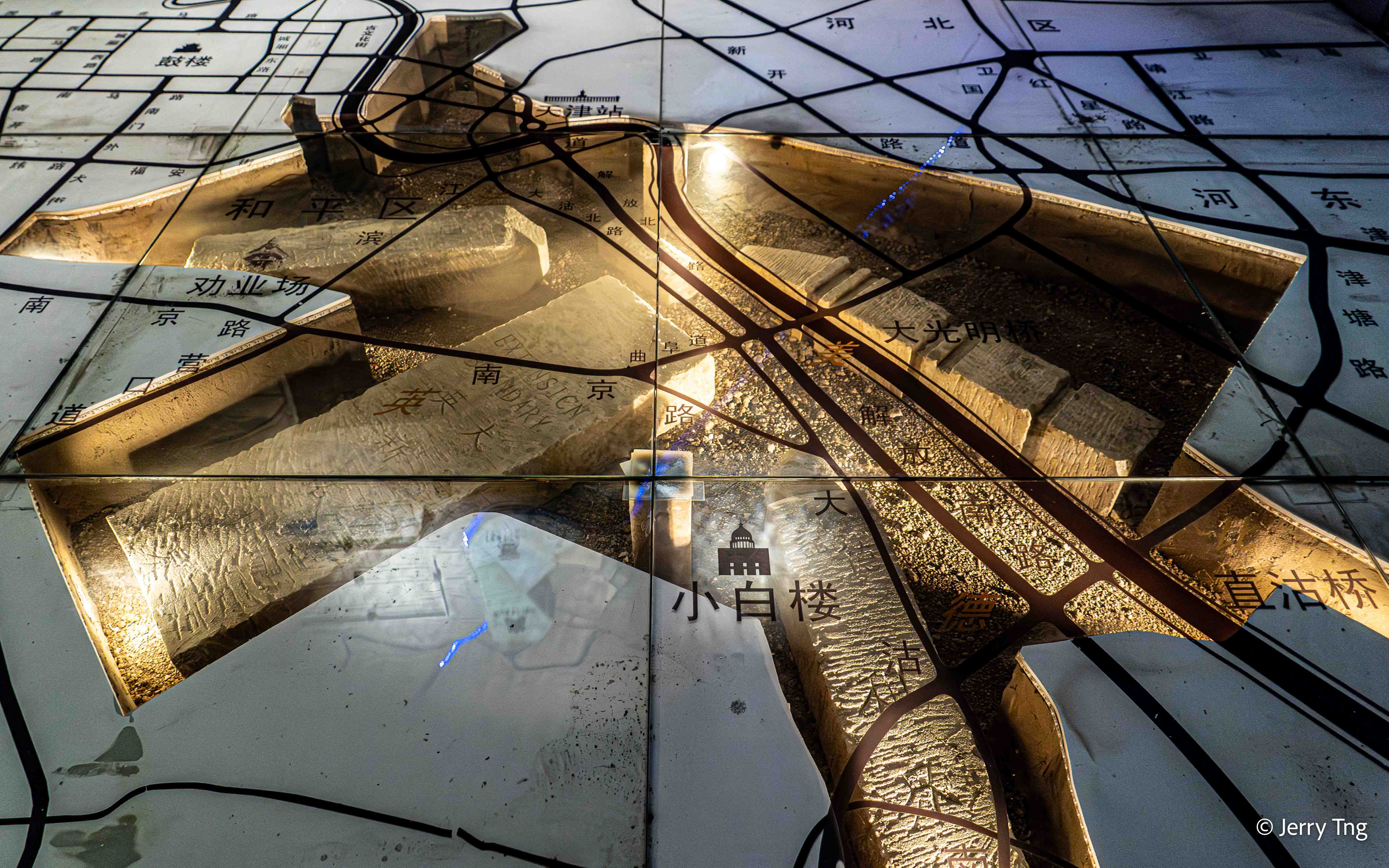
This exhibition covers the history of Tianjin in modern history. The exhibition covers the period from the First Opium War to the liberation by the Communist in 1949. Although there isn’t much in terms of artefacts and relics in this exhibition, the history covered is nevertheless very heavy stuff.
Tianjin — An Epitome of China in the Past Hundred Years 中华百年看天津
The Opium Wars and Eight-Power Allied Forces

The First Opium War (1839–1842) was a conflict between the British Empire and China’s Qing dynasty, sparked by China’s seizure of illegal British opium stocks in Guangzhou. Britain’s superior naval power led to a decisive victory, forcing China to sign the 1842 Treaty of Nanking, which opened ports, ceded Hong Kong, and began a “century of humiliation” for China. One major cause for the war was that British consumers had developed a strong liking for Chinese tea, as well as other goods like porcelain and silk. But Chinese consumers had no similar preference for any goods produced in Britain.

Because of this trade imbalance, Britain increasingly had to use silver to pay for its expanding purchases of Chinese goods. Foreign silver flooded into China in exchange for Chinese goods, expanding the Chinese economy but also causing inflation and forming a Chinese reliance on European silver. Then, they realised the Chinese addiction to opium as a recreational drug. As the demand for opium increased in China and the Qing government’s failed efforts to stop illegal smuggling of opium, this led to military action that resulted in the burning of opium by Lin Zexu, which led to the First Opium War.

The British was not satisfied after the first “successful” war with the Chinese, had the French to join them for the Second Opium War (1856–1860). The war resulted in the 1858 Treaty of Tientsin (Tianjin), in which the Chinese government agreed to pay war reparations for the expenses of the recent conflict, open a second group of ten ports (that included Tianjin) to European commerce, legalise the opium trade, and grant foreign traders and missionaries rights to travel within China. In 1860, Tianjin was forced to lend its port to foreign powers.

In 1900, the Eight-Power Allied Forces encroached on Tianjin. The old city was destroyed by the forces on November 26 of the same year. Four sections of the city walls were demolished and turned to be four avenues. Since 1860, nine imperialist countries including Britain, France, the United States, Germany, Japan, Russia, Italy, Belgium, and Austria-Hungary acquired the right to supposedly lease a tract of land as concessions in the city one after another.
The Establishment of Concessions and Military Colonial Rule


After Tianjin opened as a treaty port, Britain, the United States, and France were the first to establish concessions there. Subsequently, Germany, Japan, Russia, Italy, Belgium, and Austria-Hungary also established concessions in Tianjin. By 1902, nine countries had established concessions, covering an area approximately eight times the size of Tianjin’s city walls at the time. From July 1900 to August 1902, the Eight-Nation Alliance also established a colonial institution in Tianjin—the Governor-General’s Office.

After the signing of the Boxer Protocol, Japan established the headquarters of its Chinese Garrison in Tianjin. In 1931, Japan abducted the last emperor, Puyi, from Tianjin to Northeast China, using him as a puppet ruler. Subsequently, Japan forced the Chinese government to sign the Tanggu Truce and the He-Umezu Agreement in Tianjin. After its fall, Tianjin became a logistical base for the invading Japanese army and an important port for trafficking Chinese labourers.1


Accordingly, Tianjin has suffered the galling shame and humiliation in the modern history of China. Meanwhile, the historic and stylistic constructions together with their multi-culture derived from therein, have become important historic context and valuable cultural resources that cannot be neglected in the city construction. The mushrooming of constructions in the area of concessions brought Western architectural culture and technologies into Tianjin as torrents.
The Confluence of Chinese and Western Cultures

From the Self-Strengthening Movement onward, Tianjin’s modern education was at the forefront of the nation. Entering the 20th century, a group of visionaries dedicated to saving the nation through education and science worked diligently in Tianjin, establishing numerous nationally renowned educational, cultural, and research institutions. Simultaneously, Western art forms such as fine arts, music, drama, and film converged and evolved with traditional Chinese performing arts, represented by Peking Opera, Pingju Opera, and folk arts, on the banks of the Haihe River.

The introduction of modern civilisation gradually transformed Tianjin’s social life. People’s lifestyles, including clothing, food, housing, transportation, and leisure activities, began to exhibit changes characterised by commercialisation, urbanisation, socialisation, and a fast pace. The public sphere expanded, and social stratification became more complex.3
Political Changes

The defeat in the Second Opium War prompted some Qing government officials to initiate the Self-Strengthening Movement in the 1860s, seeking a way out for the nation and its people. Li Hongzhang, the Governor-General of Zhili and Minister of Beiyang, resided in Tianjin for 25 years, making Tianjin the northern center of the Self-Strengthening Movement and a diplomatic hub of modern China. During the Hundred Days’ Reform, Yan Fu 严复4 promoted reformist ideas in Tianjin, making it a key center of the reform movement.

After the Eight-Nation Alliance invasion of China in 1900, the Qing government implemented the “New Policies,” further exploring a path for the nation, and Tianjin became an experimental base for these policies. Xiaozhan military drills 小站练兵 played a pioneering role in the modernisation of China’s military system, and laid the foundation for the Beiyang warlord group. The three presidents of the early Republic of China—Xu Shichang, Feng Guozhang, and Cao Kun—and the six premiers—Tang Shaoyi and Duan Qirui—all came from Xiaozhan.5

Around the time of the Wuchang Uprising, bourgeois revolutionaries were active in Tianjin. The Luanzhou Uprising, launched by the Tianjin Republican Society, shook the north. Sun Yat-sen, the great pioneer of the Chinese democratic revolution, visited Tianjin three times. The activities of the bourgeois constitutionalists made Tianjin a center of political movement in northern China for a time.6

Tianjin was among the earliest Marxism-spreading cities in North China, and Li Dazhao 李大钊, the cofounder of the CPC, directly guided the establishment of CPC Prefectural Party Committee of Tianjin. After the failure of the Great Revolution, the organs like the Shunzhi Provincial Party Committee and the North Bureau of the CPC Central Committee for a time formed the centre of the CPC’s leadership in North China.

Many well-known Communists including Zhou Enlai, Liu Shaoqi, Chen Tanqiu, Peng Zhen and others had taken part in the struggle in Tianjin. The “Tianjin Pattern” formed in the Tianjin Campaign boasted a maior position for the victory of the War of Liberation. The revolutionary struggle of the Party in Tianjin had made an indelible contribution for the founding of the new China.
About Tianjin Museum

Tianjin Museum is the largest museum in Tianjin, China, exhibiting a range of cultural and historical relics significant to Tianjin. The unique architectural style of the museum, whose appearance resembles that of a swan spreading its wings, has meant that it is quickly becoming one of the city’ iconic buildings. It is built to be a large modern spot for the collection, protection and research of historic relics as well as a place for education, leisure and touring.

The Tianjin Museum has an extensive collection of ancient Chinese fine arts and exhibits on Tianjin’s history. There are nearly 200,000 collections of valuable historical and cultural art and relics, including calligraphy, paintings, bronze ware, ceramics, jade, seals, ink stone, oracle bones, coins, historic documents and relics of modern times, and local folk art.
Admission is free with relevant identification document (Foreigners would need your passports for verification.)
Open Tue-Sun from 9am to 5pm, closed on Mondays (except on Public Holidays)
Tianjin Museum 天津博物馆
No. 62 Pingjiang Road, Hexi District, Tianjin 天津市河西区平江道62号
All photos taken at Tianjin Museum, Oct 2025, unless otherwise noted.
Footnotes :
- 租界的建立与军事殖民统治
天津开埠后,英、美、法三国率先在天津建立了租界。随后,德国、日本、俄国、意大利、比利时和奥匈帝国又在天津划定了租界。到1902年,形成了九国租界,面积约相当于当时天津城厢的八倍。从1900年7月到1902年8月,八国联军还在天津设立了殖民机构——都统衙门。
《辛丑条约》签订后,日本在天津成立了中国驻屯军司令部。1931年,日本从天津将末代皇帝溥仪劫持到东北,充当傀儡。此后,日本又在天津迫使中国政府签订了《塘沽协定》与“何梅协定”。
沦陷后的天津成为侵华日军的后勤基地和贩运华工的重要港口 ↩︎ - 国立北洋大学简称北洋大学、北洋,初名北洋大学堂,是1895年10月洋务运动的代表人物、时任津海关道盛宣怀上奏光绪皇帝得到批准在天津建立的大学,是中国近代第一所官办高等学府,校训为实事求是。1912年,更名为北洋大学校,次年更名国立北洋大学。https://zh.wikipedia.org/zh-sg/北洋大学 ↩︎
- 从洋务运动开始,天津的近代教育就走在全国前列。进入20世纪,一批以教育、科学救国为己任的有识之士又在天津辛勤耕耘,创办了诸多享誉全国的教育、文化、科研机构。同时,西方美术、音乐、戏剧、电影等艺术形式与以京剧、评剧和曲艺为代表的中国传统表演艺术也在海河之畔交汇升华。
近代文明的传入使天津的社会生活逐渐发生变化,人们的衣食住行、休闲娱乐等生活方式开始出现以商业化、城市化、社会化和快节奏为特征的变迁,公共生活领域日益扩大,社会阶层更加复杂。Museum information card, Oct 2025 ↩︎ - 严复(1854年1月8日—1921年10月27日),乳名体乾,初名传初,改名宗光,字又陵,后名复,字几道[注 1],晚号愈壄老人,福建省福州府侯官县人,祖籍河南固始。中国近代启蒙思想家、翻译家。曾为复旦大学校长,京师大学堂校长,筹安会六君子之一。
严复系统地将西方的社会学、政治学、政治经济学、哲学和自然科学介绍到中国,翻译了《天演论》《原富》《群学肄言》《群己权界论》《社会通诠》《法意》《名学浅说》《穆勒名学》等著作。他的译著在当时影响巨大,是中国20世纪最重要启蒙译著。严复的翻译考究、严谨,每个译称都经深思熟虑,他提出的“信、达、雅”的翻译标准对后世的翻译工作产生深远影响。https://zh.wikipedia.org/zh-sg/嚴復 ↩︎ - 小站练兵不仅对中国军制现代化具有开创作用,而且奠定了北洋军阀集团的根基,民国初期的三任总统:徐世昌、冯国璋、曹锟及唐绍仪、段祺瑞等六任总理都出自小站。Museum information card, Oct 2025 ↩︎
- 从三口通商街门到特别市的建立
第二次鸦片战争的失败促使清朝政府中的部分官僚于19世纪60年代开始了探求民族和国家出路的洋务运动。直隶总督、北洋大臣李鸿章驻节天津25年,天津成为洋务运动的北方中心和近代中国的外交中心。
维新变法期间,严复在天津宣传变法思想,天津成为维新运动的重镇。
1900年八国联军侵华后,清政府实行“新政”,进一步探索国家出路,天津成为“新政”的实验基地。
武昌起义前后,资产阶级革命党人在天津活动频繁,天津共和会发动的滦州起义震动了北方,中国民主革命的伟大先行者孙中山曾三次来到天津,资产阶级立宪派的活动,使天津一度成为中国北方政治运动的中心。 ↩︎
0 comments on “Tianjin Museum – Tianjin in the Past Hundred Years 中华百年看天津”