
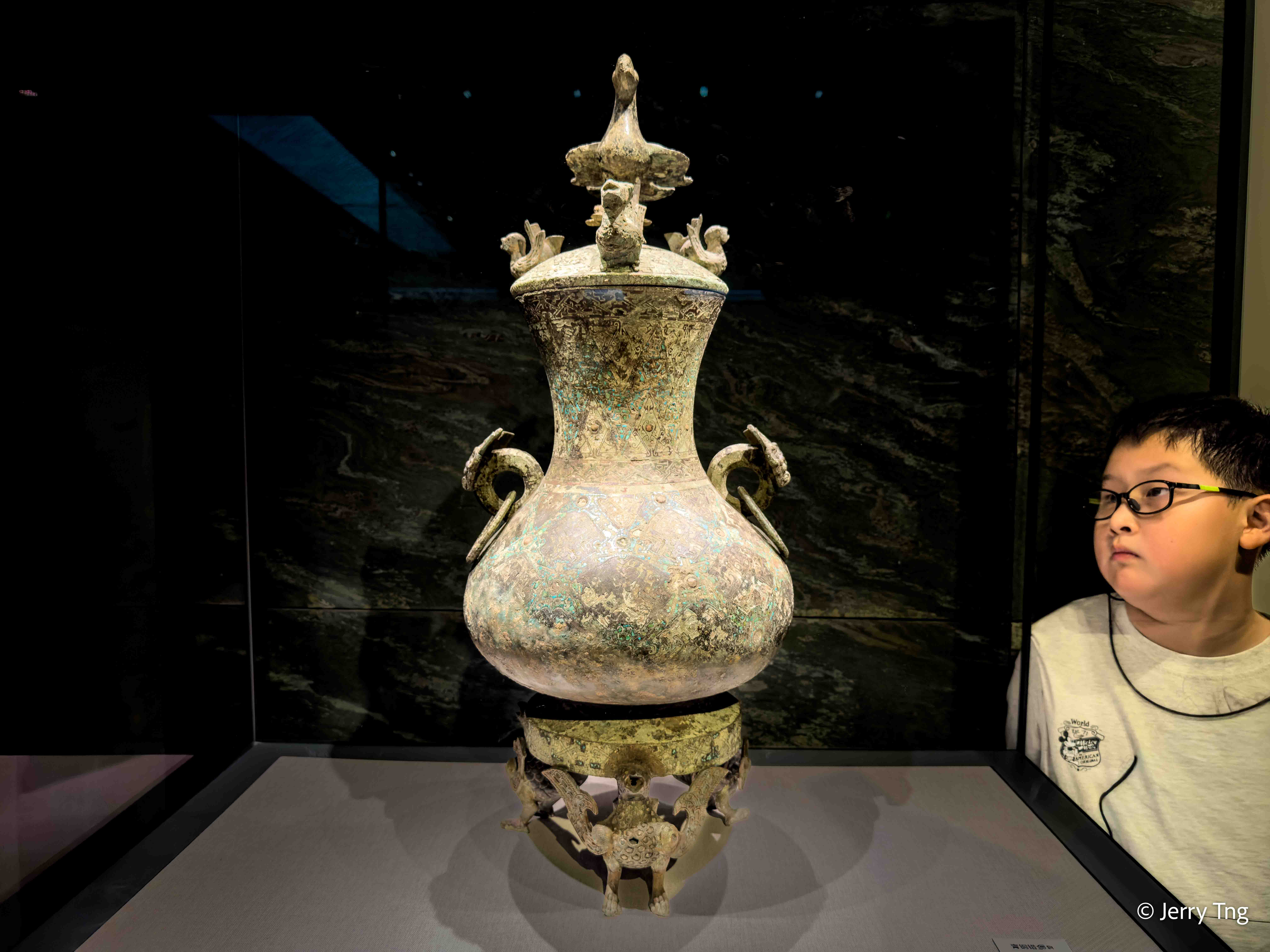
It’s the school break and parents love to bring their children to something fun and educational at the same time. And museums become the first choice for many of them. But how to keep the children’s attention during the visit to the museum? Here’s a suggestion for the Nanjing Museum.


The museum spans six different galleries (buildings) and over 23 exhibitions of different themes. It is really confusing to navigate around the compound as everything is linked on the lower floor which is called the first floor (yes, the ground level is not the first floor, but the second floor) and the exhibits are scattered around. This list is based on the gallery/exhibition they are in, and may change according to the museum plans. Check before heading to the exhibits.
Nanjing Museum for Kids
Land Before Time (Prehistoric – Neolithic)

First stop, Hall 1 “Impression of Remote Antiquity 远古印象” on Level 2 of the History Building. All the children will let go a collective “WOW” when they enter the hall as they are greeted by the skeletons of the gigantic mammoths. I was surprised how much these children know about the dinosaurs.

This is not a big hall, but nevertheless it is difficult to pry them off this hall as they marvel at these beautiful creatures that one roamed our planet. Don’t miss the long-neck Lufengosaurus that is discovered in China during the late 1930s. Be warned, this hall is really noisy with screaming parents asking their kids to move along!

As you leave the hall, the next section is the Prehistoric section of the exhibition; Palaeolithic age is usually quite boring for everyone, even adults, as you walk through pieces of stone axes and debitage. But still, there are interesting things to notice as you walk through the rubble.

While the Neolithic age focuses on excavations and discoveries around the Jiangsu region, it is not difficult to notice that the ancient Chinese had been travelling their vast land as different cultures shared different aspects of their shamanism and beliefs.

The ancient folks, through observation of the stars and night sky, believed that the sky (or heaven) is round and the land is square. Hence they took effort to carve these ceremonial jade pieces called Cong 琮 to represent the round sky and flat earth 天圆地方. Of course we now know that the earth is round and the sky is, well, infinite. It was not known when stratification of societies happened, where the ruling class monopolised the conversation with the heavens. Divinity becomes a reason for owning the power over the people for these ruling class, whom often perform ritual offerings using these ceremonial tools and, sometimes, human sacrifices.

By this time if your child is starting to be distracted, you may want to point out the different types of Neolithic pottery that are displayed all around the hall, like these three-legged pottery gui that looked like balloon poodles are the first kettles where you can place a fire underneath to heat the water inside. How do we know? There were soot found underneath when some of these gui were excavated.

Or point them to the different animal pottery, like these pig-shaped jars. No, they are not piggy banks, but the first serving bowls used as ceremonial vessels to hold food as offering to the gods. It is not unlike our modern offerings to our ancestors during important festivals, where we as kids were very excited as it meant that we were getting goodies for lunch. However, during the Neolithic period, food was not shared after prayers and many were found to contain carbonised grains and bones of animals.

These Neolithic pottery also gives us a glimpse to the animals found in nature during that time, like this finless porpoise that is still found in waters of Yangtze River. Known for its “mischievous smile” and high intelligence, this “living fossil”, which is critically endangered, serves as a key indicator of the Yangtze’s ecosystem health. Thanks to strict conservation measures, including a 10-year fishing ban, the population has shown signs of recovery, with over 1,200 estimated in 2022.1
Building of a Nation (Shang-Zhou)

After the Neolithic period came the first dynasties of China – Xia, Shang and Zhou. These dynasties rose and fell in different parts of China, but only Shang and Zhou left their marks in Jiangsu. Starting with the Shang (c.1600-c.1046 BC), they left behind writings on ox shoulder bones and turtle shells known as oracle bones although none was found in Jiangsu. But they did left behind Shang bronze wares that were awarded to chieftains and leaders of the area most likely for their war achievements. Think of them as trophies from 3,000 years ago. These “trophies” are important for us to understand the history of that period as some of them have inscriptions in them, starting why these “trophies” were given to them.

There was an uprising against the Shangs by the Zhous, which ended the tyrannical rule of the last Shang king Zhou 紂 (trad. r. 1154-1123 BC). There’s a Chinese idiom, 助纣为虐, or “aid and abet an evildoer”, and Zhou 紂 refers to him. There’s a Chinese classic novel from the Ming dynasty written some 2,700 years later, “The Investiture of the Gods”《封神榜》2, was loosely based on the rise and fall of King Zhou, and how the generals that rose against him became Taoist gods. This novel has been made into many movies and TV shows with fantastic special effects, like the recent one available on Netflix featuring one of my idol, Kris Fei, as King Zhou.


Now back to real history. The new Zhou king awarded those who had helped him overthrew the Shang dynasty by conferring them with enfeoffments, which gave rise to larger states like Jin, Qin and Chu, as well as smaller states like Wu and Yue, and even smaller states known as Fangguo 方国. Interesting to note, at this point in history, Wu state (somewhere in modern day Jiangsu and part of Shandong) was not considered part of “China” or the Sinitic sphere, with its own language and culture.

The Zhou Dynasty can roughly be split into two parts, the first 250 years is referred to as Western Zhou (c.1046-771 BC), a feudal empire that laid down a lot of rules that still influence us today, like what animals to use as offerings during ancestor worship, etc. There’s a gentleman’s ritual of offering your guest water to wash his hands called Guan Xi 盥洗 – The host will offer clean water to the guest from a water jug called Yi 匜 while the son of the host will hold the plate similar to the one above to catch the flowing water below.

The Western Zhou Dynasty earthen mound tomb at Fushan Orchard in Jurong is a commoner’s burial site. Therefore, the tomb contains mostly simple pottery, many of which were filled with food, reflecting the ancient people’s concept of “treating the dead as if they were alive.” Although there are no lavish unearthed artefacts, this pot of earthen eggs seems to allow us to see the daily life of the ancients more than 3,000 years ago—ordinary and intimate.

The next 500 years is known by historians as Eastern Zhou (771-256 BC). This period influenced how the country and society were governed for the next 2,000 years. Confucius (c. 551 – c. 479 BC) was a statesman from Lu state (modern day Shandong province) during the early part of Eastern Zhou dynasty called the Spring and Autumn period. Sun Tzu (544-496 BC), the master tactician and military strategist of Wu state, was also from this period, and his military masterpiece, “Art of War”, is still the mandatory of all generals in modern day military.

There are many artefacts on display that demonstrate the differences and similarities between these states in terms of artistic forms with mainstream Central Plains states, which are considered to be more “Chinese”. However, they were all brought under the powerful Wu state which was in turn conquered by the Yue state, and then by Chu state.
The Chinese Country (Han Dynasty)

And then we come to the Han dynasty after a long period of wars among the nations known as the Warring States (c.481-221 BC). Kids know about Qin dynasty (221-202 BC) and Emperor Shi Huangdi, the first unified country and the first emperor whom built himself a huge mausoleum and its terracotta armies. You won’t be able to see any of the terracotta warriors here – the only ones found outside the mausoleum are in the National Museum of China and Shaanxi Provincial History Museum. But you can see a very fine example of a miniature bronze chariot with the horseman and horses like those found in the pits here. It’s like a 2nd century BC Playmobil set.

Jiangsu was part of the Chu state that eventually was conquered by the Qin state. The museum also houses the largest piece of gold currency found in China dating from the Chu state called the Ying Yuan 郢爰, which looked like a golden chocolate bar. It is broken into smaller pieces like those above for payment.

The complete gold bar was placed in another exhibition that was closed for maintenance when I was there. Worth a detour if it’s reopened. There you would see the other treasure retrieved from the same Xuyi Nanyaozhuang hoard as the Ying Yuan. The gold beast pictured above is a replica in the Han dynasty display, which your child can fondle and feel the actual weight of the real thing. But the real thing is 99% gold and considered the Treasure of the Museum.

Now come to the next dynasty, the Han dynasty (202 BC – 220 AD), which was founded by Liu Bang 刘邦, a local boy from Pei County (modern day Xuzhou, Jiangsu province). The Jiangsu region became enfeoffments (feudal states given in exchange for their allegiance) of Han princes.

Emperor Wu of Han Liu Che 汉武帝 刘彻 became the first Han emperor to fight back against the Xiongnu successfully and kept them at bay behind the Han borders. He opened up the Hexi Corridor that started the Silk Road. We now refer ourselves as Han people because of the glorious period of this rule which kept the “barbarians”, the Xiongnu, outside the Great Wall.


Han artefacts are interesting as the Hans believe in “living life after death”, like these pottery funerary goods that mimic the daily lives of the tomb owners. Like the pottery that looked like a sty, it was believed that pigs were used to clean up the excrement which was relieved from the hut above the sty. Hence the Chinese phrase “上厕所”, literally “going UP the toilet.”


Among the artefacts are these eco-friendly bronze oil lamps that do not release the fumes produced from burning the oil into the room. The fumes are funnelled through the “horns” into the belly of the bronze ox, which contains water that will dissolve the fumes.
The Romantic and Chaotic Period (Six Dynasties)

Next you head down one floor to the 1st level, and we come to the “romantic” (and chaotic) period of Han history, known as the Three Kingdoms (220-280), which was immortalised in another classic novel, “Romance of Three Kingdoms”《三国演义》. While the characters in the novel are real, the stories are vaguely based on actual history, thus causing a lot of confusion in terms of what’s real and what’s fictional.

Nanjing (which was known as Jianye) later became the capital of Sun Quan 孙权, who proclaimed himself Emperor of Wu 吴 (r. 222-252), aka Eastern Wu 东吴 or Sun Wu 孙吴 (222–280), one of the Three Kingdoms.

With Shu losing to the Wei, the romance came to a halt when Sima Yan ended Wei and conquered Wu and proclaimed himself emperor and named his country Jin 晋 (265-420). While this dynasty was really weak, it produced some of the most prolific artists and calligraphers of China. Folks like calligrapher Wang Xizhi 王羲之 (303-361) and the painter Gu Kaizhi 顧愷之 (348-409) or the writers and poets Xie Lingyun 謝靈運 (385-433) and Tao Yuanming 陶淵明 (365-427) all came from this period.


Next came a chaotic period where foreign invaders came in hordes and took over parts of China, known as the Sixteen Kingdoms of the Five Barbarians (304-439). The Chinese retreated to the south of the river and started the Southern dynasties (remember Mulan? btw, Mulan is fictitious character although it was roughly based in the Northern and Southern dynasties), a period that gave Nanjing the moniker “Capital of the Six Dynasties”. The “Seven Sages of Bamboo Forest” (above) depicts the seven famous scholars in the Wei and Jin Dynasties (c. 220-420), a reminder of a glorious period in Chinese art and literature. Can you spot the eighth person?3 Remember to take a look at this magnificent brick wall as well as the celadon beast as they are designated as part of the 195 artefacts forbidden to be displayed outside of China, commonly referred to as National Treasures 国宝.

Finally it all ended with the unification of China once again by the Sui 隋 (581-618) emperor Yang Jian 杨坚 (r. 581-604). His son and successor, Yang Guang 杨广 (r. 604-617) left his mark in history as the builder of the Grand Canal that brought the rice and wealth of Jiangsu to the Northwest capital of Luoyang, and for setting up the Imperial Exams system that was used until 1905. He was killed for his tyrannical rule in Yangzhou, his third capital.
The Cosmopolitan Nation (Tang-Song-Yuan)

Then came a period where foreigners came to China to trade along the Silk Road, both on land and on sea. The firsts who came travelled via the Hexi Corridor first discovered by the Hans, and they brought along foreign religions and practices, along with foreign goods. One of the items that came with the Silk Road was rare earths that were used to colour the celadons that evolved into the Sancai pottery as well as influenced the end products like the double fish vase from Tang dynasty (618-907) that most likely was influenced by Greek amphoras.

By the 7th century, the Tang dynasty emerged after Li Yuan 李渊 overthrew the Sui dynasty and proclaimed himself the emperor. His son, Li Shimin 李世民 orchestrated a coup d’tat and forced his dad to abdicate. Li Shimin was a wise emperor and started another Pax Sinica, during which foreigners were accepted to become his officials in the government. Foreigners and religions flourished in a free exchange of goods and ideas, whereby Persian and Sogdian merchants benefited from the commerce between East and West.


During its peak, the Tang dynasty maintained hegemony over 72 tributary states. During this period, Chinese culture was revitalised and became more diverse and cosmopolitan. The amount of interaction between China and Japan increased; Chinese influence on Japanese culture and politics became more prominent since the Tang dynasty.

All good things came to an abrupt end when Tang dynasty collapsed on its own merit. Commanderies, a system that was created to divide and control the vast empire, became too powerful on their own and started to revolt against a corrupt central government. China went into a chaotic period known as the Five Dynasties and Ten Kingdoms. Southern Tang (937–976) with its capital in Jiankang (Nanjing) raised as one of the ten kingdoms which were vassal states to the central government, but pretty much ruling on their own. Southern Tang was conquered by the Song dynasty in a unification war.

The Silk Road brought trade to China from the Northwest route, but with the North under foreign rule (mainly Liao dynasty under the Khitan), trade with Song was restricted to the ocean routes. The Songs were not interested in war, and so trade and culture prospered during this period. Song dynasty was the pinnacle in terms of science in Medieval era; they invented the magnetic compass, fireworks (or explosives), the moving block printing press, all of which were way before the Western world attributed them to Neckham, Nobel and Gutenberg.

It was during the Song dynasty, which saw the development of a wealthy mercantile class and emergent market economy in China, that Jiangnan (southern Jiangsu, Shanghai, and adjacent areas) emerged as a center of trade. From then onwards, major cities like Suzhou or Yangzhou, would be synonymous with opulence and luxury in China. Today the region remains one of the richest parts of China.


Being a pushover militarily, the Song was promptly taken over by the Mongolians (more accurately Kublai Khan), which called themselves the Great Yuan dynasty (1279-1368), that included the rest of the Mongolian empire in Central Asia and parts of Europe. The museum does not feature much about the Yuan dynasty (and Kublai Khan) as they are considered to be foreign rulers, although there are some really pretty artefacts from the Yuan period, like the golden belt and plate above.

Around the world, this period is known as Pax Mongolica, which lasted for around a century between 1280 to 1360. The Mongols had built a network of supply chains from the Western world to China via the Central Steppes as well as sea routes that they inherited from the Songs. Porcelain production flourished and Nanjing became one of the inland ports from which these porcelains were exported. The infrastructure and shipbuilding capabilities that flourished later under Admiral Zheng He in the Ming Dynasty were built on these Yuan foundations.
The Renaissance (Ming Dynasty)


While China did not experience a Renaissance identical to Europe’s, the Ming Dynasty (1368–1644) is often cited as a period of cultural revival, stability, and intellectual development, characterised by a return to native Chinese rule, massive literacy growth, and the creation of masterpieces like the Forbidden City.

Yuan dynasty has never gained acceptance among the Han Chinese as they were considered to be a foreign race and the regime was not exactly benevolent. So the rule by Ming emperors was less chaotic and disruptions were mainly within the walls of the palace – political assassinations, usurpation of the throne, power struggle of the different factions.

Nanjing became the capital of Ming dynasty for only two emperors, the founder Zhu Yuanzhang 朱元璋 (Hongwu, r. 1368-1398) and his grandson Zhu Yunwen (Jianwen, r. 1398-1402). When Zhu Di 朱棣 staged a coup d’état that overthrew his nephew, he was not comfortable to rule the country from Nanjing and moved the capital to Beijing, where his power base was located.4 His rule was named Yongle 永乐 (1402-1424), which means “forever happiness”.

But for the commoners, it was relatively peaceful and prosperity came back to the land, another Pax Sinica. During the reign of Yongle, the Ming armada travelled six times to South Asia to as far as Africa.5 These voyages were led an eunuch named Zheng He, and his voyages are well documented, leaving many relics and artefacts everywhere he went. While there were some border wars in the North, the interior of China was relatively peaceful and stable.
The Last Emperor (Qing Dynasty)

Since the Zhou dynasty, the emperor is thought to be appointed by the Heavenly Mandate, and when the heavens are no longer watching over you, your dynastic rule is over. When the founding emperor of Qing dynasty proclaimed to receive the Heavenly Mandate, he had not entered into the Ming territory. By the time the Qing entered through Sanhai Pass, it was already 1644 and the Ming capital had fallen to a rebellion led by Li Zicheng who promptly declared himself emperor with dynastic title Shun 顺. So technically, the Qing did not defeat the Ming. But then, it was all over by 1911.

During the Qing dynasty (1644-1911), it was ruled using the same form of government as the Ming, nothing much was done to improve the country except territorial expansion through conquests and vassalage. China’s land mass was the largest ever in history, and is somewhat similar to the current cock-shaped and included Mongolia.

Another Pax Sinica happened between the rules of Kangxi, Yongzheng and Qianlong, a period known as 康乾盛世 (1684-1799). Because of the relative peaceful times in China, many crafts flourished and became export items. European countries craved for tea and porcelain from China, as well as many other handicrafts that can be produced cheaply and sold for a handsome profit in Europe.


The term, Chinoiserie, refers to the adaptation of Chinese artistic style to Western designs and first appeared in the 17th century and lasted throughout the Qing dynasty. This demand for Chinese goods created a huge trade deficit, where silver (and gold) from foreign countries were entering the Qing dynasty.

Then Qianlong (r. 1736-1795) decreed in 1793 to restrict trading with foreigners, whom he called “barbarians”, to Guangzhou and the Canton Hongs after his disastrous meeting with Macartney. This move practically closed the nation from foreign trade, and set the stage for the wars to come.8
Republic of China (1920s)


Republic of China (ROC) refers to the nation proclaimed by the revolutionaries after the successful Wuchang Uprising on 10 Oct 1911. Known also as Xinhai Revolution 辛亥革命, this armed revolution overthrew the Qing Dynasty. Dr Sun Yat-sen became the first President of ROC, even though he took it as a provisional position. What happened afterwards were more in-fighting and warlordism that was not dissimilar to Five Dynasties Ten Kingdoms. One warlord after another claimed hegemonic rule over parts of China. ROC did not exist as a unified nation until around 1920s, where strongmen Chiang Kai-shek (now the Chairman of the Nationalist Party) and Mao Zedong (Chairman of the Communist Party) pretty much hold the decision-making of the country.9

Nanjing became the capital of ROC (1912-1949), and the country was suddenly thrown into modernity. Pigtails were now outlawed, and Western lifestyle became vogue. In the basement of the connector between the Special Exhibition Gallery and the History Gallery is a recreated ROC Main Street, with functional shops and cafes, as well as artefacts from the era. It is a nice break from looking at just “boring” artefacts, where you can grab a slice of pizza and have some iced latter.

And if you have time in Nanjing, I strongly recommend to bring your children to the Nanjing Presidential Palace for more history of that period, as well as a recreation of throne room and other relics of Taiping Heavenly Kingdom 太平天国 (1851-1864), a short-lived revolutionary state that existed during the Qing dynasty.
Modern Times
After visiting the History Gallery and ROC Gallery, you will find the Digital Gallery that showcases history using modern multimedia technologies. Take this example of the National Treasure, Picture of the Seven Sages of the Bamboo Grove 竹林七贤砖印模画, it is difficult to understand the actual murals because of the artistic style of that era is not easily accessible to the modern folks. But the multimedia presentation makes the clay mural come alive, making the stoic content very lively and interesting. Your kids will love the interactivities.
Or if they are still apt, you may want to challenge their patience by visiting the special exhibits.
Conclusion
I find it important that a civilisation feels proud of its history and show the future generations where they came from. History is an interesting mirror of what is going on in our world today. As the saying goes, “History repeats itself,” you see the cycles that have been repeating over the 3,500 years of history of China.
People always find a way to overcome the tyranny and work through the chaos to strive for a peaceful life. There were several periods of Pax Sinica 盛世 (normally lasting around a century) during the Han, Tang, Song, Yuan (Pax Mongolica), Ming and Qing dynasties where free trade and movement of people flourishes. And many say we are in the beginning of the next Pax Sinica, as the current Pax Americana comes to an end.
If only history was taught this way, I would have paid more attention during my history class.
About Nanjing Museum

Nanjing Museum, one of China’s three major museums, was founded in 1933 and originally established as the National Central Museum. It houses over 400,000 cultural relics, spanning from the Paleolithic Age to modern times. Highlights include the Han Dynasty jade burial suit and Ming Dynasty underglaze red porcelain, offering a comprehensive glimpse into China’s historical and cultural heritage. Especially notable is the museum’s enormous collections of Ming and Qing imperial porcelain, which is among the largest in the world.


The Nanjing Museum has several main exhibition halls:
- The Historical Exhibition Hall shows the history of Jiangsu Province from prehistoric times to the Qing dynasty. It includes Neolithic pottery and tools, Shang and Zhou bronze vessels, Han lacquerware and jade burial suits, Tang sancai ceramics, and porcelain from the Ming and Qing dynasties.
- The Art Exhibition Hall displays Chinese painting, calligraphy, sculpture, jade, bronze, and ceramics, showing how artistic styles developed over time.
- The Republic of China Hall covers the period from 1912 to 1949, when Nanjing was the capital. It includes documents, photographs, clothing, and everyday objects from that time.
- The Intangible Cultural Heritage Hall presents traditional crafts and performing arts from Jiangsu Province, including Nanjing Cloud Brocade and paper-cutting.
- The Digital Hall uses multimedia and interactive technology to explain history and culture.
- The Special Exhibition Hall hosts temporary exhibitions on specific themes or new discoveries.
Nanjing Museum 南京博物院
No. 321 Zhongshan East Road, Xuanwu District, Nanjing
All photos taken at Nanjing Museum Nov 2025, unless otherwise noted.
Footnotes :
- Stephen McDonell, China correspondent. Saving China’s finless porpoise from the brink of extinction, 21 August 2025. https://www.bbc.com/news/articles/ce3jy7el90po
↩︎ - The Investiture of the Gods, also known by its Chinese titles Fengshen Yanyi (Chinese: 封神演義; pinyin: Fēngshén Yǎnyì; Wade–Giles: Fêng1-shên2 Yan3-yi4; Jyutping: Fung1 San4 Jin2 Ji6) and Fengshen Bang (封神榜),[note 1] is a 16th-century Chinese novel and one of the major vernacular Chinese works in the gods and demons (shenmo) genre written during the Ming dynasty (1368–1644).[2] Consisting of 100 chapters, it was first published in book form between 1567 and 1619.[2] Another source claims it was published in a finalized edition in 1605.[3] The work combines elements of history, folklore, mythology, legends and fantasy.[4]
The story is set in the era of the decline of the Shang dynasty (1600–1046 BC) and the rise of the Zhou dynasty (1046–256 BC). It intertwines numerous elements of Chinese mythology, Chinese folk religion, Chinese Buddhism, Confucianism, and Taoism, including deities, demons, immortals and spirits. The authorship is attributed to Xu Zhonglin. https://en.wikipedia.org/wiki/Investiture_of_the_Gods
↩︎ - National Treasure – Picture of the Seven Sages of the Bamboo Grove (Southern Dynasties)
Who were these people actually? As is traditionally depicted, a certain group of seven scholar/musician/poets wishing to escape the intrigues, corruption and stifling atmosphere of court life during the politically fraught Three Kingdoms period of Chinese history habitually gathered in the obscurity of a bamboo grove near the house of Xi Kang (aka Ji Kang) in Shanyang (now in Henan province). Here they enjoyed practicing their works, and enjoying the simple, rustic life, always with much alcohol. Besides the seven sages, there’s the drawing of Rong Qiqing, a Taoist recluse that was from another era. This “abnormal” inclusion reflects the philosophy of the tomb owner.
左至右分别为春秋隐士荣启期、阮咸、刘伶、向秀、嵇康、阮籍、山涛、王戎。
↩︎ - Zhu Yuanzhang was the Marquis of Yan (modern day Beijing), when he staged his coup d’état.
↩︎ - There’s a seventh and final journey during Xuande reign.
↩︎ - 清乾隆/嘉慶 藍色紗納繡彩雲金龍紋蟒袍
此御製藍地納紗金龍雲紋龍袍運用納繡及平金等技法,為乾隆朝晚期至嘉慶早期製品。這件夏服形制嚴謹,繡工規整,如立水上方之錦雲紋以及間飾於五彩雲紋之紅蝠等細部紋飾尤為精緻,可見織工之高超技藝。由此可斷定此為宮廷御用織造處之作品。
藍色為清朝宮廷代表色,所有貴族或是低階皇室成員均可使用。此袍衣襟及背面所繡正龍體型大於下幅所繡之行龍。此袍所繡雖為只有皇帝或其直系親屬可用之五爪龍,但亦有可能為通常帶四爪之蟒。清十八世紀後期宮廷服飾常見改稱蟒為龍的例子。由於龍袍和蟒袍的區別不在紋飾,而在於身份,故此。如不知其原主身份為何,無法斷定此袍上所飾為龍抑或蟒。
https://www.christies.com/zh/lot/lot-6043227
↩︎ - Blue-and-white porcelain plate on an underglaze red ground 青花釉里红水中八事纹盘
Porcelain | Qing Dynasty Shun Zhi Period (1644-1661) | Nanjing Museum collection
瓷器|清顺治(1644-1661年)|南京博物院藏
“水中八事”意指水面的多种生物。丰富的鱼虾蟹贝,展现了江南水产的丰饶,象征富裕美好的生活。
↩︎ - The First Opium War broke out in 1839. It is called the ‘Opium War’ because of one of its major causes: the British were smuggling opium from their Indian colonies into Chinese ports against the wishes of the Chinese government. This was to help pay for the large amounts of Chinese tea that they were importing – by the early 1800s, tea was a popular drink with the British public. Britain also wanted more control over their trade with China, as they could only trade with certain officials called Hong merchants.
The Qing dynasty suffered a humiliating defeat by the British navy, aided by the French in the two Opium Wars. The Opium Wars resulted in two treaties, each expanding the size of Britain’s Hong Kong territory. These treaties were followed by a 99-year lease in 1898 that allowed Britain to control even more land – a lease that ran out in 1997.
Here’s a good link for your child to understand the Opium Wars (from a British perspective) because I find the narrative in Chinese museums to be very lobe sided.
https://www.nationalarchives.gov.uk/education/resources/hong-kong-and-the-opium-wars/
↩︎ - Nanjing Museum is very wishy-washy about this part of the history, unlike other museums setup in the modern times (ie PRC era), where it was very clear about ROC losing the “mandate of the people” and retreated to Taiwan. It is still history unfolding, so there’s no right no wrong.
Remember that historical narrative is often written by the winners, not the losers.
↩︎
0 comments on “Nanjing Museum for Kids”