
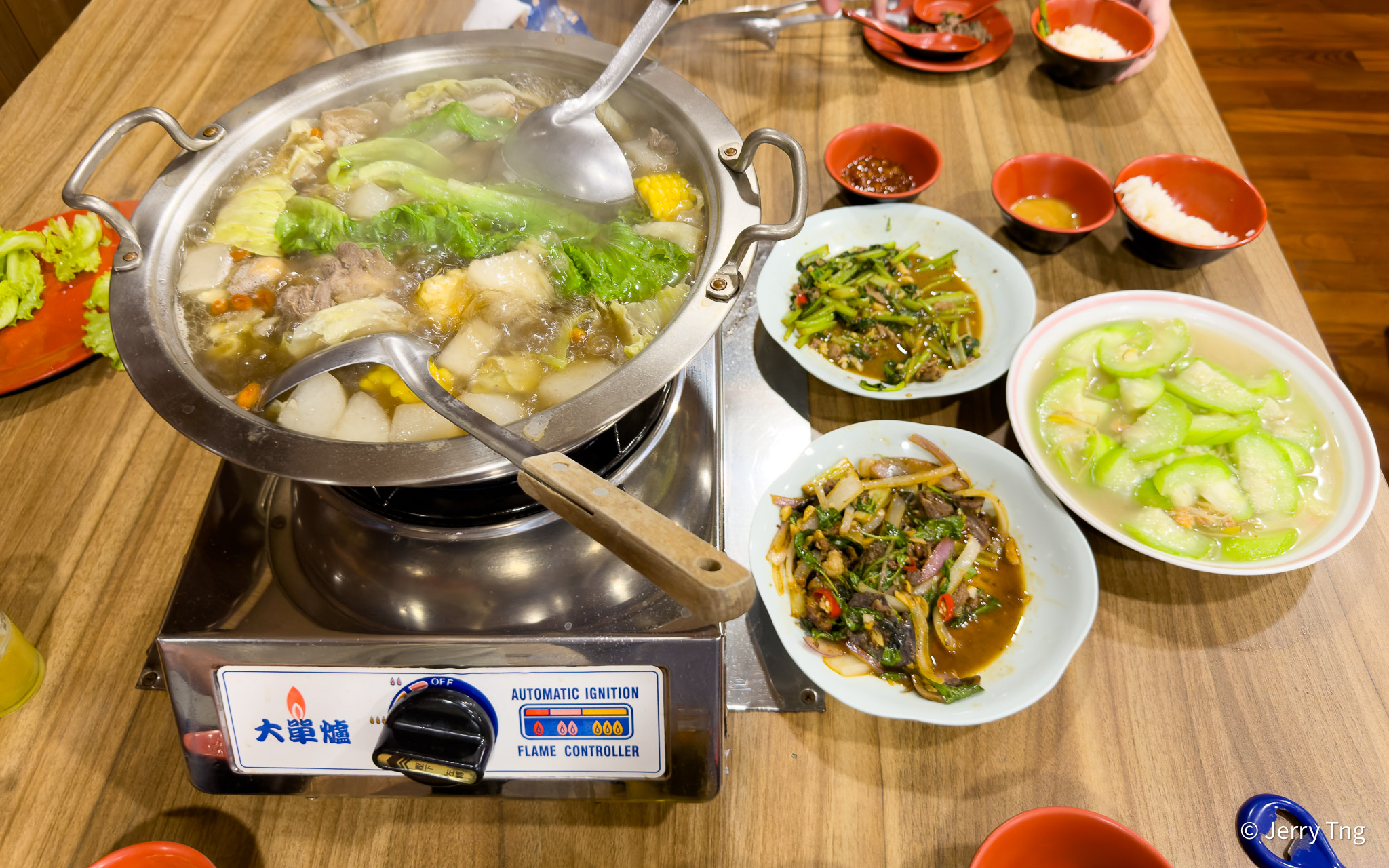
Gangshan 岡山 is a small town in Kaohsiung and in a block around the size of Toa Payoh, you have something like 20 shops that sell cuisine that feature mutton, in particular mutton hotpot called 羊肉爐. But it was almost impossible to get one in Kaohsiung city itself and we didn’t want to travel one hour to get our fix. Then our cabby introduced us to this one.

In Gangshan, many lamb hotpot specialty shops will close during the summer months, so we may end up not finding a good place to eat this cuisine. Gangshan just happens to be a farming community that has been raising the grass eating mammal for a long time. And when you have so many goats, you will start to sell products that would feature mutton. And there’s so many style they would cook the mutton – hotpot, boiled, stir-fry, herbal, braised, you name it. But you risk the possibility that they will be closed for the summer break, so we decided to go to Lamb Boss 羊老大 as recommended by the cabby instead.

The restaurant was almost empty when we were there around 7pm. This is not unusual as summer is not the time where locals go for lamb hotpot, so the restaurant also offers stir-fry dishes to complement the menu, and hopefully get the crowd going. When the rain stopped, more diners appeared.

The main attraction in this restaurant is the mutton hotpot 羊肉爐. It consists of mutton simmered in a seasoned broth and served as a communal hot pot, often accompanied by vegetables, tofu skin, enoki mushrooms, radish and other ingredients added by diners during the meal. The broth is light, mainly sweetness from the vegetables, with little to no herbal taste; the flavour is very subtle. And similar to Swatow beef hotpot, the goat is slaughtered the same day the mutton is served. But that’s where the similarity ends.


We ordered a portion of mutton belly meat with skin on 帶皮五花肉 . The skin is soft, chewy, and tender, with little to no gamey mutton smell, but those with a sensitive palate can still faintly detect the unique aroma of mutton. The meat is thick and chewy, with little gamey smell, only a rich meaty aroma, making it perfect for gourmets who don’t like eating lamb. And for tulang (bones in Malay) lovers out there, they also offered mutton bones 羊大骨 as one of the meat choices, six pieces per portion. These meat and bones were precooked to around 80% doneness in a much larger portion that produced the broth, and finished in the boiling hotpot. While the mutton belly and skin reached their desired tenderness, the bone marrow was overcooked.


So what’s the difference between mutton and lamb? Lamb and mutton are both meats from sheep, separated primarily by the animal’s age: lamb comes from a young sheep under one year old, while mutton comes from a fully grown adult sheep (usually two to three years old). Mutton tends to be musky and lean, but Gangshan goats are different. Firstly, Gangshan mutton has almost no fat but still tender and moist because they are almost never sold frozen. Secondly the meat is not gamey. Princess complained that the mutton had no “taste”, which she meant the muskiness.


And like all hotpot, you can order other things to dump into pot as per your liking. We loved the belly meat so much that we ordered another portion. And then we added more mutton meat and vegetables to round it up. The basic hotpot already came with a lot of cabbage and other ingredients, so if you have a small party, you just need to decide on the amount of meat you want to partake.

While we waited for the hotpot to boil, we ordered a portion of the classic 沙茶羊肉 Shacha “Satay” mutton. Shacha sauce is the Hokkien version of satay sauce from Southeast Asia, which the diaspora brought back to their hometown and tried to recreate a taste they acquired when they were here. But if you are expecting the satay we are used to, this shacha is not as it is made without the peanut. What makes this classic special is its selection of high-quality lamb, which has just the right amount of marbling and melts in your mouth. Paired with the restaurant’s special shacha sauce, it’s fragrant and satisfying. BTW, “shacha” (沙茶), the Mandarin pronunciation, is actually pronounced as “satay” in Hokkien and Teochew.

Everything that had mutton in it was stir-fried in the shacha sauce, like this sautéed mutton offals 炒羊雜. You can order the offals (that included liver, kidney, cheek and sometime, but not this time, the penis) in the hotpot, but experience tells me that the offals will become overcooked very quickly in the boiling broth and leave a musky taste if they are not cleaned properly. The taste of this dish is exactly the same as the sautéed mutton, and the offals were still overcooked. I rather have them in the hotpot as they were cleaned properly and not musky.

We ordered sautéed sea snails 炒螺肉 to variate the proteins we were having. They were cooked in the “three cups” (三杯) style that is very popular in kuaichao (快炒) stalls in Taiwan. Three cups refer to oil, rice wine and soy sauce that are used in equal measure to stir-fry the ingredients with copious amount of Thai basil. The sea snails used were the frozen type, so the dish was a complete disaster.

And to round up the meal, we ordered some stir-fry loofahs. Very homey taste, nothing extravagant about this dish when the loofahs are young and crunchy. You know, when loofahs aged, they become very fibrous and hard. In the past they used dried up loofahs as utensil scrubs. These days you can buy these “organic” scrubs instead of the 3M synthetic ones for a ridiculous price. Just leave some loofahs in the vine to age naturally and you get an endless supply of scrubs.

The hotpot was as good as it gets when the quality of the mutton is this good. The broth was not as robust as the one from Gangshan, but it is suitable as a hotpot broth as it thickens as you add more ingredients. Like all eateries in the South of Taiwan, the southern Taiwanese hospitality was everywhere – the straight-talking mistress of the house “commanding” us not to order too much, teaching us how to pick the right cut when they realised we are out of towners. Nice eat if you do not want to go to Gangshan for the mutton fix.
Lamb Boss’s Stir-fried Home-Style Dishes 羊老大熱炒家常菜
No. 13, Minzu 2nd Rd, Guangyao Village, Sinsing District, Kaohsiung City, Taiwan 800
高雄市新興區民族二路13號
Tel : +886 7 222 9009
Visited Jul 2026
0 comments on “Lamb Boss 羊老大 @ Kaohsiung”