
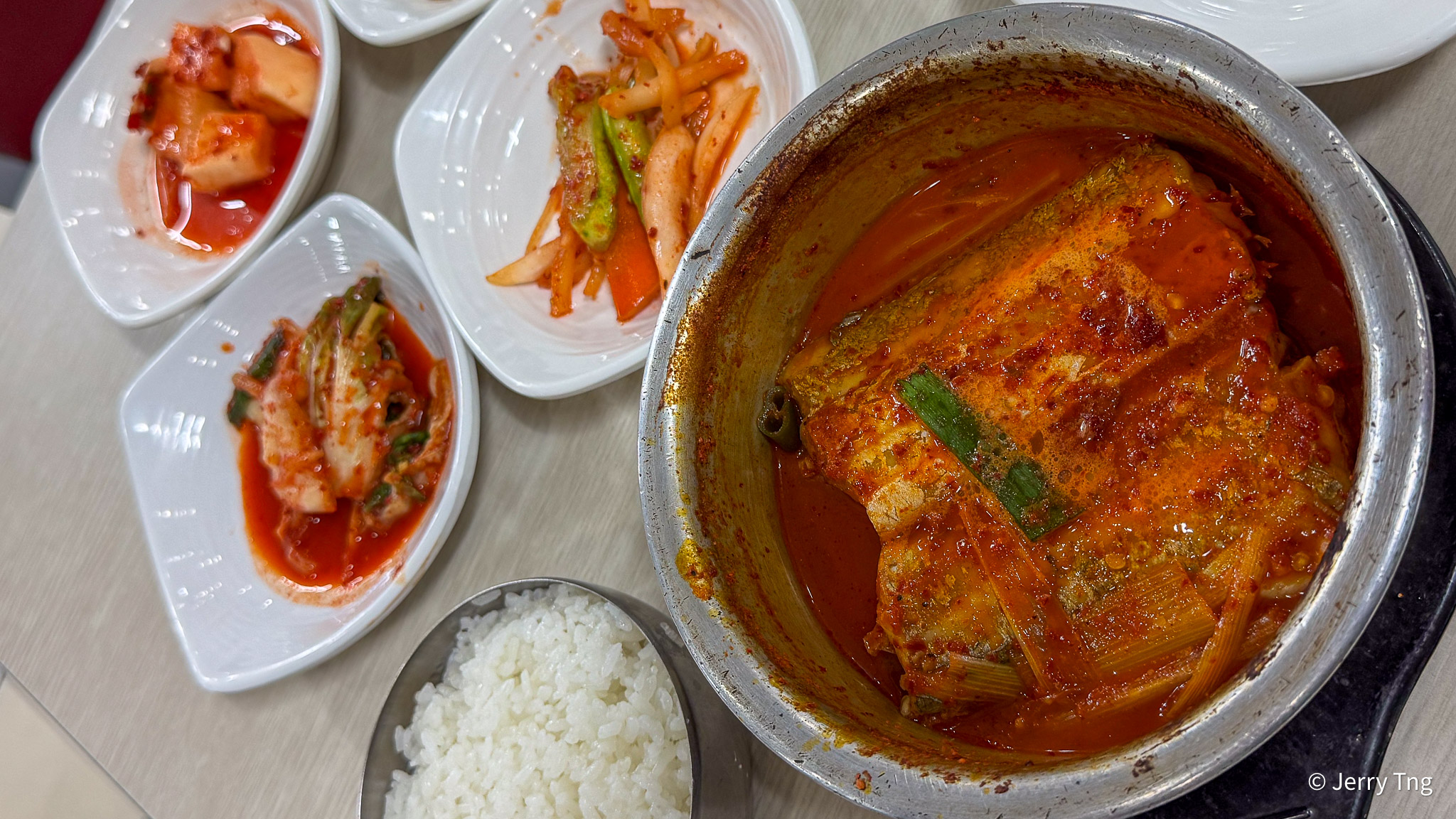
Back in Seoul and came to Nandaemun for gaichi-jorim. The Koreans love it so much, a whole street named Galchijolim Golmog 갈치조림 골목, or Hairtail Alley, is dedicated to it.

Galchi–jorim 갈치조림 is a Korean delicacy of a spicy braised galchi stew, made from beltfish (aka hairtail fish, cutlass fish is called galchi in Korean), radish, and onion.

Over the entrance to the first or second narrow alley on the left you’ll see a sign featuring a happy hairtail fish with the words “Hairtail Alley” in English at the bottom. Plunge in there, walk a bit and you’ll be in Hairtail Alley. The restaurants are all very similar; their menus are largely identical, and the quality is quite consistent.

The ajummas prepare cutlass fish stew over an open fire outside the restaurant, so be very careful when walking through the alley while deciding which restaurant to dine at. There are many restaurants, and you’ll have to control your temper as most of these restaurant workers will try convincing you to go inside (which can be a tad annoying if they start tugging at your sleeves).

But if you go during mealtime, most of these restaurants will not admit the lone diner. Then you have to go the ones along the Main Street as they charge a higher price versus those in the alley.

You can’t blame them for being snobbish, as mealtime is the only period they can attempt to recover the costs of running the restaurant. And most of these stores in the alley are too small to accommodate too many clients so they have to keep a minimum spend per table. I realise this is common in many popular dining streets.

Jorim 조림 is a category of stewed dishes in Korean cuisine, made by simmering vegetables, meat, fish, seafood, or tofu in seasoned broth until the liquid is absorbed into the ingredients and reduced down. In the past, galchi jorim was made with radish and soy sauce, but it is now seasoned with soy sauce, red pepper flakes and gochujang sauce, hence its bright red colour, and fiery hot taste.

The side dishes or banchan consist of small plates of kimchi, seaweed or soy bean sprouts depending on the season; like most Korean restaurants, banchan can be refilled if you ask politely.

Tender, delicate and fatty, this long, thin and silver-coloured fish is hard to keep fresh once it’s caught. So this style cooking is spot on. This dish is one of the so called “rice stealers” because it tastes delicious eaten with rice and people consume a big amount of it together with the fish.

The best part being not the fish itself but the mu 무 radish that had soaked up all the flavour. The braised radish complements the fish and seasoning perfectly, adding a sweet crunch to each bite. The taste was rich, and even if it was one of the spiciest dishes I have tried in Korea, the high quantity of red pepper doesn’t not overtake the flavour of the ingredients.

Any unlike the stores in the alley, the set does not come with a Korean-style steamed egg custard, or Gyeranjjim 계란찜 in Korean. But I would recommend to order it as they are a lifesaver to neutralise the spiciness of the stew. Not as silky smooth as chawanmushi, these are piping hot when served and don’t make the rookie mistake of scooping them directly into the mouth just because you don’t see any steam; they are much hotter (in temperature) than they seem.

The advantage of dining in a Main Street restaurant instead of those in the alley is that you don’t have time pressure to work through the fine bones of the cutlass fish, as well as if your companion is not a fish fan there are many other Korean favourites available. I don’t have that issue as I often dine alone.
Ihwa Bunsik 이화분식
31-20 Namdaemun Market-gil, Jung-gu, Seoul
Visited Jul 2025
0 comments on “Getting My Gaichi Jorim Fix”