
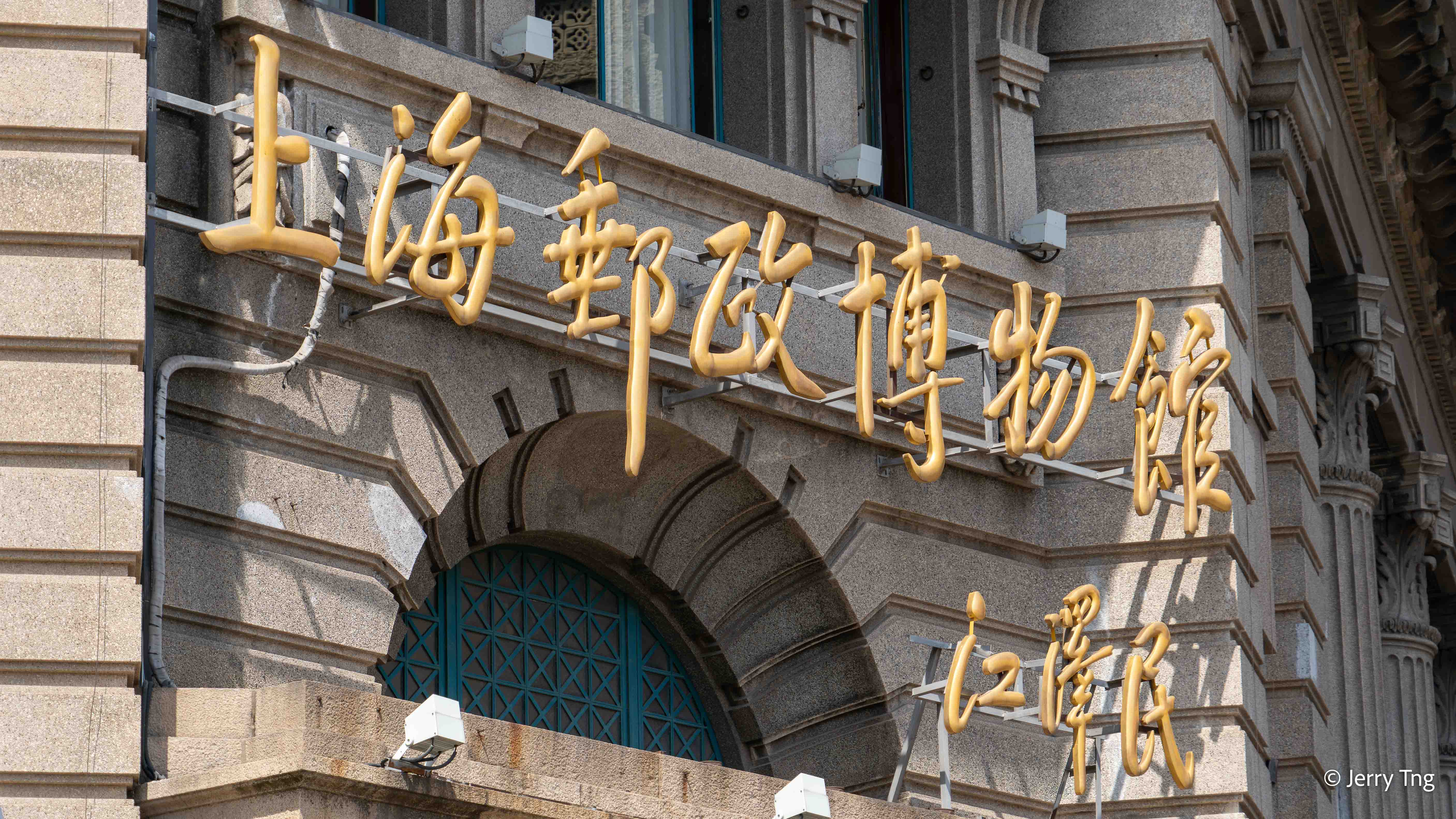
The Shanghai Post Office Museum is a large landmark building that was built in 1924 with an interesting mix of European styles of architecture. It is now a historical landmark under protection as the Shanghai Postal Museum.

The Shanghai Postal Museum has a total building area of 25,294 square meters. The building is U-shaped, with one underground floor and four floors above ground. It consists of the atrium exhibition area on the first floor (closed for renovation when I visited) and the main exhibition area on the second floor.
Table of Content
The Architecture


At the time before mass communication and international phone service, mail delivery was the main method that people communicated internationally. Shanghai needed a new post office building in the early 1920s.

Designed by the British architectural firm Stewardson, Spence & Watson by British architect R S Stewardson, and built by Chinese firm Yuhongji Construction Company1, the Shanghai General Post Office building is a typical example of European eclectic architecture. Its main facade adopts the British classical style, incorporating Roman Corinthian columns and a Baroque clock tower. The scale of the building was the largest in the postal industry in Asia at that time, with grand and magnificent stone columns and cement sculptures that reflected the style of classical British architecture.


The most eye-catching feature is the two groups of statues on the base of the clock tower, symbolising the development of transportation and postal services. One group consists of 3 people holding a train head, an anchor, and communication cables. The other group also consists of 3 people, with the Greek god Hermes the messenger god, flanked by Eros the god of love and Aphrodite the goddess of love in the middle representing commerce, and love gods on the sides symbolising the role of postal services in human communication and emotions. Unfortunately the originals had been destroyed. The ones on the building today are replicas made in 1999 from moulds a Shanghai art student secretly cast before the originals were destroyed during the Cultural Revolution.2 3


The interior decoration is magnificent, with the entrance hall paved with marble and the floors of other levels using mosaic, terrazzo, and cement. The interior space is spacious and well-lit, with exquisitely designed marble spiral staircases and mail slides.

The business hall inside the building covers an area of 1,200 square meters, integrating business, sorting, delivery, and transportation. It is known as the “First Postal Hall in the Far East.” The building has built of steel and concrete, and it is an interesting reminder of the time when Shanghai had a big international settlement.

In 2002, the second floor of the Shanghai Postal Headquarter was transformed into the “Shanghai Postal Museum,” with the museum name inscribed by Jiang Zemin. As the first specialised postal museum in the country, the Shanghai Postal Museum uses detailed historical materials and artefacts, as well as modern technology, to trace the origin and development of postal services, documenting the early party organisations’ leadership of workers’ movements and the contributions of revolutionary predecessors to the birth of New China.

Today, this building has become a landmark in the field of postal services, representing the earliest and largest postal architectural construction in use in China, and serving as a witness to the postal history of Shanghai and even China.


The exhibition is divided into the prelude that features Zhu Xuefan 朱学范, the first postmaster of PRC, and four sections: origin and development, network and technology, operations and culture, stamps and philately.
Origin and Development of the Postal Services in China 「起源与发展」

The first section is dedicated to the evolution of the postal service in China, going as far back as the Shang dynasty. Most of the artefacts are replicas to illustrate the development timeline.


The post station system gradually came into existence starting as early as from the Shang Dynasty (1600 BC -1046 BC). In the 10th year of Tianbao (752) in the Tang Dynasty (618-907), a post station was set up in the present day Songjiang District, the earnest official post station in the Shanghai region. In the 10th year of Jiading (1218) in the Southern Song Dynasty (1127-1279), a “Relay Stage Firm” (递铺) was established specialising in carrying ordinary official documents.

During the Ming (1368-1644) and Qing Dynasties (1644-1911), Relay Stage Firms and post stations 驿站 were set up one after another until they fell gradually into decline and were completely decommissioned in the early years of the Republic of China (1912-1949).

Qiaopi 侨批 are special letters that combined personal messages with remittances, sent by Chinese migrants working abroad back to their families in China during the 19th and early 20th centuries. They were crucial for maintaining family ties across the South China Sea, allowing migrants to send money to support their families while updating them on their lives. These letters serve as historical records of the struggles and stories of migrant families and were inscribed in the UNESCO Memory of the World Register in 2013.


The post box features a distinct dragon motif coiled around its base and pedestal, reflecting traditional Chinese artistry. It dates back to the late Qing dynasty and includes bilingual markings, specifically in English, due to the concession system in Shanghai at that time.

China near-modern post service which was affiliated to the customs before 1870’s, originated then after Rober Hart, the chief commissioner of Shanghai Customs, proposed the establishment of a central postal department to Qing government. In 1911, the postal service was virtually taken over by Shanghai Post Office.

Dr. Sun Yat-sen led the 1911 Revolution and overthrew the Qing Government. He was elected as Provisional President of the newly established Republic of China. At the beginning of the period of Republic of China, Grand Dragon stamps (above middle) were sealed with vertical Chinese characters of “Republic of China” in red or black for public use.

Later on, the office was moved out from behind the Shanghai Customs House, and was placed in between the International Settlement and the then Shanghai Railway Station, as a result of compromise of Qing government to British Municipal Council.

In 1914, the Republic of China joined the Universal Postal Union, and the Shanghai General Post Office became the largest international mail import and export centre in China. The government decided to build a new building, and this site was officially selected in 1922. The current building was completed and put into use two years later.


Different mailboxes used during the Republic of China era are on display. It is really interesting to see them as we also use similar mailboxes (the first one on the left) in Singapore in our colonial past except ours were in red.


During the Republic of China period, the postal service was known as Chunghwa Post 中華郵政, a name that remains today as the ROC government moved to Taiwan.

Zoya Shlakis was born in Mukden, China in 1927, to Stayses and Alexandra Shlakis. Her father was of Lithuanian descent and her mother a White Russian. The Shlakis family fled Russia for China, eventually settling in Shanghai in 1936. In 1948, as Communist forces advanced across China, the Shlakis family relocated to Taipei, Taiwan. In Taipei, Zoya acquired a visa under the 1948 Displaced Persons Act, which allowed her legal entry into the U.S.8
Postal Network and Technology「网络与科技」

The Universal Postal Union is a United Nations specialised agency and the postal sector’s primary forum for international cooperation. Established in 1874 as the General Postal Union, the UPU is among the oldest extant intergovernmental organizations. It sought to standardise international mail delivery by establishing a uniform postal rate and equal treatment between domestic and foreign mail. The organisation adopted its current name in 1878. It operated independently before being incorporated into the UN in 1948. Later, following the founding of the People’s Republic of China (PRC), the UPU recognised the PRC as the sole legitimate representative of China in the organisation, restoring its seat on April 13, 1972.9

On 1 July 1999, the ship “Snow Dragon” headed for the North Pole from Shanghai, which marked China’s first scientific exploration to the North Pole. “Snow Dragon Post Office” started its 71 days voyage covering 14200 nautical miles, the first mail route of China Post linking the North Pole.

Shanghai holds the world records for the highest post office for the Postal Service on Jinmao Building (340.1m), and for Telex Service on Oriental Pearl Tower Post Office (259 m).

These markings document the transition from local private agencies in the 1860s to a national postal system, including the impact of foreign intervention in Shanghai. The postal mark is the important mark for the postal service which verifies the obligation and right among customers and post offices, which bears three main elements, namely, place, office (or service) and time. In 1878 the Customs Post formally used the postal mark in China.


The featured machinery is part of the “Modern Postal Services” section, which highlights the evolution of mail handling through technology. This specific machinery was manufactured by the Shanghai Postal General Equipment Company in January 2005.


These are vintage self-service automated mail machines from the early 1960s used by post offices for postal services. These devices were designed to accept coins and banknotes to automatically sell stamps, envelopes, and postcards, automating traditional postal services. What really interesting was a vintage “Electronic Mailing Machine” (电子信函机) designed to facilitate “hybrid mail services,” where messages were transmitted electronically via the internet and then physically delivered as conventional mail.

While the historic 1924 General Post Office building on Suzhou Creek is more famous for its Baroque clock tower, this Pudong facility represents the modern, high-capacity infrastructure of China’s postal system. As one of China’s largest postal hubs, the design integrates large-scale industrial sorting facilities with administrative office space. The most prominent feature of the model is the long, vaulted glass roof that runs the length of the building, reminiscent of a large greenhouse or transportation hub.
Postal Operations and Culture「业务与文化」


This section focus on the transportation and operations of the postal service.
Postal Savings Bank


The Postal Savings Bank of China originated from a postal savings service in 1919. Officially established as a bank on March 6, 2007, from the former Postal Savings and Remittance Bureau, it became a major state-owned retail bank focusing on rural areas, small businesses, and urban residents, leveraging over 40,000 branches.


Stamps and Philately「邮票与集邮」

This exhibitions introduces various important stamps from home and abroad, such as 「大龙邮票」”Large Dragon Stamps,” China’s first set of stamps issued in 1878; 「万寿邮票」”Longevity Stamps,” specially issued in 1894 to celebrate Empress Dowager Cixi’s 60th birthday; and「绿衣红娘」 the “Green-Clad Matchmaker” stamp, of which only nine exist.


On March 20, 1896, Emperor Guangxu approved the establishment of a postal service, which officially commenced operations on February 20, 1897. The Qing Dynasty collapsed in 1911, marking the period of the Qing Dynasty’s national postal service. During this period, small dragon and longevity stamps, along with customs red commemorative stamps overprinted as national postal stamps, were initially used. Later, special stamps featuring coiled dragons, leaping carp, and flying geese were printed, along with commemorative, postage due, express mail, and local stamps. The main Chinese inscription read “Great Qing Postal Service,” and the face value was silver dollars.10


These are stamps issued by the General Post Office of the Ministry of Communications of the Republic of China from 1912 to 1949. In the early years of the Republic, stamps overprinted with “Provisional Neutrality” and “Republic of China” were issued. Sun Yat-sen, the Provisional President, oversaw the design of these stamps, but they were never issued. Special printing of ordinary stamps initially featured sailboats, agricultural products, and archways; later, they primarily featured portraits of Sun Yat-sen and martyrs. The inscriptions on the stamps often include the words “Republic of China,” and the currency used for the denominations changed several times, including silver dollars, legal tender, gold yuan, and silver yuan.11
Highlights of the Collection


This is a collection that will take 12 years to collect the complete set. The third round of Chinese Zodiac stamps, starting with the Year of the Monkey (2004). Each stamp measures 36 mm x 36 mm, was printed using photogravure, and has a perforation of 13. We are now in the midst of Round 4, and Round 5 cycle will start in 2028.


Stamps that feature Shanghai are highlight in the collection, like the Shang dynasty bronzeware and Shanghai Museum.


Some special stamps were on display as well. Stamps in the form of vinyl records with real recording of Buddhist chanting (Bhutan), I have a similar set issued to commemorate the ascension to the throne. Stamps in the shape of the Old Bridge of Bosnia and Herzegovina; the bridge was destroyed during the Bosnia war and a symbol of the human suffering and rebuilding. The first holographic stamps from Austria.

These are China Stamps J14 from 1977, issued to commemorate the 30th anniversary of the Taiwan People’s Uprising, which is known inside Taiwan as 228 Incident. Of course, this is no longer commemorated in China as this uprising has been seen as the start of the quest for independence of the island.
About Shanghai Postal Museum

The Shanghai Postal Museum, formerly known as the Shanghai General Post Office, is one of the birthplaces of modern Chinese postal service. Located in the former Shanghai General Post Office building on the banks of the Suzhou River. The Shanghai Postal Museum is the first provincial-level postal museum in China. They have recently reopened after a 18 months-long renovation.


According to the information from the State Administration of Cultural Heritage in December 2021, the Shanghai Postal Museum currently has 211 pieces/sets of collections, 25 pieces/sets of precious cultural relics, 13 exhibitions, 30 educational activities, and welcomes 400,000 visitors yearly.
The Shanghai Post Museum is an interesting jaunt into the obscure past of the postal service in China. It’s free to the public and there is a beautiful rooftop garden where you used to be able to sit out and get a great view of the Bund.
Opening Hours :
- 9:00-17:00 (Closed on Mondays), last entry at 4pm.12
- You may check this website of the China Post for alternative opening hours during public holidays.
(Official) Address:
395 Tiantong Rd, Luxun Park, Hongkou District, Shanghai, China, 200085
上海市虹口区天潼路395号
The entrance is actually on the junction of Suzhou N Road and Sichuan Road Bridge.
All photos taken at Shanghai Postal Museum Mar 2024, unless otherwise noted.
Footnotes :
- https://www.meet-in-shanghai.net/en/hongkou-district/shanghai-postal-museum-253358/, accessed 23 May 2026
↩︎ - 苏州河畔“邮”座博物馆,正在讲述书信慢时光, 2023-02-17
遗憾的是,两处群雕原作已毁。所幸被毁之前,由一位美术学校的学生用石膏偷翻了模子,后在1999年邮政总局大楼翻修过程中,根据这对石膏模子,重新铸造成和原件一样的复制品。https://whlyj.sh.gov.cn/gqfc/20230217/a9d7592da7d243df89e4c76251b2d174.html
↩︎ - http://www.harrisprivatetours.com/attractions.html, accessed 23 May 2026
↩︎ - 驿传铜牌 Galloping horse of the Westem Xia Kingdom.
西夏(公元1038年-1227年)
朝廷驿使传递紧急文书和军情的凭证。铜牌由两个圆形组成,以牙口咬合。一片外例是回曲花卉纹,另一片上刻有四个西夏文字“敕燃马焚”,意为“火急驰马”。
↩︎ - 海青符 Falcon Tally
元代(公元1279年-1368年)
“急递铺”和驿站使用的通信凭证,用以传递“军情急速公事”,因牌面上铸有海东青鹰的图样而得名。
Falcon Tally a pass used for delivering urgent documents in the Yuan Dynasty (1206-1369)
↩︎ - This system of relay stations was a vital communication network, often compared to an ancient “Express Delivery” service for the imperial government.
Official Header: The central document is a “Pai Dan” (排單), a dispatch list or manifest issued by the Ministry of War (兵部 – Bīngbù). These were essential for the organized transport of official mail, personnel, or supplies between relay stations.
Purpose: These documents served as a record for each station along a route. You can see grid-like sections for logging arrival and departure dates and times, ensuring the speed and accountability of the delivery.
Seals and Markings: It features red official stamps and hand-written annotations (dates like “Guangxu 26th year” or 1900) that provided legal authority to the courier.
Regional Context: The large blue-ink envelope on the right belongs to the Jiangsu Provincial Administration Commission (江蘇布政使司), indicating this specific set was used for official government business within that province.
↩︎ - This postbox was found in Shanghai around 1937. It was intended for speed post (air mail), and is unique because it is the only postbox in China to ever have both English and Chinese on the postbox.
↩︎ - https://oac.cdlib.org/findaid/ark:/13030/c81j9c8w/, accessed 24 May 2026
↩︎ - The Republic of China joined the UPU on 1 March 1914. After the People’s Republic of China was founded, the Republic of China continued to represent China in the UPU, until the UPU decided on 13 April 1972 to recognize the People’s Republic of China as the only legitimate Chinese representative. This results in International Reply Coupons not being available not Taiwan. https://www.upss.org/upuspecimens/upumembers.pdf
↩︎ - 1896年3月20日光绪皇帝批准开办邮政,并于1897年2月20日正式营业,1911年清朝覆灭,其间为清代国家邮政时期。这一时期,先用小龙、万寿邮票及海关红色印花票加盖改为国家邮政邮票;后又专印蟠龙、跃鲤、飞雁图普通邮票,并有纪念、欠资、快信、地方贴用邮票,中文铭记主要为“大清国邮政”,面值为银元。
Museum information
↩︎ - 1912-1949年中华民国交通部邮政总局发行的邮票。民国初年,曾发行加盖“临时中立”、“中华民国”邮票,孙中山临时大总统曾主持设计邮票,但未及发行。专印普通邮票,前期以帆船、农获、牌坊为图;后期主要以孙中山像和烈士像为图。邮票铭记多有“中华民国”字样,面值所用币制迭经变更,有银元、法币、金圆券、银圆券等。
Museum information
↩︎ - 关于调整上海邮政博物馆开放时间的公告, 2025-07-30.
http://shanghai.chinapost.com.cn/html1/report/2507/9131-1.htm, accessed 23 May 2026 ↩︎
0 comments on “Shanghai Postal Museum 上海邮政博物馆”