
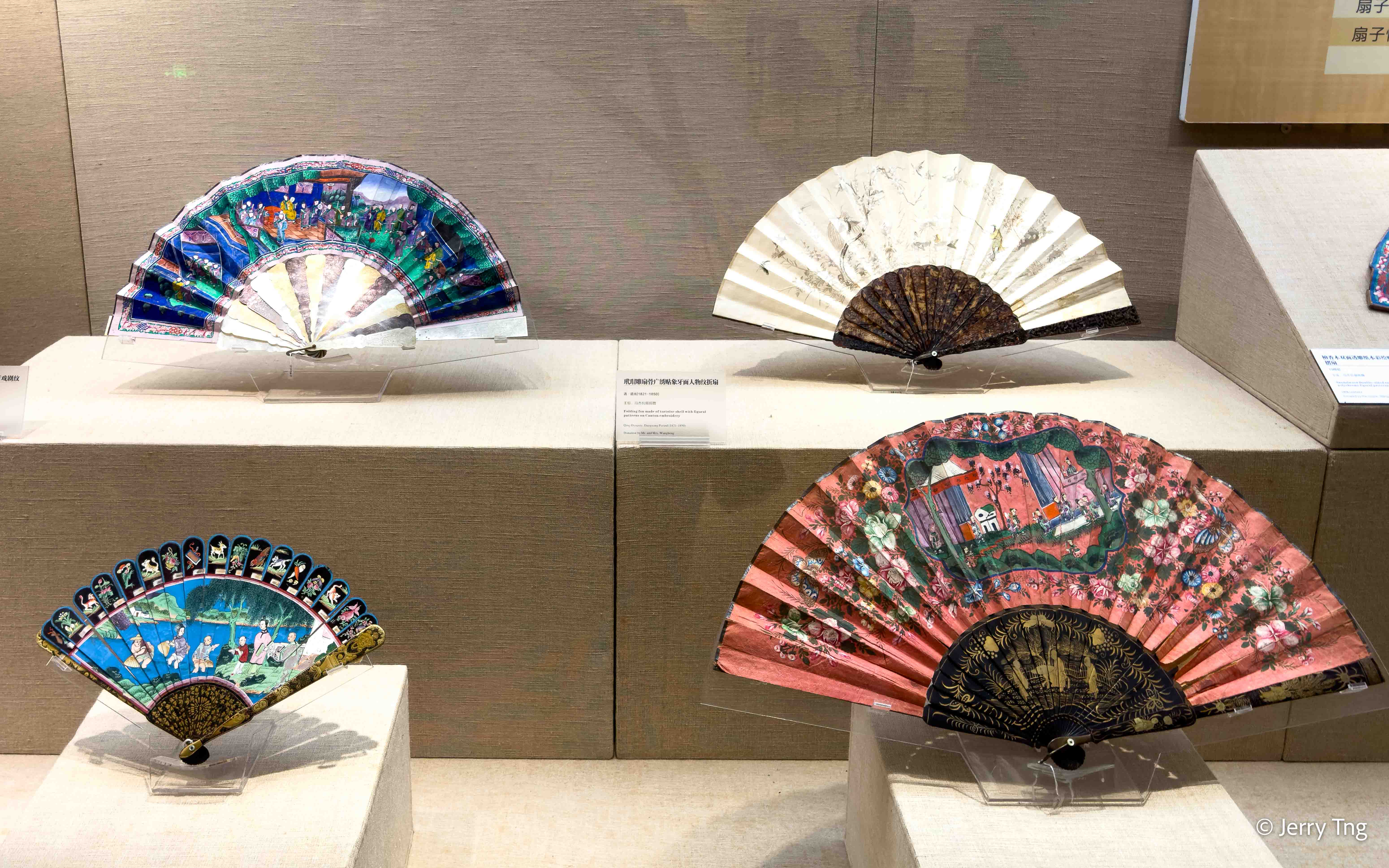
Before any SEO hit this page, we are not selling modern fans. This is a special feature of the beautiful export fans on display at the Guangzhou Thirteen Hongs Museum.
Table of Contents
Before we proceed, let’s understand the technical terms used to describe the different parts of a folding fan.

Fanning the Craze

Around the 18th century, export fans produced in Canton (modern-day Guangzhou) became popular in Europe and America. European upper-class ladies and young girls competed to carry exquisite fans with a strong oriental flavour as a fashion, and even used fans as props in social occasions, forming a set of fan language that was popular in the West. But how did the folding fans become a social status?

The folding fan is one of few Japanese handicrafts originating in Japan, and not in China, during a period where most technological learning came from the Chinese mainland. The earliest recorded domestic sighting of the Japanese fan was in the 6th century, where burial tombs were adorned with pictures of fans. It’s also recorded in the Chinese official historical record of the Song Dynasty (960–1279) that a Japanese monk, Chonen, gifted folding fans to the Song emperor in 988.2
Foreign folding fan made of engraved horn with painted figural patterns 外国制角雕扇骨人物画折扇

骨、颜料|19世纪|王恒、冯杰伉俪捐赠|广州十三行博物馆藏
The Portuguese traders first opened up the sea route to China in the 15th century and reached Japan in the mid-16th century, and appear to be the first people who introduced Chinese and Japanese fans in Europe which lead to their popularity, as well as the increased fan imports in Europe.3

In 1699, the British East India Company’s merchant ships placed their first order for 80,000 export fans in Guangzhou. These fans were highly sought after upon arriving in the European market.

Fans gained widespread popularity in Europe during the next several centuries and, by the 18th century, fan-makers were producing highly elaborate and detailed fans. These could be commissioned by wealthy ladies of the period and often were made of precious materials such as ivory, mother of pearl, exotic woods and fine fabrics or animal skins.4 Many fans featured hand painted paper or silk leaves with scenes that depicted military accomplishments, maps, dance steps, biblical scenes, and landscapes
Horn-carving-bone framework folding fan with painting of flowers 角雕扇骨抽纱油彩花卉纹折扇

骨、颜料|19世纪|王恒、冯杰伉俪捐赠|广州十三行博物馆藏
In the 18th century, fans reached a high degree of artistry and were being made throughout Europe often by specialized craftsmen, either in leaves or sticks. Folded fans of silk, or parchment were decorated and painted by artists. Fans were also imported from China by the East India Companies at this time.
Language of the Fans


The “Language of the Fans” (also known as the secret language of the hand fan) refers to a popular 18th- and 19th-century system of silent communication. Noblewomen supposedly used deliberate folding fan movements to flirt, decline offers, or send coded messages in crowded social settings without speaking.

Whilst it seems reasonable that a Victorian lady could have used her fan not only as an accessory, but also as a tool to attract additional attention through affectionate gestures, it is perhaps doubtful that her male counterpart could have mastered this secret language, said to have consisted of about two dozen different moves or gestures.

While historians debate whether it was a genuine universal code or a clever marketing campaign by Parisian fan makers5, the following gestures are the most widely cited signals from this historical practice.
Bone-carved oil-painted folding fan with landscape and figure designs 骨雕油彩山水人物纹折扇


骨、油彩|19世纪|王恒、冯杰伉俪捐赠|广州十三行博物馆藏
European court ladies often used owning a luxurious and exquisite fan as a status symbol to show off and compete with each other.
Folding fans with mother-of-pearl fan ribs and painted figure design 螺钏扇骨油彩彩人物纹折扇

Bone-carving folding fan in gold tracery 骨雕嵌银描金人物纹折扇

The case that is used display the fan is called a shadow box. These cases allow you to elegantly preserve and exhibit open, delicate, or antique hand fans while keeping them safe from dust, fading, and physical damage
Made in Canton

Canton fans, created for export to the Western world, are considered a unique form of craftsmanship combining Eastern and Western traditions in an intriguing way. It makes them one of the many luxuries China has exported to the world throughout history. And they started their journey to the West from the Thirteen Hongs in Guangzhou.

The Thirteen Hongs trading area was the official office and residence of Western merchants trading in Guangzhou during the Qing Dynasty. It was the site of three major fires6 throughout history, the last of which occurred around 1859 and completely destroyed the Thirteen Hongs trading area.
Ivory folding fan with polychrome illustration of harbour and figures 象牙雕扇骨彩绘港湾贴象牙面人物纹折扇

象牙雕扇骨彩绘港湾贴象牙面人物纹折扇
According to the historical records, at the peak of the Canton trade, there were more than 5,000 shops specialising in art export, and about 250,000 employees engaged in manufacturing and selling the decorative art that amazed by the whole world.7
Gilt silver thread cloisonné folding fan with ivory painted with the Thirteen Hongs on fire on paper 银鎏金累丝烧珐琅纸本贴象牙彩绘火烧十三行图折扇

银鎏金累丝烧珐琅纸本贴象牙彩绘火烧十三行图折扇
This fan uses fifteen gilt silver ribs, with a filigree pattern of wavy silver-gilt ribs and decorated with cloisonné enamel floral sprays. The paper-painted fan surface is divided into three panels. The central panel depicts the “Burning of the Thirteen Hongs,” while the two side panels depict scenes of official residences, bordered with bats and the Eight Treasures. This fan is expensive, exquisitely crafted, and features a unique subject matter, making it of significant value for research on the history of the Thirteen Hongs during the Qing Dynasty, Guangzhou silverware craftsmanship, fan-making techniques, foreign trade, and Sino-foreign cultural exchange.
Lacquerware in Export Fans

Lacquer was the primary material for export fans in the 18th and 19th centuries. The large-scale export of lacquer fans not only catered to the West’s fascination with Oriental lacquerware but also reflected the market’s fashion trends and aesthetic tastes. From the mainstream black lacquer with gold trim to the use of polychrome painting, red lacquer, gold and silver lacquer, and thick lacquer, and further to the skillful imitation of effects such as ivory splitting and tortoiseshell textures, the richness and imagination of lacquer art were fully expressed and interpreted in export lacquer fans.
Black lacquer folding fan with gold-painted patterns of figures, pavilions and garden 黑漆描金扇骨庭院人物纹折扇

漆器|晚清|王恒、冯杰伉俪捐赠|广州十三行博物馆藏
A Chinese lacquer brisé fan, circa 1837, Qing Dynasty, the 19 inner sticks and two guards of wood, lacquered in black and decorated in gold and deep red. Loosely translated as ‘broken’ from French, brisé was coined to describe a unique type of folding fan comprising wider, carved sticks that overlap one another. The sticks are decorative enough to form a collectible fan that no leaf is needed.

Both sides feature a similar design with a central oval left blank for the addition of initials, surrounded by a detailed depiction of several members of a family at home in their house and terrace.

The leaves are heavily decorated in gold. The rounded tips feature different figures. Both guards are more elaborate than perhaps is usual, featuring a design of tiny flowers to the very tip followed by extravagant leaves and flowers with an emphasis on the red.
Black lacquer folding fan with gold-painted and polychrome figural patterns 黑漆描金扇骨纸本彩绘贴象牙面人物纹折扇

黑漆描金扇骨纸本彩绘贴象牙面人物纹折扇
Cabriolet fans, also known as double-supported fans, are a type of fan with concentric double or multi-layered fan surfaces and exposed fan ribs. Their design originated from the open-top rental carriages popular in England and France in the 18th and 19th centuries. They were made by Guangzhou fan makers to cater to the preferences of Western customers.

Black lacquer folding fan with gold-painted and figural patterns 黑漆描银扇骨纸本彩绘贴象牙面人物纹折扇


Silver Filigree in Export Fans

Historically, silver-filigree hand fans were masterful works of art popular during the Qing Dynasty and the 19th-century Canton export trade. These brise-style fans feature interconnected sticks crafted entirely from twisted and soldered silver wire. They are highly prized by collectors.
Silver filigree cloisonné floral pattern folding fan 银累丝烧珐琅花卉纹摺扇

螺钏、颜料|19世纪|王恒、冯杰伉俪捐赠|广州十三行博物馆藏
Filigree silver fans were popular in Italy in the late 18th and early 19th centuries and were among the most prized export fans from the Thirteen Hongs.

The fan ribs are crafted using an extremely delicate and intricate filigree technique. Each rib is outlined with thick lines, then woven with fine silver wire, creating a translucent, openwork effect. Enamel glaze is then applied to the silver base to fill the patterns, followed by firing to achieve a magnificent and luxurious finish, showcasing the superb craftsmanship of Guangzhou goldsmiths during the Qing Dynasty.
Gilt silver filigree cloisonné paper painted ivory-faced folding fan with human figures 鎏金累丝烧珐琅纸本彩绘贴象牙面人物纹摺扇

鎏金累丝烧珐琅纸本彩绘贴象牙面人物纹摺扇
螺钏、颜料|19世纪|王恒、冯杰伉俪捐赠|广州十三行博物馆藏
This fan uses sixteen gilded silver fan ribs, which are decorated with shallow relief carvings of figures in a willow pavilion, pomegranates, and bamboo leaves in gilded silver. The smaller ribs are covered with a filigree pattern of gilded silver and interlocking lines, and adorned with enamel floral designs. The paper fan surface is painted on both sides with a continuous scene of figures in an official residence or domestic life. The faces of the figures are covered with ivory, creating a strong three-dimensional effect, and the fan is decorated with flowers around the edges. This fan is exquisitely crafted, ornate in style, and costly to produce.
Ivory in Export Fans

象牙镂雕十六层象牙球 (ROC)

象牙透雕亭间人物纹双耳瓶
Canton was the most important centre of ivory trade and ivory carving production in China in the Qing Dynasty. Cantonese ivory carving was unique in style and technique, famous for its openwork, hollowed-out carving, deep-carving, and combining technique. Delicate sewing boxes, jewellery boxes, letter shelves, postcard boxes and various kinds of decorative handicrafts were popular in Europe and the United States.

This particular fan showcases the intricate “hollow-out” carving technique and delicate openwork typical of Guangzhou artisans during the late Qing Dynasty. These fans often combined Chinese motifs (birds, flowers, landscapes) with Western tastes or styles, such as the cabriolet form.
Ivory folding fan with polychrome figural patterns 象牙雕扇骨彩绘人物纹折扇

This 18th-century folding fan was manufactured in Guangzhou specifically for export to the European market. It features intricately carved ivory sticks and guards decorated with vignettes of scholars in landscapes.The leaf of the fan is adorned with painted figure groups set within a Chinese landscape. The overall design style is known as chinoiserie, blending Asian motifs with European taste.
Ivory folding fan with double-sided patterns of birds on Canton embroidery 象牙雕扇骨双面广绣百鸟纹折扇

The leaf is decorated with traditional Canton embroidery depicting nature scenes, such as birds and flora. During the Ming and Qing dynasties, Canton embroidery absorbed Western techniques (such as perspective and shading) as it became a highly sought-after export to Europe and the Americas
Variety of Materials
There are a wide range of options for materials of fan ribs, including bamboo, sandalwood, ebony, tortoiseshell, ivory, mother of pearl, bones, etc., with bamboo the most common. The application of precious materials not only make the fans more visually-appealing, but also increase their value.
Sandalwood folding fan with polychrome patterns of flowers and birds on paper 檀香木雕扇骨纸本彩绘花鸟纹折刷

Sandalwood folding fan is a lightweight, intricately carved handheld fan known for its natural, sweet, and subtle woody fragrance.
Folding fan made of shell with patterns of figures and landscape on both sides 贝雕人物风景摺扇

贝壳|清末|王恒、冯杰伉俪捐赠|广州十三行博物馆藏


Folding fan made of tortoise shell with patterns of figures, willows and pavilions 玳瑁镂雕庭院人物纹折扇

During the Qing Dynasty, Guangzhou craftsmen often used tortoiseshell for fan ribs, employing exquisite openwork and inlay techniques, making them popular in Europe as high-end export products. Openwork carving emphasises “exquisite detail and delicate beauty.” Craftsmen must use techniques such as openwork and relief carving to create distinct layers of floral, bird, landscape, or human figures on hard yet brittle carapace plates, making the craft extremely difficult.


The species of turtle used were hawksbill turtle. Hawksbill turtles have a translucent carapace with a waxy lustre and unique brownish-yellow and light-yellow markings. They are an internationally protected endangered species. Hawksbill turtle products circulating in the modern market are subject to strict legal restrictions. These days, these are only to be seen in museums.
About the Collection

Most of the precious cultural relics on display in the museum are donated by Mr Wang Heng, an entrepreneur and collector from Guangzhou, and his wife Mdm Feng Jie.8 Knowing that Guangzhou Thirteen Hongs Museum was under construction, they donated these cultural relics that were produced in the heydays of the Thirteen Hongs to the museum. More than 1000 pieces have been selected for exhibition in the museum.


There are altogether 4814 pieces (sets) of cultural relics donated, including 840 pieces of Guangcai porcelain, 683 pith paintings, 125 pieces of Wuchang furniture as well as embroidery, export fans, silver ware, glass paintings, watercolour paintings, oil paintings, shell carvings and lacquer ware, etc. So there are more that are in the storeroom.
About Guangzhou Thirteen Hongs Museum

The museum building is located on the historic site of the Thirteen Hongs trading area of the Qing Dynasty. Through exhibits such as ship models and goods sold to the Western nations like tea, silver ware, Guangzhou embroidery, Guangcai porcelain and other handicrafts, it recreates the historical scene of Guangzhou when it was the only treaty port.

What is unique about this museum is that the museum’s collection of cultural relics was not funded by the government and all came from social donations. Among them, the more than 600 pieces of Guangcai porcelain donated by Mr and Mrs Wang Heng constitute the most complete Guangcai timeline in China. On display on the second floor are the hundreds of pieces of Wuchang rosewood furniture, also donations from Mr and Mrs Wang.

No reservation required; closed on Mondays (except public holidays), open from 9:00 to 17:30 (last entry at 17:00).
Guangzhou Thirteen Hongs Museum 广州十三行博物馆
No. 37, Xidi Second Road, Liwan District, Guangzhou (inside the Cultural Park)
廣州市荔灣區西堤二馬路37號(文化公園內)
All photos taken by author at Guangzhou Thirteen Hongs Museums Mar 2024, unless otherwise noted.
Footnotes:
- Silver filigree and gilt cloisonné enamel inlaid with precious stones floral and scrolling leaf patterns, fan-shaped decoration 银累丝鎏金烧蓝嵌宝花卉卷叶纹执扇形摆件
Silver, gemstones | Republic of China Period (1912-1949)|Donation by Mr. and Mrs. Wang Heng | Collection of Guangzhou Thirteen Hongs Museum. 银、宝石|民国时代(1912-1949)|王恒、冯杰伉俪捐赠|广州十三行博物馆藏
↩︎ - https://japanobjects.com/features/japanese-fans
↩︎ - https://en.wikipedia.org/wiki/Hand_fan
↩︎ - Mayor, Susan, 1980, Collecting Fans. New York. Mayflower Publishing.
↩︎ - Alexandra Starp, 2025, The Secret Language of Fans. Sotheby’s. https://www.sothebys.com/en/articles/the-secret-language-of-fans
Seeking to demystify this secret code, Duvelleroy, a fan maker and retailer founded in Paris in 1827, published a leaflet explaining the language behind the uses of the fan. In reality, the less romantic truth is that this so-called fan etiquette was invented in order to boost the sale of fans in the 19th century, after they had fallen out of fashion following the French Revolution. The leaflet proved a great success and Duvelleroy became a supplier for Queen Victoria, having opened a boutique on London’s fashionable New Bond Street.
↩︎ - In 1822, a fire broke out in a cake shop near the Thirteen Factories, spreading to the area. The fire burned continuously for two days, destroying many foreign factories (hongs) and merchant houses, resulting in severe losses. Subsequent statistics showed that of the 11 major merchant houses, only 5 remained unburned. All foreign merchants’ goods were destroyed, and all the warehouses and residences of the Chinese merchants were reduced to ashes. The fire also spread to over a thousand nearby houses and shops.
The second major fire occurred after the Opium War. Over a hundred British soldiers snatched fruit from a fruit shop run by a Chinese in front of the foreign factories and injured the shopkeeper with a knife, which aroused the indignation of the local populace in Guangzhou. At midnight, the people of Guangzhou set fire to the British factories. Qing government troops from Guangzhou arrived to fight the fire but were blocked by a dense hail of stones thrown by the crowd, preventing them from advancing. The fire burned until the next day before it was extinguished.
The third major fire occurred during the Second Opium War. British troops stationed in the Thirteen Factories area demolished large swathes of civilian houses surrounding the area to create open ground, aiming to prevent attacks by Chinese troops and civilians on the foreign factories. On the night of December 14, Guangzhou citizens who deeply resented the invaders set fire starting from the ruins of the demolished shops and houses. The flames quickly spread to the foreign factory district of the Thirteen Factories.
https://baike.baidu.com/en/item/The%20thirteen-hongs%20in%20Canton/1433372, accessed 13 Jun 2026
↩︎ - Yang Yang, 2011, “Chinese Taste” of “Made in Canton”. Art Exchange VOL.Art Exchange, https://www.cflac.org.cn/ArtExchange/ysjlzz/ysjl2019/201912/t20191210_465096.htm
↩︎ - Museum information card
本厅展出的是广州著名文物鉴藏家、企业家王恒先生与夫人冯杰女士捐赠给我馆的珍贵文物。这批文物共4814件(套),包括广彩840件、通草画683幅、五常家具125件,以及绣品、外销扇,银器、玻璃画、水彩画、油画、贝雕、漆器等,涵盖了清代广州的主要外销工艺品。其中广彩花卉人物纹冰壶是藏家热捧的外销瓷精品,通草线描风俗图册在国内外博物馆十分罕见,广绣花鸟纹屏风尺幅巨大、工艺精湛,是清代广绣的代表作。
王恒、冯杰伉俪酷爱文物,更热爱广州,深信文物是全人类共有的文化遗产,得知广州筹建十三行博物馆,遂将十余年间从世界各地集藏之十三行时期的文物捐献给国家。文物珍贵、大爱无疆、先生风范、令人敬佩!荔湾区人民政府决定在我馆辟建专门展厅,作为永久性的公开展览,与众共赏。本次遴选出一干多件(套)展出,以表达对王氏伉俪的崇高敬意。
↩︎
0 comments on “Canton Export Fans 外销扇”