
“Rock Home Town” is a witty literal English translation of Shijiazhuang (石家庄) and the city’s official cultural branding for its deep Chinese rock-and-roll heritage. Because very few outside tourists visit, prices for food, hotels, and taxis reflect genuine local living costs rather than inflated tourist rates.


Shijiazhuang offers a wide variety of simple, budget-friendly local eats centered around northern Chinese wheat-based snacks, savory braised meats, and lively night markets. Huochetou Pedestrian Street is a lively, locomotive-themed walking street packed with casual eateries, fried snack stalls, and dessert shops, best visited in the evening.

Walking the smaller lanes off Zhongshan Road or near the old station reveals unassuming neighbourhood shops serving beef stew with flatbread, mung bean cakes, and freshly sliced braised chicken.
Daguocai (“Big Pot Stew”) 大锅菜

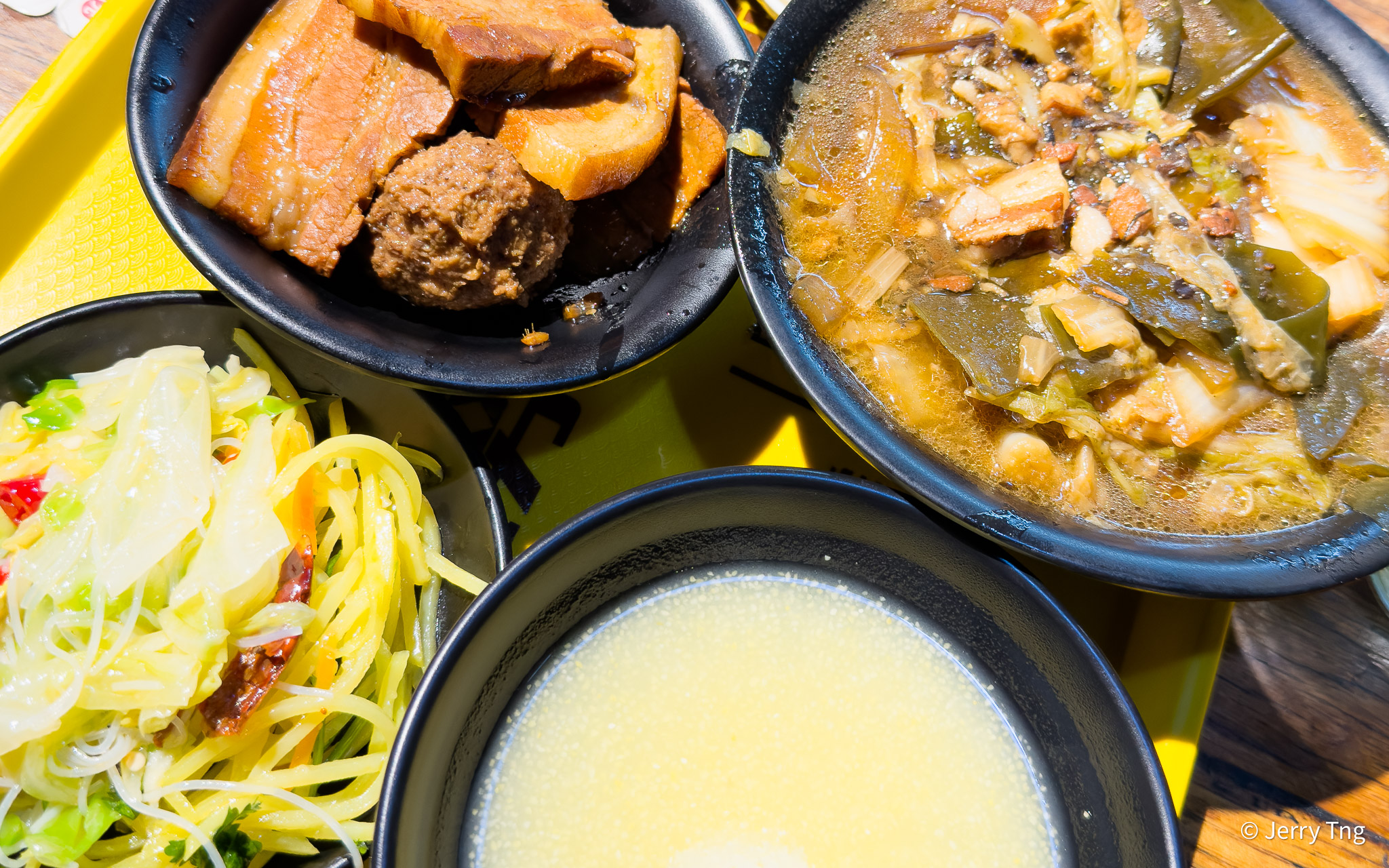
大锅菜 (literally “Big Pot Stew”) is the ultimate Hebei home-style comfort meal in Shijiazhuang. Originally cooked in massive cast-iron cauldrons for village weddings, festivals, and communal banquets, it is now sold at casual lunch counters and farmhouse restaurants across the city for around ¥15 to ¥25 per bowl. The dish relies on slow-simmering humble ingredients in a rich, savoury pork bone and spiced soy broth until everything melds together, and would usually include Napa cabbage (大白菜), crispy fried pork and meatballs (酥肉 / 炸丸子), sweet potato glass noodles (红薯粉条), kelp an mushrooms (海带 / 蘑菇).

Because the stew is rich and salty-savoury, locals always pair it with plain steamed buns (mantou 馒头), steamed rice, or golden cornbread (窝头) to soak up the broth. Many casual Daguocai shops in Shijiazhuang offer complimentary self-serve cornmeal porridge (玉米粥) and pickled cold side dishes (凉菜) alongside your bowl.

Xingfu Daguocai (幸福大锅菜) will be a good place to try this. Located near the Hebei Provincial Museum, this popular casual spot serves traditional banquet-style stew with free corn porridge and cold appetisers.
Donkey Burger 驴肉火烧

Donkey Burger or 驴肉火烧 is a classic Hebei snack consisting of tender, spiced braised donkey meat chopped and stuffed inside a flaky, freshly baked crispy bun. If you are wondering why is it called a burger but it’s not round, that’s because it’s the Hejian style. Shijiazhuang sits right between Baoding (to the north) and Cangzhou/Hejian (to the east), so both iconic Hebei styles of donkey burgers are widely sold across the city

| Feature | Hejian Style (河间驴肉火烧) | Baoding Style (保定/漕河驴肉火烧) |
|---|---|---|
| Bun Shape & Texture | Rectangular and thin with dozens of flaky, puff-pastry-like layers. | Round and slightly thicker, resembling a small, crusty pocket bread. |
| Meat Temperature | Served cold (room temperature) so the meat juices do not soften the crispy bun. | Served piping hot, freshly chopped from a simmering pot of master stock. |
| Donkey Fat (Menzi) | Often topped with menzi (焖子), a savory, bouncy jelly made from donkey broth and sweet potato starch. | Relies on rich, hot braised meat fat and juices soaking directly into the warm bread. |
| Signature Addition | Finely chopped green bell pepper (qingjiao) is frequently mixed in for crunch. | Often paired with raw scallions or a splash of hot chili oil. |

Donkey meat dumplings (驴肉饺子 or steamed 驴肉蒸饺) are a popular Northern Chinese specialty that you can easily find alongside donkey burgers across Shijiazhuang. Because donkey meat is naturally lean and rich in umami—captured by the local Hebei saying “In Heaven there is dragon meat, on Earth there is donkey meat”—chefs mix it with aromatics to keep the dumpling filling juicy and tender. And they are usually served with a dipping sauce made from rice vinegar and lots of garlic

While you are at it, order a bowl of donkey offal soup (驴杂汤) or donkey meat soup (驴肉汤) on the side, or pair a plate of dumplings with one crispy donkey burger to sample both textures. Gao Jianmin Jiulou (高建民酒楼) is a local restaurant chain known by diners for its lean donkey meat dumplings (驴肉饺子) and traditional Hebei dishes, and they are found everywhere. Not cheap, but you can be assured of the quality (and hygiene) of the food, as well as the source of the donkey meat.
Anhui Beef Banmian 安徽牛肉板面

Anhui Beef Banmian (安徽牛肉板面) is widely regarded as Shijiazhuang’s unofficial signature fast food. Although it carries “Anhui” in its name, the spicy beef version was perfected in Hebei and has become the city’s ultimate everyday comfort meal, with roughly 2,000 noodle shops serving it across Shijiazhuang.

The noodle style originated in Taihe County, Anhui Province, where it was traditionally made with mutton. Migrant workers brought the recipe to Hebei in the 1980s and 1990s. Local cooks adapted it by swapping mutton for beef and adding a bold, savory beef tallow chili base. The name banmian (板面) literally means “board noodles”. Cooks stretch and slap the dough repeatedly onto a wooden board before pulling it into thick, flat, chewy ribbons that hold up well in rich broth.

A classic bowl features a punchy red broth infused with beef tallow, Sichuan peppercorns, dried whole chilies, and more than 20 spices. You can usually ask for less chili or non-spicy if you prefer a milder taste.


A basic bowl is very cheap (typically ¥9 to ¥12), and locals customise their bowls by pointing at braised add-ons simmering in the pot next to the counter. I picked three add-ons, plus a deluxe version of the beef banmian, and it all came to ¥24.50


The tofu and other add-ons had been cooking in the sauce for a long time, so the flavours were all soaked into the core of the tofu, meatball and an unknown, elongated item.


You do not need to hunt down a single famous restaurant, as neighborhood mom-and-pop shops on street corners are often the best. Look for red or yellow signs reading 正宗安徽牛肉板面 (Authentic Anhui Beef Banmian) or 石家庄牛肉板面 (Shijiazhuang Beef Banmian). This one is near Shijiazhuang Museum and scored very high on their local dining app. It was very popular among the locals and students from nearby schools. I couldn’t grade them as it was the first time I had Anhui Banmian, but the portion was so big that I couldn’t finish it. Or because it was too oily, I couldn’t decide which was the main reason.
Visited Oct 2026
0 comments on “Simple Eats at Shijiazhuang”