
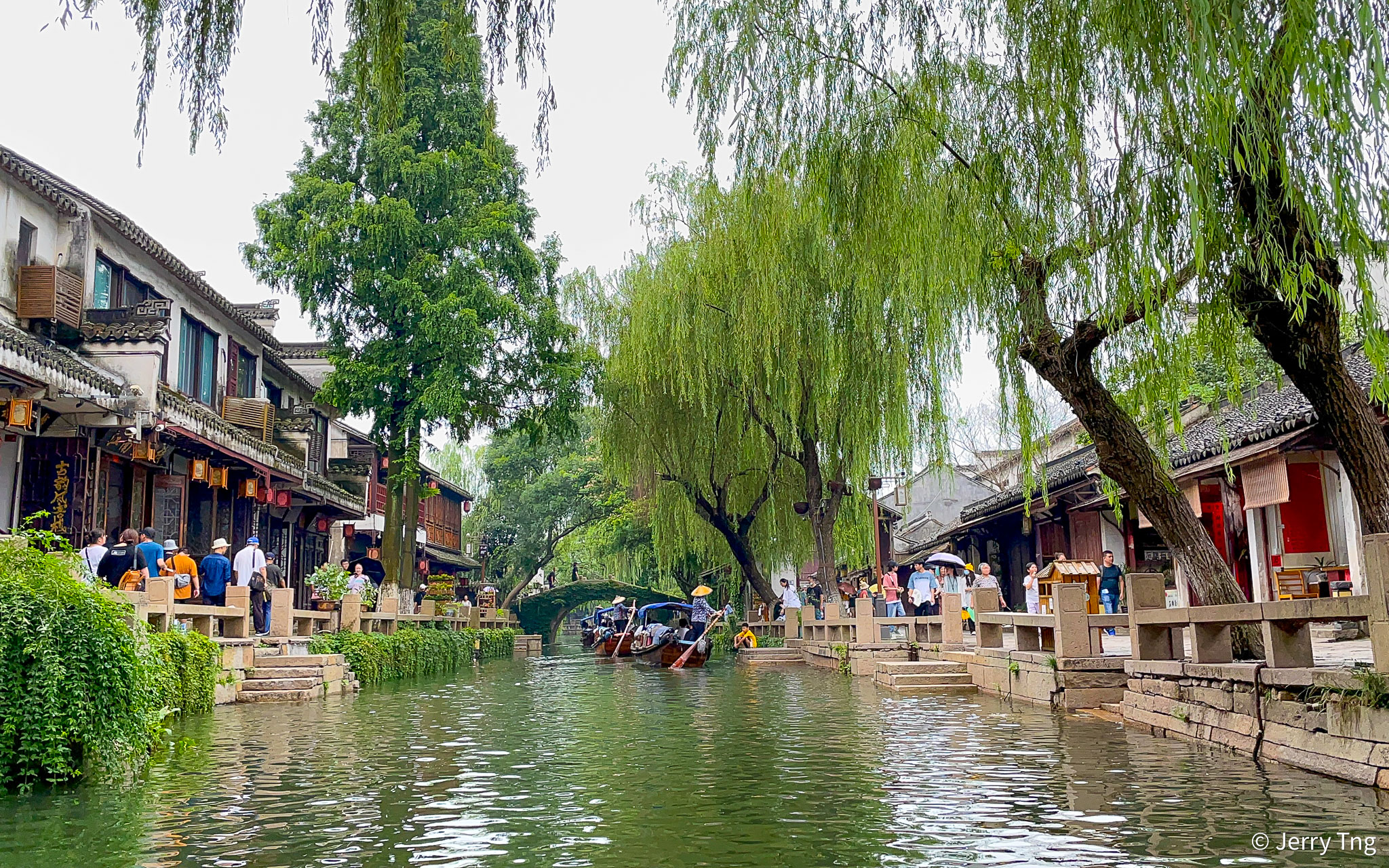
Not withstanding that it is the “Venice of the East”, one of the memorable things we saw in Zhouzhuang was the houses of millionaires in the ancient water town.
Origin of Zhouzhuang

Zhouzhuang, located on the lower reaches of the Yangtze River 长江 in Jiangsu province, is one of 264 townships and villages scattered throughout this “water country” 水乡泽国. Because of the network of lakes and rivers, fertile land and abundant products, the area has long been known as the “land of fish and rice” 鱼米之乡.


The region attracted wealthy merchants and retired government officials who established their households in this prosperous “land of brilliant mountains and graceful rivers, and also the homeland of exceptional people” 山清水秀,人杰地灵, as an old Chinese saying goes.

It was a sleepy village called Zhenfeng Li 贞丰里. In 1086 (北宋元佑元年) , a wealthy landlord and small official (迪功郎) named Zhou Yingxu 周应煦 first established the village for farming and donated land to build a temple complex for the community. In appreciation, the villagers named the community Zhouzhuang, which literally means Zhou’s Village.

Not until the millionaire Shen Wansan 沈万三 set up his headquarters in Zhouzhuang near the end of the Yuan Dynasty (1271-1368), the village enjoyed the biggest expansion since its founding.


It was during this time that the Nanshihe-Beishihe, the north-south main waterway, established itself as the village centre with Fu’an Bridge 富安桥 (1335) as its focal point.

Some of their residences, built mostly during the Ming and Qing periods, have survived the turmoil of historic disasters and are well maintained and still actively used. One of those that has been preserved is Zhang’s House.
Zhang’s House 张廳

Zhang’s House 张廳 or Hall of Zhang residence was built during in the Ming Zhengtong era 明正统 (1436–1449) . Covering more than 1800 sq m, the house has six courtyards and more than 70 rooms.

Zhang’s House was originally called Yishun Hall 怡顺堂, and was built by the descendants of Xu Kui 徐逵, who was the brother of famous Ming General Xu Da 徐达. It was bought by someone with surname Zhang, who renamed the place Yuyan Hall 玉燕堂 or Hall of Jade Swallows.
First Entry : Reception 一进|门厅

The entrance hall. comprises of three lots along Beishijie Street 北市街. The foyer mainly plays a role as reception and decoration, so it is generally a place where domestic servants often work.
Second Entry : Sedan Hall 二进|轿厅


Boats can moor up to the entrance of the house. Likewise a hand-carried sedan can enter and park in the first entry, like a modern day carpark. A marble screen partition separate this entry from the rest of the house. This was also the place of rest for the sedan carriers and boatmen while they waited for their masters to finish their visits.
Third Entry : Main Hall 三进|正厅


Third Entry is the Main Hall, originally called Yishun Hall (not the same as the town in Singapore) 怡顺堂, renamed to Yuyan Hall 玉燕堂 by the new owners. This was because in the courtyard was two gardenia 白玉兰 trees, and swallows came and built nests in the trees. These were good omens, symbolising life and vitality. Hence it was renamed “Gardenia Swallows” Hall as a blessing for the offsprings to be abundance.


There are two protruding oval carved panels in each of the corner of the main beam of the main hall, which is very similar to the hat wings 帽翅 on the official hat in ancient times, so this hall is also called the gauze hat hall 纱帽厅.

Walking through the foyer from the main street, there is a sky well 天井 with rooms on both side. The rainwater will flow from the eaves into the well and flow inwards towards the house, forming “四水归堂” formation to symbolise wealth flowing into the house.

Although those brick carved doorways were damaged during the Cultural Revolution, the delicate and exquisite carvings can still vaguely show the former splendour of Zhang’s House.
Fourth Entry : Grand Hall 四进|大堂楼

Fourth Entry of the house is the living quarters of the family, and is normally out of bounds from outsiders.


The Grand Hall 大堂楼 is a two storeys building and was the living quarters of the family. In the feudal China, the ladies of the house were not allowed go beyond this courtyard.


The furnishing is symmetrical and much care was put into decorating the hall and the altarpiece. On the altar are a pair of vases and mirrors, taking the Chinese homonyms of peace and tranquility 平平静静 and vase+mirror 瓶镜. The couplet beside the altar was written by Professor Wu Guanzhong 吴冠中 of Central Academy of Arts and Crafts, which aptly described the uniqueness of Zhang’s House.
“轿从门前进,船自家中过”
The sedan entered through the door, and the boat passed through the house.


The hall is open and bright, and under the thick column is a rare wooden drum pier 木鼓墩 (column foundation), which is 500 years old and a clear symbol of Ming Dynasty architecture. The hall is decorated with Ming-style mahogany furniture and colourful lanterns to welcome guests.
Fifth Entry : Games Room 五进|琴棋室


Fifth Entry was the original recreation room for the ladies of the house. In feudal times, the ladies of the household did not go out of the house, even not beyond the second gate. The ladies will learn to play the guzhen 古筝, play chess, learn calligraphy, paint and embroider in this room.

The boys were separated with the girls through this marble partition to divide the hall into two.


On the other side, the hall looked out into the study and was where they practice calligraphy and painting.
Sixth Entry : Study 六进|书房

Sixth Entry is the study, and it was built along the river. The lighting is very ample, and the environment is also quiet and elegant. The owner can read quietly here and open the window to enjoy the view of the back garden.
Seventh Entry : Garden 七进|后花园

The backyard of Zhang’s House is a quiet and quaint small garden, surrounded by walls of neighbours.


What is striking is a column of Taihu stone, which is exquisite and transparent, as white as snow, and the formation looks like a flying swallow at the peak of the mountain, so people call it Yuyan Peak 玉燕峰. It adds some beauty to this small garden.


On the east side of the Main Hall is a very narrow and dark corridor 陪弄. In the past, the main door was not regularly opened, and saved for important occasions like weddings and funerals, or visits by important guests. Folks from the household will use this corridor and the side door to get in and out of the house.
River Through the House 箸泾

Ruojing River 箸泾 actually runs through Zhang’s House so that small boats can enter the house through its backyard.


Although the waterway is very narrow, it is connected to the big lake outside. It has two functions. The Zhang family is a large family and consumes a lot of daily necessities every day, so they have to go in and out of here by boat. Second, the society was unstable in the old days. In case something unexpected happens, they can escape by boat at home.

Before it became famous, Zhouzhuang was a place for artists and romanticists, for tranquility and meditation, and, above all, for a taste of the simple, rustic and quiet pastoral life of the historic past. As China is pushing forward to preserve its splendid historic places, hard lessons have to be learned. The lessons learnt from the preservation of Zhouzhuang are a good beginning.
About Zhouzhuang

Zhouzhuang 周庄 is a water town known for its canals in Jiangsu Province 江苏省, China. It is located within the administrative area of Kunshan 昆山, 30 km southeast of the city centre of Suzhou 苏州. The population is roughly 2,000 and non-residents must pay a fee to enter.

In its heyday Zhouzhuang was a trading center for silk, food and many handicrafts. Nowadays it relies on tourism and is one of the top ten visited destinations in China. CNN placed it on its list of the Top 10 most beautiful towns in the world.

You can go there as a day trip from Shanghai. Entrance fees apply, and you can go in 24 hours a day as there are bed and breakfast abodes in the town.
Visited July 2021
0 comments on “Zhouzhuang 周庄 – How It All Began”