
There are many Imahans that specialise in Sukiyaki and Shabu-Shabu but there’s only one trusted brand to go to sample one of the best sukiyaki in Tokyo and that’s Ningyocho Imahan.

In 1895, Imahan was established when founder, Hantaro Aizawa (seen here with his son Kunio at the entrance of the original restaurant, circa 1920s), left Okayama prefecture and relocated to Tokyo where he opened a gyu-meshi (old name for sukiyaki) restaurant in Honjo-Azumabashi.

Then in 1921, a second Imahan was established by Noren Division System 暖簾分け制度. This is when a long-serving employee is given the blessing by the employer to set up another business using the brand (Noren). Hence this business was known as Imahan Bekkan 今半別館.
The two businesses were separate, although the 3rd generation owners married each other. This is worth a visit, because the original Imahan Goten 今半御殿 was bombed during WWII, but the decor was replicated in this store for a film set.

In 1928, the business was split into Imahan Honten 今半本店 (which is still operating under the Aizawa family), and Asakusa Imahan 浅草今半 run by Tsunetaro Takaoka 髙岡 常太郎 and specialises in beef tsukudani 牛肉佃煮.

In 1952, because of expanding business, they open another branch in Ningyocho 人形町 in Nihonbashi district.
In 1956, the 3rd Generation owners split up and formed two separate Imahans – Asakusa Imahan (which they are still erroneously referred to as the honten because they operate at the same location, but they have no more affiliation) and Ningyocho Imahan 人形町今半.

Regardless of which Imahan you prefer, they were all known around the world as the steward of the sukiyaki cuisine.

Sukiyaki became a part of Japanese cuisine towards the end of the Edo period in the 1860s and popularized during the subsequent Meiji period partly because the Emperor started to serve beef in imperial banquets. There are various stories regarding the history of sukiyaki. The name “sukiyaki” comes from “suki” meaning spade, or even “sukimi” meaning thinly sliced meat, and “yaki” means grilled.
We ordered 牛三昧コース Beef Lover’s Course for lunch.
前菜 Appetizer

Seasonality, or the use of fresh, seasonal ingredients, is very important in Japanese cuisine and culture. Shun 旬 is a Japanese word referring to seasonal ingredients as well as the time of year when a certain food is at its freshest and most flavorful. By following harvest times, produce is utilized when it’s at its peak.

The appetiser course was a feast for the eyes and featured the season’s freshest ingredients. The day we went was the near the Shosetsu 小雪 (しょうせつ) or First Day of Snow. This is the 20th season of the year according to solar terms 節氣 or in Kanji 節気 which is commonly used to demarcate seasonal changes in Asia (China, Korea, Japan and all Chinese speaking places) .

As you bite into it, Kazunoko (数の子) or salted herring ore gives a crunchy texture (the texture is explained as kori kori コリコリ in Japanese). There’s saltiness, and you can also taste umami from dashi and soy sauce base seasoning after it’s marinated.

And of course if you are specialising in beef, then roast beef cold cut is always featured as one of the appetiser.
ローストビーフ握り寿司 Beef sushi

Next came a serving of roast beef nigiri sushi. Instead of calling it roasted, the external of the beef was just seared to lock in all the juices and flavour. The beef was almost raw inside. Nevertheless, the sushi was fantastic.
お造り Sashimi

It came with a single serve of sashimi consisting of two types of fish. It was only two regular pieces of sashimi further cut into halves so that it looked like it was more than ever. This is not the place for sashimi, so I shall not comment further.
網焼ミニステーキ (50g) Mini steak (50g)

Next in the trilogy of beef was the grilled wagyu beef steak – the traditional way most people will take the wagyu because of the high fat marbling.

Inside the little container was a small little serving of grilled wagyu steak, just three small slices that were enough to whet your appetite. Anything more, you will find it too much.

The steak simply melted in your mouth and needed nothing but a simple pinch of Himalayan salt.
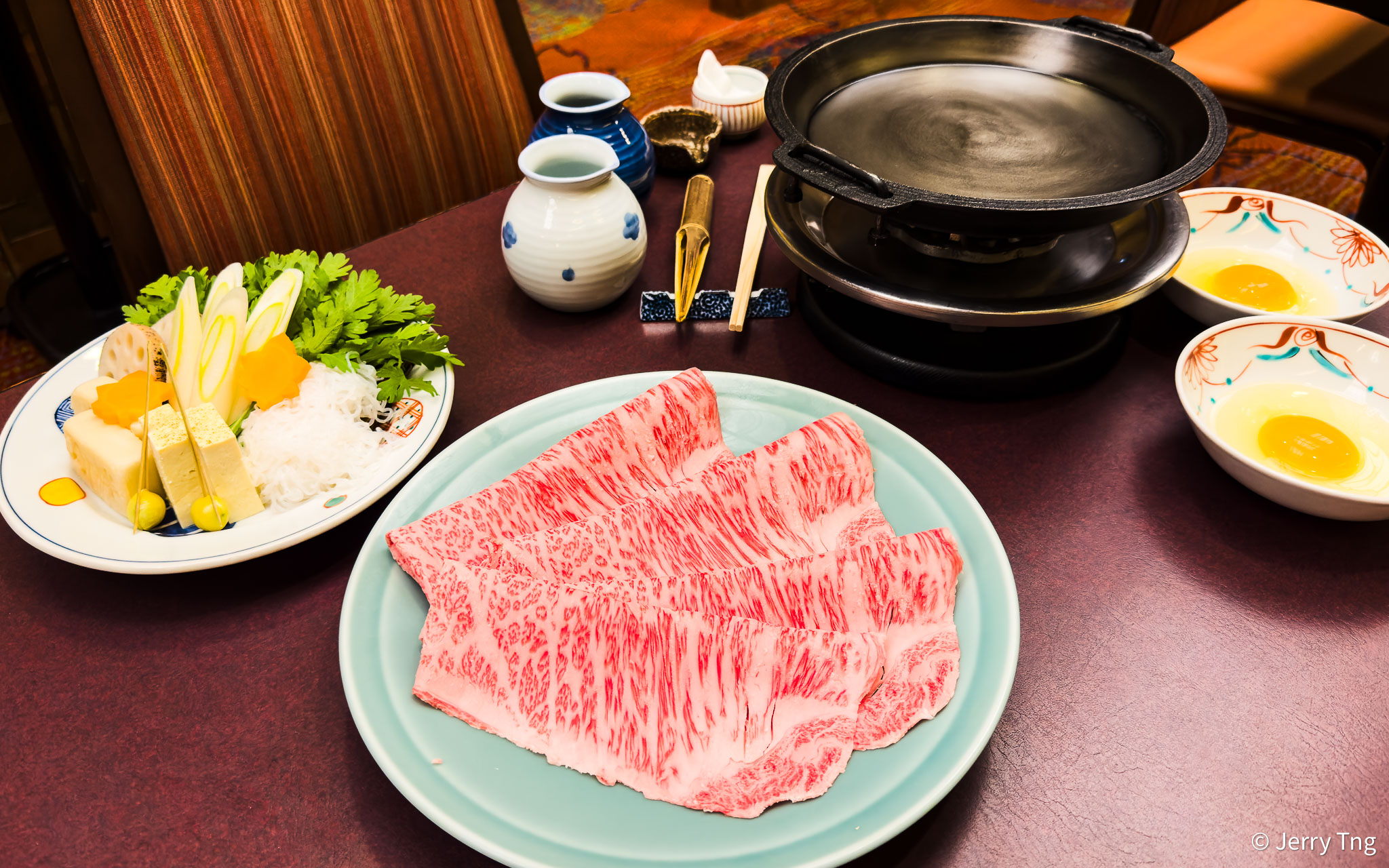
すき焼(特上 ロース 80g) Sukiyaki (High quality marbled beef 80g)

After the steak came the piece de resistance for Imahan, the sukiyaki. Everything in this restaurant has been handed down in tradition and casted/made specially for them to maximise the enjoyment of sukiyaki.


For the uninitiated, it is really difficult to differentiate the differences in quality of different wagyu beef as you can see from the three grades of beef that I ate at different occasions. And unlike other shabu-shabu restaurants, they age their beef according to the stock. This is the experience and art that help to differentiate them from others.

Besides the slices of beef, the meal came complete with vegetables like leek, lotus roots, mizuna, and the must-have with sukiyaki – tofu, konnyaku noodles and rice cake. This format has become the standard, the decadent beef is always paired with things which would absorb the flavours of the sukiyaki.

There’s no other condiments for the sukiyaki as it is traditionally dipped in a beaten raw egg to balance the sweetness of the sauce called warishita 割り下 (made from a mixture of sake, soy sauce, sugar, mirin and dashi).
That first sizzle of the beef on the pan immediately brings anticipation to your first bite of that incredible beef. Imahan is Kansai-style and they first sear the beef and caramelise it with warishita. That really brings out an intense, melt-in-your-mouth marbled beef experience.

A beaten raw egg dip is served alongside the beef. Both the beef and vegetable are dipped into the egg like a sauce. After the first slice is cooked, you can take your time eating, rolling it in as much egg wash as you want. After all you are only given 2 slices for a total of 150g.

The second slice and vegetables were then cooked as I enjoyed the first piece, and once I finished the waitress put the second slice and some vegetables into the egg sauce. If you want, you can ask for another beaten egg.

As the waitress cooked at the table side the rest of the vegetables and sides, I had finished the second piece of beef and couldn’t but order another serving of beef.

Together with the sukiyaki was a bowl of steamed white rice and some pickles to help cleanse your palate.

And you may be tempted to pour the sauce into the rice, but traditionally the Japanese do not eat steamed rice that way. That’s why you get tofu, mizuna and rice cakes to let you enjoy the sauce.
お食事 Rice set

When I thought the meal was over, my waitress came back with a bowl of eggs and some more steamed rice. The eggs were whisked and then cooked in the remaining sauce in the pan. Imagine the fluffiest egg omelette mixed with sukiyaki sauce and all that wagyu beef fat – you can only have one bowl, there’s no more.

The meal is completed with rice, pickles, and miso soup.
デザート Dessert

Dessert was a slice of Japanese melon and an almond custard with papaya. The Japanese fruit growers have done a fantastic job, every bite was fantastic and memorable.

The service is impeccable in Imahan. My server gave me the best service – she cooked, explained, charged my phone, covered my bag, took my photo, waited patiently for me to take my photos. And she did everything with a smile. She was also a little bit OCD, moving each plate back to its original location after I pull them closer to me one by one for photos.
Ningyocho Imahan (Shinjuku Dai-Ichi Seimei Building)
人形町今半 新宿第一生命ビル店
1st floor of Dai-chi Seimei Building 2-7-1 Nishi-Shinjuku, Shinjuku, Tokyo 〒160-0023 (Next to the Tokyo Metropolitan Government Building and the Hotel Hyatt Regency Tokyo)
〒163-0701 東京都新宿区西新宿2-7-1 第一生命ビル1階
Tel : +81 (03) 3345-1470
Visited Nov 2023
Pingback: Shabugen しゃぶ玄 @ Akasaka (2024) – live2makan