
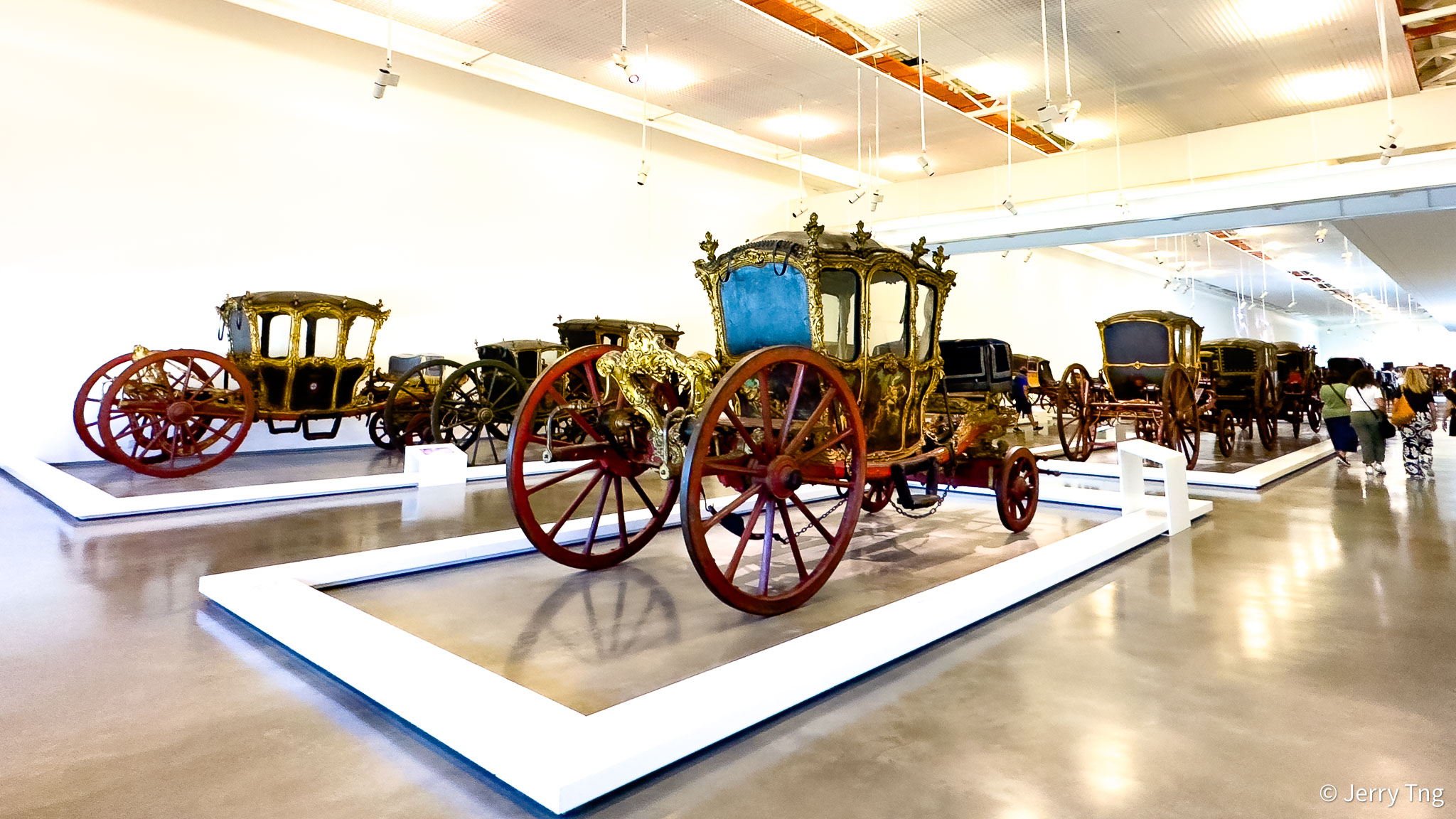
The royalties were not the only ones that went around town in their carriages, aristocrats and high clergymen were also allowed to move around in regalia.

The second part of the new museum showcases some of the vehicles used by the aristocracy and minor royalties.
Ecclesiastic Vehicles
The members of the High Clergy had a status similar to that of the Nobility and therefore had their own means of transportation. In this set we find four models of different vehicles – a berlin, a coach, a chaise and a state carriage which are decorated with ecclesiastical coats of arms. The Cardinals have a wide-brimmed hat with tasseled laces and the Patriarchs of Lisbon have a three-crowned tiara and a patriarchal cross.
Chaise of the Bishop of Bragança
Author unknown | 18th century, Portugal | 435 x 180 x 215 cm

Chaise, (French: “chair”), originally a closed, two-wheeled, one-passenger, one-horse carriage of French origin, adapted from the sedan chair. Ceremonial vehicle which belonged to the first Bishop of Bragança.
Coach of Cardinal João Da Mota E Silva
Unknown author | 18th century, 1st half, Portugal | 6,20 x 2,00 x 2,70 m | Wood, leather, glass, silk velvet, silk taffeta, gold gallon, brass, iron

This ceremonial vehicle belonged to Cardinal João da Mota e Silva, who was Secretary of State for King João V. It has a closed body with a glass window and pink taffeta curtains hemmed with gilt lace. The coat of arms of the Cardinal is Surmounted by a Cardinal’s hat and tassels. On the tailpiece there is a male figure with a beard. The interior is covered with crimson velvet.
Berlin of the Patriarchs
Unknown author | 18th century (middle), Portugal | Physical Dimensions: 267 cm x 210 cm x 580 cm Wheels: 80/180 cm (diameter); 5.8 cm (thickness) | Wood, iron, silk velvet, silk taffeta, leather, glass, bronze

18th century Ceremonial vehicle (Portuguese). Used by the Cardinals of Lisbon, it displays the prelate’s coat of arms. It comes from the Palace of São Vicente de Fora. The panels have mythological designs and the Coat of the Patriarchs surmounted by mitre. The footrest (board where the coachman places his feet) is decorated with a heart that symbolizes Charity. The body is entered using a hanging step.
State Carriage of the Patriarchs of Lisbon
Author unknown | 19th century, Portugal | 430 x 185 x 225 cm

Ceremonial vehicle, built for the Patriarchs of Lisbon.
Processional Berlin
Unknown author | 18th century, Portugal | Physical Dimensions: 311 cm x 158 cm x 431 cm Wheels: 76/143 cm (diameter); 4.7/5.2 cm (thickness) | Wood (oak and / or holm), glass, iron, silk taffeta, galloon and gold band;

These vehicles of religious apparatus were commissioned by King João V around 1740 to transport the Image of the Virgin in the Procession of Our Lady of Cape Espichel. This procession used to take place between several parishes around Lisbon and each one kept the pilgrim image for a year.


The glass case with gilded wood, also called “maquineta”, has two lamps and inside a small pedestal with a spike to place the statue of the Virgin. Worship of Our Lady of Cabo dates back to the 16th century, but the ceremonies became more noteworthy when the Royal Family began attending in 1707.
Chaises

These travel vehicles appeared in Germany in the 17th century. They were two-seater vehicles with two or four wheels. The two-wheeled one was pulled by a horse and could be driven by the occupant himself or by a postillion, who rode on horseback beside the chaise.

The four-wheeled chaise also known as “Traquitana” was pulled by two horses and led by a postillion. Due to the fact that they are light and practical for the daily use, the chaises became widely popular and were the first vehicles for rent in Lisbon.
Chaise of Plumes
Author unknown | 18th century, Portugal | 470 x 185 x 230 cm

English style travel vehicle with four wheels and two seats, which was practical for daily trips and long distances. It was built for the use of the Portuguese Royal House.
Eyeglass Chaise
Unknown author | Late 18th Cenutry Portugal | 470 x 185 x 230 cm

Two-passenger travel vehicle with two wheels. Quick, sturdy and simple, it could be driven by the occupant. It is painted green and decorated with festoons and garlands, and displays a Coat of Arms on the rear panel. It is protected from the outside by two black leather curtains each with a circular eyeglass, hence the nickname. The interior is lined in goat and tapir skin.
Four Wheel Cabriolet
Unknown | 18th century, 2nd half, Portugal | Physical Dimensions: 165 cm x 150 cm 425 cm Wheels: 120 cm (diameter); 4 cm (thickness) | Wood, leather, iron, silk velvet

These Italian style promenade vehicles are decorated with floral motifs on a golden surface and were commissioned by Queen Maria I. The Royal Family used them on their estates and in the palace gardens. Initially it was a two-wheeler but this particular one was modified, and a front wheel set was adapted to it. Although this reduced speed, it increased stability and safety. These vehicles with two seats and two or four wheels were driven by the occupant himself or by a postillion. The body closes in the front by a leather panel that works as a door and the access is made by hanging steps. On the back there is a seat for the groom.
Two Wheel Cabriolet
Unknown | 18th century, 2nd half, Portugal | Physical Dimensions: 165 cm x 150 cm 425 cm Wheels: 120 cm (diameter); 4 cm (thickness) |Wood, leather, iron, silk velvet


Promenade vehicle, of Italian origin, was especially used by the young princes in the gardens of the Palaces of Queluz and Mafra. It is an open vehicle with mythological decoration in Rococo style, directly putted to a horse.
Roman-style Litter (Melos, Alvins, Velhos and Carrilhos family)
Unknown author | 18th century, Italy | 161 x 82 x 158 cm | Wood, bronze, iron, leather, glass, damask silk

Vehicle with no wheels transported by two mules harnessed to poles fixed to the body’s side panels. The body contains two seats facing each other and is painted green, with a black leather hood sporting four bronze knobs. The panels, displaying mythological scenes are adorned with a frieze of volutes and shells. On the back panels is the Coat of Arms of the owner. The open body in “Roman” style belonged to the Melos, Alvins, Velhos and Carrilhos family.
Litter
Unknown author | 18th century, France | 179 x 98 x 184 cm

Black leather hood with tack work and eight gilt bronze knobs. Windows with red damask silk curtains. The body panels are decorated with scenes from the countryside in a Louis XV style. Due to the fact that they were easy to manoeuvre, they allowed quick and comfortable journeys in narrow streets where larger vehicles could not travel.
Phaeton of D. José de Siqueira (S. Martinho)
A.C.C. et Cie, Paris | 19th century, 2nd half, France | 250 cm x 170 cm x 245 cm | Wood, iron, leather; fabric, glass, rubber

Promenade vehicle for the country side or the city belonging to D. José de Siqueira of São Martinho. This vehicle covered in black leather has a folding hood over the driver’s seat and was used in the countryside and in the city. The suspension of the body is made by four steel pincer springs. It has steering wheel brake, pedal bell, two lanterns and wheels covered with rubber. It has a rear seat for the footman. On the wheel hubs is engraved the manufacturer’s name A. C.C. et Cie., Paris. French work. 19th century.
Milord of Viscount of Corte
J. N. Amaro, Travessa das Mercês, 64-68 | 19th century, 3rd quarter, Portugal | 210 cm x 170 cm x 315 cm | Wood, iron, flannel, leather

This promenade vehicle has two passenger seats with a folding hood and a small extra seat. It was driven by a coachman and pulled by two horses. The mudguard creates a footstep to access the body. It has a disc brake. The suspension is made by C-springs and pincers springs. It belonged to the Viscount of Corte and the body presents his coat of arms. It was manufactured in the atelier of J.N. Amaro, in Lisbon. Portuguese work. 19th Century.
Victoria of Viscount of Corte
Unknown author | 19th century, England | 2,65 x 1,41 x 1,90 m

This promenade vehicle was named in honour of Queen Victoria of England. It has a seat with a folding hood and as the coachman’s seat is removable, the passenger himself can drive it. It has a disc brake, two lanterns and the mudguard forms the access step to the body. The suspension is made by elliptical and half pincer springs. This Victoria was purchased to the Viscount of Corte. English work. 19ch Century.
Victoria of Queen Amelia d’ Orleans and Bragança
Unknown author | Late 19th century, Portugal | 2,50 x 1,40 x 1,75 m

This small promenade vehicle belonged to Queen Amelia d’ Orleans and Bragança. The body, with two lanterns, has a folding leather hood with a small rear window and a disc brake. As there is no coachman seat the driving was done by the occupant himself. The wheels covered with rubber are painted in red and have elliptical springs. Portuguese work. 19th Century.
Vinaigrette
Author unknown | 19th century, France

You read it correctly, this cross between a sedan and chaise is called a vinaigrette. This mode of transport, also called Brouette, emerged in France in the beginning of the 17th century. Its structure is a junction between the sedan chair and the wheelbarrow (in french brouette) used by to transport the vinegar. The vinaigrette has body with only one seat, the door opens in the front, two wheels, suspension and two fixed poles. It was pulled by a man and when necessary another men pushed. In the nineteenth century it was used in some european cities as a rental transport. French work. 19th Century.
About National Coach Museum
The National Coach Museum houses one of the most important collections of horse drawn carriages in the world, making this a highly recommended place to visit.

On May 23, 1905, by the initiative of Queen Amelia of Orleães and Bragança, wife of King Carlos I, the Royal Coach Museum was inaugurated in the Old Riding Arena.
When the Republic was established in 1910, the Museum was renamed National Coach Museum (Museu Nacional dos Coches).
This museum houses an important horse-drawn carriage collection of vehicles are from the seventeenth, eighteenth and nineteenth century.
The museum was formerly housed in the Royal Riding Hall of Belém, the former home of the Portuguese School of Equestrian Art, known as the Picadeiro Real. The Picadeiro Real is part of the larger Belém Palace complex, formerly a Royal Palace, which is now the official residence of the President of Portugal.

In the Royal Riding Arena it is still possible to see some vehicles, oil paintings of the monarchs of the Bragança dynasty and a set of saddles and harnesses related to the Equestrian Art.

The new museum building was inaugurated on May 23, 2015. The horse-drawn vehicles belonging to royal palaces of the Crown, the Church and various noble houses are exhibited in chronological order revealing the different models used, their characteristics and evolution from the 16th century until the end of the 19th century.
Opening Hours:
Tuesday through Sunday: 10am to 6pm. Mondays: closed.
Closed: January 1st, May 1st, Easter Sunday, June 13th, 24th and 25th December.
Visited Aug 2023
0 comments on “National Coach Museum – The Aristocrats”