
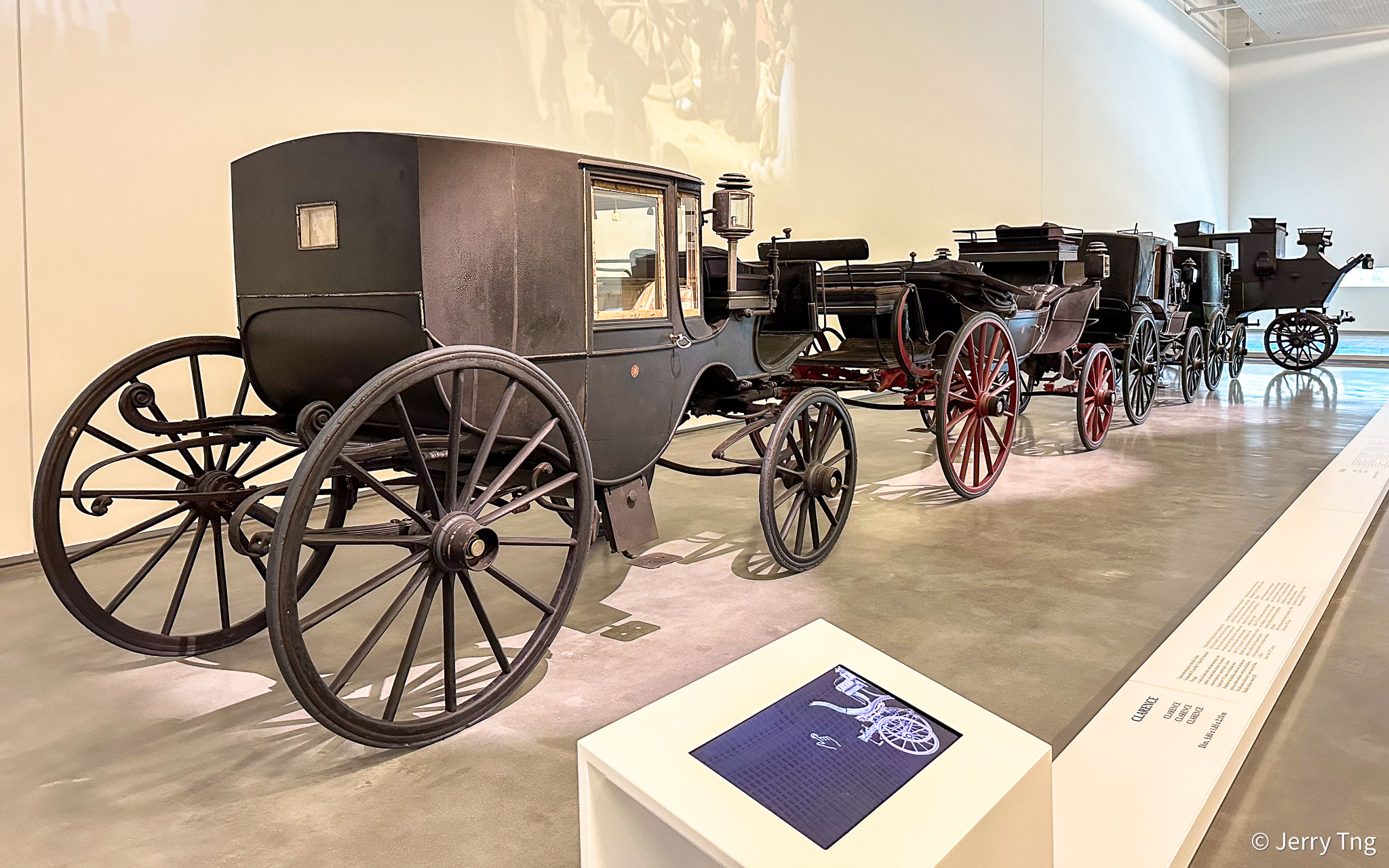
Besides the transportation and regalia, there are some really interesting functional carriages in the exhibition.

Highlights included a carriage for carrying hunting dogs, mail coaches similar to the Wild, Wild West, a prisoner transport, among others.
Table of Contents
Dog Cart
Nils Hansen & Son | 19th-20th century, Portugal | 190 cm x 182 cm x 270 cm | Madeira, ferro, flanela, verga


This country vehicle with three benches was intended to transport hunters. Under the seats there are compartments with red-boarded respirators for the dogs. Next to the rear seat there is a straw basket to hold the firearms.The suspension is made by elliptical springs. It has two copper lanterns, two steps to access the body, a steering wheel brake and a horsewhip support. It was manufactured at Niels Hansen e Filho’s workshop, in Lisbon. Portuguese work. 19th Century.
Governess Cart or Tonneau
Unknown author | 18th century | 3,30 x 1,70 x 1,50 m

This promenade cart was used to transport children accompanied by their governess. The low body facilitates the entry that is made by a single door at the back. Its rounded upholstered shape with handrails protected the children from any falls caused by the chatter of the vehicle. It has lanterns, two wheels and the suspension is made by pincer springs. It was pulled by only one horse. Portuguese work. 19th Century.
Brougham
Robinson & Cook’s | 19th century, England, London | 3,15 x 1,60 x 2 m

This car owes its name to Lord Brougham who designed it and had the first model built. The coupé with closed body has four windows, a rear window, seats for two passengers and a small extra seat. The access is made by a hanging step, it has a lever brake and two lamps. It belonged to the Count of Penha Garcia. It was manufactured at Robinson & Cook’s workshop, in London. English work. 19th Century.
Mail Coach
Unknown author | 19th century, 3rd quarter, England | 355 cm x 210 cm x 390 cm | Wood, iron


This sturdy vehicle was used to carry official mail and also passengers that travelled inside the body and on the roof. Luggage and mail were placed in the lower compartments. It has two side lanterns and in front a three-flame lantern. At the rear, next to the postillion’s seat, there is a lever brake. It was later acquired by Gustavo Ferreira Pinto Basto for travel, promenades or hunting. The doors feature the family coat of arms. English work. 19th Century.
Mail Coach “Correio Nº 7”
Jones Frères (builder) | 19th century (1854), Belgium, Brussels | 298 cm x 210 cm x 500 cm | Wood

This vehicle was intended for long distance travels. The body has two compartments for passengers and one for official mail. The coachman’s seat is at the level of the roof where there is also place for the luggage. The travel between Lisbon and Porto took 34 hours and stopped at 23 stations so that the travelers could rest and the horses could be changed. The Mail Coach is painted in black and dark red and the doors of the middle body have the words “CORREIO Nº 7 (MAIL NO.7), with the Portuguese Royal Coat of Arms painted on top. This service came to an end with the arrival of the train. It was manufactured in 1854 at Jones Frères’s workshop, in Brussels. Belgian work. 19th Century.
Prisoner Carriage
Unknown | 19th-20th century, Portugal | 5,86 x 1,95 x 2,50 m

It is the oldest horse-drawn prisoner transport vehicle known in Portugal. The metallic structure box has eight fake windows surmounted by respirators.


The access to the interior is made through a single rear door that opens only from the outside and gives access to the central corridor where there are six individual cells, three on each side, equipped with seats and doors with a perforated metal plate on the top to watch and communicate with the prisoners. Two prison guards locked the cells and remained seated at each end of the corridor, one near the front window located under the coachman’s seat, the other at the carriage access door. Portuguese work. 19th – 20th centuries.
The Little Carriages of José Cardoso Brito
The National Coach Museum presents the temporary exhibition Modeling of Carriages – José Cardoso de Brito, which brings together 14 replicas of vehicles from the MNC collection, made by the author on a 1/10 scale.
The Traveling Coach

The Traveling Coach, this was a project created by G.M. Americana, to find young people aged 14 to 19 with talent and creativity for the automotive industry in Detroit. This coach entered the contest, in the years 1934 and 1935, in which many young people participated and won scholarships.
The First Automobile in Portugal

PANHARD & LEVASSOR, Miniature of the first automobile that came to Portugal, purchased in Paris, France, by the Count of Avilez, in the year 1895, This miniature, built at 1/8 scale took about nine month, materials were used closest to the original.
Regicide Landau – 19th-20th Century

The royal family was travelling through the Terreiro do Paço in Lisbon in this landau on 1 February 1908 when they suffered an attack in which King Carlos I and Prince Luis Filipe, the heir to the throne, were killed and the Prince Manuel was wounded. Traces of the bullets are visible. The doors feature the monogram of King Carlos I.
Road Coach no 7 – 19th Century

Belgian vehicle. It has compartments for passengers and mail. The hood has the coachman’s seat and a place for the luggage. It was used on the Lisbon-Oporto route and took 34 hours, with stops at 23 stations for passengers to rest and to change the horses. This service came to an end once the railway arrived.
Road Coach no 5 – 19th Century

It has compartments for passengers and mail. The hood has the coachman’s seat and a place for the luggage. It was used on the Lisbon-Oporto route and took 34 hours, with stops at 23 stations for passengers to rest and to change the horses. This service came to an end once the railway arrived.
The Crown State Carriage -19th Century

This Empire style ceremonial carriage has a new suspension system, with short straps and C-shaped springs. The coachman’s seat is raised and the hood is topped by a royal crown. The panels feature the royal coat of arms with winged dragons, the symbol of the House of Bragança. It was used for the coronation of King Carlos I.
Coach of Napoleon – 20th Century

This model derived from two cars used by Emperor Napoleon – the car of his coronation and the car of his marriage. It was made from plans imported from the United States of America.
About National Coach Museum
The National Coach Museum houses one of the most important collections of horse drawn carriages in the world, making this a highly recommended place to visit.

On May 23, 1905, by the initiative of Queen Amelia of Orleães and Bragança, wife of King Carlos I, the Royal Coach Museum was inaugurated in the Old Riding Arena.
When the Republic was established in 1910, the Museum was renamed National Coach Museum (Museu Nacional dos Coches).
This museum houses an important horse-drawn carriage collection of vehicles are from the seventeenth, eighteenth and nineteenth century.
The museum was formerly housed in the Royal Riding Hall of Belém, the former home of the Portuguese School of Equestrian Art, known as the Picadeiro Real. The Picadeiro Real is part of the larger Belém Palace complex, formerly a Royal Palace, which is now the official residence of the President of Portugal.

In the Royal Riding Arena it is still possible to see some vehicles, oil paintings of the monarchs of the Bragança dynasty and a set of saddles and harnesses related to the Equestrian Art.

The new museum building was inaugurated on May 23, 2015. The horse-drawn vehicles belonging to royal palaces of the Crown, the Church and various noble houses are exhibited in chronological order revealing the different models used, their characteristics and evolution from the 16th century until the end of the 19th century.
Opening Hours:
Tuesday through Sunday: 10am to 6pm. Mondays: closed.
Closed: January 1st, May 1st, Easter Sunday, June 13th, 24th and 25th December.
Visited Aug 2023
0 comments on “National Coach Museum – Functional Coaches”