
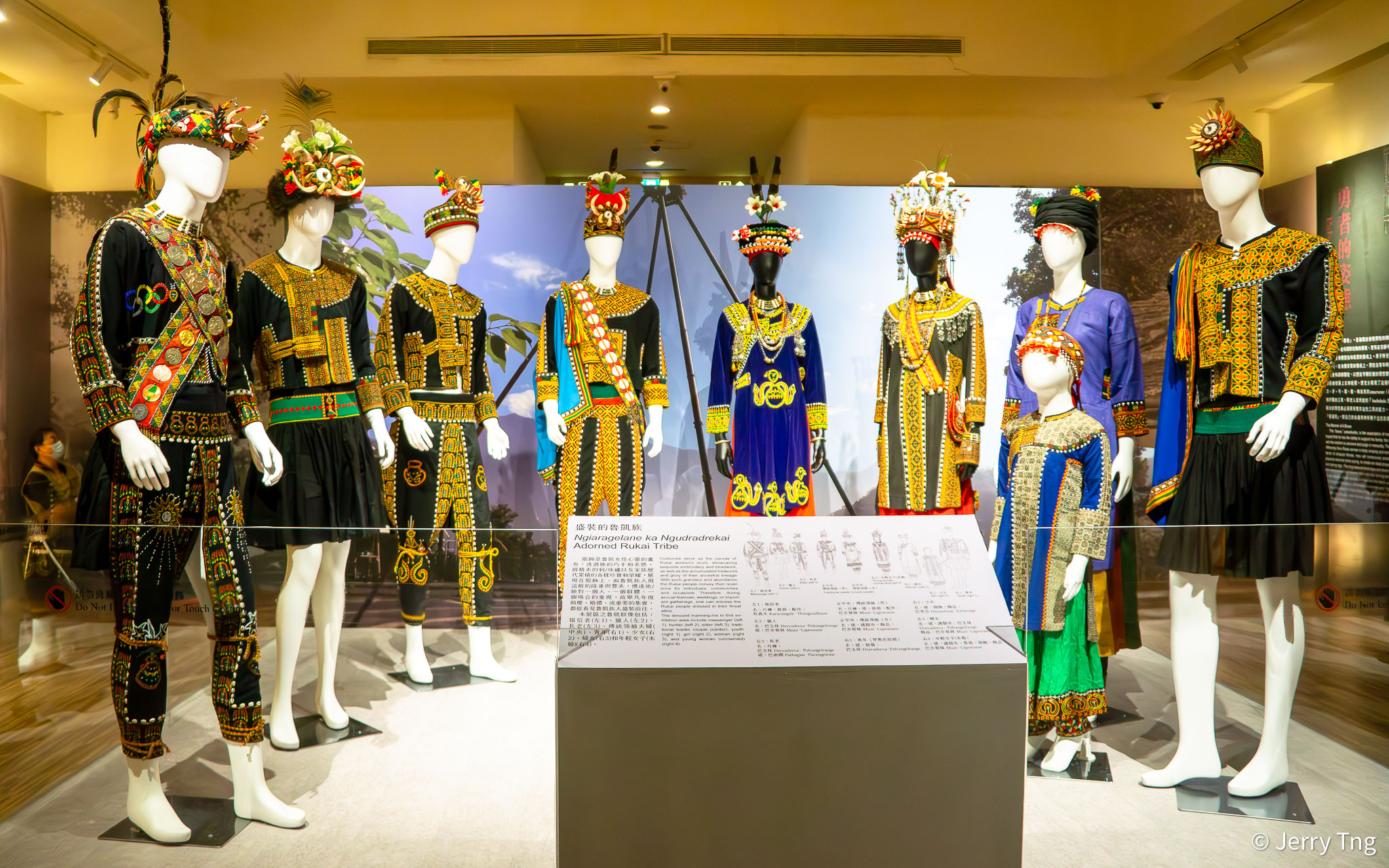
This was a themed exhibition “Kialreba, Returning Wutai: Dialogue Between NTM & Contemporary Rukai” at the National Taiwan Museum (NTM, and yes, the other museum in Taipei) about the Rukai people.
Table of Contents
“Kialreba, Returning Wutai: Dialogue Between NTM & Contemporary Rukai” displays a total of 150 Rukai artefacts, including 63 objects from the NTM Collection, 19 from the Rukai Culture Museum 霧臺魯凱族文物館 in Wutai Township, 67 on loan from the Rukai tribe and 1 carved wooden eave from the Anthropology Museum of National Taiwan University. It is regarded as the largest exhibition of Rukai artefacts in recent years, which is of great significance.
About the Rukai Tribe 魯凱族
The Rukai , or formerly known as Tsalisen (people living in the mountain), self designation Ngudradrekai or 魯凱族 in Chinese, number about 13,500 (2020), thus being the 7th largest of the peoples of Taiwan. They speak a distinct language, but were formerly considered to be part of the Paiwan, with whom they share much in the way of costume and culture. The Rukai live in the highlands north of the Paiwan, and south of the Bunun. The Rukai have a rather feudal societal structure. All of the land belongs to the aristocracy, and commoners have to pay the Lord a part of their harvest in exchange for the use of the land. Woodworking is well developed.


Particularly significant to the culture of these people are three animals; Reeve’s muntjac 山羌 (Muntiacus Reevesi), the clouded leopard 雲豹 (Neofelis Nebulosa), and the Chinese moccasin or hundred pacer’ 百步蛇 (Deinagkistrodon acutus). Pelts and horns of Reeves muntjac and clouded leopard are worn; although the clouded leopard is now extinct in Taiwan. The viper is a common motif in their ornaments and wood carvings.

The piers on both sides of the Guchuan Bridge that connects the two main townships of Rukai people also represent the three cultural motifs of the Rukai people; the ancient pottery urns represent the leaders and the noble class; eagle’s feathers are exclusive to the tribal leader; lilies have different meanings for man and woman, for man it represents the hunter, for woman it represents chastity and sanctity.
Wutai Township 霧臺鄉


Wutai Township 霧臺鄉, or in Rukai language: Vedai, is a mountain indigenous township in Pingtung County 屏東縣, Taiwan. The township is mainly inhabited by the Rukai Tribe 魯凱族. The Rukai are one of the indigenous people of Taiwan and consist of six communities residing in southern Taiwan (Budai, Labuan, Tanan, Maga, Mantauran, and Tona), each of which has its own dialect of the Rukai language.

Rukai is a tribe that values blood relationships, which is reflected in their clearly marked relative-visiting customs. Like an image of concentric circles, the Rukai relative-visiting customs range from the closest blood kin to relatives from the fourth generation, and is divided into three levels: Ngiabwale (kinship), Mwaridane (homecoming 衣錦還鄉) and Kialreba (visitations). The exhibits from the present exhibition, which came from different sources, are just like family kinsman spreading across generations, reuniting a hundred years later at the Kialreba ceremony.
Palwalwabe : The Manner of A Brave


The “brave,” palwalwabe, is the expectation of men in Rukai society. It is hoped that he has the ability to support his family, the courage to face danger and the wisdom to perceive and judge in tranquility. Therefore, men are guided differently from Rukai women in body shaping and temperament cultivation.

In terms of physical fitness, men will consciously practice dietary control and physical exercise since young, to create an ideal physique with a narrow waist and strong legs. The long-sleeved short tops and short skirts worn by adult men fully demonstrate this feature.

Costumes serve as the canvas of Rukai women’s souls, showcasing exquisite embroidery and beadwork, as well as the accumulated treasures and glory of their ancestral lineage. With such grandeur and abundance, the Rukai people convey their reverence for individuals, communities, and occasions. Therefore, during annual festivals, weddings, or important gatherings, one can witness the Rukai people dressed in their finest attire

Men use the hunting and combat tools such as knives, spears, bows, arrows, shields, and the latest amurwane (Dutch) guns, referred to as “lawbubulu, the essential survival gear” by the elders. Most men must be competent to make these tools, and perform the “blessing ceremony” on them, so one can unite his own destiny with the divine power bestowed by the gods on these outfits.
Ulrudru : Bearers of Sky and Earth – Rukai Architecture

The elders of the tribe said, “In a house, dane is above the soil, the place where the living live; balriw is below the soil, the tomb where we bury our deceased family members.” The sky-unfolding ulrudru (pillar), described by the elders as the “burden bearer,” supports a house with a “dug-standing pillar” structure. Inside the traditional Rukai house, there are a total of six pillars, varying in shapes, features on the top and locations.

From the front area to the end area of the house, the order of the pillars starts with a pair of saisadhane, followed by a pair of rathudane, and then “tadri“, the main pillar, which is solo at the centre of the house and is the tallest and solidest wood among the group, and finally taidrale standing behind the main pillar.
Ancestral Carving Ulrudru-Tadri 祖先雕刻屋柱
Painted Figures Ulrudru-Tadri 彩繪人像屋柱


大型祖先雕刻主立柱,上窄下寬,頂端有插榫,下半部淺浮雕刻飾男性祖先像及捲繞百步蛇,人像雙手上舉平肩,雙腳略彎,足尖朝外,五官清晰,雙眉細長而相連,鼻部特徵顯著,原可能有鑲嵌物,線條頗為洗練。左、右掌腳趾分有六趾、七趾,異於一般人的「五趾」,主要在彰顯祖先被神賦予的「奇異」的力量。
「百步蛇和雙臂向外開展、雙手上舉平肩、腳尖朝外的男性人像,是魯凱族普遍的雕刻意象。「那個人像的手是張開的,意思是『慷慨的給予』。」(部落耆老口述)
本件中央部位繪一著短裙之直立男子像,腳尖朝外,左右身側各有一蜿蜒而行之百步蛇圖紋自足尖向人像手肘部位伸展,人像上方並描繪由陶壺中孵化出百步蛇的形象。頂端鑿有用來掛置物品的掛孔。
各部落受訪者從屋柱頂端略微向前翹起的結構,及所使用的圖樣元素一人像和百步蛇、以及人像雙臂往外開展的型態來判斷,認為本件為魯凱族的tadri(主柱)。但因圖像的製作方式為「彩繪」而非常見的「雕刻」技法,故有受訪者表示,可能要往有用「畫」的屋柱的家,如已過世的Gilagilau家(吉露部落),去尋找可能的製作者。
Among them, tadri plays the role of a “channel,” vertically transmitting the blessings of Twaumas (the Creator god) and people’s thoughts. And in the secular horizontal space, it is the centre, outlining the gendered ethics of using the space.
Carved House Eave “Vagingi” from Wutai 霧毫部落傳統家屋木雕簷桁
Wood, carving | Japanese Colonial Rule (1895 to 1945) | Collection (1932) of Anthropology Museum of NTU 國立臺灣大學人類學博物館,水野繼吉採自霧臺村,1932年入藏


The horizontal eave of the front of the Rukai house called vagingi carved with the usual human head figures and Chinese moccasins motifs. The details of each face are varying, just like the people that have lived in the house in the past. The vipers intertwined as if they are protecting the inhabitants of the house. Chinese moccasins are thought to be the spiritual embodiment of the Rukai ancestors. The eave is carved with a V-shaped trench called a gagingi on the bottom to wedge the eave onto the slate walls.
House of a Nobleman, Tawgadhu Gilagilaw 貴族 杜長助 家屋

Another sample of an eave with repeating patterns, which is solemn and aesthetically pleasing in Rukai culture, a reflection of the strict social hierarchy in Rukai societies.
Ulrudru-Tadri (Pillar) 人面紋彩繪雕刻屋柱
Wood, paint | c. 18th century | Wutai Township, Collection of National Museum of Taiwan 屏東縣霧臺鄉霧臺村 國立臺灣博物館藏
Kapuduku (Wooden Stool) 雙蛇木凳
Wood, paint | c. 18th century | Wutai Township, Collection of National Museum of Taiwan 屏東縣霧臺鄉大武村 國立臺灣博物館藏


The tadri belonged to the Tawgadhu family.The elongated diamond shape has a protruding top, the lower half has a pair of human heads and intertwining Chinese moccasins. The bottom is stuck into the ground.
According to oral history of Kabalelradhane tribe 神山部落, the mystical hunting hound was similar to the clouded leopard, hence the addition of the dog.
The dog was added to the tardi afterwards, as evident of the different styles of the carvings.
This wooden stool is called taetale kitadri (seat of the main column) and serves as an altar for hunted game for thanksgiving rituals. It is also the place where the head of the family and important guests sit down.
If a tribal leader 頭目 is present, the host will invite him to sit here to show his respect. Women are not allowed to use this stool.
The front of the wooden seat is carved with a pair of Chinese moccasins.
The Rukai people believe that the beauty and meaning of engraving should complement the ability, deeds and importance of individuals or families. While eagle’s feathers, ancient pottery urns and other objects with social class significance are exclusive to nobility, other patterns (such as Chinese moccasin pattern) and their significance are the common assets of the Rukai people.
Ulrudru-Saisadhane (Main Column) 木雕屋柱
Wood, carvings accredited to tribal carver Lidagu Mabaliu 木雕師 蔡旺 | Japanese Colonial Rule (1895 to 1945) | From Wutai Township, Pingtung County, Collection of NTM 屏東縣霧臺鄉霧臺村,國立臺灣博物館藏


This is a rare example of a semi-cylindrical carved ancestral roof columns. The surrounding body is embossed with upright male statues and coiled with Chinese moccasin patterns. The upper row of portraits connect the tip of the feet and hands with the serpent. There are three male statues in the lower row. The middle one faced the front, while each side is a man’s (left and right), with their right hand raised above the head holding a Chinese moccasin. There is no gagingi “groove” on the top, instead thick iron nails are added to it to form a V-shaped shape to stabilise the vagingi “roof beam”. This construction method is called wakalravisi in Rukai. This pillar is located in the lower part of the roof of the front room of the house, close to the stone wall.
The Preservation of Food


As the saying goes, 民以食為天 “food is everything to the people”. The Rukai people follow the solar terms of the earth and choose the best time for various livelihood activities to gain a good harvest in farming, fishing, and hunting. For them, it is gratifying to have abundant harvests, but only the excellent food processing and preservation methods can provide the security of life in the face of abnormal weather or man-made disasters.
Balraku (Winnowing Basket) 大籐籩
Rattan | 20th century | PIngtung County, Wutai Township, Collection of National Museum of Taiwan 屏東縣霧臺鄉大武村,國立臺灣博物館藏

Food containers and storage space are thus valued by Rukai. Food containers are mostly woven from bamboo or yellow rattan, harder than shell ginger in structure, such as balraku or 大籐籩 rattan winnowing basket.
Cepenge (Food Basket) 籘筐
Rattan | 19th-20th century | PIngtung County, Wutai Township, Collection of National Museum of Taiwan 屏東縣霧臺鄉霧臺村,國立臺灣博物館藏


There are two types of base for cepenge, “dense” or “holed”. The dense ones are used to contain the fresh taros with soil stains for further roasting and dehydrating when the upland taros are reaped in late autumn. The holed ones, good for ventilation, are mainly used to store the sun-dried, neatly bundled millet, or to contain the dry, cooked food.
Sabadhane : The Courtesy of Reciprocity 禮尚往來
How should the “betrothal gift” in marriage be appropriately and expressively presented? The kadilrungane (ancient urn) and silu (glass) from the wedding gifts of Rukai nobles will tell this story.

The necessary procedures and content in feudal society are to highlight the family’s status in tribal society, so there must be certain steps in the negotiation between men and women’s families.

Although ballads are not class-specific and can be sung by everyone, the combination of different ballads at different stages reflects the connection between the negotiation stage and ballad singing, which seems to form the response role played in the process from marriage negotiation to marriage.

While the hierarchical society of Rukai consents to inter-class marriages, the dowry must be in line with class of the bride. In an aristocratic wedding, the elders will perform “Singili” in front of the participants, a ceremony for introducing the bloodlines of the two families, to signify that this marriage is both “harmonious” and “courteous.” To ensure the completeness of information, thathuvukane (a special glass bead jewellery) is used to mark the ancestor’s era and the family house 家屋 in the process.

If the bride’s family is more aristocratic than the groom’s, the sakiramavane (reciprocal gift) 合乎禮 given by the groom as dowry must express respect for the bride’s noble status and her role as a model and leader in society. Items of sakiramavane include kadilrungane (ancient urn) 古甕 as sawdanane (audience gift) 晉見禮 and a thathuvukane (glass bead) 七彩琉璃珠 that symbolises niakesu (your breath; also interpreted in the Rukai bible as “plenty”).
Kadilrungane-Pinusingsingsingane 「飾有少女鈴鐺紋」古陶壺
Pottery | c. 18th century | Collection of Rukai Culture Museum 霧臺鄉魯凱族文物館藏

Traditional ancient pottery pot, round bottom, bulging abdomen, folded shoulders and neck, extravagant mouth, two rows of concentric round patterns in the upper part of the abdomen and the upper part of the upper part of the shoulder near the neck, and a circle of ribbon-shaped diamond/tortuous pattern combination decoration. In addition to the bride ceremony used by the nobles for marriage, the Rukai people “mwaridane recognises the ancestors to the root” (to show that “we are one Family) is also used when it is a ritual. Among them, the “concentric round pattern” is taken from the small singsing used for decoration on Lu Kai’s girl’s clothes, hence the name.

Kadilrungane (Ancient Pottery Urn) 古陶壺
Pottery | 18th century | PIngtung County, Wutai Township, Collection of National Museum of Taiwan 屏東縣霧臺鄉霧臺村,國立臺灣博物館藏

The traditional ancient pottery pot with a circle foot is round in shape. Extravagant mouth, short neck, folded shoulders, bulging abdomen, the body is slightly spherical, and the top of the shoulder near the neck is decorated with two circles of protrusions. As a bride gift for a noble marriage, it symbolises “niyakesu“, which means “this is the breath of your life”. Elders believe that this kind of ancient pottery pot with long feet is a more late type than the ancient pottery pot with an arc-shaped background.
Irabu-Nirukudrane (Ceremonial Dagger) 禮刀
Wood, rattan, metal | 18th-19th century | Rukai Culture Museum Collection 霧臺鄉魯凱族文物館藏

Whether it is aristocrat or a commoner, the ceremonial dagger and the big cast iron wok are important essential betrothal gifts. The dagger is a symbol of farming the land, supporting and defending the family; it symbolises the newly wedded will start a new family or new “house”. This piece is a typical dagger of the Rukai; the wooden sheath is carved with a Chinese moccasin, hundred-step snake, and near the handle is capped with silver bracelets, which according to the tribal elders, is a highly regarded ceremonial dagger.
Kalathe-Garase (Glass Bracelet) 玻璃手鐲
Glass | 20th century | Pingtung County Wutai Township, Collection of National Museum of Taiwan 屏東縣霧臺鄉阿禮村 國立臺灣博物館藏

Two kalathe-garase or glass bracelets (green and blue) are found among the tribal leaders herilooms. THese are not originated from the aborigines of Taiwan, definitely not from Rukai according to the elders. They are most likely dowry gifts from marrying with “outsiders”, i.e. non-tribal. Interesting the phonetic for Rukai language garase is similar to the Dutch glas.

Kalathe-Cikwane (Bronze Bracelet) 銅腕飾
Bronze | 19th-20th century | Pingtung County Wutai Township, Tribal Heirloom (on loan) 屏東縣霧臺鄉霧臺村神山部落,部落家傳文物
Kalathe-Kinarungurungutane (Silver Bracelet) 銀腕飾
Silver | 19th-20th century | Pingtung County Wutai Township, Collection of National Museum of Taiwan 屏東霧臺鄉大武村,國立臺灣博物館藏
These bracelets are traditional jewellery of the Rukai women, usually worn alone and passed down from mother to daughter.


Karuthaili (Looping Cup) 連杯
Wood | 19th-20th century | Rukai Culture Museum 霧臺鄉魯凱族文物館藏

There are different types of drinking wooden cups for Rukai ceremonies, such as single cups and double or triple cups. Karuthaili means “the chalice used by two of a kind”, which can only be nobility of the same class or peers in the same field. This ceremony of “drinking together” often appears at the occasion of the harvest festival, tribal alliance and wedding, to show unity and harmonious sharing.

Ibuku with Butterfly Pattern (Men’s Long Sleeve Shirt) 男子蝶紋長袖短衣
Cloth, metal, embroidery | 19th-20th century | Pingtung County Wutai Township, Collection of National Museum of Taiwan 屏東縣霧臺鄉阿禮村,國立臺灣博物館藏

Ibuku, a traditional long-sleeved shirt, is a shirt exclusively for men with tattoos for important occasions. The combination of patch embroidery, butterfly pattern, metal bindings and colourful combinations all have the style of Wutai region.

Talaraedre (Strap) 瑪瑙珠銀鍊佩帶
Agate, Silver | 19th-20th century | Pingtung County Wutai Township, Collection of National Museum of Taiwan 屏東縣霧臺鄉大武村,國立臺灣博物館藏
The strap is made with 18 perforated silver pieces inlaid with agate beads, which are connected by chain strips and tied at both ends. This strap can be used to tie the man’s or woman’s slant carrying bag (similar to our modern-day messenger bag) to the side.
Tukutuku (Decorative Shawl) 雲肩
Embroidery, silver, pearls, precious stones | c. 18th century | Wutai Township, heirloom of Mdm Drevadreva 屏東縣霧臺鄉霧臺村神山邵落,巴玉珠女士家傳文物

When women dress up, they wear clothes on the layers, which are common in girls or young women. The glazed beads used in this piece are from the Rusaliane family in Tathigarane district, Wutai. Rukai tradition let the eldest daughter to inherit the glass jewellery, so this tukutuku has been passed down from generation to generation Mdm Drevadreva. She uses these ancient beads to make this spiritual shoulder ornament for her daughter based on Rukai traditional kinaciacianane pattern (patch embroidered figure “3”” glyph pattern).
Pwalrima Ki Tinaita : Hands of the Mother
In Rukai society, the making of clothes, styles, and wearing etiquette are distinctly related to gender, changes in growth stages, and even occasions. The establishment of all these norms has originated from the formation of a piece of “imai, ramie woven clothes.” A female elder said, “If we girls don’t know how to weave, embroider, and make clothes, our family will be very poor! There will be no quilt to cover, and no clothes to wear. And the saddest thing is that there will be no shroud for the deceased family members in the burial!” In Rukai society, weaving jobs are exclusively for women.

Tabelangane is a weaving house specially built for every tribal woman and the skill is passed down from the mother (ina) and grandma (kaingu). Men build this house and make the tools. But once they are done, it is a taboo, tawlrisiane, for men to touch the weaving tools or enter a weaving studio; it was believed that touching will cause the men not to be able to hunt, so there’s no weaving done in the main house.
Ibuku with Crossed Embroidery Octagonal Star Pattern (Men’s Long Sleeve Shirt) 男子十字繡八角星形紋飾長袖短衣
Cloth, metal, embroidery | 19th-20th century | Pingtung County Wutai Township, Collection of National Museum of Taiwan 屏東縣霧臺鄉霧臺村,國立臺灣博物館藏

Ibuku, a traditional long-sleeved shirt, is a shirt exclusively for men with tattoos for important occasions. The tribal elders said, “There are too many different embroidery patterns in a garment, which will make people dizzy and not look good.”


Most of this adult men’s clothing are decorated with the same one-line embroidery pattern, which is beautiful in Rukai’s aesthetic; the cross-stitch octagonal star-shaped pattern is also one of the characteristics of the Rukai people.
Belange (Weaving Machine) with Imai (Ramie Cloth) 織布機(含苧麻布)
Bamboo, ramie | 19th-20th century | Pingtung County Sandimen Township, Collection of National Museum of Taiwan 屏東縣三地門鄉,國立臺灣博物館藏

Belange is the general term for weaving tools, and among all traditional fabrics, “imai” (ramie cloth) is the most important because it is the basic material for cloth-made items, and it is also used as a shroud.


Variations in clothing of the Rukai tribe depend on the occasion and the age of the wearer. Clothing was decorated with patterns that were based on social class. In general, married women and the elders of the tribe tended to wear clothing simpler in style than unmarried women and younger members of the tribe.
About the Special Exhibition

The special exhibition of “Kialreba, Returning Wutai: Dialogue Between NTM & Contemporary Rukai” includes Rukai collections from the NTM, Rukai Cultural Museum in Wutai Township, Wutai communities and the Anthropology Museum of National Taiwan University. The exhibition in NTM ran from 20 Jun 2023 to 10 Mar 2024.
Visited Sep 2023
About National Taiwan Museum

National Taiwan Museum 國立臺灣博物館, established in 1908, is the oldest museum in Taiwan. The Japanese government wanted to commemorate the opening of the west coast railway and so established the Taiwan Governor Museum 「臺灣總督府民政部殖產局附屬博物館」on October 24, 1908. At its opening, there were more than 10,000 pieces of collections in the museum.
In 1913, funds were collected to build the Governor-General Kodama Gentaro and Chief Civil Administrator Goto Shinpei Memorial Museum at current site in 228 Peace Memorial Park. In 1915, after two years of construction, the museum was completed. It is one of the most noteworthy public buildings in Taiwan.

From the colonial-era Taiwan Governor Museum to the National Taiwan Museum today, the building has witnessed the history of Taiwan and also recorded the natural and anthropological development of this land. The collection and research continue to focus on the research of anthropology, earth sciences, zoology, and botany. Today, the museum is divided 4 separate buildings spread across Taipei covering different topics of Taiwanese history.
- Main Building – Located in the 228 Peace Memorial Park 228 和平紀念公園, this building houses the permanent collections of taxidermy that are left behind from the colonial days, as well as special exhibitions of local history.
- Natural History Branch – Located opposite the Main Building in the former Taiwan Land Bank 臺灣土地銀行, this Natural History Branch focuses on Palentology and history of the original occupiers of the building. The admission ticket for the Main Building covers this exhibition too.
- Nanmen Branch – Located in the camphor factory of the Monopoly Bureau 專賣局舊樟腦工廠, it is part of the historical monument reuse program which combines the historical architecture with the museum exhibitions.
- Railway Department Park – Located onn the site of the former Railway Department of the Transportation Administration 台灣總督府交通局鐵道部, features exhibitions on Taiwan’s railway history.
Two more branches are planned to be opened in the near future that would cover the Tobacco Monopoly Bureau and old Mitsui Bussan Company building.
The museum has witnessed Taiwan’s history and recorded its natural and humanitarian developments. Through this window, one may catch a glimpse of Taiwan’s evolution with regard to the fields of earth sciences, humanitarian developments, zoology, and botany.
0 comments on “National Taiwan Museum – Returning to Wutai 重返霧臺”