
Shinzo Japanese Cuisine is one of the best Japanese Omakase restaurant in town. I have been wanting to come back to Shinzo since they changed the head chef back in Apr 2021.

Shinzo serves set lunches and omakase for dinners. They have removed the a la carte menu for dinner, but it was the omakase that we came for anyway so it didn’t bother us. Chef Lawrence Chia has since gone to another restaurant, and helming the kitchen team is now Chef Kelvin Hoo, another Nogawa alumni.

First appetiser was a simple boiled fava beans 空豆 (soramame). These beans have a buttery and nutty taste. The first time I had this was at another Nogawa’s alumni, Ronnie Chia’s Tatsuya, in exactly the same style.

At Shinzo, one can expect nothing less than the freshest ingredients flown in directly from Japan. Just as the ingredients vary with the seasons in Japan, so does Shinzo’s menu. Like these firefly squids ホタルイカ (hotaru ika) from Toyama Bay, they are served only during springtime. I love it for the intense squid taste condensed into such a small size.

When the seafood is this fresh, you do not need anything condiments – maybe just wasabi and soy sauce if you need more kick in the flavours. The first of the sashimi for the evening were Botan shrimp ぼたんえび (botanebi) topped with some Italian caviar and accompanied with Hokkaido sea urchin 馬糞 ウニ (Bafun uni). We were told to leave the head of the shrimp alone as they would go deep fry them for another course.

I didn’t pay attention as I was talking to a business associate, but as Chef Kelvin was presenting the first fish of the evening, there were oohs and aahs in my party. Obviously the origin of this yellowtail 鰤 (buri) was quite something.

There’s no compromise to the highest quality of fish in a restaurant of this calibre (and this price). The two slices of yellowtail made you craved for more with its buttery texture and sweet, clear taste.

Next up, medium fatty bluefin tuna belly 中トロ (chutoro) hauled in from Ine Bay, Kyoto Prefecture. I have heard of Kyoto, the feudal capital of Japan, but as a Prefecture, it does have some of the prettiest sights in all of Japan. Ine Town 伊根 is a fishing hamlet at Ine Bay, famous for their funaya 船屋 – stilted houses along the bayside that can park boats in them.

Why not the otoro, the fattiest cut of the bluefin tuna, you asked? We were assured we will get some of that later. However I agree with Chef Kelvin that those were too greasy during winter to be used as sashimi. 中トロ Medium fatty tuna belly was just right in terms of texture and taste for sashimi at this point in time. Everything is about timing and seasonality.

Next up, a palate cleanser of sort – Amela fruit tomato. Slightly acidic, generally sweet, I was told the part closest to the stem was the sweetest, and the waitress was right. The Japanese fruit and vegetable produce are arguably the best in the world. And how they have cultivated the tomato into a fruit will only perpetuate the age-old argument of determining whether the tomato is a vegetable or a fruit.

Amela was born in 1996 in Japan, where today it is a tomato of great prestige. These days, they have brought it to be mass produced in Spain. These were the original Japanese ones.

First of the cooked courses, a classic grilled silver cod 銀鱈 (gindara) with sweet miso paste. Quite forgettable.

And then the deep fried prawn head made its reappearance. Strangely I could taste somebody’s tissue wipe as a lingering whiff as Munched it in my mouth. Need more salt.

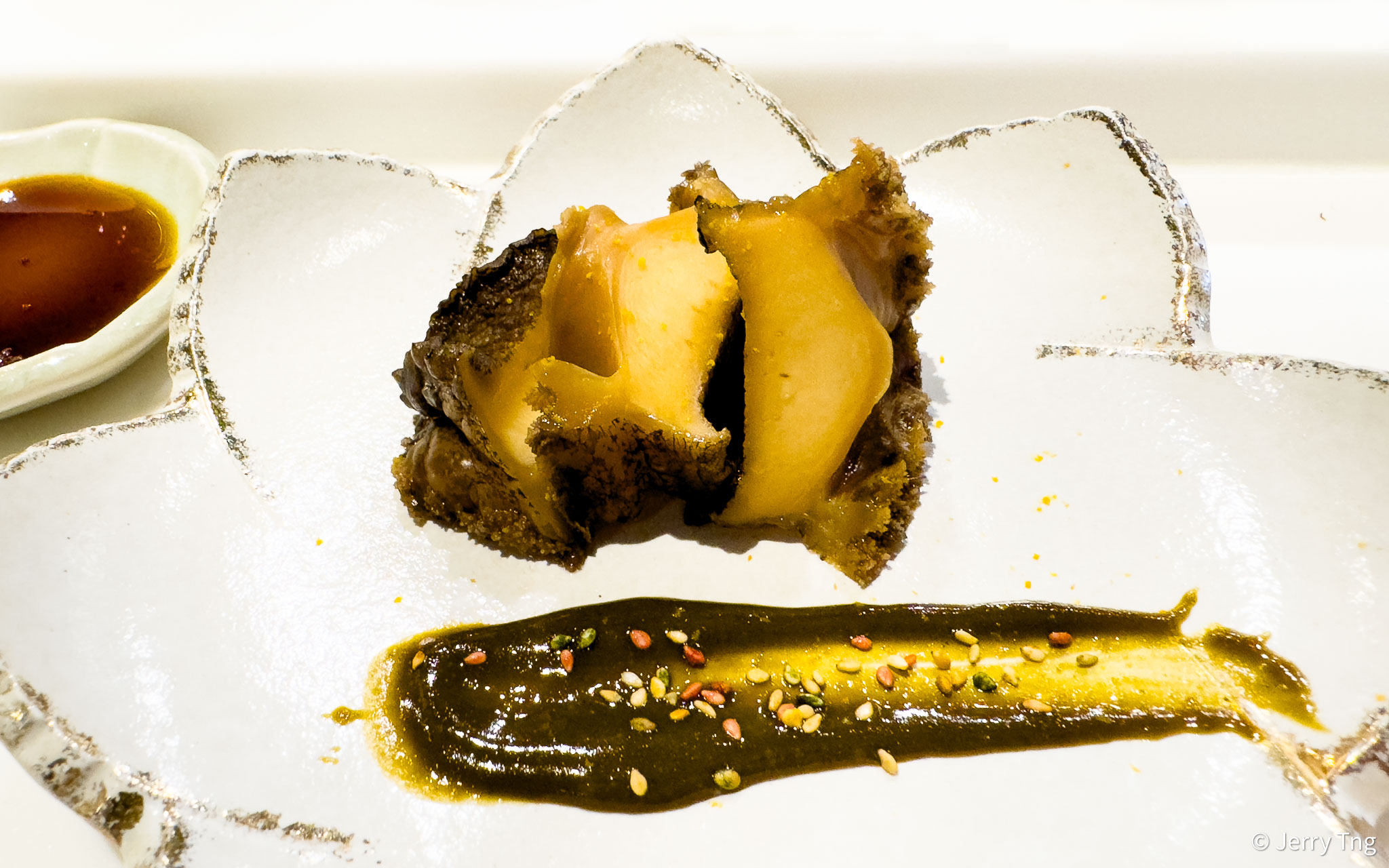
Abalone was not my favourite mollusc – it has no taste of its own, it is chewy if not done correctly and it’s overpriced. All abalone dishes “borrowed” the taste from the sauce, the ingredients that were cooked together with the abalone.

Black abalone 黒鮑 (kuroawabi) from Japan is a sought-after delicacy no matter what cuisine it is used in. Here, the braised abalone was served with Chef Kelvin’s special liver sauce. Just the right texture, it was al dente but not chewy.

Monkfish liver あん肝 (ankimo) is usually served as an appetiser dressed with a ponzu sauce. Here, they served it as a sashimi with a small dash of grated ginger. Unlike most Japanese sushi dishes, ankimo should not be combined with soy sauce, as it spoils the delicate taste of ankimo too much.

Ankimo’s taste is very rich, less like fish, creamy but at the same time very light and tender. The soft texture gives a velvety feeling on the tongue and the high fat content makes ankimo melt in the mouth.

The waitress emphasised it twice its A5 wagyu from Kagoshima. For those unfamiliar with the grading system in Japan still, A5 is highest you can get in terms of tenderness and marbling. Do not underestimate the small morsels of bovine on the relatively large plate, they packed so much flavours and grease that you would be begging for a palate cleanser after the second bite.

Thank goodness, Chef Hoo provided three types of condiments to compliment the really fatty beef. First, a shiso pepper infused wasabi that helped to cut the “jelatness” (Malay for that greasy feeling ad naseum); this was followed by a peppercorn miso glaze, and finally fried garlic and salt flakes. We were told to eat each piece of the wagyu in sequence – naked, with the wasabi, with the miso garlic, and then everything together. Yes, only four small bites, but once you had it, you will never forget why you paid that price.

With the wagyu marked the end of the cooked food portion of the omakase and we proceeded to the anticipated part of the meal, the nigiri sushi 握寿司.

We kicked off with tai 鯛 (Japanese Sea Bream). Tai season begins in the winter time, but doesn’t reach its peak until the first week of April. The fish is then called sakura-dai (cherry blossom sea bream) and fetches high prices at market. The ones we had were delicate yet full of umami from the fish at its prime.

Oysters are never served as nigiri in Japan; they don’t pair well with vinegared sushi rice. This is the first time I had oyster on a sushi, though I heard that it is quite popular in Taiwan and the US to do so. The Iwate oyster was really plump and delicious.

All itamae chefs love to do this theatric before serving the torigai 鳥貝 (Japanese cockle). They would smash the clam meat on the prep board and the cockle will curl up as if it was still alive. This is just a final torture to the shellfish and muscle reflex reaction.

Other than the theatric, the torigai was a really good eat. Sweet and crunchy, it is one of my favourite sushi.

First we had this for sashimi, then we had it for sushi. In the winter months, buri is regarded as the fattiest and most flavourful shiromi (white fish) – its taste and depth of flavor can equal the best maguro, especially when carefully aged for a few days to allow for naturally occurring enzymes to break down the fish’s proteins and fats into amino acids such as glutamate.

The piece de resistance for the sushi tonight was the otoro from Nagasaki Tsushima 長崎対馬. Otoro is the fattiest and most flavourful part of the blue fin tuna, located in the belly area. Tsushima is a group of islands located 100 miles northeast of Kyushu. Because of its strait-like geography location, Tsushima is surrounded by bountiful fish.

Otoro is the best during winter, once the tuna acquires additional body fat. It should always be consumed fresh as it doesn’t last too much when frozen. This part of tuna is rarely found outside of Japan.

There is no word that can describe the feeling of having true otoro for the first time. But when you have tried it so many times, it is just a very fatty piece of fish. While it was still a favorite among my guests, I usually give this up to anyone who wants a second.

Chef Hoo prepared another version of otoro, this time an even fattier cut which he would aburi 炙り(grilled with a blowtorch) slightly one side of the fish.

Because of the excessive fats in this cut, grilling it released the flavours and gave the finished nigiri a smoky flavour. I liked it a lot, but still I am past the age of having very fatty food.

Then we were served some consommé made from the bones of the fish with pieces of salmon. In all good Japanese restaurant, salmon is never used for sushi or sashimi. They are usually served grilled or put into soups like these.

Dessert is usually the weakest link in an omakase. The musk melon was not fully ripen yet, but still amazingly sweet and juicy.

Food quality was fantastic as usual. Chef Kelvin was very jovial and on top of his game. Service was intimate and the environment was really friendly. The clientele was mainly the regulars, and therefore there was much friendly banter around the table. Definitely a go-to place for quality omakase in Singapore.
Shinzo Japanese Cuisine 心臟
17 Carpenter St Singapore 059906
Tel : 6438 2921
Visited Apr 2024
0 comments on “Shinzo @ Carpenter (2024)”