

Ru ware 汝窯 is a highly renowned and exceptionally scarce form of Chinese pottery from the Song dynasty. This pottery was crafted exclusively for the imperial court during a brief period around 1100.
Ru Ware: Chinese Pottery from the Song Dynasty 汝窯
Five Famous Kilns of the Song Dynasty 宋代「五大名窯」
The Five Famous Kilns of the Song dynasty (960-1279 AD) were the Ru 汝, Guan 官, Ge 哥, Ding 定, and Jun 鈞 kilns. Each was renowned for producing monochrome ceramics. The concept of five famous kilns originated in the Ming dynasty and was formalised in the Qing. Highly influential, the wares produced by these kilns were widely imitated in later periods. Distinctive features such as the crackled glazes 釉面開片紋 of certain wares also inspired decoration on furniture, paper, and other art objects.
Ru Ware 汝瓷
The Ru kiln was producing celadon for the court during the end of the Northern Song dynasty and the number of extant works that are attributed to Ru kiln are approximately 90 in the world, making them the rarest celadon wares. The location of the Ru kiln has long been a mystery until in 2000 a kiln which produced court ware was discovered in Qingliangsi Buddhist temple, Baofeng County, Henan Province.
Dish with Bluish-Green Glaze and Bing Mark, Ru Ware 汝窯 青瓷碟 「丙」字銘
Ceramics | Northern Song Dynasty (960-1127 AD) | Dimensions – H: 3.3cm, D: 13.0cm (Top), 8.9cm (Bottom) | National Palace Museum 陶瓷器|北宋(公元960-1127年)|高3.3公分 口徑13.0公分 足徑8.9公分|國立故宮博物院

This piece of artifact has the characteristic crackling glaze of Ru ware, and was considered by Emperor Qianlong as a very fine piece. The Bing mark「丙」字銘 was believed to be the grade of the ware during Song dynasty (which is third grade). Emperor Qianlong lamented in the poem carved on the bottom of the plate,「淡青冰裂細紋披,秘器猶存脩內遺。古丙科為今甲第,人材歎亦或如斯」which praised the beautiful crackling glaze making this third grade piece to become a top rated ware today, and hoped that human talents were like this too. There is another piece still in Beijing’s Palace Museum that has the same Bing mark.
Narcissus Basin with Bluish-Green Glaze Ru Ware 汝窯 青瓷無紋水仙盆
Ceramics | Northern Song Dynasty (960-1127 AD) | Dimensions – H: 6.9cm, D: 23.0×16.4cm (Top), 19.3×12.9cm (Bottom) | National Palace Museum 陶瓷器|北宋(公元960-1127年)|高6.9公分 口徑23.0 X 16.4公分 足徑19.3 X 12.9公分|國立故宮博物院

There are only 6 pieces of this narcissus basin 水仙盆 from Ru kiln left in the world, 4 are in National Palace Museum in Taipei 台北故宮, and one each in Jilin Provincial Museum 吉林省博物院 and the Museum of Oriental Ceramics in Osaka 日本大阪市立東洋陶瓷美術館. This piece is unique because it does not have the crackled glaze so famous among Ru wares. Although it was called a narcissus basin, its original purpose would most likely be a brush washer basin 笔洗. It got this name because of an overseas exhibition to UK in 1936 and the name of “Narcissus basin” has been used since.
Washer with Celadon Glaze and Fenghua Mark, Ru Ware 汝窯 青瓷洗 「奉華」銘
Ceramics | Northern Song Dynasty (960-1127 AD) | Dimensions – H: 2.3cm, D: 12.7cm (Top), 10.1cm (Bottom) | National Palace Museum 陶瓷器|北宋(公元960-1127年)|高2.3公分 口徑12.7公分 底徑10.1公分|國立故宮博物院

This piece was one of the 27 pieces that was collected by the Imperial Household in 7th year of Yongzheng reign 雍正七年 (1729) that was mentioned in the catalog《活計檔》that recorded the history of this piece. The inscription “Fenghua” 「奉華」銘 was most likely the personal mark of Lady Liu of Southern Song dynasty 南宋劉貴妃 (?-1187), who was the favourite consort of Emperor Gaozong 宋高宗趙構 (1107-1187). How much did he love her? When Lady Liu passed away from a sudden illness in 1187, Emperor Gaozong died a few months later from a broken heart.
Gallbladder-shaped Vase with Green Glaze 汝窯 青瓷膽瓶
Ceramics | Northern Song Dynasty (960-1127 AD) | Dimensions – H: 17.8cm, D: 3.6cm (Top), 8.4cm (Bottom) | National Palace Museum 陶瓷器|北宋(公元960-1127年)|高17.8公分 口徑3.6公分 足徑8.4公分|國立故宮博物院
Emperor Qianlong had a habit of inscribing his thoughts on these relics that were brought before him. On the bottom of this vase, a rectangular patch of glaze was removed and his poem was inscribed on it, dated 40th year of his reign 乾隆四十年 (1775).
But he wasn’t an expert and mistaken that this vase was from a private kiln by the famous Zhang brothers, and this mistake was carved into vase forever. And this was not the only example where his mistake was carved or sealed forever. Of course nobody dared to point out his mistakes.

Gallbladder-shaped vase with green glaze
Dish with Pale Sky Blue Glaze 淡天青釉盤 汝窯
Ceramics | Northern Song Dynasty (960-1127 AD) | Dimensions – H: 3cm, D: 17.1cm (Top), 9.1cm (Bottom) | The Palace Museum 陶瓷器|北宋(公元960-1127年)|高3厘米,口径17.1厘米,足径9.1厘米|故宮博物院

Brush washers and dishes were typical products of the Ru kilns and are often characterised by a translucent blue-green glaze with fine crackle. The basic glaze colour of Ru ware is commonly known as “duck eggshell blue” 「鴨蛋殼青色」. The glaze layer is not thick and varies with the purpose of the ware.
Imitation Ru Ware Glaze Dish 仿汝釉盤
Porcelain with Ru-style glaze | Ming dynasty, Xuande period (r. 1426-1435) | Dimensions – H: 4.2cm, D: 17.6cm (Top), 11cm (Bottom) | Imperial Kilns, Jingdezhen, Jiangxi province | The Palace Museum 瓷|明宣德(1426-1435年)|高4.2厘米,口径17.6厘米,足径11厘米|江西景徳鎮御窯|故宮博物院

Out of interest in archaism, imitations of Ru wares, among others, were commissioned during the Xuande period (r. 1426-1435) of the Ming dynasty. Xuande reign was the only period in the Ming dynasty that produced Ru ware imitations; it was not until the Qing Yongzheng period that the production of imitation Ru wares reached its peak.
Fenghua Mallet Vase with Greenish-Blue Glaze, Ru Ware 汝窯 青瓷紙槌瓶 「奉華」銘
Ceramics | Northern Song Dynasty (960-1127 AD) | Dimensions – H: 22.4cm, D: 4.4cm (Top), 8.6cm (Bottom) | National Palace Museum 陶瓷器|北宋(公元960-1127年)|高22.4公分 口徑4.4公分 底徑8.6公分|國立故宮博物院
Two of these mallet vases are kept in the National Palace Museum, this one on display has an inscription “Fenghua” 「奉華」銘 at the base. It was mentioned in the “Illustrated Travels” that a similar piece was seen in the courts of 12th century Goryea dynasty. This piece was one of the 27 pieces that was collected by the Imperial Household in 7th year of Yongzheng reign 雍正七年 (1729).
The inscription was most likely the calligraphy of Emperor Qianlong to indicate that this vase was in the collection of Lady Liu, according to records in 43rd year of Qianlong reign 乾隆四十三年(1779).

Xu Jing’s Illustrated Travels of the Xuanhe Emissary to Goryeo 徐兢 《宣和奉使高麗圖經》(1124)
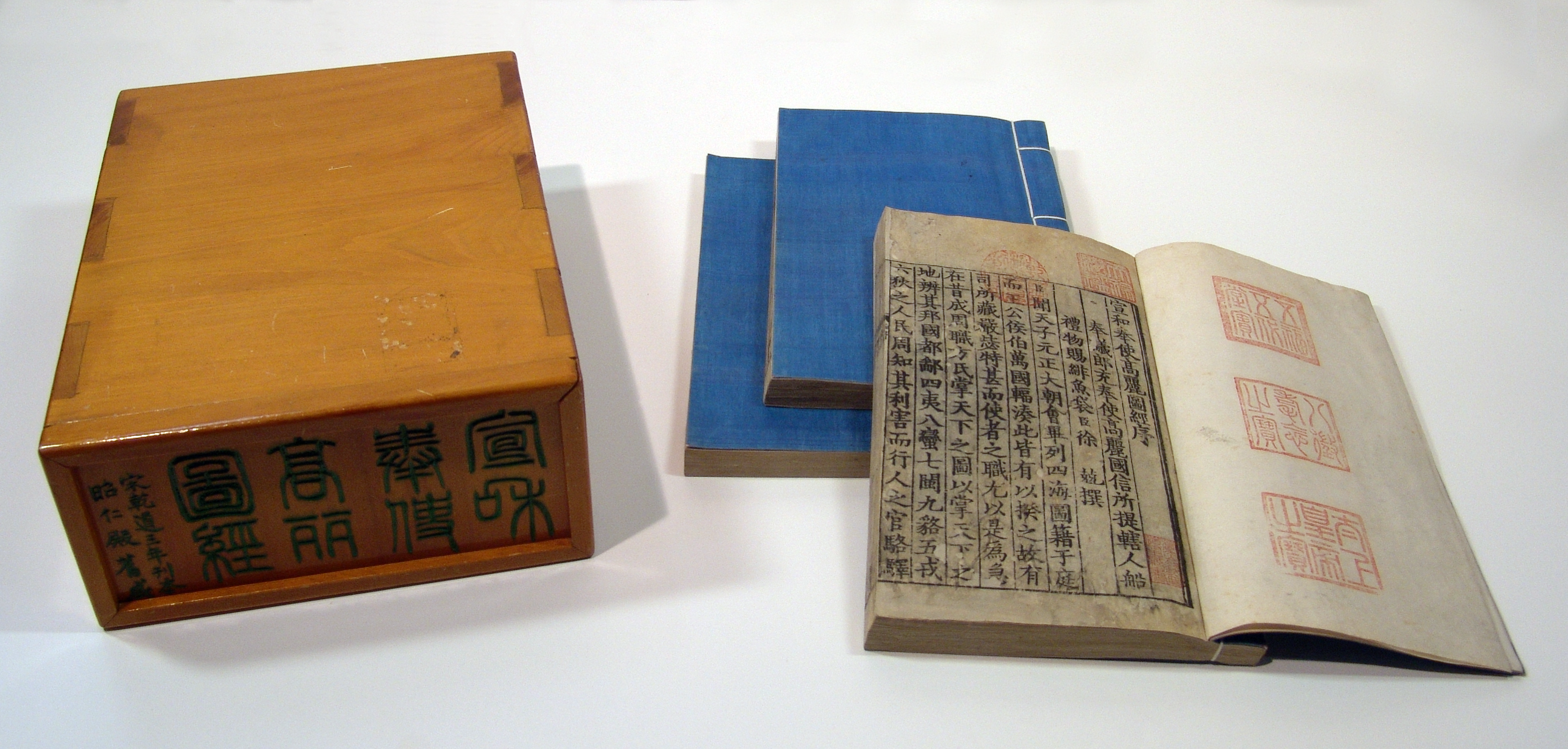
During the Northern Song period, Ambassador Xu Jing 徐兢 to the Korean Goreyo 高麗 imperial court saw ceramic ware that closely resembled Ru ware. These records reveal how Chinese elites during the Song Dynasty acknowledged and admired the beauty of Korean celadon glazes. Its statement reflects the two-way ceramic trade between the Northern Song and the Goreyo during the 12th century. This is attested in a close resemblance between the forms of Goreyo bluish-green ceramics, and Ru ware warming bowls and mallet shaped vases.
Flower-Shaped Bowl, Celadon 青瓷花卉紋碗 청자 꽃모양 사발
Celadon | Goryeo Dynasty, 12th Century | National Museum of Korea

From early on, the potters of the Goryeo dynasty produced various flower-shaped bowls using molds. The bowl does not feature any designs or other forms of ornamentation, but the use of jade-green glaze highlights its pure and elegant beauty.
Lotus-Shaped Warming Bowl in Light Bluish-Green Glaze, Ru Ware 汝窯 青瓷蓮花式溫碗
Ceramics | Northern Song Dynasty (960-1127 AD) | Dimensions – H: 10.4cm, D: 16.2cm (Top), 8.0cm (Bottom), Depth: 7.6cm | National Palace Museum 陶瓷器|北宋(公元960-1127年)|高10.4公分 口徑16.2公分 底徑8.0公分 深7.6公分|國立故宮博物院

Vessels with a form identical to this example were produced in China during the Northern Song dynasty at the Ru kilns located in Henan Province. An almost identical Ru ware flower-shaped bowl from that period can be found in National Palace Museum in Taipei.
Celadon Pear-Shaped Toilet Bowl with Lightning Pattern 青磁 陰刻雷文舟形容器 번개무늬가 새겨진 청자 배모양 그릇
Celadon | Goryeo Dynasty, 12th Century | National Museum of Korea, Acquired in 1916

A vessel that is narrow and shaped like a boat, with lightning pattern incised at the mouth. The use of this celadon bowl is presumed to be altered from its original intended use. In the Joseon Dynasty, a copper tub with a similar shape was placed on a wooden frame, and was used as a urinal. The scholars believe this celadon was intended to be the King’s urinal basin. This form of celadon ware remains very rare.
Celadon Ewer with Carved and Incised Cucumber Tendrils 青磁陰刻蔓瓜文注子 청자 넝쿨무늬 주전자
Celadon | Goryeo Dynasty, 12th Century | Dimensions – H: 19cm, D: 6cm (mouth), 9.6cm (bottom) | National Museum of Korea, Dongwon Collection, Bequest of Lee Hong-kun, 1987

In the Goryeo Dynasty, there were many national rituals related to Buddhism. Various celadon utensils would have been used for these events, and precious food, drinks and prayer items would have been placed on these precious celadons. Everyday use celadons were also found among the items in the Goryeo palace, but to a lesser extent in terms of beauty and variety.
Celadon Covered Box with Incised Clouds, Dragon Design and Inlaid Inscription of Sang-Yak-Gook (尚藥局/Royal Pharmacy) 青磁 陰刻雪龍文 尚藥局銘盒 ‘상약국’이 새겨진 청자 구름 용무늬 합
Celadon (National Treasure) | Goryeo Dynasty, 12th Century | National Museum of Korea, Acquired in 1919

Early Goryeo celadons emulated Chinese forms, but, gradually, Korean artisans developed their own aesthetic. The Goryeo royal court heavily invested in celadon production and the development of its refined ornamentation. Archaeological evidence indicates that celadon production started in the Goryeo capital of Gaeseong in the second quarter of the tenth century. In the late eleventh to early thirteenth centuries, celadon kilns were re-established in Gangjin, located in today’s South Jeolla province.
About the Artefacts Featured in this Post
Artefacts from National Palace Museum (Taipei, Sep 2023), The Palace Museum (Beijing, May 2019), Hong Kong Palace Culture Museum (most artefacts on loan from The Palace Museum, Dec 2023) , National Museum of Korea (Seoul, Nov 2022).
0 comments on “Ru Ware: Chinese Pottery from the Song Dynasty 汝窯”