
Long blog alert! This was one of the best dinner I had in San Francisco in recent time at Saison.

Saison is recognised as the original fine dining establishment in the U.S. to use open hearth cooking. They launched modestly in 2009 as a pop-up, scaling into a full time brick and mortar in the Mission and eventually moving into the current location on Townsend St.

Today, Saison is an open wood fire restaurant emphasising the bounty of California’s evolving terroir, where Executive Chef Richard Lee crafts nuanced flavours with intention, inspired by the culinary diversity of Northern California. It is driven by his dedication to purity and innovation, paired with a Grand Award-winning wine list in a dynamic space where guest and team celebrate an intimate, culture-shifting experience.
He wasn’t there that evening, so Executive Sous Chef Dan Sita (above) was in-charged.

I got my favourite table of the house, the one with the view of the open kitchen. I love to watch the dynamics and activities going on in the kitchen as the meal progresses. I got it as part of my birthday dinner.

It’s about a 2.5-hour meal and they do turn the tables. Wine pairings are available and a supplemental A5 Wagyu is offered when booking. There’s no a la carte, but you can state your allergies if you inform them early.
Early Spring Menu, with Wine Pairing 26 Apr 2024
herbal bouquet

Before we started the dinner proper, a herbal tea was brought out to help balance the palate before the first course was served.

Farm Tea infusion with fermented honey. It was warm and mild with shades of lemon in the flavour.
oyster, green strawberry

The accompaniment to this briny Shigoku oyster from the Washington coast was changed to green strawberries and lovage with droplets of basil oil as the weather transitioned to warmer days.

Contrary to common sense, green strawberry is not unripe strawberry or the new spices of white strawberry (pineberry). Green strawberry (Fragaria viridis) is a species of strawberry native to Europe and central Asia. It has fruits with fine flavour. They have surprisingly little of the usual strawberry aroma, but a refreshing acidity, and sometimes ripen without becoming red.

The green strawberry is a refreshing accompaniment to the seafood sweet, succulent oyster was a great start to the dinner.
Billecart-Salmon, Blanc de Blancs, Cuvée Louis Salmon, Mareuil-sur-Aÿ, France 2009

The champagne is showing beautifully, unfurling in the glass with scents of crisp yellow apple and stone fruits mingled with dried white flowers, freshly baked bread, buttery pasty and mandarin oil.
Full-bodied, ample and fleshy, it’s a textural, racy, penetrating wine endowed with considerable cut and concentration. It’s derived from the villages of Cramant, Mesnil-sur-Oger and Chouilly, with the latter accounting for some 40% of the blend.
caviar, white asparagus, geoduck

A quenelle of smoked caviar, delicately balanced on a warm asparagus cream with thinly sliced and lightly poached geoduck and white asparagus, and finished with a sturgeon broth. The locally sourced caviar was smoked slightly before serving, and hence the intense colour and flavour. This was almost like a chawanmushi except there wasn’t any egg.

The white sturgeon caviar was from Wilton, CA where they specialise in sustainable product growth. Plus being local they are able to supply caviar without the additives often found in imported varieties.
dungeness crab

Dungeness crab, a San Franciscan delicacy, was presented in 3 ways – on lettuces with citrus, fried with spring garlic and black cardamom and the broth of its shells. We were fortunate to enjoy the crab in the peak of their season.
heart of palm, citrus

The first plate included large chunks of delicious dungeness crab with tender baby romaine, hearts of palm and citrus (blood orange?). It was fresh and light while still packing beautiful flavour, with some bold aromatics used in the mix.

There’s something familiar with the flavours of the aromatics used. The incorporation of rau rum (Vietnamese coriander), commonly known here as laksa leaves, was very refreshing. Together with purple shiso leaf, dill and edible flowers, they formed an explosion of flavours in the mouth.
spring garlic, sesame leaf

A beloved staple in Korean cooking, perilla leaves (or sesame leaves) have an intense aroma and flavour. Wrapped between the crab legs and a pastry crust, it helped to shield the crab from overcooking in the deep frying. The cannoli-like one bite was served with a garlicky mayo dip.
broth of its shell, black cardamom

The shell of the crab was not wasted. They were boiled with black cardamom and some pepper (?) to produce a deep consommé that resembled a lobster bisque that has been clarified. Just a small cup but packed full of flavours.
Weingut Rebholz, Pinot Blanc, Vom Muschelkalk, Pflaz, Germany 2022

Pfalz was the first German region I was introduced when I was a teenage exchange student in Mannheim. Since then, it was my go-to region for whites.
An elegant Pinot Blanc with a smell of green apple, herbs and lemon balm. The wine has a pleasant acidity. In the glass reflects a fine light yellow. The estate has been certified organic since 2005 and practicing biodynamic since 2006.
Great pairing with the Dungeness crab course.
trout, new potatoes, peas

Next up, the fish course. The freshwater trout was sous vide, the new potatoes were made into a mash and topped with salmon roes, and sweet peas was sautéed with nameko mushroom. This plate could be found in a Japanese kaiseki and still wouldn’t be out of place.

The skin was left on the trout and torched to a crisp before serving. That gave a contrast to the texture of the fish. Personally I like trout better than salmon because of the milder taste and smoother texture. I am usually disappointed with cooked fish at fine dining, but this trout was melt-in-your-mouth tender and lightly salted to perfection.
Domaine Didier Dagueneau, Silex, Loire Valley, France 2019

The founder of the Domaine was Didier Dagueneau. He was seeking to make “the best Sauvignon blanc in the world”. His vineyard practices were a combination of the exacting extremely low yields, hand harvesting in multiple passes with the unusual, such as using horses to plow the soil between vines. He was described as a risk taker and an experimenter, with perfectionist attitudes to his work, cutting yields severely to achieve greater ripeness.
Straw yellow, floral aromas on the nose, accompanied by mineral notes. On the palate the wine is vigorous, harmonious and sapid.
spring vegetables, fermented rice

The palate cleanser was an incredibly light and refreshing pickled radish dish, with green almond and sprigs of baby bokchoy.

OK, I didn’t get the part about fermented rice. Was it the sweet rice wine lee that is commonly used in Shanghainese cuisine? Maybe someone who has been to Saison can tell me.

I really loved the pickled radish; it correctly set the tone for the rest of the dinner.
brioche, our butter

House baked brioche made from a 60 year old starter with their own cultured butter. Fresh off the hearth, be careful not to get scalded by the hot and crusted brioche with sprinkled rock salt.
rabbit, morel

Sorry for this poor focused photo, I got excited when they said rabbit. Bunny was presented in 3 forms. On the bottom right was rabbit belly (which looked like a piece of BBQ pork belly) topped with mustard seeds, the left was a slice of sous vide loin wrapped with bacon and hidden among the bokchoy was a morel mushroom stuffed with rabbit blood sausage.

Another amazing course (and much better close up), even though we didn’t opt for the truffle supplement. The belly was so delicious – perfectly crisped and just enough fat rendered to leave plenty of flavour yet not dry it out. The rabbit loin was really tender and flavourful. The morel with another take on rabbit preparation was also wonderful.
Reeve, Pinor Noir, ‘Ya Moon, Bybee Vineyard, Mendocino, California 2022

First red of the evening. My introduction to American Pinot Noir was from the movie “Sideways”, in which the protagonist went on and on about the varietal vs Merlot, which I adored. I have since mature in my wine selection as to not reject it.
The glass is full of fresh crushed berry aromas, sweet rose petals and even a hint of spice. That is followed by very energetic flavours of red cherries, plums, raspberry and boysenberry. Superb vibrant finish.

Before the next course, the ingredient was presented at our table. Texas wild antelope, aged 18 days in house. It gets to the restaurant 18 hours after harvesting. Antelope was not the usual choice of meat for me; the only other time I had game meat in the US was in Denver.

A case of knives was presented next and you chose one to use for the antelope. These are traditional Nordic hunting knives known as puukko. They are sharpened and crafted for wood carving, fishing, and hunting.

These bespoke knives are getting popular at these posh dining places. Heavy and incredibly fast, they are perfect for red meat and enhance the overall experience.
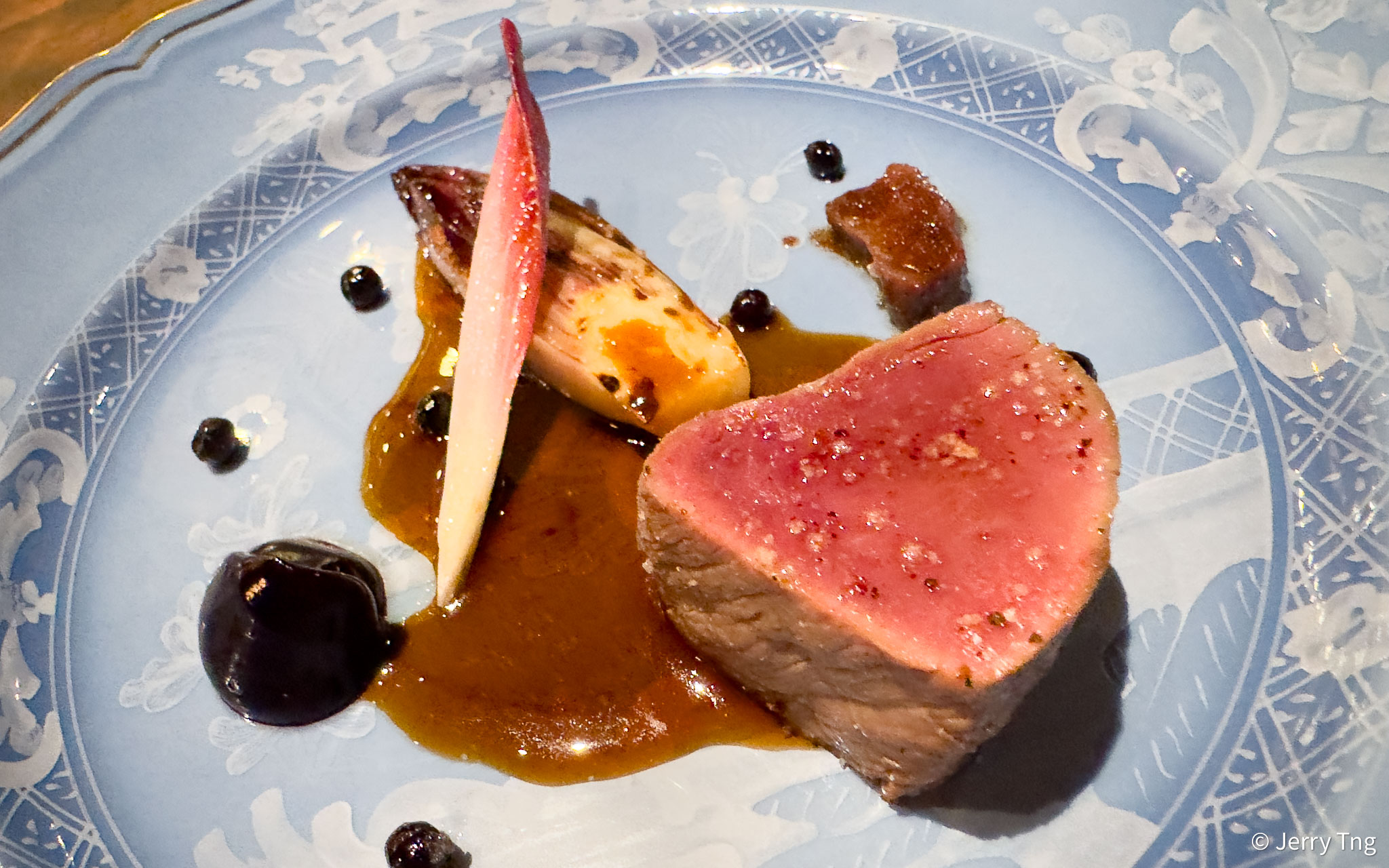
antelope, endive, huckleberry

A beautifully prepared piece of loin from the antelope was presented with grilled endives, specks and a chutney of huckleberry, and a finishing sauce made from some citrus and the grilled bones of the same antelope. A small little piece of the antelope heart was provided for a different texture and taste. Antelopes are very lean so it shouldn’t be cooked up too much. The flavour is much more mild than deer or venison, not as gamey or iron heavy.

The aging process intensifies the meat’s natural flavour and creates a higher level of tenderness. The antelope loin was grilled bone-in over the embers, leaving it around 30% doneness. The meat had not reached its optimum temperature and would freaked out many with its bloodiness, but it was perfect for me. The entire presentation was spartan to say focus on the meat which was incredibly tender and delicious.

Broumeij 3 Fonteinen, ‘Hommage’, Beersel, Belgium (01.2020)
A rare double pairing of a single course, to give the antelope course different dimensions with two very contrasting beverage, wine and lambic (strong Belgian beer).
Pierre Gonon, Les Iles Feray, Rhone-Valley, France 2012
A Vin de Pays from Northern Rhône Valley. Pure black olive juice on the nose at first, but then it picked up a bloody, iron note like raw game meat. Juicy and focused on entry, then broader in the mid-palate, offering pliant black and blue fruit flavours lifted by tangy acidity. Finishes sweet and long, with excellent clarity and soft, even tannins.
Brouweij 3 Fonteinen, ‘Hommage’, Beersel, Belgium (01.2020)
3 Fonteinen Hommage is obtained by macerating hand-picked organic raspberries and cherries on young traditional lambic and further fermented in the bottle. Natural fruit, without adding juices, syrups or sugars. The lambic for this specific Hommage used comes from 6 different barrels and 5 different brews.
I really enjoyed the lambic with the antelope, lifting the lean meat with a bit of fizz and panache. On the other hand, the Vin de Pays was a safe bet to pair with red meat, but a more heavy handed Shiraz or Merlot would be better.
waygu

This was a supplement course and the wagyu was a Miyazaki A5, the cut unknown (shoulder cap meat?). There are two keys to presenting wagyu. First, it must be cooked correctly, just enough to render the fat sufficiently but not a second longer. Secondly, you need to balance that intense marbling of the meat.

Saison got the first part correct but not the second. The accompany sauce made from bone marrow and dried mushroom was heavy and greasy. The naked asparagus could not compensate the overall heaviness of the dish. Luckily it was a very small piece, so we still enjoyed it nevertheless, washed down with the best pairing of the evening.
Corison, Cabernet Sauvignon, St. Helena, Napa Valley, California 2018

Perennially a yardstick of balance and grace, Cathy Corison’s St. Helena Cabernet admirably sums up the best that the 2018 vintage has to offer: power, clarity and poise.
Violet and dried rose perfume jumps out of the glass along with tart cherry, blueberry, plum and cassis fruit. Flavours follow with cocoa and refreshing minerality joining the party with a tantalizing white pepper note for interest. Signature velvety tannins add texture and a gentle grip to complete the picture. Delicious.
blood orange, salted cream

Next up, the first dessert that doubled as palate cleanser – blood orange sorbet on a bed of salted cream encased in a calamansi meringue.

You cracked open the meringue like a creme brûlée to reveal the sorbet and cream under the sphere. The citrusy sorbet was much needed after the heavy wagyu corse. I personally do not have a sweet tooth and left much of the meringue alone.
sunchoke, brown butter

Sunchoke ice cream, candied hazelnuts, brown butter cream, chocolate tuile. The brown butter cream was very rich and nutty, which went well with the more subtle and starchy sunchoke flavour.
Broadbent, Malvasia, Single Cask, Madeira, Portugal 1997

The first time I heard about Madeira was while I was imbibing another of the island’s famous concoction, the Poncha.
I was never a drinker of fortified wine, like this Malvasia. Aged using the traditional “Canteiro” method in American oak. The colour is a medium brown tea with just a bit of yellow appearing on the edges. A very expressive semi-sweet nose with beef, old wood varnish and toffee. A bit dry from the get go in the mouth.
lemon poppy seed cake, eiderflower

We celebrated my birthday early this evening, and we were presented with this lemon poppyseed cake with elderflower and white chocolate, compliments from the Saison team.
stroopwafel, chanterelle

And finally the Dutch specialty – stroopwafel of chanterelle and caramel paired with toasted buckwheat tea. The proper way to eat the stroopwafel was to place it on the warm tea to slightly soften the filling between the wafers. Not too long, or the wafers turned soggy. Couldn’t taste the chanterelle mushroom as the caramel covered all the flavours.

They were dropped to 2 Michelin Stars a couple of years ago but with the level of service and the quality of the meal, I can see that third star back in their pocket soon.
Saison
178 Townsend Street, San Francisco, CA 94107
Tel : +1 (415) 828 7990
Visited Apr 2024
Michelin California Guide (guide took a hiatus in 2020; before 2019, it was called the San Francisco Bay Guide)
- 1 Star 2011 (debut)
- 2 Stars 2012-2014, 2019-2023
- 3 Stars 2015-2018
World’s 50 Best Restaurants, #98 (2023)
#saison #saisonrestaurant #michelindining #infatuationsf #sanfrancisco
#sanfranciscofood #michelinguide #chefsfeed #instafood #tastingtable #chefsofinstagram #bayareaeats #tastest #prettyfood #sffoodguide #eatersf #Worlds50Best #lesgrandestablesdumonde #livefirecooking
0 comments on “Saison @ San Francisco”