
Coming to Penang, there’s a local cuisine that is a must-try. Peranakan cuisine found its roots/origins in the three Crown colonies, an amalgamation of cultures.

Back in her twenties, Auntie Gaik Lean first learned her trade cooking at Motorola’s kitchen. Eventually she established her own business, supplying meals to the canteens of various multinational companies including Intel, Seagate and Dell. From those early days until the present, she remains dedicated to using locally sourced ingredients and crafting her rempah from scratch for every recipe. This commitment to using the finest ingredients to create authentic flavours is reflected in her culinary ethos.

Upon returning from Singapore in 2013, Auntie Gaik Lean’s son Adrian established the restaurant. Through the years, the restaurant garnered a string of loyal supporters. The restaurant occupies 2 shop lots in Lebuh Bishop Penang, offering an unpretentious dining environment just like a colonial style restaurant with glass shopfront and classy decor. Memorabilia in show windows and a 60s soundtrack exude the charm of a bygone era.

In December 2022, the restaurant received a remarkable accolade, being one of four restaurants to be awarded a star in the inaugural Michelin Guide Malaysia. While it is not the first Peranakan restaurant to receive the star (Candlenut in Singapore was the first), but it is still the only that stuck to style of the cuisine. (Candlenut has moved away and offers “modern” Peranakan.)

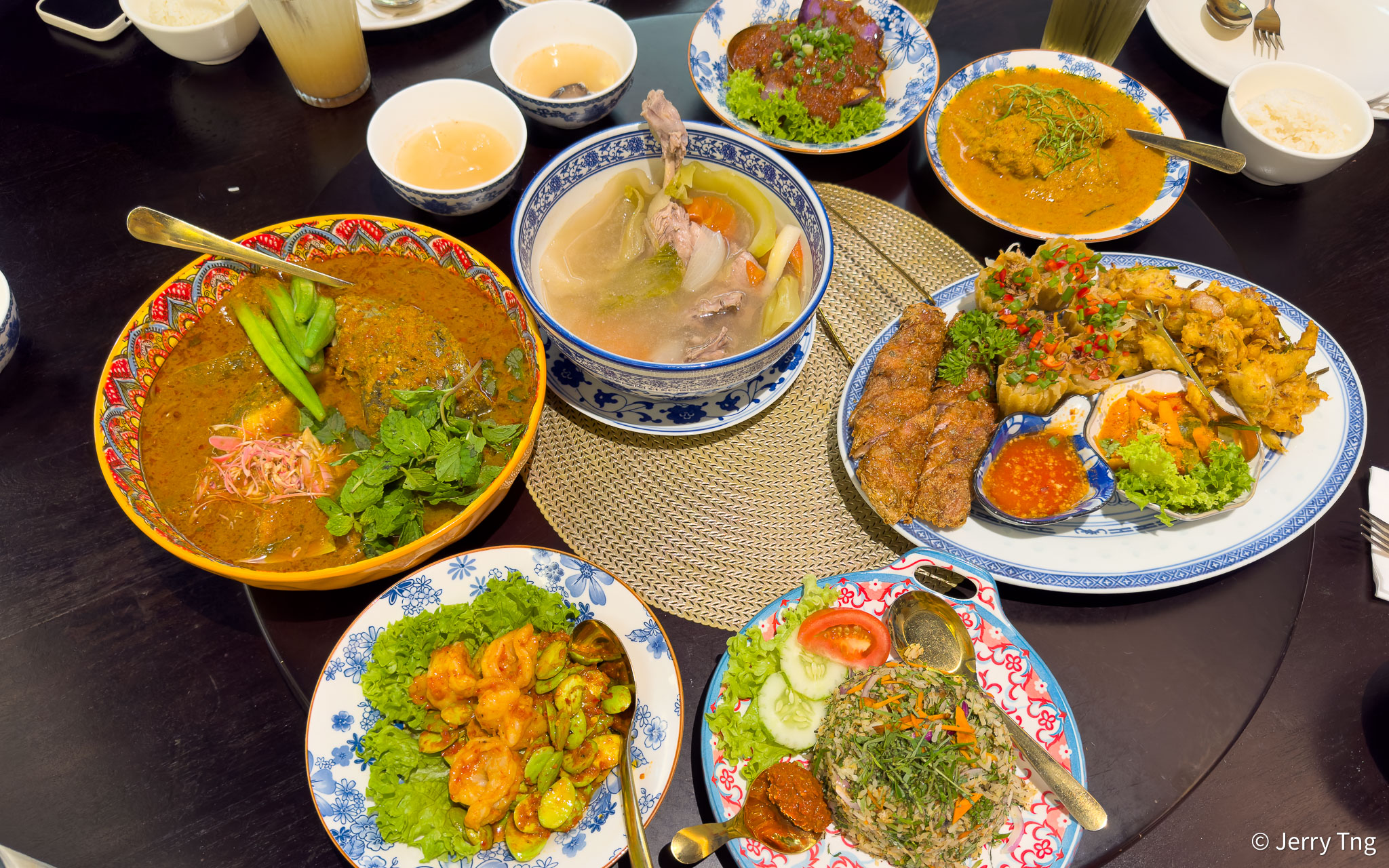
The menu in Auntie Gaik Lean’s offers a great number of Nyonya dishes, such as the classic Jiu Hu Char, Kiam Chai Ark, Asam Hae and many more. We ordered all their signatures for lunch.
Our Lovely Lunch Selection
Baba Delight (Kuih Pie Tee, Lor Bak, Cucur Udang & Acar Awak) 峇峇小食(小金杯,卤肉卷,蔬菜虾煎,开胃沙律)

峇峇小食(小金杯,卤肉卷,蔬菜虾煎,开胃沙律)
We started with an assortment of Peranakan appetisers. Kuih Pie Tee 小金杯, little pastry cups filled with shredded jicama sautéed with dried shrimps and oyster sauce, was a new addition after the renovation, perhaps after frequent requests by patrons. Lor Bak 卤肉卷 is a Hokkien specialty, similar to ngoh hiang, Cucur Udang 蔬菜虾煎 is inspired by the Malay snack and resembled Japanese kaki age, Acar Awak 开胃沙律 is a fusion of Chinese pickles and Malay spices. These appetisers represent the Peranakan cuisine, a potpourri of different cuisines integrated in a harmonious way.
Curry Kapitan 甲必丹咖喱鸡

A Straits Settlement style curry chick that has its roots from Portuguese, Chinese and Indian cuisines, with local Malay ingredients. Rempah is a complex paste of spices used as the foundation of many Malay, Indonesian and Peranakan dishes, and curry kapitan is one of my favourite style of curry rempah. The chicken has been cooked to perfect tenderness and the mild curry blended well with the poultry. Only complain, they should use a better and larger chicken.
Nasi Ulam 野菜饭

Nasi ulam, the resplendent, colourful Nyonya rice salad, is must-have when one is in Penang. The rice is a luxurious mix of finely-shredded herbs, edible leaves, and flowers with flavoured rice. Because of all the work required to shred the ingredient to such fine consistency (nothing can be done with machinery like food processor), this rice dish is seldom offered these days. Toasted shredded coconut lends a rich, nutty flavour, whilst the dried shrimps and salted fish provide the savoury umami hit.
Sambal Brinjal 参峇茄子

Soft tender deep-fried eggplant (aka brinjal) slices were topped with a sweet and spicy sambal. This delectable signature dish, one of her mother’s recipes, woke up my taste buds in the best way possible.
Sambal Petai 参峇臭豆

Next dish, sautéed stink beans (aka petai) with sambal belachan (fermented prawn paste chilli). The super fresh prawns took second place in this dish that featured an ingredient that would not be found in Western tables. The chilli used was different from the brinjal, and that’s the beauty about Peranakan cuisine – all the rempah and chilli are all different and meticulously put together.
Kiam Chai Ark 咸菜鸭汤

Kiam Chai Ark 咸菜鸭汤, aka Sup Itik Tim, is Nonya soup that has its roots in Teochew/Hokkien cuisine. The Teochews, Hokkiens and Nonya all have their own versions of salted vegetable duck soup, but the main ingredients are salted mustard green (kiam chai), tomato and duck. The most time consuming part is to remove all the fats from the duck that emerge from all that simmering. The soup is super yummy, with the flavours of the salt from the kiam chye and the natural flavour of the duck blending into the soup to give you that punch of flavour.

We finished the meal with a couple of delightful desserts. This was a good meal, very satisfying in a lovely environment. The service was attentive and portion was sufficient to be shared. Locals claimed that there are equivalent Peranakan restaurants around, but for a foreigner on a short trip here, Auntie Gaik Lean’s will not be wrong.
Auntie Gaik Lean’s Old School Eatery
1 Bishop St, Georgetown, 10200 George Town, Penang, Malaysia
Tel : +60 (017) 434 4398
Visited May 2024
Michelin Penang Guide 1 Star 2023, 2024
0 comments on “Auntie Gaik Lean’s Old School Eatery @ Penang”