
It was not Midsummer Day of the Ox (土用の丑の日) which in Japan is the day when everyone goes out to eat unagi. I was craving for some high quality eel which can only be gotten in Japan.

A dish called kabayaki 蒲焼 was created in 1399. At that time, eels that were skewered and grilled whole were called kabayaki. Since then, it has been popular in Japan for over 600 years, and its deliciousness and health efficacy have been recognised.

Shinjuku Unatetsu began about 60 years ago when the grandfather of Kenta Hanazawa, the third-generation owner, founded the first restaurant here in Kabukicho. The inside of the store has a rustic atmosphere with a counter on the first floor and a tatami room on the second floor. The smoke and smell of binchotan filled the air as you pass through the curtains, intermingled with the fragrant smell of grilled sauce, the energetic voices of the craftsmen…

Eel was an expensive product at the time (and even now for the wild caught ones). Because they wanted to offer something that can go with drinks (like yakitori in an izakaya) and to keep the price down, they began offering grilled eel (and all its parts) on skewers. Everything from head to tail of the eel is separated carefully and grilled expertly.


The great fanfare around this dish is that it embodies two main culinary concepts. Firstly, that no part of an animal should be wasted so long as it’s edible. when it comes to eel, the spine of freshwater eel is deep fried and eaten as a snack, the livers grilled with sweet sauce on a stick and finally the stomach being made into soup. The second concept at play here of course, is the celebration of high quality ingredients.

The otoshi お通し was served after we have placed our orders and our cold beer served. Two small bites were provided, a boiled vegetable with dashi, and shredded radish with grain mustard which you can pour the soy sauce on it for more savouriness.
The Dinner Menu
Hone Kara-age 骨のから揚げ Fried Eel Bone

While waiting for the grilled eel skewers to arrive, they offered a bamboo basket of fried eel bones as a snack. For first timer, the bones can be an eyesore and quite unbearable to chew. But once you had it, you would always order this with your beer.
Kimoyaki 肝焼き Eel liver and guts (sweet soysauce)

There are actually 9 kinds of parts of the eel and each has a different taste. First of the nine skewers, eel liver and guts in sweet soy sauce. The sauce used was similar to those used for the kabayaki.
Kabuto かぶと Eel head (sweet soysauce)

I have never had grilled eel heads before this, and it was really nice. The charred exterior with a soft inside, it was not as disgusting as it looked.
Liver レバー Eel liver (salt)

This was usually served in a soup at the end of the meal, but eel liver was equally good when grilled. A little fishy, and not so fatty as compared to chicken liver but still excellent with salt.
Kurikara くりから Eel’s backside (soy sauce and wasabi)

Ok, this is not the anus, but the flesh from the back of the eel along the bone. This side was not as fatty as the belly side of the eel and needed some sweet soy sauce to enhance the dryness and flavours.
Kushi-yaki 串焼き Eel’s belly side (salt and lemon juice)

Next up, the other side (belly side) of the eel, which was fatty and juicy and just needed a sprinkle of salt. Like eating wagyu, it simply melted in the mouth.
Shiro-bara 白ばら White meat (salt and lemon juice)

The white meat had a firm texture with a somewhat sweet taste naturally occurring in the meat. Simply salted and grilled to taste the naturally flavour of the eel.
Bara ばら Eel ribs (sweet soysauce)

Besides the salt grilled white meat, the same cut was grilled with sweet soy sauce and served with a raw egg yolk..
Hire ひれ Dorsal fins and tail fins (sweet soysauce)

This was another rare part that I have not tasted before, grilled fins of the eel. The dorsal and anal fins are fused with the caudal or tail fin, forming a single ribbon running along much of the length of the eel. This was like eating burnt skin of a fish. Yummy.
Tan-jaku 短尺 Small size kabayaki (sweet soysauce)

This was like a sampler cut of the kabayaki that you get with the main course and as a last skewer was a good introduction to the next course.
Ginnan 銀杏 Gingko | Shishito 獅子唐 Sweet pepper | Wakegi 分葱 Scallions

And finally some add-on vegetables which were not exactly delicious. The shishito was soggy, the scallions undercooked, only the gingko nuts passed the flavour test.
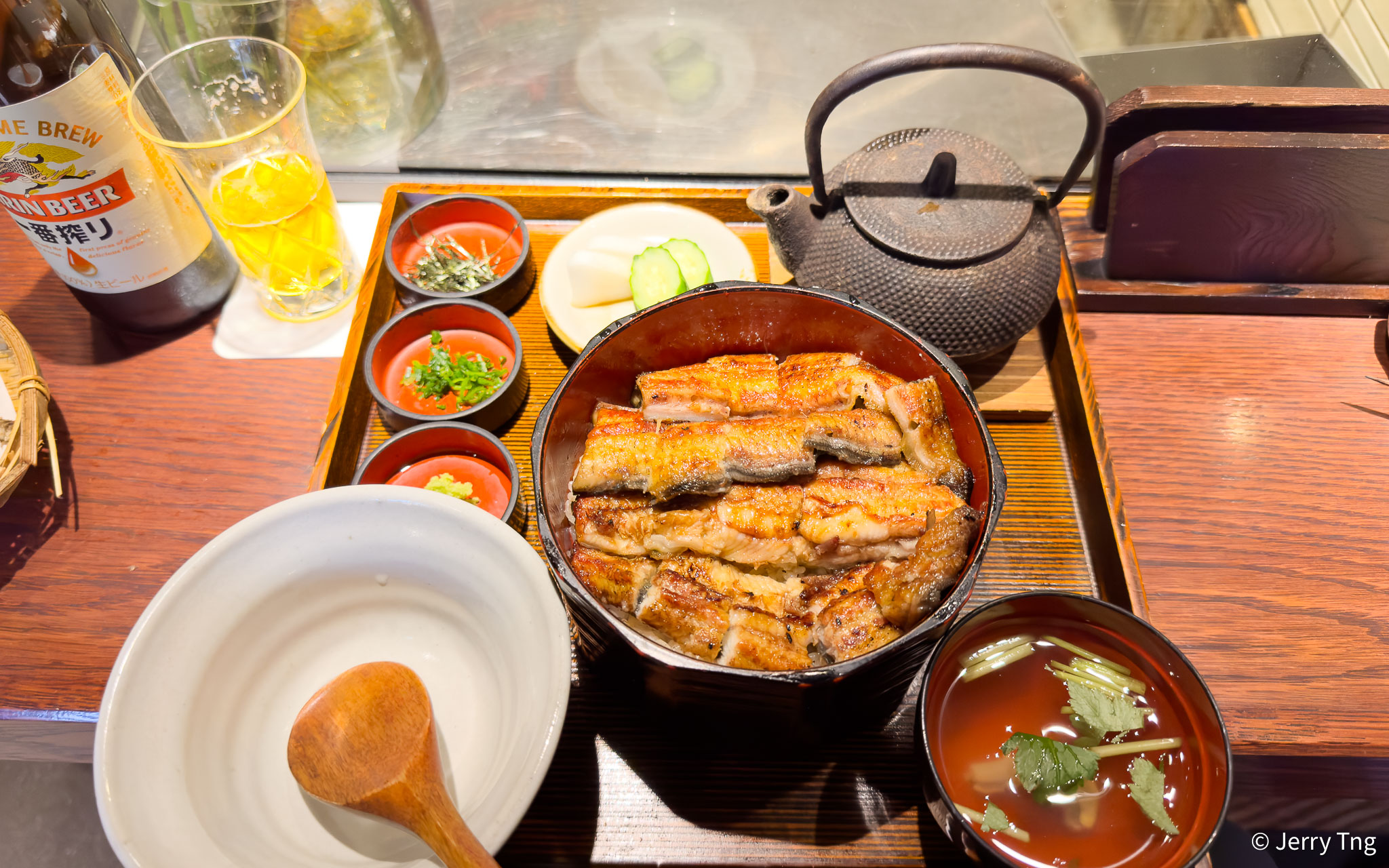
Hitsumabushi ひつまぶし特上 (Chopped grilled eel on rice (Extra Special)

After all the skewers were served, the main attraction of Unatetsu was presented on a large tray. Hitsumabushi ひつまぶし特上 Chopped grilled eel was cooked over a binchotan grill, giving it a smoky and irresistible aroma.

Kabayaki 蒲焼 Grilled eel with sweet soy sauce was served over rice. The sauce was not overpowering, so you may ask for more sauce on the side if you like the unagi drenching in sauce. But the Japanese love their kabayaki lightly dressed so that they can eat it the traditional way.


Firstly, they would eat it as-is, by taking a quarter of the rice with the grilled eel. This is to enjoy the original flavours of the grilled eel. Then, they will add condiments to the second quarter. And then, they will eat the third quarter with a dashi broth and wasabi.

The texture was fluffy, the skin was charred and fragrant, and the slightly sweet sauce was irresistible. Shichimi togarashi (Japanese seven spice blend), which is a common cross-section of traditional Japanese flavours, and sansho pepper, which has a tangy, citrus-like flavour, can be added as needed.

And finally, you still one quarter of the hitsumabushi to enjoy in any way you like. I usually would take the rice and eat it like a ochazuke and enjoy the grilled eel as a side dish.
Kimosui 肝吸い Clear soup with eel liver

And to wash it all down, kimosui (clear eel liver soup) was served as a final delicacy of the all eel meal. To the untrained diner, this might seem like a random piece of pork or chicken that’d you find in a bowl of soup, but instead, this unassuming piece of flesh is actually the liver attached to the stomach of the eel.


If you only wanted kabayaki, I think there are more delicious eel restaurants, but the biggest reason why I recommend this restaurant is that you can taste various eels like in yakitori style.
Shinjuku Unatetsu 新宿うな鐵
22-2 Kabukicho, Shinjuku-ku, Tokyo 東京都新宿区歌舞伎町1-22-2
Tel : +81 (03) 6233 7878
Visited Apr 2024
0 comments on “Unatetsu うな铁 @ Shinjuku”