
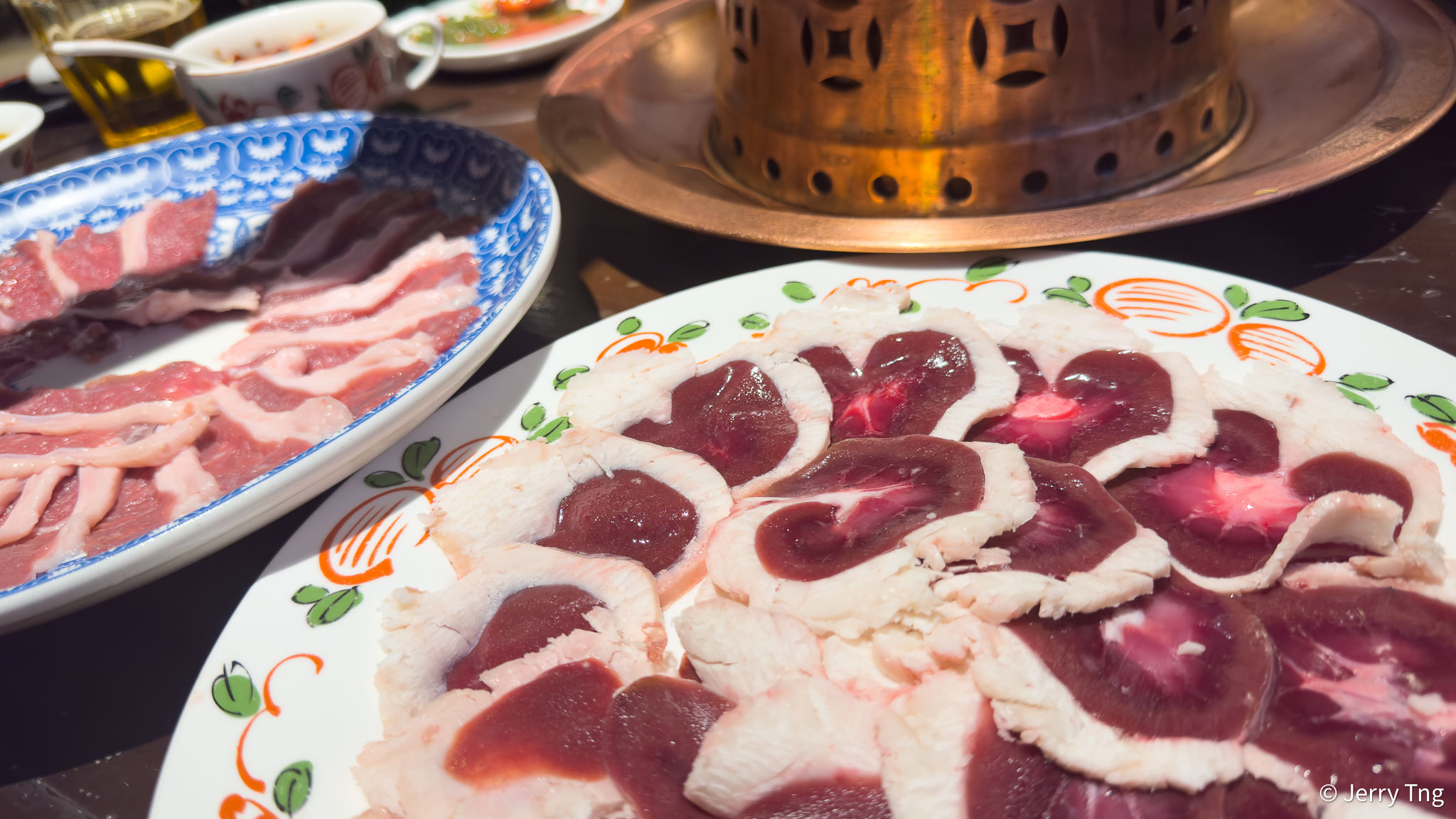
Beijing-style hotpot is an acquired taste. Imagine a boiling pot of water and nothing else to cook your meat – the flavours are all the dipping sauce.

Every old Beijinger will have their favourite mutton hotpot 涮羊肉 place. The tourist favourite is 东来顺. But old Beijinger will not be seen there. Besides 东来顺, 聚宝源 and 福寿斋, the three oldest restaurants of this genre, Old Door Post 老门框爆肚涮肉 is considered a hidden gem and only frequented by those in the know.

Old Door Post 老门框 was founded in 1910, named after 门框胡同 Menkuang Hutong. Hutongs are little streets in Beijing that are lined with rustic old houses called SiHeYuan 四合院 that contains rooms on all four sides and a courtyard in the middle. Hutong originated from Yuan Dynasty (which made Beijing the capital) – remember Kublai Khan?

The Mongolians brought in mutton as one main source of meat, and the Beijing hotpot was allegedly brought in by them and made popular in the Qing Dynasty a thousand year later.

According to tradition, the Beijing hotpot 涮锅 must have the following characteristics:
- It must be a copper pot. And this is the most important rule of all.
- The meat must be fresh meat hand-cut, never frozen.
- No stock, just plain water with a couple of cut pieces of leeks.
- Dipping sauce with only three ingredients : sesame sauce 芝麻酱, chives 韭菜 and preserved tofu 豆腐乳.

Compared with the hot and spicy Sichuan-style hotpot, the stock used for the Beijing hotpot is only water, maybe with a stalk of leek and a slice of old ginger. The meat becomes the star and so the meat quality has to be exceptional. If it is not fresh or tender, it can be directly declared as a failure.
Any responsible restaurant owner will make sure you have proper pot that would have enough fire that would last throughout your two-hour meal. The water will continue boiling without fail. The timing of the flame is as important as the copper pot.

The dipping sauce is a standard sesame sauce 芝麻酱. Not really tahini, it has a thicker texture. To that you add sesame oil, preserved tofu 豆腐乳, vinegar, sugar and chives 韭菜酱. And for the more adventurous, you add stinky preserved tofu. I would not recommend to add chilli or other crazy, strong tasting stuff as they will kill the delicate taste of the mutton.

In the past, there was no refrigerator in old Beijing, and there was no meat processing machinery. So there was no frozen meat and everything was hand cut. Frozen meat will result in bloody plates, as explained by the butcher at Old Door Post. And none of the meat here leaves any residual blood on the plate as the meat was cut at room temperature.

A lamb of 60 pounds will only produce around 30 pounds of edible parts – around 8 of 12 parts of a sheep can be eaten as ingredients of hotpot. The texture of these parts can either be fat, lean, and/or crisp. The amount of fat in mutton is too much for the average person to eat. So when a butcher cuts the meat, he has to delicately balance the amount of fat with lean meat. They have to be of a proper thickness to stand the boiling water. Too thin, the meat will turn to leather in the hot soup.

No matter what part of the lamb it comes from – tendon, head, grind, rib, loin, shank or innards – everything is hand-cut. The right hand holds the knife while the left hand holds a piece of cloth and press down on the flesh. Each piece has a bit of fat and a bit of lean meat, and its thickness is always the same. This requires years of practice. The knife work is swift and the meat does not bleed as much, the nicely lined meat sticks to the plate. And when you finish with the plate of meat, there is no residue blood.

The perfect blanching time for these lamb is around 7 sec using a swift flicking action. If you throw the meat into the boiling water, it will be overcooked when you fish it out of the pot. There is no sieve or ladle given for this hotpot as one is not expected to drink the soup. You dip the ingredients to the respective doneness and you take them out.

These days, many offered both hand-cut and machine cut choices of meat, as many do not eat lamb and you can only get machine cut beef. You don’t get pork as Old Door Post is a Halal restaurant. I don’t like these machine cut meat. They are sliced too thinly and because you need to freeze the meat in order to slice them with the machine, all moisture of the meat are lost in the defrosting process.

Besides lamb, you can also order vegetables, tofu and noodles to be added to the hotpot. These days, candied garlic 糖蒜 is optional and comes at an additional charge.

Baodu 爆肚 (boiled tripes) is a halal tripe dish that is part of Beijing cuisine. It was first recorded in the Qing dynasty. There are many restaurants and street pedlars selling it in Beijing, such as Feng Baodu 冯爆肚, a traditional and well-known restaurant established in 1881 and where the founders of Old Door Post came from.

As a by-product of selling mutton and beef, you get a lot of offals. The dish is made of fresh beef tripe which is firstly cut into slices, blanched in boiling water rapidly. It is a stiff test of a cook’s ability, requiring rich experience and superb cooking skills to control the boiling time and the temperature. The boiled offals are eaten with the same condiments as the hotpot.

The original store at Jinbao Street has since closed. Fortunately they have a couple more branches spread around Beijing. This one is still inside the fourth ring in Chaoyang. The food still tastes the same, the meat is still as good. This is not a date night restaurant, the service in this place is pleasant at best.
Old Doorpost Hotpot 老门框爆肚涮肉 (甜水园店)
北京市朝阳区甜水园东街12号楼
Tel : +86 10 6994 8808
Visited Jun 2024
0 comments on “Old Door Post 老门框爆肚涮肉 @ Beijing”