
There are some very interesting fine dining restaurants that combine Korean flavours with French cooking techniques. alla prima is one of those that is highly recommended.

alla prima 알라프리마 is Michelin two-star modern restaurant by the Chef Kim Jin-hyuk who presents bold and creative cuisine of his own. The combination of his reverence for local and seasonal ingredients, attention to balance, and delicate yet assertive sauces work together in harmony.
Chef Kim received formal culinary training in Japan and while in Japan, he learnt about French and Italian cuisine by visiting fine restaurants. He began to tinkle with innovative cooking when he was fascinated with Ferran Adria’s molecular cuisine. But he didn’t have the chance to cook what he wanted until he opened in alla prima in 2015.


The restaurant’s L-shaped counter with ample seating, the gleaming open kitchen, the spacious dining hall, and the private dining room all come together to make diners feel comfortable. The only thing I wasn’t too sure was how close parked cars were to the glass window that showcase the kitchen at the entrance.

Once settled in, the waiter came with a really nice cold towel for instant relieve from the hot summer day. After confirming any allergy among my guests, the dinner began, as there’s no ala carte menu, only some additional add-ons to certain courses.
alla prima 2024.07.19
Almond. Delaware 생아몬드. 알라에어포도

First up, a cold almond soup beautifully added with extra virgin olive oil that it resembled a sunny-side up egg. I was advised to eat the soup with a spoon as there’s surprise in the soup.

The Delaware grape is a table grape variety sold in supermarkets throughout South Korea and Japan, which were carefully peeled and added to the cold soup to give contrast in texture and added a sweet taste to the soup.
Sea urchin. Corn. Consommé 성계. 콘소에

Next appetiser, raw Murasaki sea urchin from Jeju Island is served with corn mousse. The whole thing is topped with consommé jelly.

When you land the spoon into the three layers, you get the beautiful umami from the sea urchin, the sweetness of the corn and held together with the savoury, slight sour jelly. I loved this well-thought through appetiser.
Humpback shrimp. Prosciutto. Yam 도화새우. 페르슈. 마

This course is designed to be a sandwich without bread. Humpback shrimps are sandwiched between two slices of Chinese yam called “ma” 마 in Korean. The whole thing is breaded (just slightly) and deep fried. Topped with shredded lettuce and served with some shaved Japanese prosciutto ham.

The humpback shrimp or “dohwasaeu” 도화새우 is also known as Toyama shrimp トヤマエビ in Japan, as they are found mainly in Toyama Bay. It is one of the best eating shrimp available in the waters off the Korean peninsula.
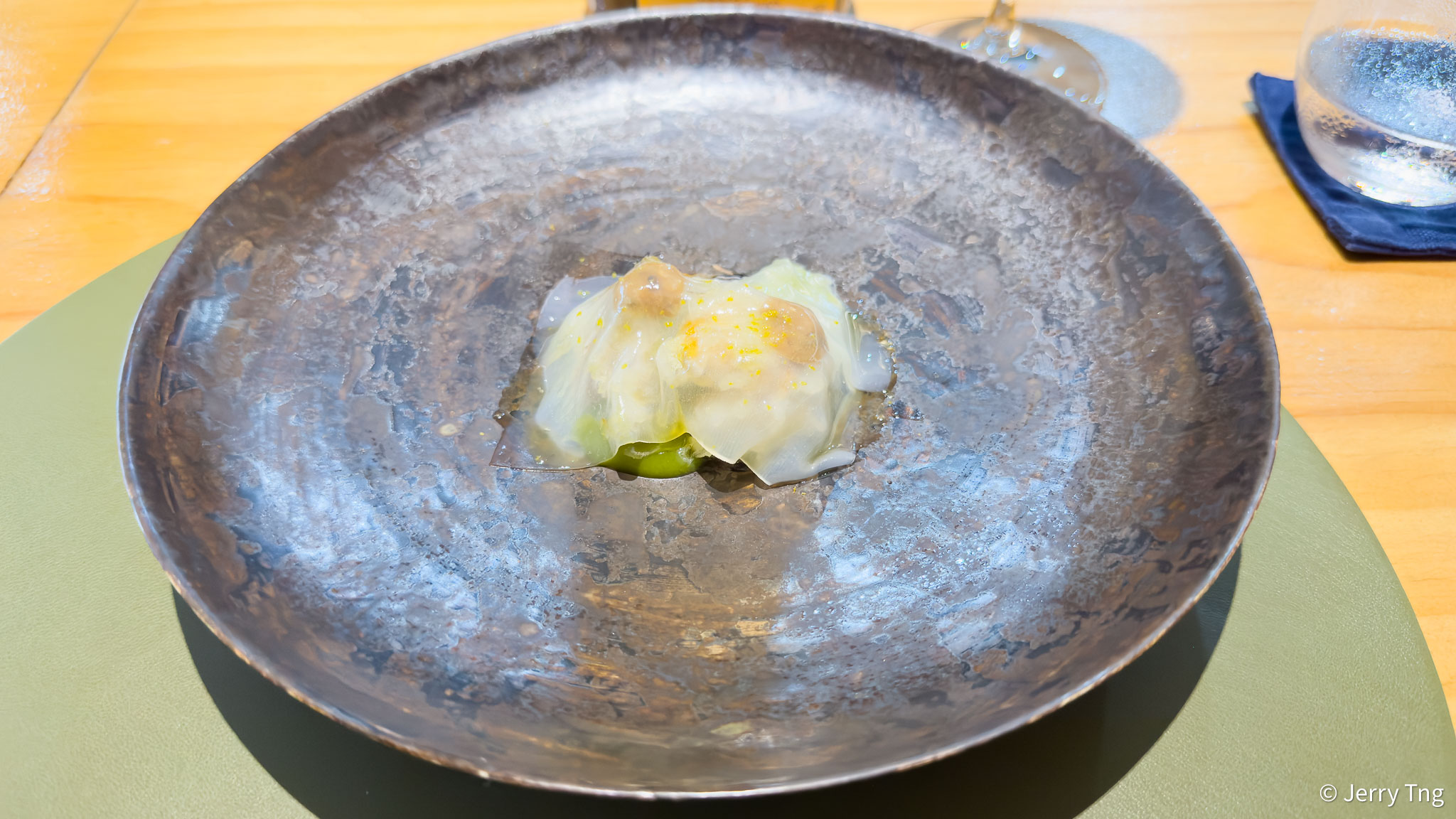
Zucchini. Big fin squid. Squash blossom. Malt 주키니. 무늬오징어. 호박꽃. 누룩 + Krug x Flower

This next course is inspired by the ravioli, except there’s no pasta in this course. And this course is paired with the king of champagnes – Krug Grande Cuvée 172ème Édition.


Every year, Krug announces an ingredient of the year to inspire the chefs of the world to create dishes to go with their spectacular champagne. And for 2024, it’s flowers. The Krug 172nd was generous, fresh and truly grand. I loved the bright white gold colour, and the deep aromatics that had everything from fine brioche to ultra-bright citrus. In the mouth it hid its profound complexity under a silky texture of fine bubbles and a balance that made it super easy to drink.

Bigfin reef squid (アオリイカ) is used to make the skin of the ravioli. And the filling is made with zucchini blossoms that are lightly floured and deep fried. And the sauce is made from zucchini and malt. So there’s the umami of squid, the delightful tastes of spring from the flowers and the malty sauce that bonded everything together.
Pike eel. Burdock. Chopi 갯장어. 우엉. 제피

Chef Kim loves fish, and from his days in Japan, mastered the different ways to cook fish. Pike conger or hamo 鱧 in Japanese is featured in the this course. The fatty fish is grilled over charcoal fire and served on a bed of chopped rockets or arugula and mochi made from radish.

And the pike conger is then topped with deep fried shredded burdock for that crunch and that ginseng like bittersweet taste.
A sauce made from fish bone stock with chopi 초피, aka sanshō 山椒 in Japanese, is then poured at the tableside into the piping hot cast iron bowl.

I could not say I love this course. It was very complex with a variety of flavours and texture. The sansho and arugula combined with burdock did overpower everything, which totally destroy the light tasting pike conger.
Glutinous rice. Barley. Egg. Caviar 잡쌀. 보리. 유정란. 캐비어 + Black truffle

Koreans have been eating multi-grain rice for generations, but this is the first time I have eaten glutinous barley rice. This course is inspired by the Italian risotto with a twist. A quenelle of glutinous barley rice that has been flavoured and mixed with seaweed dust. Another quenelle of homegrown smoked caviar on a pool of raw egg yolk. And then we wait for star of the dish to appear – Australian winter black truffle.

According to the waiter, winter truffles are better and Australia is still in winter. Is it so? Let’s do a quite trivial about the differences. Although they are referred by their seasonality, the two truffles are different. Summer truffles are the species of fungi called Tuber Aestivum and winter truffles are the species of fungi called Tuber Melansporum aka Perigord truffles (more common) and/or Tuber Brumale.
Australian truffles are all tuber melansporum the last time I checked. Tuber aestivum and tuber bramble both smells good but do not work well with cooking, so they are often found in oils or just shaved and eaten raw.

Perigord truffles are extremely prized for their depth in flavour and can withstand heat without losing much flavour, making them perfect with hot dishes like pasta. Frankly I find them to be a light taste and can be overwhelmed by stronger flavours, like in this instance. I always felt they were more about the presentation and smell.

I didn’t know that Korea has its own caviar production, but over the past two decades South Korea is emerging as a notable producer. The caviar was smoked in-house but I could not taste the result. While this was a tasty risotto, I didn’t like the texture of barley rice as it can be rather chewy. Perhaps I am getting old, I prefer softer food these days.
Blackthroat seaperch. Abalone Intestine 금태. 게우

It wasn’t a visually appealing dish – the sauce made from abalone intestine looked like vomit. What was missing from the visual department was made up tremendously in taste. The blackthroat seaperch, also known as rosy seabass or nodoguro in Japanese, is a beautiful fish with clean, yummy taste and a high fat content perfect for grilling.

The skin of the seaperch was smothered with a very light miso sauce and grilled over charcoal fire for that smokey flavour. The perfectly grilled fillet was placed on a bed of grilled Spanish paprika surrounding by the abalone intestine sauce and decorated with a couple of nasturtium. The sauce was so delicious, full of umami that comes with shellfish. It complimented the light fish very well.

When you dug into the plate, the grilled Spanish paprika appeared under the sauce that added slight heat and crunch to the dish. The gelatin under the skin of the fish was yummy. Very satisfying the sauce is.
Striploin (1++) 채끝등심 (1++)

Next course, the proud ingredient of the Korean culinary makes its debut in tonight’s dinner. The Hanwoo beef, IMHO is better than wagyu, is the featured protein. The striploin cut was first sous vide (horror!!!!) and the finished on the pan to give it the crust.

The striploin is served with anchovies oil with capers, padron peppers and a sauce made from sake wine lees and au jus, and accompanied with grilled eggplant. The beef was really tender, and the anchovies oil worked very well with the beef. I still think it was a waste to sous vide a top quality piece of beef.
Spaghetti. Sakhalin surf clam. Cucumber. Shiso 스파게티. 북방조개. 오이. 시소

The final savoury course was a Sakhalin surf clam spaghetti served with Japanese cucumber and purple perilla (shiso) dressed in clam juice, extra virgin olive oil and perilla oil.

This spaghetti was a very light tasting pasta perfect for summer. I wanted some more of it as it felt like there was nothing at all and also it taste so good. The peppery, minty perilla and crunchy cucumber with umami from the clams.

Sakhalin surf clam, aka hokkigai in Japanese, is a popular item on the sushi circuit. While many sushiya these days would serve the Canadian pacific clams as a cheaper substitute, the original surf clams are still sought after for their sweetness and good eating. Lightly poached and served with spaghetti, this is spaghetti “vongole” deluxe.
Mascarpone. Espresso. Marsala 마스카포네. 에스프레소. 마르살라

And then we proceeded to the first of two desserts, and from the ingredients we knew it was a deconstructed tiramisu. The surprise ingredient was masala or Indian curry powder.

Be careful of the super thin chocolate wafer as you cracked into the tiramisu like a creme brûlée. The sharp angles can still be nasty as you bite into them.
Strawberry. Eucalyptus 딸기. 유칼립투스

The final dessert was a tart ball of eucalyptus foam enveloping a white milk truffle with strawberry filling on a chocolate tart base. Very pleasing to the eye.

The dessert was all about summer ingredients. This is the first time I had eucalyptus in a dessert, although I had it in my tea when in Australia. I don’t think it worked as it felt like eat medicated oil.
Coffee. Tea 커피. 차

And for the send-off, two pieces of petit four and a cup of hot hojicha tea. The petite macaron was camomile flavour and the tiny financier was topped with fig. I was disappointed there were only two items.

While it was a good meal, I don’t think it’s a two star quality. A very good one star, but definitely not two. Too many things were going one at the same time in each plate, and I felt that Michelin is focusing too much on technique and composition while missing the most important thing about food – the taste. There was not rhythm or pace on the taste journey in this meal. By the fifth course, you are already fatigue from all the complexities. Good to try, not to repeat.
alla prima 알라프리마
1F, 13, Hakdong-ro 17-gil, Gangnam-gu, Seoul
(1F, 42-6, Nonhyeon-dong, Gangnam-gu, Seoul)
Tel : +82 (02) 511 2555
Visited Jul 2024
Michelin Seoul Guide 1 Star 2017-18, 2 Stars 2019-2024
Asia’s 50 Best Restaurants 2024 #51
0 comments on “alla prima @ Seoul”