
This is one of the most beautiful Japanese ryotei that I have been to so far, and I have been to many. And every hour, they will create a man-made mist that makes one feel like walking in the clouds.
Chinzanso Garden 椿山荘庭園

Built by Prince Yamagata Aritomo 山縣有朋 (1838-1922) in 1878 on Camellia Hill, a historical scenic location, Chinzanso Garden 椿山荘庭園 stands out as one of the most beautiful Japanese gardens in Tokyo. It enables guests to savor the beauty of the seasons in the heart of the city and at the same time provides a glimpse into Japan’s rich history and culture.
The garden is part of Hotel Chinzanso Tokyo ホテル椿山荘東京, an institution on its own with its rich history and the most beautiful wedding halls in the country.

Periodically, a man-made shower of mist will descend onto the pond from all angles of the garden. This is a view that one should not miss. There are umbrellas and raincoats available to all who are observing this spectacle at close range. As you can see, even on a hot summer evening like this one, the mist would linger over the water to form a sea of cloud called Unkai 雲海.


Besides the sea of clouds and water features, the garden has many surprises for you to explore as you walk around. Many of the sculptures and statues are transplanted from other places to this garden, like the Hisagoishi Rock is a gourd-shaped stone object brought from Osaka and it is believed to be a “Taikoseki” 太湖石, a stone associated with feudal lord Toyotomi Hideyoshi 豊臣 秀吉 (1537 – 1598). Also, Look out for centuries old statues of the seven auspicious deities 七福神1 hiding among the trees and bushes.


Itō Jakuchū 伊藤若冲 (1716-1800) was a painter known for his almost surrealist, detailed depictions of exotic birds and fowl. In the mid-1770s, Jakuchū retreated to the Sekihōji temple 石峰寺 in the mountains of Tamba Province (modern-day Kyōto Prefecture). He embarked on a project to create a series of outdoor sculptures depicting the eight phases of Shakyamuni’s life (釋迦八相 Shaka hassō), which included 500 stone images of Rakans 羅漢. 20 of these 500 arhats were moved here in 1925.

If the sea of cloud over Yusuichi Point is impressive, then you should not miss the reflections of 三重塔「圓通閣」Entsukaku Three-story Pagoda and the surrounding hills on the water at night. For me, this was the highlight of the garden.
Ryotei Kinsui 料亭 錦水

From warm hospitality to delicious cuisine, the restaurant in this traditional Sukiya-style building 数寄屋2 overlooking Unkinchi pond 雲錦池 offers a deeply satisfying dining experience.


Executive Chef Hitoshi Biwasaka 枇杷阪 仁 started his career as an apprentice in Kinsui almost 30 years ago, and worked his way up the ranks. He was sent to Kinsui’s outpost in Taipei in 2016, and came back to helm the mothership in 2020. He was in charged of our dinner, and what a journey it was.


Besides a Masterchef, the interior decoration of the ryotei should exude luxury and elegance without being crass. Everything here is an antique piece, like the wedding kimono was handmade and worth a lot of money.

I was thankful to my hosts that we were seated in a non-traditional private room, even though it wouldn’t be a complete experience. I rather be enjoying the dinner than to constantly worry about leg cramps.
Mizuhikisou Kaiseki 水引草会席
A haiku is in order to describe this kaiseki we are having.

水引草
一糸の軽ろさ
風に在り
河野南畦 『硝子の船』(山形、慈恩寺付近)
Mizuhikisou
The lightness of a single thread
Floating in the wind
Nanshu Kono “Glass Boat” (Yamagata, near Jionji Temple)
Modern kaiseki is artfully prepared and presented; dishes are not only visually appealing, but the tastes and textures are also perfectly balanced. To create such amazing food, only shun (in season) ingredients are used. This was the last week that this menu was being offered. It was introduced in July as a late summer menu, and a new menu is ready for early autumn, which will arrive on 7 Aug 2024.
Mizuhikisou Kaiseki Menu【水引草会席】 御献立


A kaiseki 会席 is not only meal. It is a sensory experience. Every step of the way, the tastes and ingredients are complemented by the choice of utensils. Like this amuse bouche that was served before the first formal course.

Even they were such small bites (sweet glutinous rice with pine nuts on the left, and a small cup of cold chicken soup), they were served in Inari pottery with a rabbit and frog drawn based on the national treasure ‘Birds and beast figures caricature’ of Kyoto Takayamaji from the 12th century. Birds and beasts are said to be auspicious due to their similar longevity and reading.

A Japanese can identify the season by the food they eat. Shun 旬 is a Japanese word referring to seasonal ingredients as well as the time of year when a certain food is at its freshest and most flavourful. Seasonality, or the use of fresh, seasonal ingredients, is very important in Japanese cuisine and culture. By following harvest times, produce is utilised when it’s at its peak.
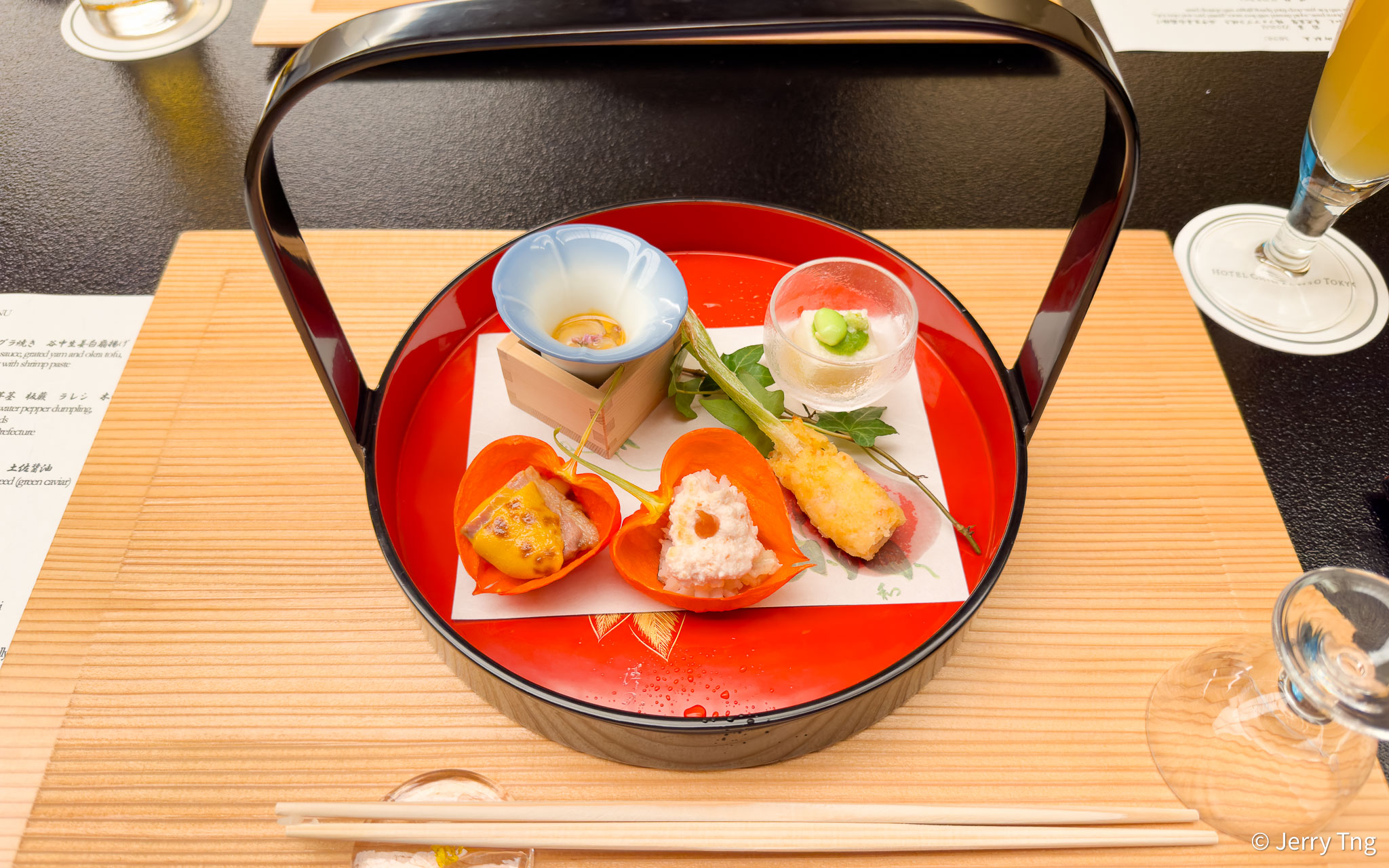
前 菜 Zensai

前菜 Zensai is the first official course of the kaiseki. It usually consists of seasonal ingredients that are each prepared carefully to exhibit the range of techniques of the chef.
鱧梅香焼き Pike conger with pickled plums paste

We had pike conger or hamo 鱧 almost every meal this trip to Japan. It must be in season. Here, the chef first grilled the conger eel, mashed the fish up and paired it with pickled plum paste. Served on a bed of chopped pickled radish inside half a lantern flower.
鴨フォアグラ焼き Grilled duck with foie gras

Served in the other half of the lantern flower was a piece of grilled duck breast with skin on and coupled with its foie gras smothered with a traditional sauce. Even for such a small bite, there was already so many elements working together.
鯣烏賊肝和え Squid dressed with liver sauce

Japanese flying squid or surumeika 鯣烏賊 is served as a sashimi soaked in its own liver sauce, similar to shiokara. I love shiokara but I am always worried about the amount of salt. It was not as heavy as shiokara, so I liked it even more. Alas, there was only one small bite.
養老豆腐 Grated yam and okra tofu

Not tofu in the traditional sense, this cube of mashed mountain yam or yamaimo 山芋 held in shaped by curdling it in soy milk, topped with mashed okra and served with a single edamame and freshly grated wasabi. All superfood that will make you live longer. No wonder it was named “Longevity Tofu”.
谷中生姜白扇揚げ Deep-fried Spring ginger with shrimp paste

There’s a saying in Japanese, “鴨が葱を背負って来る”3 meaning the duck (customer) carrying the spring onion (money) to the shop. We already had the duck, here comes the spring onion.
It looks like Vietnamese sugarcane shrimp, but it was close. It’s shrimp paste wrapped around a stalk of spring onion and deep fried. The only different between the Vietnamese version and the Japanese version was the used of the “stick” and the taste. The Japanese version was so much lighter and let the sweetness of the shrimp to come through. We were told not to eat the green part because the texture wasn’t pleasant. The waitress was absolutely right.
吸 物 Suimono

It was served purposely with water droplets on the beautiful lacquerware. Yes, the next course is the soup course or suimono 吸物 (“something you sip”)and is served in proper lacquerware, not some plastic lookalike.
鮎一夜干し 鮎蓼真丈 結び芋茎 板蕨 ラレシ 木の芽 Clear soup with sweetfish salted and dried overnight, sweetfish and water pepper dumpling, taro stem, dried bracken sheet, radish and leaf buds

And since it’s summer, one would expect ayu 鮎 or sweetfish would be served somewhere in this dinner. I didn’t expect it in the soup course. There’s the sweetfish salted in the special one-day drying method 一夜干, and sweetfish mixed with watercress 蓼 in fish cake called shinjo 真丈4. You can taste the sweetness of radish in the clear fish broth, and the tastes of each ingredient, though each tasting different, did not ended up in a multi-vehicle crash.

And we need to introduce the water used to make the soup. It’s not from your tap or bottled water. It is specialty water collected from the foothills of Mt. Atago, Kyoto Prefecture 京都・愛宕山麓. That’s right, unfiltered water from the mountains. No wonder it tasted so good.
造 り Tsukuri

Next up the sashimi course or otsukuri お造り, which is like the first little highlight of the meal.
本日の薄造り 本鮪 蒸し鮑 海葡萄 妻一式5 白凝り酢 土佐醤油 Thinly-sliced sashimi of the day, bluefin tuna, steamed abalone, Umibudo seaweed (green caviar) served with homemade white ponzu vinegar jelly and soy sauce


Thinly-sliced sashimi of the day 本日の薄造り, which was madai 真鯛 or red sea bream, was the highlight of the sashimi course, and it was paired with a homemade white ponzu vinegar jelly 白凝り酢.

Madai is a celebration fish. These days, due to the demand, wild-caught ones are very rare. You curl some spring onion with the fish and dip into the ponzu. Yummy.
煮 物 Nimono

The simmered course or nimono 煮物 is the first of a series of hot courses and is traditionally served in a lidded vessel. Hence its other name, futamono 蓋物, generally consists of a base ingredient simmered in shiru stock and seasoned with sake, soy sauce, and a small amount of sweetening.
本日の煮付け 青味 木の芽 針生姜 Simmered fish of the day, greens, leaf buds and ginger

Today’s main ingredient is the beltfish or tachiuo 太刀魚. This is one of my favourite fish, and I usually eat it pan fried or grilled. The Koreans are known to stew them, but this is the first time I have it simmered in Japan. Served with simmered burdock, shredded myoga ginger (another summer ingredient), and greens.

The belt fish by itself is quite bland, that’s why we usually pan fried it. Simmering the fillet in a rich sauce helped to give the humble fish lots of depth in flavours.
焼 物 Yakimono

Next course, the grilled course or yakimono 焼物, and usually it featured the most expensive ingredient of the evening. Cue the fanfare! Enter the kuroge wagyu beef.
黒毛和牛フィレ炭焼き 焼き無花果 山葵卸し Charcoal-grilled Kuroge Wagyu beef fillet, grilled fig, and grated daikon radish and wasabi

Under the beautiful covered dish was three pieces of charcoal-grilled wagyu fillet (cut unknown, but it tasted like the tenderloin). The beef was accompanied by some fresh grilled figs and a dollop of wasabi-radish mash.

I was quite disappointed because it was not at the temperature that I was expecting and the doneness (medium) was not what I wanted. It was quite obvious the beef was grilled and left under the salamander for some time. It was very high quality beef nevertheless, and the figs were delicious.
箸休め Hashiyasume

The next course is interestingly named hashiyasume 箸休め6 “the chopsticks stop”. It can be thought as a palate cleanser as you reset the palate or a logical break in the long meal.
冬瓜 蛸 蟹 トマト酢ジュレ Chilled winter melon, octopus, crab with tomato vinegar jelly

The palate cleanser was quite strong in flavours, with a piece of simmered winter melon simmered in dashi, soft boiled sliced octopus tentacles and a single craw of matsubakani served on a bed of tomato vinegar jelly. Everything was nice except the crab that was cooked to death.
強 肴 Shiizakana

The main course is called the “strong” course or shiizakana 強肴, and is usually a showcase of the season’s main ingredient. And you guessed it, it’s the pike conger eel or hamo 鱧.
鱧すき鍋 長葱 玉葱 椎茸 水菜 Pike conger hot pot, green onion, onion, shiitake mushrooms and mizuna leaves

This time, the pike conger is prepared in the most classic way it is usually served, poached in a delectable stock and served piping hot in a claypot. Even the vegetable used is predictable – mizuna, shiitake, scallions and sliced yellow onions. The broth was delicious, very simple yet full of flavours.
食 事 Shokuji


And right after the main course, the final savoury course of the kaiseki. The filler just in case you are not full is usually a carb-heavy course served with soup aka tomewan 止椀 and Japanese pickles aka konomono 香の物. You have a choice of rice or noodles. Choices are for children, I had both.
蛸土鍋御飯(国産米)止椀付き(袱紗仕立て)
Steamed rice with octopus in clay pot, red and white miso soup


Steamed rice with octopus in clay pot, red and white miso soup
The claypot was just a container, the rice was not cooked in it. However, the rice was cooked with dashi and chopped octopus, so you can really taste the bonito infused dashi. You can refill the rice if you didn’t have enough. Served with a miso soup that used both the red and white miso.
鯛の冷や汁うどん
Cold miso soup with sea bream, vegetable and ground toasted sesame seeds, poured over Udon noodles


Cold miso soup with sea bream, vegetable and ground toasted sesame seeds, poured over Udon noodles
Inaniwa udon 稲庭うどん is served cold on the side with a bowl of cold miso soup with pieces of sea bream and sliced pickled cucumbers and shredded myoga ginger. You can dip the udon into the soup, or like me, simply dump everything in and start making the slurping sound.
香の物 三種盛り Three kinds of pickles

And with either rice or udon, you get some Japanese pickles, a custom if you have a main course.
果 物 Kudamono – 盛り合わせ Assorted fruits

The first of two desserts, a plate of Japanese fruits – musk melon, kyoto and muscat grapes. Outstanding, must go to the supermarket and buy some home.
甘 味 Kanmi – 錦水きんつば Kintsuba (Confection of sweetened beans wrapped in wheat-flour dough)

And finally, a piece of Japanese confection or wagashi 和菓. It may seem stingy that there’s only one small piece, unlike French petit fours. But the significance is less is more. Wagashi is often bought as omiyage おみやげ, or gifts for your friends after you come home from a tour, to thank them for taking care of the neighbourhood when you are not around. This small piece of Japanese sweet is like a thank you for coming.

The foam on the matcha is made with a tea ceremony bamboo whisk called chasen 茶筅. To drink it, hold the bottom of the bowl with your left hand and turn two times, each time 90˚ with your right hand, towards you. Take a small sip, enjoy it, and then drink the rest in one gulp. The portion and temperature is good for one gulp anyway. Then turn it two more time to return the bowl in the original position where you started and place down the bowl.

You have to come here at least once in your visits to Tokyo. It’s one of the best kaiseki I had with an environment to match. The food was really good, the service out of this world. Definitely a three-star experience for me, and much better than some three-stars in Japan.
Ryotei Kinsui 料亭 錦水
Hotel Chinzanso Tokyo
10-8, Sekiguchi 2-chome, Bunkyo-ku, 112-8680 Tokyo, Japan
Tel : +81 3 3943-1111
Visited Aug 2024
- 日本的七福神,分别是:大黑天、惠比寿、毘沙门天、弁财天、福禄寿、寿老人、布袋和尚。 他们的诞生和南北朝时期中国佛教的兴盛的原因有几分相似。 ↩︎
- 数寄屋是指茶室。被称为数寄屋的茶室出现是在安土桃山时代。原来,作为面向庭院的别栋而建造的小茶室(大部分是四张半榻榻米以下)被称为“数寄屋”。 ↩︎
- 日本有一句俗语:“鴨が葱を背負って来る。(鸭子扛着葱来。)”鸭子意指客人,而葱则比喻金钱。所谓“鸭子扛着葱来”,即是指客人带着钱过来,意喻好事成双,主动送上门来。 ↩︎
- 真丈,也称真薯、糝薯、真蒸,日语假名写作“しんじょ”(shinjo),或しんじょう。它是用虾、蟹、白身鱼肉等(有时也用鸡肉、猪肉)磨碎成糜,加入山药泥、蛋清、出汁等调和后,以蒸、煮或炸的料理方式做成的食物。 ↩︎
- 所謂的妻(つま/tsuma)多半是指生魚片盤中的白蘿蔔絲。不僅是搭配顏色及襯底吸收水分的角色,由於從前保鮮技術不及現代,而帶有辛辣感的白蘿蔔被視為具有殺菌作用,也能消除口中的餘味精確的品嘗每道料理的風味。
除了白蘿蔔之外,其他會使用的妻還有海藻類、紫蘇、茗荷、紅蘿蔔、黃瓜等食材,可去除刺身的腥味且讓口腔內維持清爽,如同賢內助一般輔佐映襯主料理,因此被通稱為「妻」。 ↩︎ - 「箸休め」是指在吃饭途中为了让口腔清爽,让味道发生变化而吃的简单料理。筷子休息后准备下一道菜”的意思,是指醋菜、拌菜、咸菜等味道清淡的小菜。日本料理套餐中也有在料理中清洗筷子的意义,所以也会提供汤或蒸鸡蛋羹等汤料。 ↩︎
0 comments on “Walk in the Clouds”