
What’s the difference between a reverent sushi-ya and a new place when both chef is the same person? A new approach to omakase from a chef that has been set free.


Sushi Aoi 鮨葵 in Akasaka is an authentic Edomae style sushi-ya that is owned by the chef that has spent years honing his skills in a brandname in sushi (Kyubey). And as you can expect, everything in that chain has to work according to the rules laid down by the executive chefs so that everyone delivers the same high quality sushi every time. So if you are an itamae, you probably get very bored after 15 years.


The owner/chef is an alumni of Kyubey, a famous restaurant in Ginza. The repertoire of nigiri that he built up over 15 years of training is truly an art form. And he decided to start his own place so that he would not be working with the same ingredients all the time. The cosy place is made up of a wide plain wood counter seat where you can see the chef’s work. There is also a private room behind the counter.

Here’s a major difference between Kyubey and Aoi – the drink list. Because they are not a major purveyor, Aoi cannot access to some of the popular vintages like Dassai 21. But what they lose in prestige, they make up with selection. Like 千萬あるべし”There must be a million” shochu from Hakkaisan that used the “three-stage preparation” using sake yeast and yellow koji that has a slight aroma reminiscent of ginjo sake – 25% proof, go easy.

The concept behind tonight’s omakase is “a little bit of everything” 「少しずつの沢山」, but all made from superior ingredients of the season. And to kick us off was a small cup of wam cream of sweet corn as the amuse bouche.
おまかせ上握りコース Omakase Course and Ala Carte
先付け Appetisers

刺身 Sashimi

The sashimi choices for the evening were isaki 伊佐木 (いさき/chicken grunt), buri 鰤 (ぶり/yellowtail) and hiramasa 平政 (ヒラマサ/yellowtail amberjack). The isaki was torched on the skin side to release the oil, the buri has been “zuke” (marinated in soy sauce) and the hiramasa cut was from the belly. All excellent!
前菜3点 Three Types of Appetisers


The three appetisers came at different point the course as markers to each phase of the sushi presentation. Right after the sashimi was the first of the trio, 子持ち昆布 herring roe on kelp topped with shaving of dried bonito. The second appetiser was a piece of poached hamo 鱧 (pike conger) topped with finely shredded red onion, perilla leaves and radish, served after the small bowl. The final appetiser was a salad of shredded fish skin with radish pickles
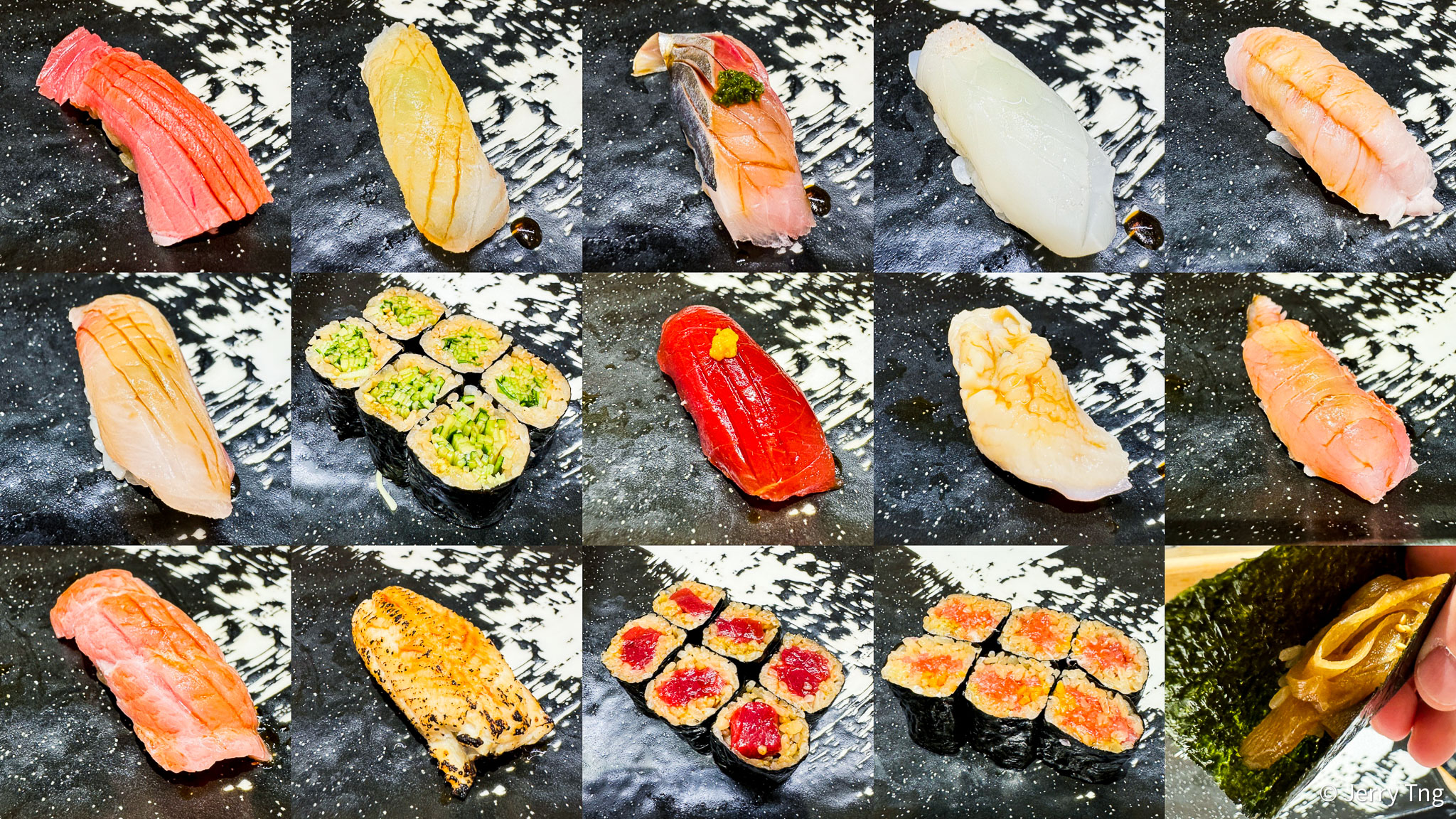
握り7貫 Seven Pieces of Nigiri Sushi


The five pieces came in really quick succession – otoro, hamachi, saba, ika, ebi – one after another, each contrasting in flavour, texture and oiliness. The the other two came after a lot of interludes which somewhat broke the rhythm.
小丼ぶり Small Rice Bowl

いくら丼 Salmon roe bowl was the 小丼ぶり small rich bowl of the day. Ikura (salmon roe) marinated in house was not as salty as the ones commercially available and was deliciously fresh on top of sushi meshi.
アジ Horse Mackerel

When it comes to tasty fish in summer in Japan, aji 鰺 (horse mackerel) is the first fish that comes to mind. The delicious fish is prepared in daimyo oroshi style, which displays the beautiful colours.
茶碗蒸し Steamed Egg Custard

巻物 Maki Roll

The temperature of shari (sushi rice after squashed to shape) is ideally body temperature so that it is in harmony with neta (sushi topping), which is typically room temperature in Japan. The shari served here is the traditional one with the kozusu 粕酢 (sake lee vinegar) instead of the very popular akazu 赤酢 (red vinegar), therefore the sushi meshi (sushi rice) remains white.
Ala carte


How can we stop with the 7 pieces in the omakase menu; we kept going until the chef ran out of neta to serve us.

And as a ritual for me, I always end my sushi omakase with tekka maki 鉄火巻 (tuna roll).
干瓢巻き Dried Gourd Roll

The shari shone through in this 干瓢巻き dried gourd roll, the sweet and slightly salty pickle on rice wrapped with nori, served as a palate cleanser before the miso soup and tamago.
赤だし Red Miso Soup

水菓子 Dessert

Yokan 羊羹 (sweet bean jelly) is a traditional Japanese sweet served with matcha. So some smart confectioner decides to combine the two and created this matcha mizu yokan, which is less dense than the traditional yokan and very suitable for summer.
Overall an excellent meal, good value. The pace could be slightly faster but only two itamaes taking care of 16 people at the counter and 8 more in the room, I can understand why they kalang kabuk (Malay verb for chaotic) a bit. Recommend to book in advance.
Sushi Aoi Akasaka 鮨葵 赤坂
Japan, 〒107-0052 Tokyo, Minato City, Akasaka, 5 Chome−4−14 Beltempo Akasaka 2F 東京都港区赤坂5-4-14ベルテンポ赤坂2F
Visited Jul 2024
0 comments on “Sushi Aoi 鮨葵 @ Akasaka”