
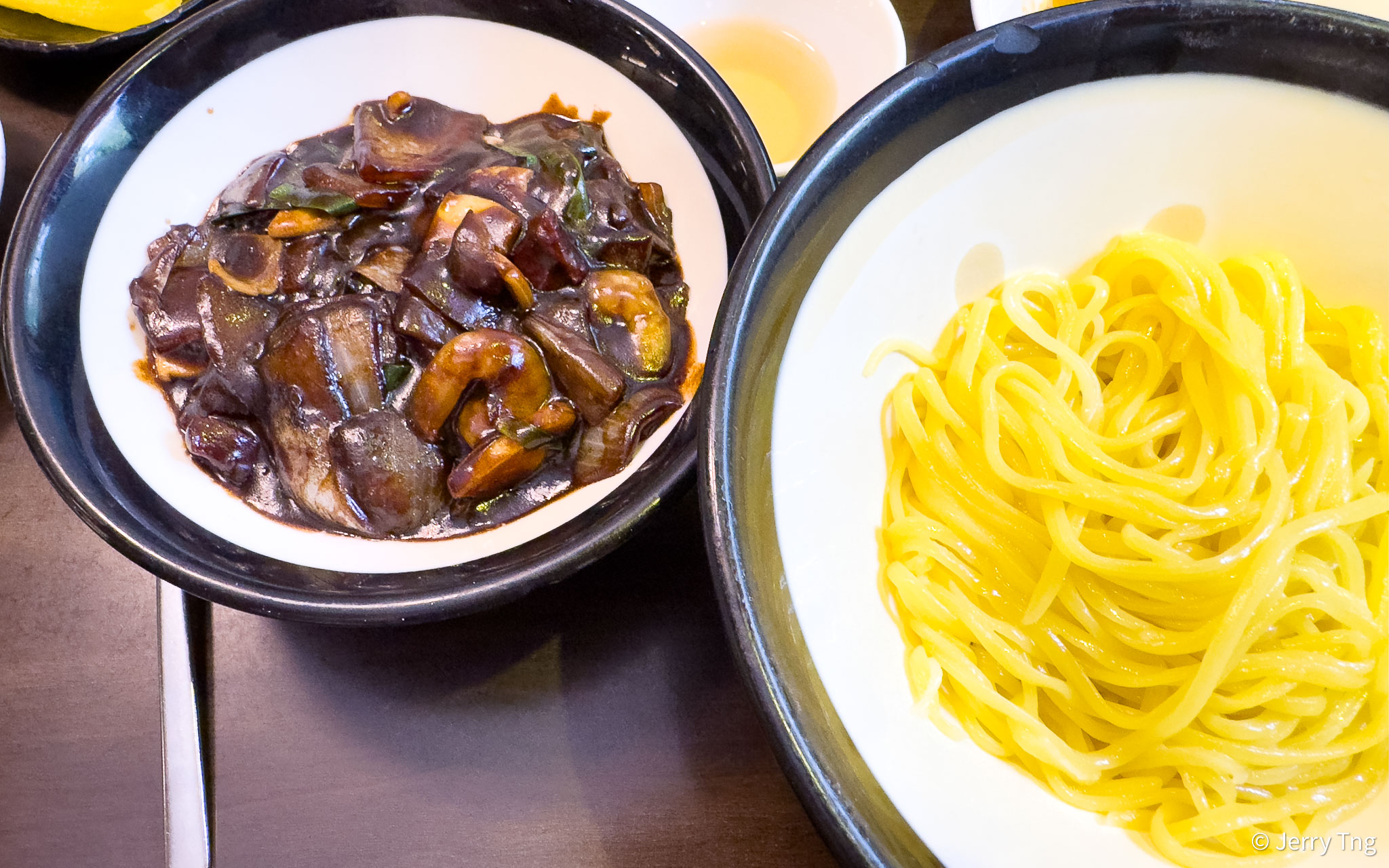
I don’t understand why my Korean business associates always bring me to this Korean-Chinese restaurant near their office. Perhaps they thought I am homesick.

Korean-Chinese cuisine was introduced to Korea during the 19th century in the port city of Incheon, where most of the ethnic Chinese population of Korea lived. The 3 dishes that characterises Korean-Chinese cuisine include
- Jjajangmyeon 자장면 – noodle dish topped with thick black bean sauce with origins from the Chinese’s Zhajiangmian 炸酱面;
- Jjamppong 짬뽕 which is a spicy noodle soup flavored with vegetables, meat or seafood; and
- Tangsuyuk 탕수육 – a Korean version of the sweet and sour meat dish 糖醋肉.
But that’s where the resemblance ends. The taste of these Korean-Chinese food is not what you expect from the original. Au contraire!
Jjajangmyeon 짜장면 Black Soy Bean Sauce Noodles
If you are expecting the Beijing version also known as zhajiangmian 炸酱面, then you are in the wrong place. Korean jjajangmyeon is closer to Singapore’s lor mee 卤面. The noodles is both chewy and bouncy, yet still soft to the bite at the same time. The jjajang is not too sweet, and the onion and pork are diced into small pieces but not minced.

Koreans even have a non-official celebration for jjajangmyeon on April 14, when single people celebrate their shared loneliness on Black Day with a bowl of jjajangmyeon.
Samsun Jjambbong 삼선짬뽕 Spicy Seafood Noodles Soup

The Jjambbong (spicy seafood noodle soup) came in a soup that was not as spicy as it looked. The dish was like a fresh bowl of Korean kimchi instant noodle, but with an alkaline yellow noodle and seafood in the soup that interestingly had a bit of wokhei.
Yangjangpi 양장피 Mung Bean Noodles Salad with Mustard Sauce

The original name is Yangbunpijapchae 양분피잡채 (洋粉皮雜菜), it evolved to become Yangjangpi 양장피 (兩張皮). The noodles here is made with mung bean starch, which is tasteless. It gets all its flavours from the yellow mustard sauce. The noodles is mixed with a generous serving of seafood like shrimps, squid, sea cucumber, and shrdded vegetables. The special ingredient here is the century egg called pidan 皮蛋.

The Chinese-style original is made with jellyfish mixed with shredded vegetables called 涼拌海蜇皮 or jellyfish salad. It’s not a sweet taste like honey mustard, but more like a wasabi sauce; so if you put too much sauce, there may be people who can’t eat it.
Gunmandu 군만두 Korean-style Fried Dumplings

Mandu 만두 (dumpling) is cognate with the names of similar types of meat-filled dumplings along the Silk Road in Central Asia, and same as Jiaozi 餃子 which is cognate to Japanese gyoza although now in China mantou refers to a bun without filling. Gunmandu 군만두 is the deep fried or pan-fried version and is filled with ground pork, cabbage, chives, and ginger. In Chinese restaurants that often serve fried dishes such as sweet and sour pork, the gunmandu is almost always deep fried.
Tangsuyuk 탕수육 Sweet & Sour Pork

Tangsuyuk 탕수육 is the Korean version of sweet & sour pork. What sets this version apart from the more well-known Chinese one is that the sauce is served separately as a dip, is thicker, more savoury and less acidic.

Unlike the Chinese koloyuk 咕咾肉 which comes as a bite sized chunk, the Korean tangsuyuk comes in thin strips of meat. The pork was crunchy, juicy, tender and the sauce was addictive.

Nallang 난랑 in Gangnam is really popular at lunchtime. The food is OK, not missing anything unless you like this style of Korean-Chinese food.
Nallang Chinese Restaurant 중국식당 난랑
South Korea, Seoul, Seocho District, Seoun-ro, 32 1층
Tel : +82 2 583 0019
Visited Aug 2024
0 comments on “Nallang 난랑 @ Seoul”