
The last time I came, Le Jules Verne was still run by Alain Ducasse. Now it has a new chef in charged, and the approach to the cuisine has taken a different turn, just like the plots in the science fiction novels by the author.


Le Jules Verne was built in 1983 to honour the famous French author Jules Verne, who wrote science fiction classics like “20,000 leagues under the sea”, “Journey to the centre of the earth”, “Around the world in 80 days”. Located on the 2nd floor of the Eiffel tower, it enjoys a mythical setting, an invitation to discovery and travel.

The restaurant’s interior was designed by Aline Asmar d’Amman, who used shades of silver-grey, blue-grey, and green-grey to echo the Eiffel Tower’s surroundings.
Almost every table offers a front-row seat to the breathtaking spectacle of the Paris skyline from its vantage point perched 125 meters above the ground. In the evening, the twinkling lights of the city below undeniably create a mesmerising canvas, enhancing the overall dining experience.

Within Le Jules Verne, more secrets are waiting to be explored in the numerous dining room options. The three main dining rooms offer the classic viewpoints of Paris, named respectively the Quai Branly, Trocadéro, and Champ de Mars. For guests interested in viewing the mechanical engineering of the Eiffel Tower, the L’Alcôve contains two intimate tables specifically designed to witness the incredible inner-workings.

Additionally, the Le Comptoir is another room that comfortably accommodates up to eight guests. Within this room, guests have a spectacular view of the rotating iron wheels which power the tower’s elevator. The dining rooms are decorated in a modest colour palette of black and gold. As a result, the aesthetic views from the Eiffel Tower is the visual focal point. Sleekness and elegance are two words that capture the essence of this restaurant.

Helmed by Chef Frédéric Anton, a culinary virtuoso with three Michelin stars to his name, the menu at Le Jules Verne reflects a commitment to excellence. Above all, each dish is a masterpiece, showcasing the finest ingredients and innovative techniques. In 2024, Le Jules Verne has the honour of being awarded a second star in the Michelin Guide.

Instead of the usual precious china table service, a book cast in plaster of Paris with a quote from one of Jules Verne’s novel was placed in front of us. Mine was a passage from “20,000 Leagues Under The Sea”.
Voyages Extraordinaires (Degustation Menu)
We went for the full 7-course degustation menu that is offered for dinner even though a wallet-friendly 4-course version of lunch was offered as well. And then there’s the a la carte, but since we were on a gastronomy tour, we decided to go all in. The courses were unique but not weird or exotic. We threw in the supplementary cheese course as well.
Champagnes Louis Roederer Blanc de Blancs 2016, Rosé Brut ‘Henriette’ Pierre Moncuit


The 2016 Brut Blanc de Blancs is laced with hints of tropical fruit, lime, mint, passionfruit and crushed rocks. Intensely aromatic and light on its feet, the 2016 impresses with its gracious, understated personality. Sourced from plots in the mid-slope Grand Cru vineyard of La Côte in Avize.
The Champagne Rosé ‘Henriette’ by Pierre Moncuit is produced from Chardonnay and Pinot Noir from Mesnil-sur-Oger and Ambonnay. After a maturation for 36 months on the lees it expresses a charming bouquet of small red fruits and bread crusts. The taste is crisp, fresh and elegant.
Amuse Bouche – La Tomate

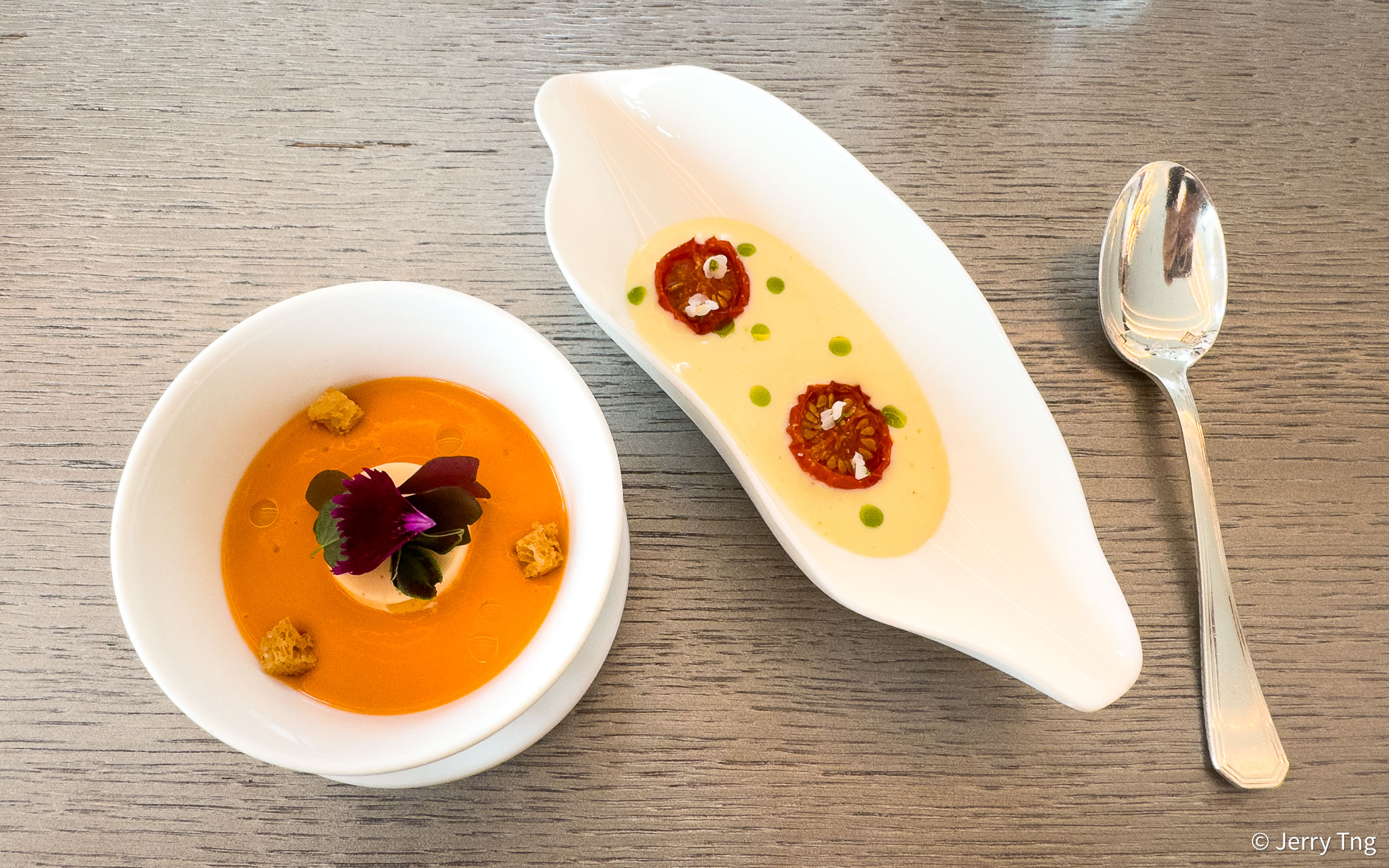
With a glass of champagne on the side we were relaxed and ready for the seven courses ahead. But to first, the customary amuse bouche to whet our appetites. And we were presented with three small bites around the theme of tomatoes in different forms.
Gougère filled with eggplant caviar and onion confit

We started with a single tomato-inspired gougère filled with eggplant caviar and onion confit and sprinkled with hazelnut, presented in a tart shell like our Nonya kueh pie tee.

You’ve probably heard of Baba Ganoush, an excellent dish made from charred eggplants. Baba Ganoush has a fantastic earthy and smokey flavour and is perfect for those warm days when you don’t want a hot meal. Caviar d’Aubergines is the French version that is just herbs and eggplant, and being French they can call it caviar.
Tomato gazpacho with espelette ice cream

Next up, a cold tomato gazpacho with ice cream made with espelette peppers. These peppers are cultivated in the French commune of Espelette, Pyrénées-Atlantiques, traditionally the northern territory of the Basque people and was referred to by the waiter as Spanish pepper. The gazpacho is creamy and delicious, slightly sour in an excellent way but not too much until it hurts your stomach. Very refreshing with the peppery ice cream.
Sundried cherry tomato and sabayon

Dessert as an amuse bouche? French sabayon is a rich and creamy dessert made without dairy. But it is simply a sauce of egg yolks, wine, and savoury seasonings and would work very well as a starter. Accompanied by a couple of sundried cherry tomato and drops of basil oil, this tastes like a deconstructed Caprese salad. I guess this sets the tone of the degustation – familiar flavours in a different presentation.

There’s only one kind of bread on offer, a rustic sourdough made from a mother yeast that has been kept alive for a long time, and Brittany salted butter. Very heavy, so go easy, there’s more courses to come.
2006 Chateau Pavie St Emilion Grand Cru


Not that much experience with Pavie, but this was a pleasant surprise. The nose was bursting with dark fruits – almost Napa like in style – and despite its (relative) youth, this was going down very smoothly with well resolved tannins, and a bit of spice. The texture on the palate was very smooth, but didn’t have the finish or complexity to match up to the other wines in the flight. Still good and going strong, drinking well. Vanilla oak now completely integrated. Cedarwood, blackcurrant, blackberries, spices, graphite. Still big long finish.
Le Homard | Lobster
Au parfum de Vanille, Zéphyr Pomme Granny à l’Huile d’Olive | Flavored with Vanilla, Granny Smith Apple Zephyr and Olive Oil

Zephyr is an airy and delicate confectionary flavoured with Tahitian vanilla, similar to marshmallows, but made with apple puree. The classic recipe calls for an acidic apple, so the Granny Smith is chose here. Topped with olive oil in a slight cavity made on the top of the dome and dusted with black truffle powder, it was pretty sight.

We were told to dig deep into the airy confection to get to the prize underneath. Breton bleu lobster, or what was the meat other than the tail which is IMHO the best part of the lobster, was sweet and full of umami. The slightly sour zephyr and the bits of Granny Smith apple balanced the saltiness of the sea with freshness of the fruit. Delightful first course of the journey.
La Girolle | Chanterelles
Galette soufflée au Vieux Comté, Girolles au Vin Jaune | Puffed Buckwheat Galette, Comte Cheese and Yellow Wine

Pancake? No, it was a very well made soufflé with Comté cheese incorporated into the batter. It’s about the diameter and thickness of the folded-up McD hotcakes. I love Chanterelle mushrooms but they are so rare in Singapore. They are infamously difficult to cultivate so they mostly grow in the wild, meaning they must be foraged. They require a period of heavy rainfall in a coniferous forest, followed by several days of continuous heat and high humidity.

The mushrooms have a fruity, nutty, and peppery notes with a mild and delicate aroma. They have a meaty texture that work so well in sauces. The Vin Jaune (yellow wine) sauce was so good that I asked for more and devoured more of the sourdough bread as a result.
La Langoustine | Langoustine
Préparée en ravioli, Sauce Dieppoise, fine gelée à la Betterave | Prepared as a Ravioli, Parmesan cream, Thin Beetroot jelly and Truffle

The langoustine is prepared as a single ravioli stuffed with the entire crustacean, covered with a fine layer of beetroot gelée and swimming in parmesan cream (Sauce Dieppoise).

Sauce Dieppoise is a white wine sauce that comes from Dieppe in Normandy and made originally from seafood. It tasted like a lobster bisque, only richer because of the addition of parmesan cheese.

When you cut into the ravioli, you can see the entire shelled langoustine as the filling. The beetroot gelée provided the sourness to balance the rich, savoury seafood taste from the sauce and crustacean.
Le Turbot | Turbot
Cuit au Naturel, Beurre Blane, Yuzu et Caviar Oseiètre | Simply cooked, Beurre Blanc, Yuzu and Oscetra Caviar

This next course is lifted directly from Chef Anton’s other restaurant, the 3-starred La Pré Catelan. The perfectly poached wild-caught turbot is dusted with herbs and topped with farmed Oscietra caviar. The sauce is a rich white butter sauce with drops of yuzu oil dripped on at table side.

Wild turbot — often caught in Galicia or Brittany — is completely overfished and difficult for even the best-sourced restaurants to obtain. Because of its scarcity and mild flavour, turbot ranks on top as a fish that’s more closely associated with the high-calibre, white-glove dining palaces of Europe because this fish is like a white canvas for the skills and creativity of the chef to shine through.

This was the first time Princess ate turbot in a fine dining restaurant and she changed her perspective of the fish. Until this point in time she only had it as a steamed fish in a Chinese setting. The delicate and boneless turbot filet (she hated bones in fish) was cooked perfectly and the sauce that came with it brought out the clean flavours of this favourite fish among the French chefs.
Le Ris de Veau | Veal Sweetbread
Caramélisé à la Grenobloise, Jus Gras | Caramelised, Grenoble Sauce, Veal Fats

The original sequence, this was supposed to the lamb course. But it is almost impossible to get sweetbreads in Singapore, and Princess acquired the taste for it. So I requested for the lamb to be replaced by veal sweetbread. Sweetbreads are the thymus and pancreas of young calf and have a mild, mineral flavour and a soft, succulent texture.

The sweetbread was roasted in brown butter and its own fats, creating a rich and caramelised flavour. The sauce consists of a meunière butter with a dash of lemon. Croutons and peppers are added on the sweetbread à la Grenobloise. Delicious, decadent and delightful.
L’Agneau | Lamb
Confit au Thym, Pomme Boulangère, Petit Pois et Sarriette | Confit of Thyme, Baker’s Potatoes, Sweet Peas in Savory Herb

A lamb loin embedded into a potato puff topped with petit pois et sarriette, or sweet peas cooked with sarriette (savory herb). The French love potatoes, everyone loves potatoes, me not so much. Like a creamless gratin, this pomme boulangère gets its flavour and richness from caramelised onions and chicken stock reduction.

Pomme Boulangère gets it’s name from a time in France when wood for cooking was in short supply, so the villagers would take their potatoes in pots along to the local boulangerie (bakery) and have the baker cook them in the bread oven at the same time as the bread was baking. Sarriette is a Provencal herb that is in the same family as rosemary and thyme. It goes very well with beans, lentils and other legumes, helping to reduce flatulence. Mental note to self: buy some home for my baked beans.
Le Fromage Affinè á la Truffe | Mature Cheese with Truffles (Supplement)

If you have room, go for the cheese course — not the usual plate with a selection of cheeses, but instead a wonderful gooey baked delight, topped with slices of truffles. The cheese supplement was so worth the extra 35,€.

Le Fromage Affinè has actual pieces of black truffles are added to the soft creamy brie cheese. It is melted and topped with more freshly shaved black truffles for an intense truffle kick. Eat it with the accompanying warm brioche to balance the intensity.
La Framboise | Raspberry
Zéphyr parfumé aux Fleurs de Sureau, Réduction de Vin Rouge | Elderflower Zephyr, Red Wine Infusion

Elderflower tastes like a flowery honey without the sweetness. It blends well with many other natural fruit flavours like raspberries, and is often used in desserts with these berries to bring a balance to the tartness.

But I digressed, the dessert was all about the raspberry. Frozen bits of raspberry are scattered on a elderflower zephyr accompanied by a sweet raspberry and red wine sauce. It was almost like a palate cleanser to me.
Le Chocolat | Chocolate
Soufflé chaud, Crème glacée au Grué de Cacao, Gavotte croustillante | Warm Soufflé, Cocoa nibs ice cream, Crispy Gavotte

This is two desserts in one – a chocolate soufflé and a chocolate crêpes dentelles. The gavotte is crushed up pieces of crêpes dentelles, or lacey crêpes, with texture more like a tuile or a biscuit than the pancake-type dessert I imagine when I hear ‘crêpes’. These incredibly thin layers of sweet, caramelised crêpe are rolled up into a cigar shape, and then filled with Chantilly cream.

We were told to try them together, a scoop of soufflé and a bit of gavotte. Warm and cold, fluffy and crispy, that’s how the French like to make their dessert, lots of contrasts and surprises.
Mignardises

And finally, the mignardises were served. Two little bites for the afternoon (photos from dinner showed four, even though I ordered the same degustation for lunch) – a meringue with fig honey, and a chocolate ganache tart with dried fruits. Yummy.

And like all fine dining in Paris, they would leave behind something for you to remember the meal, to extend the experience when you are home. Here they give you dark chocolate shaped in the same fashion like the plaster books. And they took the effort to make sure the quote on the chocolate matches your book.

The chocolate was embossed with the Eiffel Tower. It was very high quality dark chocolate and delicious.


Reservations are available for lunch and dinner with a complimentary private valet upon arrival. We arrived by Uber so did not use this service. You do not need to queue with the rest of the tourists, as you have a separate security queue. Guests with reservations can access the restaurant at the south pillar entrance of the Eiffel Tower. Upon arrival to the entrance, a private elevator awaits to whisk guests to another world above the bustling city landscape.


Following your meal, you can enjoy the ambiance of the Eiffel Tower’s viewing deck as well! Le Jules Verne has a private entrance for restaurant guests to access one of the viewing decks so you can go outside and enjoy Paris from above. I think this is one of the best reasons (excuses?!) to dine here. This is more than a meal. It is a view of Paris.
What Chef Anton and his team have created is both impressive and unexpected — transforming a restaurant celebrated mostly for its views and location into a true culinary destination. Le Jules Verne showcases cooking that is firmly rooted in the classics and skilfully modernised, precisely cooked, perfectly seasoned and complemented by intense, nicely refined sauces. It’s unpretentious, clean and easy to understand, possessing distinct flavours.


For the longest time, the restaurant remained at 1 Star. Until this year, they were awarded their second star. Given enough time, I bet they will get their third star but they have to improve the menu to incorporate bolder ideas and a better wine list. A meal is always unforgettable. One is either overwhelmed by the view, or the food. Now it’s both. I look forward to another trip soon.
Le Jules Verne
Avenue Gustave Eiffel 2ème, Eiffel Tower, Av. Anatole France, 75007 Paris, France
Tel : +33 1 83 77 34 34 (Reservations)
Visited Sep 2024
Michelin France Guide 1 Stars 1992-2006 (Alain Reix), 2007-2018 (Alain Ducasse), 2019-2023 (Frederic Anton), 2 Stars 2024
0 comments on “Le Jules Verne @ Paris (2024)”