
Coming back from a out-of-town trip using the Shinkansen, we stopped by a row of restaurants under the train tracks of Tokyo Station.

A nondescript sign on the pavement along the overhead tracks of Tokyo Station beckons you in for some yakitori 焼鳥. Unlike its competition in this izakaya row on the right hand side next to Marunouchi North Exit, Takashina 高しな exterior is not as fancy as the rest.

Fresh ふもと赤鶏 “Fumoto Akadori” chickens, born and raised in Mitsuse Village, Saga Prefecture 佐賀, are delivered every morning. Each skewer is carefully skewered and grilled to perfection over charcoal by a skilled chef.

Beyond the food, visitors are greeted by the warm, engaging staff who ensure every dining experience is memorable, providing attentive service with a personal touch. The interior of the restaurant is modelled after a “public bar” and has a lively and lively atmosphere.

An otoshi is a quick nibble that is served first at Japanese restaurants or Japanese-style pubs called izakaya. However, otoshi is not complimentary and is added to the bill as a cover charge at most restaurants. The otoshi system is actually more similar to the Italian coperto, which includes a cover, bread, and service charges.
Our Yakitori Selection for the Evening
わさび枝豆 Wasabi edamame

At first I thought this was the otoshi. The wasabi is not as pronounced as I expected, but it as a good snack to nibble on.
菜花酢味噌 Rapeseed blossom vinegar miso

Nanohana なのはな, or rapeseed blossom, typically signals the coming of spring. The blanched vegetable is served a dressing of vinegar miso poured over it and sprinkled with crushed almonds.
温ポテトサラダ Warm potato salad

The waiter cheekily informed us that this potato salad would taste better if served by a waitress, but no female server was working that day.

The potato is whipped at table side using a swift spinning action. No wonder he said it would be better done by a waitress. The result is like a Japanese potato salad mixed with KFC coleslaw, two of my favourite things combined in one.
Yagen nankotsu ヤゲン軟骨 Chicken cartilage

This particular cartilage from tip of the rib bone is called “yagen nankotsu” because it looks like the traditional Japanese “yagen” or herb mortar/grinder. Crunchy texture is what you are looking for in this chicken part.
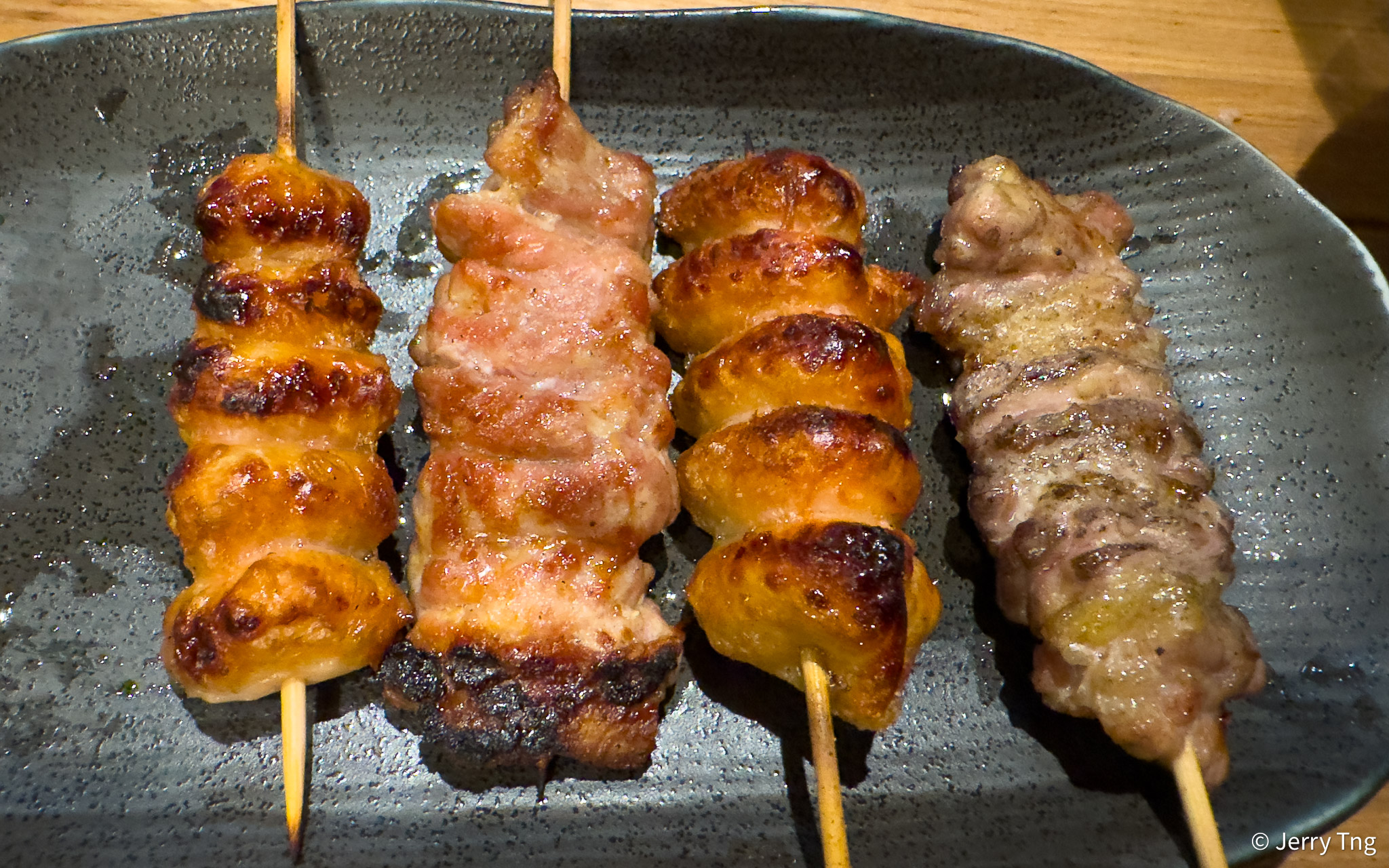
Momoniku もも肉 Chicken thigh

Momo もも is my favourite part of the chicken. As it is dark meat so it does not turn dry and flaky after grilling.
Sunagimo 砂肝 Chicken gizzards

Not the best sunagimo (gizzards) I have tasted, but not the worst too. At ¥190 (S$1.50) per stick, I cannot complain.
Mune bainiku むね梅肉 Chicken breast with plum

The traditional start to yakitori, the chicken breast was grilled ever so slightly. Japan is the only place I would eat raw chicken, and sasami ささみ aka mune むね is usually served rather pink. And instead of wasabi, the meat was served with plum.
Torogawa トロ皮 Fatty skin

Usually, when talking about yakitori kawa or “skin,” it refers to the skin of the neck, but toro kawa トロ皮 is made from the fatty skin of the underbelly of the chicken. The thick fat gives the skewers a chewy elasticity and rich flavour. Rare part.
極上せせり Premium chicken breast

Rebateki レバテキ Beef liver steak

This beef liver steak was plump, tasty and tender. Very rich, like eating foie gras as it was grilled just right.
Rebā レバー Chicken liver

In comparison, the chicken liver was not as rich but nevertheless still an excellent eat as they were grilled perfectly. If only they used a tare instead of just salt.
Kei-toro 鶏トロ Chicken toro
Negi-kan 葱間 Chicken with leeks

Chicken toro is a rare part that can only be taken from a small amount from one bird between the chicken breast and the chicken wings. Also known as “shoulder meat” and “furisode” 振袖 (lit. ‘swinging sleeves’), it is characterised by a juicy and soft texture. Negi-kan 葱間, aka negima ねぎま, is made with thigh meat alternating with huge chunks of leeks and is the most common yakitori skewer.
Harami はらみ Chicken diaphragm

This is a rare chicken part, a tiny sliver of meat just above the diaphragm of the chicken. The meat has a certain bite to it, and full chicken flavours.
Tonjiri ぼんじり Chicken’s tail
Seseri せせり Chicken neck meat

Bonjiri is a triangular meat around the base of the chicken’s tail. It is a fatty part, elastic but juicy, and a popular part of yakitori. Seseri せせりis another sort after part of the chicken, and consists of the meat and skin around the neck.

I always look forward to this complimentary soup that is served when you finish all the yakitori. The chicken consommé is made by boiling all the chickens bones to get this rich and delicious soup. With a bit of ginger to neutralise the strong poultry taste, this is the true chicken soup for the soul.
干し柿クリームチーズ Dried persimmons cream cheese

Most yakitori restuarants do not have good dessert. But this spread made from dried persimmons with cream cheese was quite delicious. The sweetness from the persimmons and the savouriness from the cream cheese blend well. Spread it on these pancake from Saga Prefecture called Maruboro 丸ぼうろ; these small, cake-like disks are made special by the sweetness of brown sugar and the richness of the local eggs used to make them.

Located at the best location possible, this restaurant is perfect for those looking to immerse themselves in an authentic dining atmosphere, Takashina promises an exploration of taste that is truly Japanese and an experience that is uniquely its own.
Saga Fumoto Akadori Sakaba Takashina (Tokyo Eki Gado Shita Ten)
Right of Tokyo Station Marunouchi North Exit ticket gate
佐賀ふもと赤鶏 酒場 高しな (東京駅ガード下店)
東京都千代田区丸の内1-7-4 東京駅丸の内北口 高架下 味の散歩道
Tel : +81 (03) 6268 0308 (Reservations)
Visited Mar 2025
0 comments on “Takashina 高しな @ Tokyo”