
In an extensive 21-course menu, the omakase at Toritsuki 鳥しき is a feast of bite-sized yakitori and seasonal dishes. A part of the restaurant group owned by Yoshiteru Ikegawa of award-winning Torishiki grooms a batch of disciples and each runs a high end yakitori restaurant in the group. Toritsuki stands out for its unique menu that incorporates elements from world cuisines.

There are various occasions to enjoy yakitori, and what was once just a menu item at an izakaya has now diversified to include chain, speciality, and high-class restaurants. The reality is that even under such circumstances, yakitori has not yet reached the status of sushi or tempura, and one of the reasons for this is that there are not many artisans who can convey the “essence of yakitori.”

Overseen by Yoshiteru Ikegawa 池川義輝, the owner chef of Torishiki, the group restaurants share his refined technique as well as top-quality ingredients but each operate under different concepts. Devoted to perfecting the craft of yakitori, Ikegawa’s restaurants promise a satisfying experience by recreating a place where deliciousness, the atmosphere of the restaurant, and the atmosphere of the customers become a trinity.

Standing behind the grill, the owner/chef Tatsuya Nagaoka begins preparing the meal. As he briskly fans the skewers sizzling over crackling charcoal, the sweet and smoky aroma fills the air.

Kishu Binchotan 紀州備長炭 (charcoal) is made from ubame oak ウバメガシ, which grows in the forested areas of the Kii Peninsula. It is made over a two-week period by artisans with generations of experience. The highest quality binchotan is baked through a process of drying, kilning and sorting the oak.

Date chicken 伊達雞 is a brand name chicken that was created in response to chefs’ requests. Date chickens are raised in an open chicken coop, an environment close to nature where they can move around, and has little odour and is characterised by its high quality fat, which gives it a delicious and rich flavour.

When Ikegawa and Nagaoka began talking about the concept for Toritsuki, they were interested in serving yakitori like a sushi restaurant that alternates between nigiri and small plates. They wanted to create a dynamic menu that was different to a typical yakitori restaurant. The result was a 21-item omakase course of small yakitori and bite-size dishes.
おまかせコース Chef’s Tasting Course

Two condiments are provided – the traditional shimichi powder and a special sansho pepper powder. They packed a lot of kick, so use sparingly.
Lotus root soup with chicken ball

You must be wondering where’s the lotus root. It has been blended into the dashi stock to form the thickened soup. I just had this style of soup at a Kyoto kaiseki restaurant, but they used onions instead of lotus root.
Momo もも Chicken thigh

The first yakitori is kashiwa, or thigh. The juicy meat is full of umami with a satisfying texture. Exactly what it should be, very properly done stick of yakitori.
Suganimo 砂肝 Chicken gizzard

The gizzards were just the right doneness, perfectly juicy and nice crunch. It is one of the best example I have eaten. It was so good that I repeated the order during the a la carte session later.
Strawberry, king crab, walnut

Right after two sticks of chicken came another appetiser made from the in-season strawberry and shredded mikan peel with boiled king crab leg and crushed walnut with Kewpie sesame dressing.

They all come together perfectly, especially the sweet and slight bitter mikan peel. The ichigo (strawberry) was sweet and paired well with the seafood sweetness (some described it as umami) of the king crab. The walnut provided the crunch, but I wasn’t a fan.
Seseri せせり Chicken neck

It has a good ratio of meat and skin, juicy and fatty when grilled.
Uzura tamago うずら卵 Quail eggs

Not chicken, but quail eggs are quite popular in yakitori-ya. This is the first time I have exploding quail eggs (molten yolk).
Sasami ささみ Chicken breast

Next up, the traditional ささみ Sasami (lightly grilled with salt and garnished with wasabi).

The chicken breast was grilled to medium rare (yes, rare chicken) and served with a dap of freshly grated wasabi. Japan is the only place on earth that I dare to eat raw chicken.
Yamaimo with chicken breast

After an almost rare chicken breast, this one is properly poached and served with grated yamaimo and 銀餡 Gin-an, a transparent sauce made from thickening dashi with kudzu powder. I love the Kintsugi bowl that it was served in.
ブロッコリー Broccoli

Inheriting the techniques of award-winning Torishiki, the skewers are grilled up close using a strong flame. Charred on the outside and moist on the inside, the grill adds a rich aroma to the ingredients. The broccoli was a bit burnt, but it’s ok.
チキンカツサンド Chicken cutlet sandwich

The next course is a portion of chicken cutlet sandwich that came with chips that are made from bread ends that have been air fried and coated with butter and sugar, yummy!

Made with Shingen chicken that was marinated in yakitori sauce, the meat is deep fried in crispy batter. The sauce is a light egg-based aioli made with lemon juice. Two bites and it’s gone!


When you book the restaurant, there’s an option for you take home a pack of chicken sandwich for breakfast. I highly recommend it as they are really tasty. Even without a microwave in the hotel, they are wonderfully crispy in the morning (or for a late night snack)
Chicken in orange cream sauce


Kata 肩 Chicken shoulder

Chicken shoulder is a rare part that can only be taken from a small amount from one bird between the chicken breast and the chicken wings. Also known as “kei-toro” 鶏トロ and “furisode” 振袖 (lit. ‘swinging sleeves’), it is characterised by a juicy and soft texture
Tsukune つくね Chicken meatball

The taste and shape of tsukune vary depending on the store, so this is the defining taste of each yakitori-ya that differentiates it from others. Tsukune meatballs are made of coarsely-ground thighs, breasts and cartilage. The tare is highlight here, as it is very light and not too sweet (which I liked a lot).
Nankotsu 軟骨 Chicken cartilage

This particular cartilage from tip of the rib bone is called “yagen nankotsu” because it looks like the traditional Japanese “yagen” or herb mortar/grinder. Crunchy texture is what you are looking for in this chicken part.
Mizuna nameko

Next up. some boiled mizuna with slippery, gelatinous nameko mushroom in a dashi stock with wasabi, very refreshing.
Ginnan ぎんなん Gingko

After all the chicken, a non-chicken skewer of gingko nuts. The salty, bitter taste is perfect with cold beer.
Fried Radish

The fried radish tasted like the oden version, very tender and flavourful.
Tebasaki 手羽先 Wings

And the last grilled item in the omakase was the chicken mid-joint. The skin was grilled to a crispy texture while the flesh remained tender and moist. Superb technique on show here.
A la carte order
The chicken wing marked the last skewer of the set. Only a gohan course and a dessert left in the set. So we are now allowed to order a la carte items if we did not have enough.
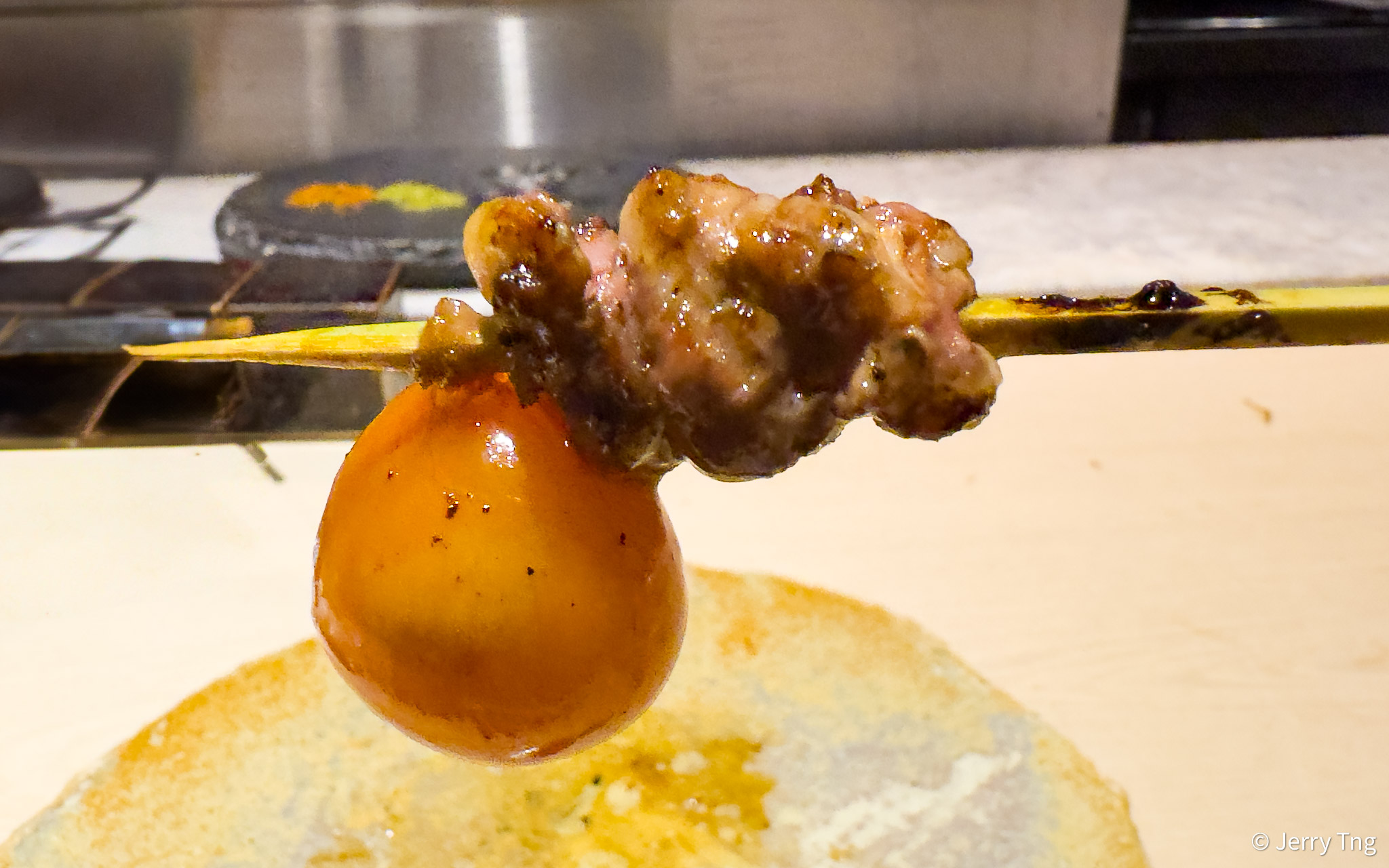
Cochin ちょうちん Chicken lantern

The yolk called kinkan きんかん before it becomes a chicken egg, the fallopian tube through which the kinkan passes, and the ovary are used. It looks interesting. The kinkan and strings strung together look similar to a “paper lantern,” hence the name.

I always order this extremely rare part as you can enjoy the richness of the egg yolk and the squishy texture of the ovary and fallopian tube. I managed to get the last piece in the restaurant for my seating as I ordered it in advance.
Saezuri さえずり Oesophagus

Also known as shokudō 食道, this is a rare part that is crunchy and elastic, with fat on the surface. It is found inside the neck skin, a long, thin part that runs parallel to the neck.
Bonjiri ぼんじり Chicken tail

Bonjiri is a triangular meat around the base of the chicken’s tail. It is a fatty part, elastic but juicy, and a popular part of yakitori.
Hatsu ハツ Heart

The name “hatsu” is said to be derived from a corrupted English word “hearts.” They have a springy texture typical of internal organs, and if this is the first chicken offal that you are trying, it is easy to eat because it is less odorous than other offal.
Reba レバー Liver

This is the regular chicken liver, it would perfect if they have the white liver which tastes like foie gras. But nevertheless this was still a delicious eat.
Kawa かわ Skin

And my final stick is the satisfying chicken skin. I loved the burnt bits, and the delicious caramelised tare on the skewer.
Bibimbap

And when you have your fill of a la carte orders, they serve the final two courses of the omakase. First the gohan course of bibimbap served a raw egg yolk. The Koshihikari rice used for this course comes from a farm in Toyama Prefecture.

Like a Korean bibimbap, there’s gochujang and lots of ingredients which you mix together to form a mixed rice (“bibim” is mixing, and “bap” rice) with all the flavours and texture blended together.

Ochazuke お茶漬け is another way to enjoy the bibimbap and it takes the traditional dish which literally means “submerged in tea”.
Matcha mousse


The matcha mousse tasted just like the one you would get from Uji in Kyoto, very rich, very herby, some might even say fishy. Balanced with the sweet evaporated milk/cream and mango. Accompanied by hojicha.

A great yakitori omakase experience and well worth the effort to took to find the restaurant. The chef was patient with us, explaining what every cut was, and providing a little booklet that explained a bit more about the techniques, the sourcing of the chicken and the history of the restaurant. An amazing meal with friends, and well worth a repeat journey. Come for the second seating if you do not want to be rushed through your meal.
Toritsuki 「鳥つき」
2nd floor of M Road Toda, 1-8-13 Ebisu Nishi, Shibuya-ku, Tokyo
東京都渋谷区恵比寿西1-8-13 エムロード戸田2階
Tel : +81 03-6433-7505 (Reservations)
Visited Mar 2025
0 comments on “Award Winning Yakitori”